| Size | Price | Stock | Qty |
|---|---|---|---|
| 10mg |
|
||
| 25mg |
|
||
| 50mg |
|
||
| 100mg |
|
||
| 250mg |
|
||
| 500mg | |||
| Other Sizes |


Purity: ≥98%
| Targets |
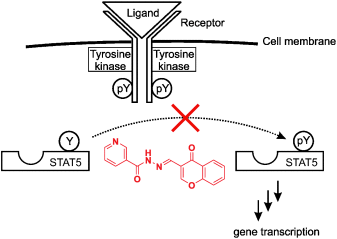
The target of STAT5-IN-1 is the transcription factor STAT5 [1]
|
||
|---|---|---|---|
| ln Vitro |
A member of the STAT protein family, signal transducer and activator of transcription 5 (STAT5) is connected to the development and maturation of cells. By attaching itself to the SH2 domain, STAT5-IN-1 suppresses STAT5. There is a slight inhibition of the tyrosine kinase Lck's and STAT3, STAT1, and SH2 domain functions (IC50>500 μM). In K562 nuclear extracts, STAT5-IN-1 inhibits the binding of STAT5 and STAT5 DNA. The activity of STAT5-IN-1 against STAT5β is unaffected by the substitution of an ethyl group for the hydrogen at position C6 in the chromone ring, but all selectivity against other STAT family members is lost[1].
1. Small molecule library screening was conducted to identify compounds that could inhibit the activity of the transcription factor STAT5, and STAT5-IN-1 (a chromone-based compound) was discovered as a potential inhibitor of STAT5 through this screening process [1] 2. Studies on the structure-activity relationship (SAR) of STAT5-IN-1 were performed, focusing on the chromone scaffold of the compound, to explore how structural modifications might affect its ability to interact with STAT5 and inhibit its activity. However, specific data on the inhibitory effect of STAT5-IN-1 on STAT5-mediated signal transduction, such as changes in downstream gene expression detected by PCR or alterations in STAT5 protein phosphorylation levels measured by western blot, were not provided [1] |
||
| ln Vivo |
|
||
| Enzyme Assay |
1. A drug screening assay targeting the transcription factor STAT5 was established. The assay involved preparing a reaction system containing STAT5 protein, DNA sequences that STAT5 specifically binds to, and STAT5-IN-1 at different concentrations. The interaction between STAT5 and the specific DNA was monitored using a detection method (the specific detection technique was not detailed in the literature). The purpose of this assay was to evaluate whether STAT5-IN-1 could interfere with the binding of STAT5 to its target DNA, thereby inhibiting STAT5's transcriptional activity. [1]
|
||
| Animal Protocol |
|
||
| References | |||
| Additional Infomation |
N'-[(4-oxo-4H-chromene-3-yl)methylene]nicotinamide is a carbamate hydrazine in which the terminal nitrogen atom of the nicotinamide hydrazine undergoes a condensation reaction with the aldehyde group of 4-oxo-4H-chromene-3-carboxaldehyde. It is an inhibitor of the STAT5 (signal transduction and transcription activator 5) protein. It functions as a STAT5 protein inhibitor. It is a carbamate hydrazine belonging to the chromone and pyridine classes of compounds.
1. STAT5-IN-1 is a chromone-based compound whose discovery is part of research aimed at developing inhibitors of the transcription factor STAT5. STAT5 is a key component of the JAK-STAT signaling pathway and plays an important role in cell proliferation, survival and differentiation; abnormal activation of STAT5 is closely related to the occurrence and development of certain diseases (especially cancer) [1] 2. Research on STAT5-IN-1 mainly focuses on identifying it as a potential STAT5 inhibitor through small molecule library screening and preliminary structure-activity relationship studies, laying the foundation for further optimization of chromone STAT5 inhibitors [1] |
| Molecular Formula |
C16H11N3O3
|
|
|---|---|---|
| Molecular Weight |
293.28
|
|
| Exact Mass |
293.08
|
|
| CAS # |
285986-31-4
|
|
| Related CAS # |
|
|
| PubChem CID |
9566174
|
|
| Appearance |
White to light yellow solid powder
|
|
| Density |
1.3±0.1 g/cm3
|
|
| Index of Refraction |
1.657
|
|
| LogP |
1.76
|
|
| Hydrogen Bond Donor Count |
1
|
|
| Hydrogen Bond Acceptor Count |
5
|
|
| Rotatable Bond Count |
3
|
|
| Heavy Atom Count |
22
|
|
| Complexity |
501
|
|
| Defined Atom Stereocenter Count |
0
|
|
| SMILES |
C1=CC=C2C(=C1)C(=O)C(=CO2)/C=N/NC(=O)C3=CN=CC=C3
|
|
| InChi Key |
DAVIKTBRCQWOGT-GIJQJNRQSA-N
|
|
| InChi Code |
InChI=1S/C16H11N3O3/c20-15-12(10-22-14-6-2-1-5-13(14)15)9-18-19-16(21)11-4-3-7-17-8-11/h1-10H,(H,19,21)/b18-9+
|
|
| Chemical Name |
|
|
| Synonyms |
|
|
| HS Tariff Code |
2934.99.9001
|
|
| Storage |
Powder -20°C 3 years 4°C 2 years In solvent -80°C 6 months -20°C 1 month |
|
| Shipping Condition |
Room temperature (This product is stable at ambient temperature for a few days during ordinary shipping and time spent in Customs)
|
| Solubility (In Vitro) |
DMSO: ≥ 20 mg/mL
Water: 1mg/mL (Insoluble) Ethanol: 1mg/mL |
|---|---|
| Solubility (In Vivo) |
Solubility in Formulation 1: ≥ 2 mg/mL (6.82 mM) (saturation unknown) in 10% DMSO + 40% PEG300 +5% Tween-80 + 45% Saline (add these co-solvents sequentially from left to right, and one by one), clear solution.
For example, if 1 mL of working solution is to be prepared, you can add 100 μL of 20.0 mg/mL clear DMSO stock solution to 400 μL PEG300 and mix evenly; then add 50 μL Tween-80 + to the above solution and mix evenly; then add 450 μL normal saline to adjust the volume to 1 mL. Preparation of saline: Dissolve 0.9 g of sodium chloride in 100 mL ddH₂ O to obtain a clear solution. (Please use freshly prepared in vivo formulations for optimal results.) |
| Preparing Stock Solutions | 1 mg | 5 mg | 10 mg | |
| 1 mM | 3.4097 mL | 17.0486 mL | 34.0971 mL | |
| 5 mM | 0.6819 mL | 3.4097 mL | 6.8194 mL | |
| 10 mM | 0.3410 mL | 1.7049 mL | 3.4097 mL |
*Note: Please select an appropriate solvent for the preparation of stock solution based on your experiment needs. For most products, DMSO can be used for preparing stock solutions (e.g. 5 mM, 10 mM, or 20 mM concentration); some products with high aqueous solubility may be dissolved in water directly. Solubility information is available at the above Solubility Data section. Once the stock solution is prepared, aliquot it to routine usage volumes and store at -20°C or -80°C. Avoid repeated freeze and thaw cycles.
Calculation results
Working concentration: mg/mL;
Method for preparing DMSO stock solution: mg drug pre-dissolved in μL DMSO (stock solution concentration mg/mL). Please contact us first if the concentration exceeds the DMSO solubility of the batch of drug.
Method for preparing in vivo formulation::Take μL DMSO stock solution, next add μL PEG300, mix and clarify, next addμL Tween 80, mix and clarify, next add μL ddH2O,mix and clarify.
(1) Please be sure that the solution is clear before the addition of next solvent. Dissolution methods like vortex, ultrasound or warming and heat may be used to aid dissolving.
(2) Be sure to add the solvent(s) in order.
Chembiochem.2008 Mar 25;9(5):723-7. |
|---|
Products are for research use only; We do not sell to patients
Copyright 2020 InvivoChem LLC | All Rights Reserved


 COA
COA