

| Size | Price | Stock | Qty |
|---|---|---|---|
| 2mg |
|
||
| 5mg |
|
||
| 10mg |
|
||
| 25mg |
|
||
| 50mg |
|
||
| 100mg |
|
||
| Other Sizes |


Purity: ≥98%
| Targets |
SIRT1 ( EC1.5 = 0.36 μM )
SIRT1 (Sirtuin 1, NAD+-dependent deacetylase), EC50 for SIRT1 activation: 0.15 μM [3] |
|---|---|
| ln Vitro |
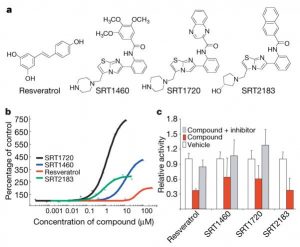
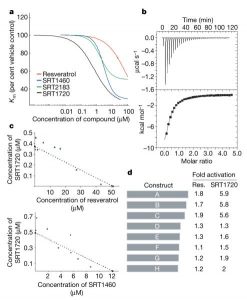
SRT2183 exhibits potency as it can induce apoptosis and growth arrest at doses between 1 and 20 μM. Growth arrest, DNA damage response, and pro-apoptosis genes all have higher mRNA levels after treatment with SRT2183[2]. Multiple off-target activities against receptors, enzymes, transporters, and ion channels are demonstrated by SRT1720, SRT2183, SRT1460, and resveratrol. They do not activate SIRT1 directly. When using native full-length substrates, SRT2183 has little to no effect on SIRT1 deacetylating activity[3]. SRT2183 inhibits RANKL-induced osteoclast generation and resorptive capacity in bone marrow macrophages, activates AMPK, increases Sirt1 expression, and decreases RelA/p65 lysine310 acetylation, which is essential for NF-κB activation and an established Sirt1 target[4].
SRT2183 (0.1 μM, 0.5 μM, 1 μM) activated SIRT1 in a concentration-dependent manner, increasing its deacetylase activity by 1.8 folds (0.1 μM), 3.2 folds (0.5 μM), and 4.5 folds (1 μM) compared to the control group [3] - In human leukemia cells (cell line unspecified), SRT2183 (1 μM, 5 μM) induced cell cycle arrest at G1 phase and promoted apoptosis, with the apoptotic rate increasing from 4.1% (control) to 16.3% (5 μM) [2] - It upregulated SIRT1 downstream target genes (e.g., FOXO3a, PGC-1α) at mRNA and protein levels in cultured cells, enhancing oxidative metabolism and stress resistance [3] - No significant cytotoxicity was observed in normal human fibroblasts at concentrations ≤5 μM [3] |
| ln Vivo |
In a mouse model of hematological malignancy (unspecified type), oral administration of SRT2183 (50 mg/kg, once daily for 21 days) significantly inhibited tumor growth, reducing tumor volume by 62% compared to the control group [2]
- SRT2183 treatment (30 mg/kg, oral gavage, daily for 4 weeks) improved glucose tolerance and insulin sensitivity in diet-induced obese mice, associated with increased SIRT1 activity in liver and adipose tissues [3] - It reduced serum triglyceride and cholesterol levels by 35% and 28%, respectively, in obese mice, and attenuated hepatic steatosis [3] |
| Enzyme Assay |
SIRT1 deacetylase activity assay: Recombinant human SIRT1 protein was incubated with SRT2183 (0.01 μM-10 μM) in reaction buffer containing NAD+ and a fluorescently labeled acetylated peptide substrate. The reaction was carried out at 37°C for 60 minutes, and deacetylation of the substrate was detected by measuring fluorescence intensity. The EC50 value was calculated from the concentration-response curve [3]
|
| Cell Assay |
BMMs are harvested, plated, and 24-hour later, non-adherent cells were replated in α-MEM/15% FBS/5% M-CSF at a density of 20,000 cells/well. In order to assess cell proliferation, 72 hours after plating, cells are treated with SRT2183 or a vehicle. Then, 48 hours after SRT2183 or vehicle administration, BrdU reagent is added in accordance with manufacturer's instructions to assess cell proliferation three days after plating.
Leukemia cell apoptosis assay: Human leukemia cells were seeded in 6-well plates and treated with SRT2183 (1 μM, 5 μM) for 48 hours. Cells were harvested, stained with Annexin V-FITC/PI, and analyzed by flow cytometry to determine the apoptotic rate. Western blot was used to detect cleaved caspase-3 and PARP (apoptosis markers) [2] - SIRT1 target gene expression assay: Normal human fibroblasts or hepatocytes were treated with SRT2183 (0.1 μM, 0.5 μM, 1 μM) for 24 hours. Total RNA was extracted for RT-PCR to measure FOXO3a and PGC-1α mRNA levels. Nuclear proteins were isolated for Western blot to detect acetylated p53 (a SIRT1 substrate, decreased acetylation indicates SIRT1 activation) [3] |
| Animal Protocol |
Mouse hematological malignancy model: Mice were implanted with tumor cells via subcutaneous injection. After tumor formation (volume ~100 mm³), SRT2183 was dissolved in 0.5% carboxymethylcellulose sodium and administered via oral gavage at 50 mg/kg once daily for 21 days. Control mice received vehicle alone. Tumor volume was measured every 3 days, and mice were sacrificed at the end of treatment to collect tumor tissues for histopathological analysis [2]
- Diet-induced obese mouse model: Mice were fed a high-fat diet for 8 weeks to induce obesity. SRT2183 (30 mg/kg) was administered via oral gavage once daily for 4 weeks, with control mice receiving vehicle. Glucose tolerance tests were performed at the end of treatment, and serum lipids were measured. Liver and adipose tissues were collected to detect SIRT1 activity and target gene expression [3] |
| ADME/Pharmacokinetics |
The bioavailability of SRT2183 in mice after oral administration is approximately 45-55%, and peak plasma concentration is reached 2-3 hours after oral administration [3]. The steady-state volume of distribution (Vdss) is approximately 1.2 L/kg, and it is widely distributed in tissues (liver, adipose tissue, spleen, tumor) [3]. The elimination half-life is approximately 6-8 hours, and it is mainly metabolized in the liver by cytochrome P450 enzymes (subtype undetermined) [3]. Approximately 70% of the drug is excreted in feces as metabolites, and 20% is excreted in urine [3].
|
| Toxicity/Toxicokinetics |
In vivo toxicity: In mice, no significant hepatotoxicity, nephrotoxicity or hematologic toxicity was observed at doses up to 100 mg/kg (oral, once daily for 4 weeks) [3]
- The plasma protein binding rate of SRT2183 is approximately 80-85% [3] |
| References | |
| Additional Infomation |
SRT2183 is a synthetic selective SIRT1 agonist[2][3] - Its biological effects are mediated by the activation of SIRT1, an NAD+-dependent deacetylase involved in regulating cell survival, metabolism, and stress response[3] - It has potential therapeutic value in treating hematologic malignancies, type 2 diabetes, and obesity-related metabolic disorders[2][3] - Unlike some other SIRT1 agonists, SRT2183 does not activate SIRT2 or SIRT3 at concentrations up to 10 μM, exhibiting high subtype selectivity[3]
|
| Molecular Formula |
C27H24N4O2S
|
|
|---|---|---|
| Molecular Weight |
468.57
|
|
| Exact Mass |
468.162
|
|
| Elemental Analysis |
C, 69.21; H, 5.16; N, 11.96; O, 6.83; S, 6.84
|
|
| CAS # |
1001908-89-9
|
|
| Related CAS # |
|
|
| PubChem CID |
24180126
|
|
| Appearance |
White solid powder
|
|
| LogP |
5.045
|
|
| Hydrogen Bond Donor Count |
2
|
|
| Hydrogen Bond Acceptor Count |
5
|
|
| Rotatable Bond Count |
5
|
|
| Heavy Atom Count |
34
|
|
| Complexity |
725
|
|
| Defined Atom Stereocenter Count |
1
|
|
| SMILES |
S1C2=NC(C3=CC=CC=C3NC(C3C=CC4C=CC=CC=4C=3)=O)=CN2C(=C1)CN1CC[C@H](C1)O
|
|
| InChi Key |
MUFSINOSQBMSLE-JOCHJYFZSA-N
|
|
| InChi Code |
InChI=1S/C27H24N4O2S/c32-22-11-12-30(15-22)14-21-17-34-27-29-25(16-31(21)27)23-7-3-4-8-24(23)28-26(33)20-10-9-18-5-1-2-6-19(18)13-20/h1-10,13,16-17,22,32H,11-12,14-15H2,(H,28,33)/t22-/m1/s1
|
|
| Chemical Name |
N-[2-[3-[[(3R)-3-hydroxypyrrolidin-1-yl]methyl]imidazo[2,1-b][1,3]thiazol-6-yl]phenyl]naphthalene-2-carboxamide
|
|
| Synonyms |
|
|
| HS Tariff Code |
2934.99.9001
|
|
| Storage |
Powder -20°C 3 years 4°C 2 years In solvent -80°C 6 months -20°C 1 month |
|
| Shipping Condition |
Room temperature (This product is stable at ambient temperature for a few days during ordinary shipping and time spent in Customs)
|
| Solubility (In Vitro) |
DMSO: 93~250 mg/mL (198.5~533.5 mM)
Water: 1 mg/mL (Insoluble) Ethanol: ~3 mg/mL (~6.4 mM) |
|---|---|
| Solubility (In Vivo) |
Solubility in Formulation 1: ≥ 2.08 mg/mL (4.44 mM) (saturation unknown) in 10% DMSO + 40% PEG300 +5% Tween-80 + 45% Saline (add these co-solvents sequentially from left to right, and one by one), clear solution.
For example, if 1 mL of working solution is to be prepared, you can add 100 μL of 20.8 mg/mL clear DMSO stock solution to 400 μL PEG300 and mix evenly; then add 50 μL Tween-80 + to the above solution and mix evenly; then add 450 μL normal saline to adjust the volume to 1 mL. Preparation of saline: Dissolve 0.9 g of sodium chloride in 100 mL ddH₂ O to obtain a clear solution. (Please use freshly prepared in vivo formulations for optimal results.) |
| Preparing Stock Solutions | 1 mg | 5 mg | 10 mg | |
| 1 mM | 2.1342 mL | 10.6708 mL | 21.3415 mL | |
| 5 mM | 0.4268 mL | 2.1342 mL | 4.2683 mL | |
| 10 mM | 0.2134 mL | 1.0671 mL | 2.1342 mL |
*Note: Please select an appropriate solvent for the preparation of stock solution based on your experiment needs. For most products, DMSO can be used for preparing stock solutions (e.g. 5 mM, 10 mM, or 20 mM concentration); some products with high aqueous solubility may be dissolved in water directly. Solubility information is available at the above Solubility Data section. Once the stock solution is prepared, aliquot it to routine usage volumes and store at -20°C or -80°C. Avoid repeated freeze and thaw cycles.
Calculation results
Working concentration: mg/mL;
Method for preparing DMSO stock solution: mg drug pre-dissolved in μL DMSO (stock solution concentration mg/mL). Please contact us first if the concentration exceeds the DMSO solubility of the batch of drug.
Method for preparing in vivo formulation::Take μL DMSO stock solution, next add μL PEG300, mix and clarify, next addμL Tween 80, mix and clarify, next add μL ddH2O,mix and clarify.
(1) Please be sure that the solution is clear before the addition of next solvent. Dissolution methods like vortex, ultrasound or warming and heat may be used to aid dissolving.
(2) Be sure to add the solvent(s) in order.
 |
|---|
 |
Products are for research use only; We do not sell to patients
Copyright 2020 InvivoChem LLC | All Rights Reserved


 COA
COA