

| Size | Price | Stock | Qty |
|---|---|---|---|
| 25mg |
|
||
| 50mg |
|
||
| 100mg |
|
||
| 250mg |
|
||
| 500mg |
|
||
| Other Sizes |


Purity: ≥98%
| Targets |
Yeast Silent Information Regulator 2 (Sir2p), a NAD⁺-dependent deacetylase. For Splitomicin (Splitomycin), the IC50 value for recombinant yeast Sir2p was 60 μM (measured via histone deacetylation assay). It showed weak inhibition of human SIRT1 (IC50 > 100 μM) and no activity against other histone deacetylases (e.g., Rpd3p), confirming yeast Sir2p selectivity [1]
|
|---|---|
| ln Vitro |
MCF-7 and H1299 cells are treated with splitomicin (10-333 μM) for 24 hours, and the antiproliferative impact is concentration-dependent. Splitomicin effectively suppresses MCF-7 and H1299 cell colony formation at 100 and 333 μM, but it is unable to decrease the number of colonies at 33 μM [2].
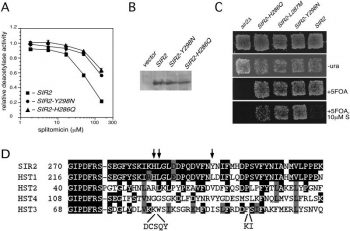
In recombinant yeast Sir2p assays, Splitomicin (10 μM–200 μM) dose-dependently inhibited histone H4K16 deacetylation. At 60 μM, it reduced deacetylation activity by 50% (IC50 = 60 μM), with no effect on the class I HDAC Rpd3p (even at 200 μM) [1] - In Saccharomyces cerevisiae (budding yeast) with a telomeric ADE2 reporter gene, Splitomicin (100 μM) treatment for 48 hours relieved Sir2p-mediated gene silencing. The proportion of white colonies (ADE2 expressed, silencing relieved) increased from 5% (vehicle) to 45%, while red colonies (ADE2 silenced) decreased accordingly. This effect was reversed by overexpressing Sir2p [1] |
| ln Vivo |
Splitomicin increases tissue factor (TF) activity in the arterial vessel wall and speeds up carotid artery thrombosis in C57BL/6 mice when given intraperitoneally every 24 hours for five days at a dose of 80 mg/kg [3].
In Saccharomyces cerevisiae (not mammalian animals), Splitomicin (100 μM, added to culture medium for 72 hours) increased transcription of telomere-associated genes (e.g., TEL1-proximal genes) by 2.5-fold vs. vehicle, confirming in vivo (yeast cellular) inhibition of Sir2p silencing function [1] |
| Enzyme Assay |
Yeast Sir2p Deacetylation Assay: Recombinant yeast Sir2p (residues 1–562) was incubated with [³H]-acetylated histone H4 peptide (Ac-K16) and NAD⁺ (500 μM) in assay buffer (50 mM Tris-HCl pH 8.0, 1 mM DTT, 10% glycerol). Serial dilutions of Splitomicin (1 μM–200 μM) were added, and the mixture was incubated at 30°C for 30 minutes. Deacetylated peptides were separated from substrates via thin-layer chromatography (TLC), and radioactivity was quantified via liquid scintillation counting. IC50 was calculated based on the percentage of deacetylation inhibition [1]
|
| Cell Assay |
Cell Proliferation Assay[2]
Cell Types: Human breast cancer MCF-7 and lung cancer H1299 cells Tested Concentrations: 10, 33, 100, and 333 μM Incubation Duration: 24 hrs (hours) Experimental Results: Inhibited colony formation in a dose-dependent manner. Yeast Telomeric Silencing Assay: Saccharomyces cerevisiae strain UCC5600 (carrying an ADE2 reporter gene integrated at telomere VII-L) was cultured in YPD medium containing Splitomicin (0 μM, 50 μM, 100 μM) at 30°C for 48 hours. Cells were diluted and plated on YPD agar plates, then incubated at 30°C for 3 days. The number of white (ADE2 expressed) and red (ADE2 silenced) colonies was counted to assess Sir2p-mediated silencing [1] |
| Animal Protocol |
Animal/Disease Models: C57BL/6 mice aged 12-14 weeks weighing on average 27 g[3]
Doses: 80 mg/kg Route of Administration: intraperitoneal (ip)injection every 24 h for 5 days Experimental Results: Increased TF activity in mouse carotid artery as compared with the controls . |
| Toxicity/Toxicokinetics |
In Saccharomyces cerevisiae, concentrations up to 200 μM of mitochondrial did not affect cell growth rate (as determined by OD600 absorbance over 72 hours) or colony morphology, indicating that it has no nonspecific cytotoxicity to yeast [1].
|
| References |
|
| Additional Infomation |
Splitomicin is a benzo[f]chromene ketone with the structure 2,3-dihydro-1H-benzo[f]chromene, substituted with a carbonyl group at the 3-position. Studies have found that it has potential inhibitory activity against Sir2 protein. It can function as a Sir2 inhibitor and a platelet aggregation inhibitor. It is a benzo[f]chromene ketone, δ-lactone and naphtho-α-pyranone.
Splitomicin (Splitomycin) is the first small molecule yeast Sir2p inhibitor to be discovered, and its discovery was made to study the biological function of Sir2p in gene silencing and telomere maintenance[1]. - Its mechanism of action involves competitive binding to the NAD⁺ binding pocket of Sir2p, thereby disrupting NAD⁺-dependent deacetylation without affecting NAD⁺ hydrolysis[1]. - Splitomicin was once the prototype for developing Sirtuin family inhibitors, but its weak activity against human SIRT1 limited its application in mammalian studies[1]. |
| Molecular Formula |
C13H10O2
|
|
|---|---|---|
| Molecular Weight |
198.22
|
|
| Exact Mass |
198.068
|
|
| CAS # |
5690-03-9
|
|
| Related CAS # |
|
|
| PubChem CID |
5269
|
|
| Appearance |
White to light yellow solid powder
|
|
| Density |
1.3±0.1 g/cm3
|
|
| Boiling Point |
383.6±17.0 °C at 760 mmHg
|
|
| Melting Point |
73-74.5℃
|
|
| Flash Point |
161.2±18.4 °C
|
|
| Vapour Pressure |
0.0±0.9 mmHg at 25°C
|
|
| Index of Refraction |
1.656
|
|
| LogP |
3.03
|
|
| Hydrogen Bond Donor Count |
0
|
|
| Hydrogen Bond Acceptor Count |
2
|
|
| Rotatable Bond Count |
0
|
|
| Heavy Atom Count |
15
|
|
| Complexity |
261
|
|
| Defined Atom Stereocenter Count |
0
|
|
| SMILES |
O=C1CCC2=C3C=CC=CC3=CC=C2O1
|
|
| InChi Key |
ISFPDBUKMJDAJH-UHFFFAOYSA-N
|
|
| InChi Code |
InChI=1S/C13H10O2/c14-13-8-6-11-10-4-2-1-3-9(10)5-7-12(11)15-13/h1-5,7H,6,8H2
|
|
| Chemical Name |
1H-benzo[f]chromen-3(2H)-one
|
|
| Synonyms |
|
|
| HS Tariff Code |
2934.99.9001
|
|
| Storage |
Powder -20°C 3 years 4°C 2 years In solvent -80°C 6 months -20°C 1 month |
|
| Shipping Condition |
Room temperature (This product is stable at ambient temperature for a few days during ordinary shipping and time spent in Customs)
|
| Solubility (In Vitro) |
DMSO: 39 mg/mL (196.0 mM)
Water: 1 mg/mL (Insoluble) Ethanol: 39 mg/mL (196.0 mM) |
|---|---|
| Solubility (In Vivo) |
Solubility in Formulation 1: ≥ 2.08 mg/mL (10.49 mM) (saturation unknown) in 10% DMSO + 40% PEG300 + 5% Tween80 + 45% Saline (add these co-solvents sequentially from left to right, and one by one), clear solution.
For example, if 1 mL of working solution is to be prepared, you can add 100 μL of 20.8 mg/mL clear DMSO stock solution to 400 μL PEG300 and mix evenly; then add 50 μL Tween-80 to the above solution and mix evenly; then add 450 μL normal saline to adjust the volume to 1 mL. Preparation of saline: Dissolve 0.9 g of sodium chloride in 100 mL ddH₂ O to obtain a clear solution. Solubility in Formulation 2: ≥ 2.08 mg/mL (10.49 mM) (saturation unknown) in 10% DMSO + 90% (20% SBE-β-CD in Saline) (add these co-solvents sequentially from left to right, and one by one), clear solution. For example, if 1 mL of working solution is to be prepared, you can add 100 μL of 20.8 mg/mL clear DMSO stock solution to 900 μL of 20% SBE-β-CD physiological saline solution and mix evenly. Preparation of 20% SBE-β-CD in Saline (4°C,1 week): Dissolve 2 g SBE-β-CD in 10 mL saline to obtain a clear solution. View More
Solubility in Formulation 3: ≥ 2.08 mg/mL (10.49 mM) (saturation unknown) in 10% DMSO + 90% Corn Oil (add these co-solvents sequentially from left to right, and one by one), clear solution. |
| Preparing Stock Solutions | 1 mg | 5 mg | 10 mg | |
| 1 mM | 5.0449 mL | 25.2245 mL | 50.4490 mL | |
| 5 mM | 1.0090 mL | 5.0449 mL | 10.0898 mL | |
| 10 mM | 0.5045 mL | 2.5224 mL | 5.0449 mL |
*Note: Please select an appropriate solvent for the preparation of stock solution based on your experiment needs. For most products, DMSO can be used for preparing stock solutions (e.g. 5 mM, 10 mM, or 20 mM concentration); some products with high aqueous solubility may be dissolved in water directly. Solubility information is available at the above Solubility Data section. Once the stock solution is prepared, aliquot it to routine usage volumes and store at -20°C or -80°C. Avoid repeated freeze and thaw cycles.
Calculation results
Working concentration: mg/mL;
Method for preparing DMSO stock solution: mg drug pre-dissolved in μL DMSO (stock solution concentration mg/mL). Please contact us first if the concentration exceeds the DMSO solubility of the batch of drug.
Method for preparing in vivo formulation::Take μL DMSO stock solution, next add μL PEG300, mix and clarify, next addμL Tween 80, mix and clarify, next add μL ddH2O,mix and clarify.
(1) Please be sure that the solution is clear before the addition of next solvent. Dissolution methods like vortex, ultrasound or warming and heat may be used to aid dissolving.
(2) Be sure to add the solvent(s) in order.
 |
|---|
Products are for research use only; We do not sell to patients
Copyright 2020 InvivoChem LLC | All Rights Reserved


 COA
COA