| Size | Price | Stock | Qty |
|---|---|---|---|
| 10mg |
|
||
| 25mg |
|
||
| 50mg |
|
||
| 100mg |
|
||
| 250mg |
|
||
| 500mg | |||
| Other Sizes |
Purity: ≥98%
| Targets |
p38 MAPK; TNF-α; IL-1 (IC50 = 1 μM)
p38 mitogen-activated protein kinase (p38 MAPK): SKF-86002 (chemical name: 6-(4-fluorophenyl)-2,3-dihydro-5-(4-pyridinyl)imidazo(2,1-b)thiazole) is a specific inhibitor of p38 MAPK; no specific Ki/IC₅₀ values were provided in the literature[1, 4] - Cyclooxygenase (COX, including prostaglandin H2 synthase): SKF-86002 inhibits COX activity, with IC₅₀ values of 120 μmol/L (for purified prostaglandin H2 synthase), 70 μmol/L (for prostanoid production in rat basophilic leukemia [RBL-1] cells), 100 μmol/L (for prostanoid production in RBL-1 cell sonicate), and 1 μmol/L (for prostanoid production in human monocytes)[2] - Lipoxygenase (LOX, including 5-lipoxygenase): SKF-86002 inhibits LOX activity, with IC₅₀ values of 10 μmol/L (for dihydroxyeicosatetraenoic acid [diHETE] and 5-hydroxyeicosatetraenoic acid [5-HETE] generation in RBL-1 cell high-speed supernatant), 20 μmol/L (for leukotriene B4 [LTB4] generation in human neutrophils), 20 μmol/L (for leukotriene C4 [LTC4] generation in human monocytes), and 40 μmol/L (for 5-HETE production in RBL-1 cells)[2] |
|---|---|
| ln Vitro |
The effects of the non-steroidal anti-inflammatory drug SK&F 86002 [5-(4-pyridyl)-6 (4-fluorophenyl)-2,3-dihydroimidazo (2,1-b) thiazole] on the production of eicosanoids in vitro and on inflammatory responses in vivo are described.
Inhibition of p38 MAPK-mediated neutrophil apoptosis: Stress stimuli (UV, hyperosmolarity, sphingosine) induced apoptosis in human neutrophils and activated p38 MAPK. Treatment with SKF-86002 (specific concentration not detailed) inhibited p38 MAPK activation and blocked stress-induced neutrophil apoptosis. In contrast, SKF-86002 had no effect on anti-Fas-induced or spontaneous apoptosis (which is p38 MAPK-independent). Pretreatment with caspase inhibitors (Val-Ala-Asp-fluoromethyl ketone or Asp-Glu-Val-Asp-fluoromethyl ketone) inhibited apoptosis induced by all stimuli, indicating that both p38 MAPK-dependent and -independent pathways require caspase activation[1] - Modulation of CD23 expression in IL-4-stimulated monocytes: SKF-86002 reduced soluble CD23 levels in IL-4-stimulated human monocytes and U937 cells (human monocytic cell line) in a concentration-dependent manner. Unlike the metalloprotease inhibitor batimastat (which directly blocks CD23 proteolysis and increases surface intact CD23 [iCD23]), SKF-86002 decreased surface iCD23 expression (detected by flow cytometry) and total cell-associated CD23 protein levels (detected by Western blot) without affecting CD23 mRNA levels (detected by Northern blot). IL-4 induced late (>4 h) activation of p38 MAPK and its substrate MAPKAPK-2, which was blocked by SKF-86002, consistent with its inhibition of CD23 expression[4] - Dual inhibition of arachidonic acid metabolism: SKF-86002 inhibited both COX and LOX-mediated eicosanoid generation. For COX activity: it suppressed prostaglandin H2 synthase activity and prostanoid production in RBL-1 cells, RBL-1 cell sonicate, and human monocytes (IC₅₀ values as listed in Target section). For LOX activity: it reduced 5-LOX product generation, including diHETE, 5-HETE, LTB4, and LTC4, in RBL-1 cell fractions, human neutrophils, and human monocytes (IC₅₀ values as listed in Target section)[2] |
| ln Vivo |
Anti-inflammatory activity in rodent models: SKF-86002 exhibited anti-inflammatory effects in multiple in vivo models when administered orally (specific dose range not detailed):
1. Inhibited carrageenan-induced edema in rat paws and arachidonic acid-induced edema in mouse ears and rat paws[2, 5] 2. Reduced cell infiltration induced by carrageenan in mouse peritoneum and arachidonic acid in rat air pouch[2] 3. Prevented the development of adjuvant-induced arthritis (AA) (both immune and nonimmune-mediated inflammation) and reduced established inflammation in AA and collagen type II-induced arthritis in rats[5] 4. Inhibited established inflammation in carrageenan-induced edema and platelet-activating factor (PAF)-induced edema (models insensitive to selective COX inhibitors like naproxen and indomethacin)[5] 5. Suppressed immune-mediated inflammatory responses in sensitized animals challenged with purified protein derivative (an effect not observed with indomethacin)[5] - Analgesic activity in mice: SKF-86002 produced dose-related analgesia in mice (specific analgesic test and dose not detailed). This analgesic effect was not reversed by the narcotic antagonist naltexone, indicating it is not mediated by opioid receptors[5] |
| Enzyme Assay |
Prostaglandin H2 (PGH2) synthase activity, prostanoid production by rat basophilic leukemia (RBL-1) cells (IC50 70 microM), the sonicate of these cells (IC50 100 microM), and human monocytes (IC50 1 microM) were all inhibited by SK&F 86002 (IC50 120 microM). A high speed supernatant fraction of RBL-1 cells produced dihydroxyeicosatetraenoic acid (diHETE) and 5-hydroxyeicosatetraenoic acid (5-HETE), which were both inhibited by SK&F 86002 (IC50 10 microM).
COX (prostaglandin H2 synthase) activity assay: Purified prostaglandin H2 synthase enzyme or cell/tissue fractions (RBL-1 cell sonicate, human monocyte lysate) were incubated with arachidonic acid as substrate, in the presence of different concentrations of SKF-86002. After incubation at 37°C for a specific time (e.g., 15-30 minutes), the production of prostaglandin H2 (or its stable metabolites like prostaglandin E2) was measured using radioimmunoassay (RIA) or enzyme-linked immunosorbent assay (ELISA). The IC₅₀ value was calculated by plotting the percentage of enzyme activity inhibition against SKF-86002 concentration[2] - LOX (5-lipoxygenase) activity assay: High-speed supernatant fractions of RBL-1 cells (enriched in 5-LOX) or intact cells (human neutrophils, human monocytes, RBL-1 cells) were incubated with arachidonic acid, along with different concentrations of SKF-86002. After incubation at 37°C for 20-60 minutes, the generation of LOX products (5-HETE, diHETE, LTB4, LTC4) was quantified using high-performance liquid chromatography (HPLC) with UV detection or RIA. The IC₅₀ value was determined based on the dose-response curve of product inhibition[2] - p38 MAPK activity assay: Human neutrophils or HL-60 cells (differentiated toward neutrophil phenotype) were stimulated with stress stimuli (UV, hyperosmolarity, sphingosine) in the presence or absence of SKF-86002. Cells were lysed, and p38 MAPK was immunoprecipitated from cell lysates using a specific antibody. The immunoprecipitated p38 MAPK was incubated with a synthetic substrate (e.g., myelin basic protein [MBP]) and [γ-³²P]ATP. After incubation, the reaction mixture was spotted onto phosphocellulose paper, and radioactivity was measured using a scintillation counter to assess kinase activity. The inhibition of p38 MAPK activity by SKF-86002 was calculated by comparing with vehicle-treated controls[1] |
| Cell Assay |
Leukotriene B4 (LTB4) generation from human neutrophils (IC50 20 microM), leukotriene C4 (LTC4) generation from human monocytes (IC50 20 microM), and 5-HETE production from RBL-1 cells (IC50 40 microM) were used to determine the effectiveness of SK&F 86002 in reducing cellular production of 5-lipoxygenase products. By acting in inflammation models that are resistant to selective cyclooxygenase inhibitors, SK&F 86002's in vivo profile of anti-inflammatory activity supports the dual inhibition of arachidonate metabolism. SK&F 86002 and phenidone inhibited the effects of arachidonic acid-induced edema in the mouse ear and rat paw, as well as cell infiltration brought on by carrageenan in the mouse peritoneum and by arachidonic acid in the rat air pouch, but not the selective cyclooxygenase inhibitors naproxen and indomethacin.
Human neutrophil apoptosis assay: Human neutrophils were isolated from peripheral blood and cultured in vitro. For stress-induced apoptosis: cells were treated with UV radiation (specific dose: e.g., 20 J/m²), hyperosmolar medium (e.g., 500 mmol/L sorbitol), or sphingosine (specific concentration: e.g., 20 μmol/L) in the presence or absence of SKF-86002 (specific concentration: e.g., 1-10 μmol/L). For anti-Fas-induced apoptosis: cells were treated with anti-Fas antibody (specific concentration) with or without SKF-86002. Apoptosis was assessed after 4-24 hours by morphological criteria (Hoechst staining for nuclear condensation), flow cytometry (Annexin V/PI staining), or DNA fragmentation assay (agarose gel electrophoresis). Caspase involvement was confirmed by pretreatment with caspase inhibitors (Val-Ala-Asp-fluoromethyl ketone or Asp-Glu-Val-Asp-fluoromethyl ketone, 10-50 μmol/L)[1] - IL-4-stimulated CD23 expression assay in monocytes/U937 cells: Human monocytes were isolated from peripheral blood, and U937 cells (human monocytic cell line) were cultured in RPMI 1640 medium. Cells were stimulated with recombinant human IL-4 (specific concentration: e.g., 10 ng/mL) in the presence of different concentrations of SKF-86002 (e.g., 0.1-20 μmol/L). After incubation for 24-48 hours: 1. Soluble CD23 in culture supernatants was measured by ELISA[4] 2. Surface iCD23 was detected by flow cytometry using a fluorescently labeled anti-CD23 antibody[4] 3. Total cell-associated CD23 protein was analyzed by Western blot (cell lysates separated by SDS-PAGE, transferred to membrane, probed with anti-CD23 antibody, and visualized by chemiluminescence)[4] 4. CD23 mRNA was quantified by Northern blot (total RNA isolated, separated by agarose gel electrophoresis, transferred to nylon membrane, hybridized with a radiolabeled CD23 cDNA probe, and detected by autoradiography)[4] - HL-60 cell differentiation and kinase activity assay: HL-60 cells were differentiated toward the neutrophil phenotype by treatment with dimethyl sulfoxide (DMSO, specific concentration: e.g., 1.25%) for 5-7 days. Differentiated HL-60 cells were stimulated with formylmethionylleucylphenylalanine (fMLP, specific concentration: e.g., 100 nmol/L) or stress stimuli (UV, hyperosmolarity) with or without SKF-86002. Cell lysates were prepared, and p38 MAPK/c-Jun NH2-terminal kinase (JNK) activity was measured by immunoprecipitation kinase assay (using MBP as substrate for p38 MAPK and c-Jun as substrate for JNK) to assess the effect of differentiation on kinase activation and SKF-86002 inhibition[1] |
| Animal Protocol |
Lewis rats, with adjuvant-induced arthritis (AA)[5]
10 mg/kg, 30 mg/kg, 90 mg/kg Oral administration, daily, for 22 days Rodent anti-inflammatory models: 1. Carrageenan-induced edema (rat paw/mouse peritoneum): Male rats (e.g., Sprague-Dawley) or mice (e.g., CD-1) were used. SKF-86002 was dissolved in an appropriate solvent (e.g., 0.5% carboxymethyl cellulose sodium [CMC-Na] or DMSO diluted with saline) and administered orally (gavage) at doses of 1-100 mg/kg 30-60 minutes before carrageenan injection. For paw edema: 1% carrageenan (0.1 mL) was injected into the hind paw, and paw volume was measured using a plethysmometer at 1-4 hours post-injection. For peritoneal cell infiltration: 1% carrageenan (1 mL) was injected intraperitoneally, and 4 hours later, peritoneal exudate was collected to count total leukocytes[2, 5] 2. Arachidonic acid-induced edema (mouse ear/rat paw): SKF-86002 was administered orally (1-50 mg/kg) 30 minutes before topical application of arachidonic acid (e.g., 1 mg/20 μL in acetone) to mouse ears or subcutaneous injection of arachidonic acid (e.g., 100 μg/paw) to rat paws. Ear thickness (mouse) or paw volume (rat) was measured 1-2 hours post-stimulation[2, 5] 3. Adjuvant-induced arthritis (AA) in rats: Male Lewis rats were injected with Freund's complete adjuvant (0.1 mL) into the hind paw to induce AA. SKF-86002 was administered orally (1-30 mg/kg) once daily starting from the day of adjuvant injection (for prevention) or from day 10 post-adjuvant (for established inflammation). Paw volume and arthritis score (based on redness, swelling, and joint involvement) were measured every 2-3 days for 21 days[5] 4. Collagen type II-induced arthritis in rats: Male rats were immunized with bovine collagen type II (emulsified in Freund's incomplete adjuvant) to induce arthritis. SKF-86002 was administered orally (1-30 mg/kg) once daily, and arthritis severity was evaluated by paw volume and clinical score[5] - Mouse analgesic assay: Male mice (e.g., Swiss-Webster) were used. SKF-86002 was administered orally (1-50 mg/kg) 30 minutes before the analgesic test (e.g., acetic acid writhing test: 0.6% acetic acid injected intraperitoneally, number of writhes counted for 10-20 minutes; or hot plate test: latency to paw licking/jumping measured at 55°C). For naltexone reversal: naltexone (1 mg/kg) was injected subcutaneously 15 minutes before SKF-86002 administration[5] |
| References |
|
| Additional Infomation |
6-(4-fluorophenyl)-5-pyridin-4-yl-2,3-dihydroimidazo[2,1-b]thiazole belongs to the imidazolium class of compounds. SKF-86002 is a novel imidazothiazole derivative with the chemical name 6-(4-fluorophenyl)-2,3-dihydro-5-(4-pyridinyl)imidazo[2,5]thiazole. The anti-inflammatory mechanism of SKF-86002 is attributed to its dual inhibition of COX and LOX-mediated arachidonic acid metabolism, distinguishing it from selective COX inhibitors (e.g., naproxen, indomethacin) that lack activity in LOX-dependent inflammation models [2,5]. SKF-86002 modulates IL-4-stimulated CD23 expression. It exerts its effects on monocytes through p38 MAPK inhibition. Since anti-CD23 antibodies can alleviate collagen-induced arthritis in mice, this effect suggests that SKF-86002 has other anti-inflammatory mechanisms besides inhibiting arachidic acid [4]. - In human neutrophils, SKF-86002 specifically blocks p38 MAPK-dependent stress-induced apoptosis, but does not block p38 MAPK-independent anti-Fas/spontaneous apoptosis, indicating that p38 MAPK regulation of apoptosis is cell type-specific and stimulus-specific [1]. - SKF-86002 is effective orally and exhibits anti-inflammatory and analgesic properties in rodents, and its analgesic effect is independent of opioid receptors [5].
|
| Molecular Formula |
C16H12FN3S
|
|
|---|---|---|
| Molecular Weight |
297.35
|
|
| Exact Mass |
297.073
|
|
| Elemental Analysis |
C, 64.63; H, 4.07; F, 6.39; N, 14.13; S, 10.78
|
|
| CAS # |
72873-74-6
|
|
| Related CAS # |
SKF-86002 dihydrochloride;116339-68-5
|
|
| PubChem CID |
5228
|
|
| Appearance |
Coffee solid powder
|
|
| Density |
1.4±0.1 g/cm3
|
|
| Boiling Point |
476.1±55.0 °C at 760 mmHg
|
|
| Melting Point |
189-190ºC(lit.)
|
|
| Flash Point |
241.7±31.5 °C
|
|
| Vapour Pressure |
0.0±1.2 mmHg at 25°C
|
|
| Index of Refraction |
1.713
|
|
| LogP |
1.9
|
|
| Hydrogen Bond Donor Count |
0
|
|
| Hydrogen Bond Acceptor Count |
4
|
|
| Rotatable Bond Count |
2
|
|
| Heavy Atom Count |
21
|
|
| Complexity |
355
|
|
| Defined Atom Stereocenter Count |
0
|
|
| SMILES |
S1C([H])([H])C([H])([H])N2C1=NC(C1C([H])=C([H])C(=C([H])C=1[H])F)=C2C1C([H])=C([H])N=C([H])C=1[H]
|
|
| InChi Key |
YOELZIQOLWZLQC-UHFFFAOYSA-N
|
|
| InChi Code |
InChI=1S/C16H12FN3S/c17-13-3-1-11(2-4-13)14-15(12-5-7-18-8-6-12)20-9-10-21-16(20)19-14/h1-8H,9-10H2
|
|
| Chemical Name |
6-(4-fluorophenyl)-5-pyridin-4-yl-2,3-dihydroimidazo[2,1-b][1,3]thiazole
|
|
| Synonyms |
|
|
| HS Tariff Code |
2934.99.9001
|
|
| Storage |
Powder -20°C 3 years 4°C 2 years In solvent -80°C 6 months -20°C 1 month |
|
| Shipping Condition |
Room temperature (This product is stable at ambient temperature for a few days during ordinary shipping and time spent in Customs)
|
| Solubility (In Vitro) |
DMSO: ~10 mM
Water: 1 mg/mL (Insoluble) Ethanol: 1 mg/mL |
|---|---|
| Solubility (In Vivo) |
Solubility in Formulation 1: ≥ 2.5 mg/mL (8.41 mM) (saturation unknown) in 10% DMSO + 90% (20% SBE-β-CD in Saline) (add these co-solvents sequentially from left to right, and one by one), clear solution.
For example, if 1 mL of working solution is to be prepared, you can add 100 μL of 25.0 mg/mL clear DMSO stock solution to 900 μL of 20% SBE-β-CD physiological saline solution and mix evenly. Preparation of 20% SBE-β-CD in Saline (4°C,1 week): Dissolve 2 g SBE-β-CD in 10 mL saline to obtain a clear solution. Solubility in Formulation 2: ≥ 2.5 mg/mL (8.41 mM) (saturation unknown) in 10% DMSO + 90% Corn Oil (add these co-solvents sequentially from left to right, and one by one), clear solution. For example, if 1 mL of working solution is to be prepared, you can add 100 μL of 25.0 mg/mL clear DMSO stock solution to 900 μL of corn oil and mix evenly. (Please use freshly prepared in vivo formulations for optimal results.) |
| Preparing Stock Solutions | 1 mg | 5 mg | 10 mg | |
| 1 mM | 3.3630 mL | 16.8152 mL | 33.6304 mL | |
| 5 mM | 0.6726 mL | 3.3630 mL | 6.7261 mL | |
| 10 mM | 0.3363 mL | 1.6815 mL | 3.3630 mL |
*Note: Please select an appropriate solvent for the preparation of stock solution based on your experiment needs. For most products, DMSO can be used for preparing stock solutions (e.g. 5 mM, 10 mM, or 20 mM concentration); some products with high aqueous solubility may be dissolved in water directly. Solubility information is available at the above Solubility Data section. Once the stock solution is prepared, aliquot it to routine usage volumes and store at -20°C or -80°C. Avoid repeated freeze and thaw cycles.
Calculation results
Working concentration: mg/mL;
Method for preparing DMSO stock solution: mg drug pre-dissolved in μL DMSO (stock solution concentration mg/mL). Please contact us first if the concentration exceeds the DMSO solubility of the batch of drug.
Method for preparing in vivo formulation::Take μL DMSO stock solution, next add μL PEG300, mix and clarify, next addμL Tween 80, mix and clarify, next add μL ddH2O,mix and clarify.
(1) Please be sure that the solution is clear before the addition of next solvent. Dissolution methods like vortex, ultrasound or warming and heat may be used to aid dissolving.
(2) Be sure to add the solvent(s) in order.
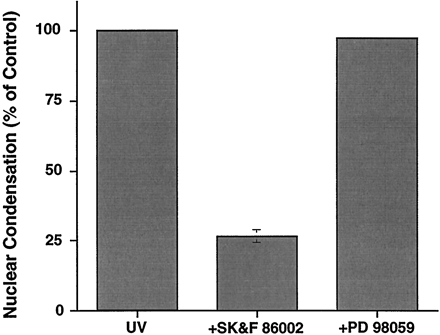
MEK1 inhibitor did not inhibit apoptosis.J Biol Chem.1998 Apr 3;273(14):8389-97. |
|---|
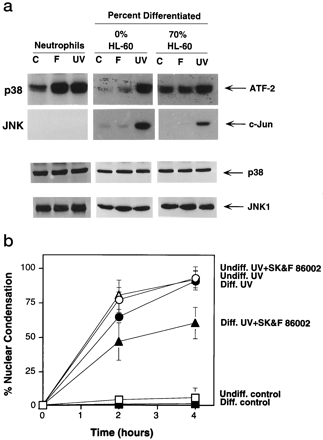
HL-60 cells decreased JNK activation and acquired p38 as they became neutrophil-like.J Biol Chem.1998 Apr 3;273(14):8389-97. |
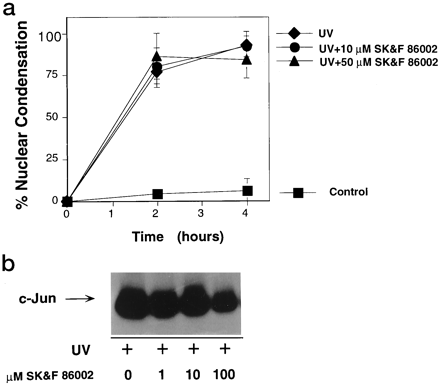
SK & F 86002 did not inhibit UV-induced apoptosis in undifferentiated HL-60 cells.J Biol Chem.1998 Apr 3;273(14):8389-97. |
Products are for research use only; We do not sell to patients
Copyright 2020 InvivoChem LLC | All Rights Reserved


 COA
COA