

| Size | Price | Stock | Qty |
|---|---|---|---|
| 2mg |
|
||
| 5mg |
|
||
| 10mg |
|
||
| 25mg |
|
||
| 50mg |
|
||
| 100mg |
|
||
| 250mg |
|
||
| 500mg |
|
||
| Other Sizes |


Purity: ≥98%
| Targets |
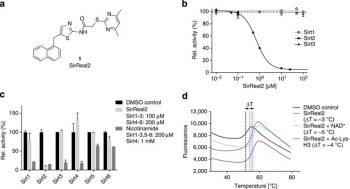
Sirtuin 2 (SIRT2), a NAD⁺-dependent deacetylase. For SirReal2, the Ki value for human SIRT2 was 0.2 nM (measured via isothermal titration calorimetry, ITC), and the IC50 for SIRT2 deacetylase activity was 0.3 nM (fluorogenic peptide assay). It exhibited extreme selectivity over other sirtuins: IC50 > 100 μM (SIRT1), IC50 > 100 μM (SIRT3), IC50 > 100 μM (SIRT4–SIRT7), and no inhibition of class I/II HDACs (e.g., HDAC1, HDAC6) at 10 μM [1]
- Consistent with [1], SIRT2 was the target, with identical selectivity profiles (Ki = 0.2 nM for SIRT2, no activity against SIRT1/SIRT3–SIRT7). The study focused on developing SirReal2 as an affinity probe for SIRT2 detection, with no new potency data [2] |
|---|---|
| ln Vitro |
In vitro activity: SirReal2 selectively inhibits Sirt2 via a Sirt2-specific amino acid network, and induces a tubulin hyperacetylation and a significant depletion of BubR1 in HeLa cells.
Kinase Assay: SirReal2 is a potent, isotype-selective Sirt2 inhibitor with an IC50 value of 140 nM and has very little effect on the activities of Sirt3-5. SirReal2 leads to tubulin hyperacetylation in HeLa cells and induces destabilization of the checkpoint protein BubR1 In recombinant sirtuin enzyme assays, SirReal2 (0.01 nM–10 μM) dose-dependently inhibited SIRT2-mediated deacetylation of a fluorogenic acetylated peptide (Ac-KK(Ac)-AMC), with IC50 = 0.3 nM. At 10 μM, it showed <5% inhibition of SIRT1, SIRT3–SIRT7, and class I/II HDACs, confirming SIRT2-specificity [1] - In HeLa cells, SirReal2 (1 μM, 5 μM) treatment for 24 hours dose-dependently increased acetylated α-tubulin (a SIRT2 substrate) levels by 2.5-fold (1 μM) and 4.0-fold (5 μM) via Western blot. Immunofluorescence showed colocalization of acetylated α-tubulin with microtubules, with no changes in SIRT2 protein expression [1] - As an affinity probe (biotin-conjugated SirReal2), it specifically bound to endogenous SIRT2 in HeLa cell lysates, detected via streptavidin pull-down followed by Western blot. No binding to SIRT1 or other deacetylases was observed, validating its use as a SIRT2-specific detection tool [2] |
| ln Vivo |
In vivo, SirReal2 inhibits Sirt2 activity without affecting the activity of the other Class-I sirtuins Sirt1 and Sirt3.
|
| Enzyme Assay |
SIRT2 Fluorogenic Deacetylation Assay: Recombinant human SIRT2 protein (residues 1–382) was incubated with a fluorogenic acetylated peptide (Ac-KK(Ac)-AMC, 20 μM) and NAD⁺ (500 μM) in assay buffer (50 mM Tris-HCl pH 8.0, 1 mM DTT, 150 mM NaCl). Serial dilutions of SirReal2 (0.001 nM–10 μM) were added, and the mixture was incubated at 37°C for 60 minutes. Fluorescence intensity (excitation 360 nm, emission 460 nm) was measured, and IC50 was calculated via four-parameter logistic regression [1]
- ITC Binding Assay: SirReal2 (100 μM) was dissolved in ITC buffer (20 mM Tris-HCl pH 8.0, 150 mM NaCl) and titrated into a solution of recombinant SIRT2 (10 μM) in the same buffer at 25°C. Heat changes during binding were recorded, and Ki values were derived from a one-site binding model [1] - SIRT2 Affinity Pull-Down Assay: Biotin-conjugated SirReal2 (5 μM) was incubated with HeLa cell lysates (1 mg total protein) and streptavidin-agarose beads at 4°C for 2 hours. Beads were washed with lysis buffer, and bound proteins were eluted with 2× SDS sample buffer. Eluted SIRT2 was detected via Western blot using an anti-SIRT2 antibody [2] |
| Cell Assay |
HeLa Cell Acetylated α-Tubulin Assay: HeLa cells were seeded in 6-well plates (5×10⁵ cells/well) and treated with SirReal2 (0.1 μM, 1 μM, 5 μM) or vehicle (DMSO, 0.1%) for 24 hours. For Western blot, cells were lysed in RIPA buffer, proteins separated by SDS-PAGE, and probed with anti-acetyl-α-tubulin and anti-GAPDH antibodies. For immunofluorescence, cells were fixed, permeabilized, stained with anti-acetyl-α-tubulin antibody (fluorescent secondary antibody) and DAPI, and imaged via confocal microscopy [1]
- Endogenous SIRT2 Detection Assay: HeLa cells were treated with biotin-conjugated SirReal2 (1 μM) for 4 hours, lysed, and subjected to streptavidin pull-down. Bound SIRT2 was detected via Western blot, and no cross-reactivity with SIRT1 was observed. This confirmed SirReal2’s ability to specifically target SIRT2 in intact cells [2] |
| Animal Protocol |
SirReal2 (12.5, 25, and 50 μM) treatment did not induce the increase in acetylation of p53
|
| References | |
| Additional Infomation |
SirReal2 is a highly efficient and selective small molecule inhibitor of SIRT2, characterized by ligand-induced rearrangement of the SIRT2 active site—a structural change that enhances binding affinity and specificity, distinguishing it from earlier SIRT2 inhibitors [1]. In [2], SirReal2 was modified into a biotin-conjugated affinity probe (SirReal2-Biotin) for the specific detection and purification of endogenous SIRT2 in cells. This probe allows for direct observation of the localization of SIRT2 and its interacting proteins, thus expanding its application as a research tool [2]. Due to a lack of in vivo and pharmacokinetic data, SirReal2 is primarily used as a chemical probe to study the biological functions of SIRT2 (e.g., microtubule deacetylation, cell cycle regulation) rather than as a therapeutic candidate [1][2].
|
| Molecular Formula |
C22H20N4OS2
|
|
|---|---|---|
| Molecular Weight |
420.55
|
|
| Exact Mass |
420.107
|
|
| CAS # |
709002-46-0
|
|
| Related CAS # |
|
|
| PubChem CID |
1096292
|
|
| Appearance |
Off-white to light yellow solid powder
|
|
| Density |
1.4±0.1 g/cm3
|
|
| Index of Refraction |
1.701
|
|
| LogP |
5.83
|
|
| Hydrogen Bond Donor Count |
1
|
|
| Hydrogen Bond Acceptor Count |
6
|
|
| Rotatable Bond Count |
6
|
|
| Heavy Atom Count |
29
|
|
| Complexity |
541
|
|
| Defined Atom Stereocenter Count |
0
|
|
| SMILES |
CC1=CC(=NC(=N1)SCC(=O)NC2=NC=C(S2)CC3=CC=CC4=CC=CC=C43)C
|
|
| InChi Key |
MENNDDDTIIZDDN-UHFFFAOYSA-N
|
|
| InChi Code |
InChI=1S/C22H20N4OS2/c1-14-10-15(2)25-22(24-14)28-13-20(27)26-21-23-12-18(29-21)11-17-8-5-7-16-6-3-4-9-19(16)17/h3-10,12H,11,13H2,1-2H3,(H,23,26,27)
|
|
| Chemical Name |
2-[(4,6-Dimethyl-2-pyrimidinyl)thio]-N-[5-(1-naphthalenylmethyl)-2-thiazolyl]acetamide
|
|
| Synonyms |
|
|
| HS Tariff Code |
2934.99.9001
|
|
| Storage |
Powder -20°C 3 years 4°C 2 years In solvent -80°C 6 months -20°C 1 month |
|
| Shipping Condition |
Room temperature (This product is stable at ambient temperature for a few days during ordinary shipping and time spent in Customs)
|
| Solubility (In Vitro) |
DMSO: 84 mg/mL (199.7 mM)
Water: 1 mg/mL (Insoluble) Ethanol: 1 mg/mL |
|---|---|
| Solubility (In Vivo) |
Solubility in Formulation 1: ≥ 2.08 mg/mL (4.95 mM) (saturation unknown) in 10% DMSO + 40% PEG300 + 5% Tween80 + 45% Saline (add these co-solvents sequentially from left to right, and one by one), clear solution.
For example, if 1 mL of working solution is to be prepared, you can add 100 μL of 20.8 mg/mL clear DMSO stock solution to 400 μL PEG300 and mix evenly; then add 50 μL Tween-80 to the above solution and mix evenly; then add 450 μL normal saline to adjust the volume to 1 mL. Preparation of saline: Dissolve 0.9 g of sodium chloride in 100 mL ddH₂ O to obtain a clear solution. Solubility in Formulation 2: ≥ 2.08 mg/mL (4.95 mM) (saturation unknown) in 10% DMSO + 90% (20% SBE-β-CD in Saline) (add these co-solvents sequentially from left to right, and one by one), clear solution. For example, if 1 mL of working solution is to be prepared, you can add 100 μL of 20.8 mg/mL clear DMSO stock solution to 900 μL of 20% SBE-β-CD physiological saline solution and mix evenly. Preparation of 20% SBE-β-CD in Saline (4°C,1 week): Dissolve 2 g SBE-β-CD in 10 mL saline to obtain a clear solution. View More
Solubility in Formulation 3: ≥ 2.08 mg/mL (4.95 mM) (saturation unknown) in 10% DMSO + 90% Corn Oil (add these co-solvents sequentially from left to right, and one by one), clear solution. |
| Preparing Stock Solutions | 1 mg | 5 mg | 10 mg | |
| 1 mM | 2.3778 mL | 11.8892 mL | 23.7784 mL | |
| 5 mM | 0.4756 mL | 2.3778 mL | 4.7557 mL | |
| 10 mM | 0.2378 mL | 1.1889 mL | 2.3778 mL |
*Note: Please select an appropriate solvent for the preparation of stock solution based on your experiment needs. For most products, DMSO can be used for preparing stock solutions (e.g. 5 mM, 10 mM, or 20 mM concentration); some products with high aqueous solubility may be dissolved in water directly. Solubility information is available at the above Solubility Data section. Once the stock solution is prepared, aliquot it to routine usage volumes and store at -20°C or -80°C. Avoid repeated freeze and thaw cycles.
Calculation results
Working concentration: mg/mL;
Method for preparing DMSO stock solution: mg drug pre-dissolved in μL DMSO (stock solution concentration mg/mL). Please contact us first if the concentration exceeds the DMSO solubility of the batch of drug.
Method for preparing in vivo formulation::Take μL DMSO stock solution, next add μL PEG300, mix and clarify, next addμL Tween 80, mix and clarify, next add μL ddH2O,mix and clarify.
(1) Please be sure that the solution is clear before the addition of next solvent. Dissolution methods like vortex, ultrasound or warming and heat may be used to aid dissolving.
(2) Be sure to add the solvent(s) in order.
 |
|---|
Products are for research use only; We do not sell to patients
Copyright 2020 InvivoChem LLC | All Rights Reserved


 COA
COA