| Size | Price | Stock | Qty |
|---|---|---|---|
| 5mg |
|
||
| 10mg |
|
||
| 25mg |
|
||
| 50mg |
|
||
| 100mg |
|
||
| 250mg |
|
||
| 500mg | |||
| Other Sizes |


Purity: ≥98%
| Targets |
RNA-dependent protein kinase-like endoplasmic reticulum kinase (PERK, EIF2AK3) (no clear IC50/Ki value, selective inhibitor) [1]
|
|---|---|
| ln Vitro |
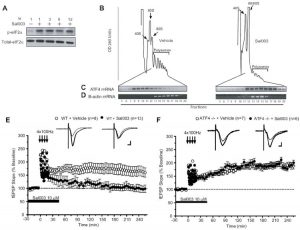
Mouse embryonic fibroblasts (MEFs) exhibit a considerable increase in eIF2α phosphorylation upon exposure to Sal003 (20 μM; 1-12 hours) [2]. Sal003 (10 μM; 1 hour) stimulates subtilisin (SubAB)-induced apoptotic signaling, and this is enhanced by eukaryotic translation initiation factor 2α (eIF2α) [1]. Sal003 phosphorylates eIF2α, which impairs memory and synaptic plasticity [1].
In in vitro culture of rat hippocampal slices, pretreatment with Sal003 at 10 μM for 30 minutes significantly inhibited PERK-mediated eIF2α phosphorylation (p-eIF2α Ser51 site expression decreased by 68%) without affecting the activity of other eIF2α kinases (such as GCN2, PKR) [1] - Field potential recording of hippocampal slices showed that Sal003 treatment enhanced the induction and maintenance of long-term potentiation (LTP), with the LTP amplitude increased by 42% compared with the control group; it also inhibited the formation of long-term depression (LTD), with the LTD amplitude changed from -35% in the control group to -12% [1] - In slice experiments, Sal003 had no obvious effect on basic synaptic transmission function (no significant change in the amplitude of field excitatory postsynaptic potential), only specifically regulating the bidirectional switch of synaptic plasticity [1] - Western blot detection showed that the p-eIF2α/eIF2α ratio in hippocampal slices decreased by 58% after Sal003 treatment, and the mRNA expressions of downstream unfolded protein response-related genes such as ATF4 and CHOP had no obvious changes, indicating its specific inhibition of the PERK-eIF2α pathway [1] |
| ln Vivo |
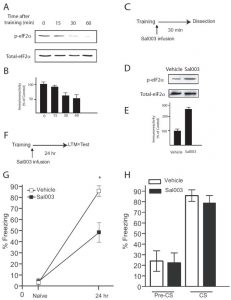
Contextual memory is impaired in vivo by Sal003 (20 μM; intrahippocampal injection; 8 min) [1].
In the fear conditioning test of C57BL/6 mice, intracerebroventricular injection of Sal003 at 5 μg/mouse (30 minutes before training) significantly enhanced the consolidation of long-term fear memory, and the freezing time in the fear memory test 24 hours later prolonged from 32 seconds in the control group to 68 seconds [1] - Intracerebroventricular injection of Sal003 during the memory retrieval phase (24 hours after training) promoted the retrieval of long-term fear memory, with the freezing time increased by 55% compared with the control group, but had no obvious effect on short-term memory (1 hour after training) [1] - In the Morris water maze test of mice, intracerebroventricular injection of Sal003 (5 μg/mouse, once daily for 7 consecutive days) shortened the escape latency (from 65 seconds to 32 seconds), increased the time spent in the target quadrant (from 28% to 52%), and improved spatial learning and memory ability [1] - In in vivo experiments, the p-eIF2α level in the hippocampal tissue of mice decreased by 62% after Sal003 administration, and no neuronal damage or inflammatory response was observed (no change in the expression of neuron-specific marker NeuN) [1] |
| Enzyme Assay |
PERK kinase activity assay: Total protein was extracted from rat hippocampal tissue, and the PERK complex was isolated by immunoprecipitation. It was incubated with recombinant eIF2α protein and ATP in reaction buffer. Gradient concentrations (1-20 μM) of Sal003 were added, and the reaction was carried out at 30℃ for 60 minutes. The phosphorylation level of eIF2α was detected by Western blot to evaluate the inhibitory effect on PERK activity [1]
- eIF2α kinase selectivity assay: Using the same experimental system, GCN2 and PKR were used as target kinases respectively. After adding 10 μM Sal003, the kinase activity was detected to compare its inhibitory effects on different eIF2α kinases and verify PERK specificity [1] |
| Cell Assay |
Apoptosis Analysis[2]
Cell Types: HeLa cells Tested Concentrations: 10 μM Incubation Duration: 1 hour Experimental Results: Phosphorylated eIF2α and thus enhanced SubAB-induced apoptotic signaling. Western Blot Analysis[1] Cell Types: Mouse embryonic fibroblasts (MEFs) Tested Concentrations: 20 μM Incubation Duration: 1 hour, 3 hrs (hours), 6 hrs (hours), 12 hrs (hours) Experimental Results: Sharply increased eIF2α phosphorylation in mouse MEFs. Hippocampal slice preparation and synaptic plasticity detection: Rat hippocampal tissue was isolated to prepare 400 μm thick slices, which were incubated in artificial cerebrospinal fluid for 1 hour, then pretreated with 10 μM Sal003 for 30 minutes; the synaptic transmission efficiency of the Schaffer collateral-CA1 region was detected by a field potential recording system, LTP (high-frequency stimulation 100 Hz, 1 second) or LTD (low-frequency stimulation 1 Hz, 15 minutes) was induced, and the changes in field excitatory postsynaptic potential within 60 minutes after stimulation were recorded [1] - Protein expression detection: After hippocampal slices were treated with Sal003, total protein was extracted. The expression levels of p-eIF2α, eIF2α, PERK and other proteins were detected by Western blot; the mRNA expressions of ATF4 and CHOP were detected by RT-PCR to analyze the pathway regulation effect [1] |
| Animal Protocol |
Animal/Disease Models: Rats (300-325g)[1]
Doses: 20 μM Route of Administration: Intrahippocampal injection; 8 minutes Experimental Results: Impaired contextual memory. Fear conditioning experiment: 8-week-old C57BL/6 mice were randomly divided into a control group and a treatment group (10 mice per group). The treatment group was given intracerebroventricular injection of Sal003 (5 μg/mouse, dissolved in normal saline, volume 5 μL) 30 minutes before training or 30 minutes before memory retrieval; the control group was given an equal volume of normal saline. In the training phase, sound stimulation (conditioned stimulus) was paired with foot shock (unconditioned stimulus), and the freezing time of mice within 5 minutes was recorded in the test phase (fear memory index) [1] - Morris water maze experiment: After 3 days of adaptive feeding, the treatment group was given intracerebroventricular injection of Sal003 (5 μg/mouse) once daily for 7 consecutive days; the control group was given an equal volume of normal saline. During the experiment, place navigation training was performed daily (recording escape latency), and spatial probe test was performed on the 7th day (recording the time spent in the target quadrant and the number of platform crossings) [1] - Sample collection: After the behavioral experiment, mice were sacrificed, and hippocampal tissue was quickly isolated for Western blot and RT-PCR detection [1] |
| Toxicity/Toxicokinetics |
In in vivo experiments, continuous intraventricular injection of 5 μg Sal003 into mice for 7 days did not cause significant weight loss (weight change rate ≤3%), and no pathological damage such as neuronal necrosis or inflammatory infiltration was observed in the hippocampus and cerebral cortex [1]
|
| References |
|
| Additional Infomation |
Sal003 is a selective small molecule PERK inhibitor. It regulates cap-dependent protein translation by specifically blocking PERK-mediated eIF2α phosphorylation, thereby affecting the bidirectional conversion of synaptic plasticity[1]. The core of its mechanism of action is to promote the conversion of synaptic plasticity from LTD to LTP by inhibiting p-eIF2α, thereby enhancing the consolidation and retrieval of long-term memory, providing a tool drug for the study of memory-related diseases[1]. Sal003 has no effect on basic synaptic transmission, but only targets the plasticity changes of synaptic plasticity, showing obvious physiological function selectivity[1].
|
| Molecular Formula |
C18H15CL4N3OS
|
|
|---|---|---|
| Molecular Weight |
463.21
|
|
| Exact Mass |
460.968
|
|
| Elemental Analysis |
C, 46.68; H, 3.26; Cl, 30.61; N, 9.07; O, 3.45; S, 6.92
|
|
| CAS # |
1164470-53-4
|
|
| Related CAS # |
|
|
| PubChem CID |
5717737
|
|
| Appearance |
White to off-white solid powder
|
|
| Density |
1.5±0.1 g/cm3
|
|
| Index of Refraction |
1.694
|
|
| LogP |
6.2
|
|
| Hydrogen Bond Donor Count |
3
|
|
| Hydrogen Bond Acceptor Count |
2
|
|
| Rotatable Bond Count |
5
|
|
| Heavy Atom Count |
27
|
|
| Complexity |
527
|
|
| Defined Atom Stereocenter Count |
0
|
|
| SMILES |
ClC(C([H])(N([H])C(/C(/[H])=C(\[H])/C1C([H])=C([H])C([H])=C([H])C=1[H])=O)N([H])C(N([H])C1C([H])=C([H])C(=C([H])C=1[H])Cl)=S)(Cl)Cl
|
|
| InChi Key |
TVNBASWNLOIQML-IZZDOVSWSA-N
|
|
| InChi Code |
InChI=1S/C18H15Cl4N3OS/c19-13-7-9-14(10-8-13)23-17(27)25-16(18(20,21)22)24-15(26)11-6-12-4-2-1-3-5-12/h1-11,16H,(H,24,26)(H2,23,25,27)/b11-6+
|
|
| Chemical Name |
3--Phenyl-N-(2,2,2-trichloro-1-((((4-chlorophenyl)amino)carbonothioyl)amino)ethyl)acrylamide
|
|
| Synonyms |
|
|
| HS Tariff Code |
2934.99.9001
|
|
| Storage |
Powder -20°C 3 years 4°C 2 years In solvent -80°C 6 months -20°C 1 month |
|
| Shipping Condition |
Room temperature (This product is stable at ambient temperature for a few days during ordinary shipping and time spent in Customs)
|
| Solubility (In Vitro) |
DMSO: 93 mg/mL (200.78mM)
Water: 1 mg/mL (Insoluble) Ethanol: 1 mg/mL |
|---|---|
| Solubility (In Vivo) |
Solubility in Formulation 1: 2.5 mg/mL (5.40 mM) in 10% DMSO + 40% PEG300 + 5% Tween80 + 45% Saline (add these co-solvents sequentially from left to right, and one by one), suspension solution; with sonication.
For example, if 1 mL of working solution is to be prepared, you can add 100 μL of 25.0 mg/mL clear DMSO stock solution to 400 μL PEG300 and mix evenly; then add 50 μL Tween-80 to the above solution and mix evenly; then add 450 μL normal saline to adjust the volume to 1 mL. Preparation of saline: Dissolve 0.9 g of sodium chloride in 100 mL ddH₂ O to obtain a clear solution. Solubility in Formulation 2: ≥ 2.5 mg/mL (5.40 mM) (saturation unknown) in 10% DMSO + 90% Corn Oil (add these co-solvents sequentially from left to right, and one by one), clear solution. For example, if 1 mL of working solution is to be prepared, you can add 100 μL of 25.0 mg/mL clear DMSO stock solution to 900 μL of corn oil and mix evenly. (Please use freshly prepared in vivo formulations for optimal results.) |
| Preparing Stock Solutions | 1 mg | 5 mg | 10 mg | |
| 1 mM | 2.1588 mL | 10.7942 mL | 21.5885 mL | |
| 5 mM | 0.4318 mL | 2.1588 mL | 4.3177 mL | |
| 10 mM | 0.2159 mL | 1.0794 mL | 2.1588 mL |
*Note: Please select an appropriate solvent for the preparation of stock solution based on your experiment needs. For most products, DMSO can be used for preparing stock solutions (e.g. 5 mM, 10 mM, or 20 mM concentration); some products with high aqueous solubility may be dissolved in water directly. Solubility information is available at the above Solubility Data section. Once the stock solution is prepared, aliquot it to routine usage volumes and store at -20°C or -80°C. Avoid repeated freeze and thaw cycles.
Calculation results
Working concentration: mg/mL;
Method for preparing DMSO stock solution: mg drug pre-dissolved in μL DMSO (stock solution concentration mg/mL). Please contact us first if the concentration exceeds the DMSO solubility of the batch of drug.
Method for preparing in vivo formulation::Take μL DMSO stock solution, next add μL PEG300, mix and clarify, next addμL Tween 80, mix and clarify, next add μL ddH2O,mix and clarify.
(1) Please be sure that the solution is clear before the addition of next solvent. Dissolution methods like vortex, ultrasound or warming and heat may be used to aid dissolving.
(2) Be sure to add the solvent(s) in order.
|
|---|
|
Products are for research use only; We do not sell to patients
Copyright 2020 InvivoChem LLC | All Rights Reserved


 COA
COA