| Size | Price | Stock | Qty |
|---|---|---|---|
| 5mg |
|
||
| 10mg |
|
||
| 25mg |
|
||
| 50mg |
|
||
| 100mg |
|
||
| 250mg |
|
||
| 500mg |
|
||
| Other Sizes |


Purity: ≥98%
| Targets |
5-HT2A Receptor ( Ki = 7.53 nM ); Sigma-2 Receptor ( Ki = 8.19 nM )
Roluperidone (MIN-101) has high equipotent affinities for the sigma-2 receptor (Ki = 8.19 nmol/L) and the 5-hydroxytryptamine 2A (5-HT2A) receptor (Ki = 7.53 nmol/L). It also shows binding affinity for α1-adrenergic receptors, but has low or no affinity for muscarinic, cholinergic, and histaminergic receptors. The compound has no affinities for pre- or postsynaptic dopaminergic receptors. [1] |
|---|---|
| ln Vitro |
Roluperidone (CYR-101) additionally exhibits α1-adrenergic receptor binding affinity, but little to no affinity for histamine, cholinergic, or muscarinic receptors. Despite the lack of affinity for pre- or postsynaptic dopaminergic receptors, roluperidone (CYR-101) is likely associated with sigma-2 receptors that are involved in the modulation of glutamatergic and dopaminergic pathways as well as calcium neuronal modulation[1].
In rodents, Roluperidone (MIN-101) improved impairment of social interaction induced by phencyclidine and impairment of spontaneous alternation behavior induced by MK-801. These experiments are hypothesized to be predictive of a therapeutic effect on negative symptoms. [1] Also in rodents, higher doses of Roluperidone (MIN-101) reduced hyperlocomotion induced by apomorphine and by methamphetamine. These models are predictive of antipsychotic effects. [1] Roluperidone (MIN-101) demonstrated effects on the conditioned avoidance response test, without reducing the percentage of escapes, consistent with the finding that it does not have a sedative effect. [1] |
| ln Vivo |
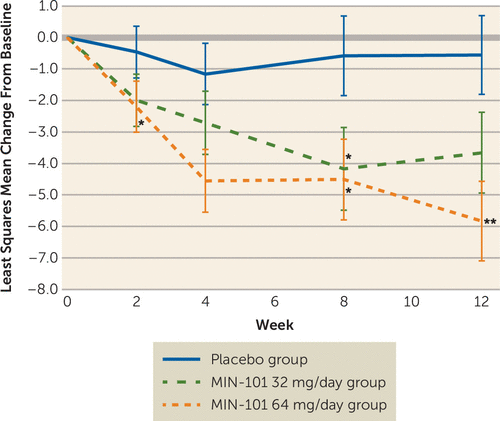
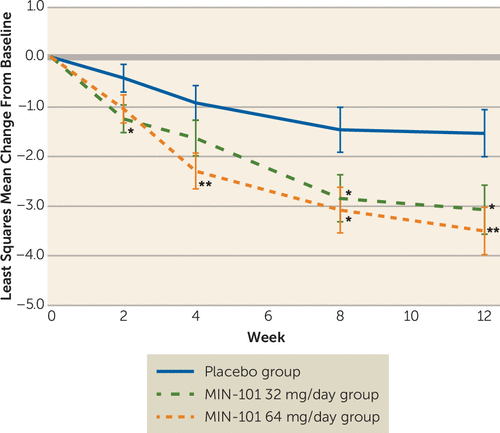
In a 12-week, randomized, double-blind, placebo-controlled trial involving 244 stabilized schizophrenia patients with prominent negative symptoms, Roluperidone (MIN-101) at dosages of 32 mg/day and 64 mg/day demonstrated statistically significant improvement in the primary outcome measure (PANSS negative factor score from the pentagonal structure model) compared to placebo (effect sizes, d=0.45 and d=0.57, respectively). Significant improvements were also observed on several secondary measures, including the PANSS total score, Brief Negative Symptom Scale, and CGI severity item. No significant improvement was observed on PANSS positive symptoms. [1]
|
| Animal Protocol |
The literature mentions preclinical rodent models used to evaluate Roluperidone (MIN-101), including tests for social interaction impairment induced by phencyclidine, spontaneous alternation behavior impairment induced by MK-801, hyperlocomotion induced by apomorphine and methamphetamine, and the conditioned avoidance response test. However, it does not provide detailed experimental protocols for these animal studies, such as specific animal species, drug formulation, dosing regimen, or route of administration. [1]
The clinical trial involved human subjects. Eligible patients were withdrawn from all psychotropic drugs for at least 5 days before being randomly assigned to receive oral placebo, Roluperidone (MIN-101) 32 mg/day, or Roluperidone (MIN-101) 64 mg/day for 12 weeks. No other psychotropic medications were allowed except for specified rescue medications for insomnia or agitation. [1] |
| Toxicity/Toxicokinetics |
In the 12-week clinical trial, roluperone (MIN-101) was generally well tolerated. No clinically significant changes were observed in vital signs, routine laboratory values, weight, metabolic parameters, or abnormal involuntary movement scale (AIMS) scores. The most common adverse events during treatment in the roluperone (MIN-101) group were headache, anxiety, insomnia, exacerbation of schizophrenia symptoms, fatigue, nausea, and somnolence, with most occurring in ≤7.5% of cases. A total of 6 patients (out of 161) in the MIN-101 group experienced serious adverse events, including hospitalization due to exacerbation of schizophrenia symptoms (4 cases), and single episodes of vomiting/abdominal pain and syncope/bradycardia. [1]
|
| References | |
| Additional Infomation |
Roluperidone has been used in clinical trials for the treatment of schizophrenia. Roluperidone (MIN-101) is a novel cyclic amide derivative developed specifically for the treatment of negative symptoms of schizophrenia. Its mechanism of action is thought to involve synergistic effects on the 5-HT2A and σ-2 pathways, potentially antagonizing dysregulation of the dopamine and glutamate neurotransmitter pathways without directly blocking dopamine D2 receptors. [1] A phase 2b clinical trial demonstrated its efficacy in reducing negative symptoms in patients with stable schizophrenia, outperforming some currently marketed antipsychotics in similar cases. Improvement in negative symptoms was largely independent of changes in depressive symptoms. [1] The trial was designed to include patients with moderate negative symptoms and mild positive symptoms to minimize confounding factors. The primary efficacy endpoint was the PANSS negative factor score based on a pentagonal structural model. [1]
|
| Molecular Formula |
C22H23FN2O2
|
|---|---|
| Molecular Weight |
366.4286
|
| Exact Mass |
366.174
|
| Elemental Analysis |
C, 72.11; H, 6.33; F, 5.18; N, 7.64; O, 8.73
|
| CAS # |
359625-79-9
|
| PubChem CID |
9799284
|
| Appearance |
White to yellow solid powder
|
| Density |
1.2±0.1 g/cm3
|
| Boiling Point |
551.7±50.0 °C at 760 mmHg
|
| Flash Point |
287.4±30.1 °C
|
| Vapour Pressure |
0.0±1.5 mmHg at 25°C
|
| Index of Refraction |
1.593
|
| LogP |
2.59
|
| Hydrogen Bond Donor Count |
0
|
| Hydrogen Bond Acceptor Count |
4
|
| Rotatable Bond Count |
5
|
| Heavy Atom Count |
27
|
| Complexity |
538
|
| Defined Atom Stereocenter Count |
0
|
| SMILES |
FC1C([H])=C([H])C(=C([H])C=1[H])C(C([H])([H])N1C([H])([H])C([H])([H])C([H])(C([H])([H])N2C(C3=C([H])C([H])=C([H])C([H])=C3C2([H])[H])=O)C([H])([H])C1([H])[H])=O
|
| InChi Key |
RNRYULFRLCBRQS-UHFFFAOYSA-N
|
| InChi Code |
InChI=1S/C22H23FN2O2/c23-19-7-5-17(6-8-19)21(26)15-24-11-9-16(10-12-24)13-25-14-18-3-1-2-4-20(18)22(25)27/h1-8,16H,9-15H2
|
| Chemical Name |
2-[[1-[2-(4-fluorophenyl)-2-oxoethyl]piperidin-4-yl]methyl]-3H-isoindol-1-one
|
| Synonyms |
MT-210; MIN101; CYR-101; MT 210; MIN 101; CYR 101; MT210; MIN-101; CYR101; Roluperidone
|
| HS Tariff Code |
2934.99.9001
|
| Storage |
Powder -20°C 3 years 4°C 2 years In solvent -80°C 6 months -20°C 1 month Note: This product is not stable in solution, please use freshly prepared working solution for optimal results. |
| Shipping Condition |
Room temperature (This product is stable at ambient temperature for a few days during ordinary shipping and time spent in Customs)
|
| Solubility (In Vitro) |
DMSO: ~33.33 mg/mL (~91.0 mM)
|
|---|---|
| Solubility (In Vivo) |
Solubility in Formulation 1: ≥ 3 mg/mL (8.19 mM) (saturation unknown) in 10% DMSO + 40% PEG300 + 5% Tween80 + 45% Saline (add these co-solvents sequentially from left to right, and one by one), clear solution.
For example, if 1 mL of working solution is to be prepared, you can add 100 μL of 30.0 mg/mL clear DMSO stock solution to 400 μL PEG300 and mix evenly; then add 50 μL Tween-80 to the above solution and mix evenly; then add 450 μL normal saline to adjust the volume to 1 mL. Preparation of saline: Dissolve 0.9 g of sodium chloride in 100 mL ddH₂ O to obtain a clear solution. Solubility in Formulation 2: ≥ 3 mg/mL (8.19 mM) (saturation unknown) in 10% DMSO + 90% Corn Oil (add these co-solvents sequentially from left to right, and one by one), clear solution. For example, if 1 mL of working solution is to be prepared, you can add 100 μL of 30.0 mg/mL clear DMSO stock solution to 900 μL of corn oil and mix evenly. View More
Solubility in Formulation 3: ≥ 2.5 mg/mL (6.82 mM) (saturation unknown) in 10% DMSO + 90% (20% SBE-β-CD in Saline) (add these co-solvents sequentially from left to right, and one by one), clear solution. |
| Preparing Stock Solutions | 1 mg | 5 mg | 10 mg | |
| 1 mM | 2.7290 mL | 13.6452 mL | 27.2903 mL | |
| 5 mM | 0.5458 mL | 2.7290 mL | 5.4581 mL | |
| 10 mM | 0.2729 mL | 1.3645 mL | 2.7290 mL |
*Note: Please select an appropriate solvent for the preparation of stock solution based on your experiment needs. For most products, DMSO can be used for preparing stock solutions (e.g. 5 mM, 10 mM, or 20 mM concentration); some products with high aqueous solubility may be dissolved in water directly. Solubility information is available at the above Solubility Data section. Once the stock solution is prepared, aliquot it to routine usage volumes and store at -20°C or -80°C. Avoid repeated freeze and thaw cycles.
Calculation results
Working concentration: mg/mL;
Method for preparing DMSO stock solution: mg drug pre-dissolved in μL DMSO (stock solution concentration mg/mL). Please contact us first if the concentration exceeds the DMSO solubility of the batch of drug.
Method for preparing in vivo formulation::Take μL DMSO stock solution, next add μL PEG300, mix and clarify, next addμL Tween 80, mix and clarify, next add μL ddH2O,mix and clarify.
(1) Please be sure that the solution is clear before the addition of next solvent. Dissolution methods like vortex, ultrasound or warming and heat may be used to aid dissolving.
(2) Be sure to add the solvent(s) in order.
| NCT Number | Recruitment | interventions | Conditions | Sponsor/Collaborators | Start Date | Phases |
| NCT06107803 | Recruiting | Drug: Roluperidone 64 mg Drug: Olanzapine 10 MG |
Negative Symptoms in Schizophrenia |
Minerva Neurosciences | October 13, 2023 | Phase 1 |
| NCT03397134 | Completed | Drug: Placebo Oral Tablet Drug: Roluperidone 32 mg |
Negative Symptoms of Schizophrenia |
Minerva Neurosciences | December 15, 2017 | Phase 3 |
|
|
Products are for research use only; We do not sell to patients
Copyright 2020 InvivoChem LLC | All Rights Reserved


 COA
COA