| Size | Price | Stock | Qty |
|---|---|---|---|
| 10mg |
|
||
| 25mg |
|
||
| 50mg |
|
||
| 100mg |
|
||
| 250mg |
|
||
| Other Sizes |


| Targets |
TRPC3 (IC50 = 0.49 uM)
Pyr6's primary target is the TRPC3 channel. It is a selective inhibitor of TRPC3, with an IC50 of 0.49 μM for inhibiting Ca2+ influx. It also inhibits Orai1-mediated calcium entry. |
|---|---|
| ln Vitro |
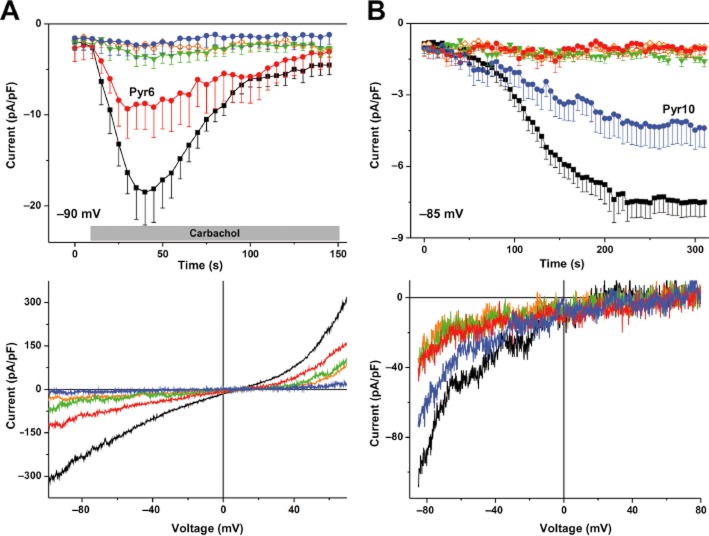
Pyr3, a previously suggested selective inhibitor of TRPC3, inhibited Orai1- and TRPC3-mediated Ca2+ entry and currents as well as mast cell activation with similar potency. By contrast, Pyr6 exhibited a 37-fold higher potency to inhibit Orai1-mediated Ca2+ entry as compared with TRPC3-mediated Ca2+ entry and potently suppressed mast cell activation. The novel pyrazole Pyr10 displayed substantial selectivity for TRPC3-mediated responses (18-fold) and the selective block of TRPC3 channels by Pyr10 barely affected mast cell activation[1].
The pyrazole derivatives Pyr6 and Pyr10 are able to distinguish between TRPC and Orai-mediated Ca2+ entry and may serve as useful tools for the analysis of cellular functions of the underlying Ca2+ channels[1]. In vitro, Pyr6 is a selective inhibitor of TRPC3 with an IC50 of 0.49 μM. It blocks SOCE in thapsigargin-treated, calcium-depleted BRL-2H3 cells. It is a more potent inhibitor of CRAC channel-mediated Ca2+ entry compared to TRPC3. |
| ln Vivo |
Specific in vivo activity data for Pyr6 is not detailed in the provided search results. As a research tool for studying TRPC3 and calcium signaling, its primary application is in in vitro and cell-based assays.
|
| Enzyme Assay |
For characterization of Pyr6 and Pyr10 selectivity for TRPC channels, n-terminally GFP-tagged murine TRPC6, n-terminally YFP-tagged TRPC5 (Schindl et al., 2008) and c-terminally YFP-tagged TRPC4beta (Graziani et al., 2010) were used.
The in vitro activity of Pyr6 is assessed using calcium imaging assays. Cells are loaded with a calcium-sensitive fluorescent dye and treated with thapsigargin to deplete intracellular calcium stores. The inhibition of store-operated calcium entry (SOCE) by Pyr6 is measured to determine the IC50. |
| Cell Assay |
Electrophysiology[1]
Patch pipettes were pulled from borosilicate glass capillaries (resistance 3–5 MΩ). Currents were recorded at room temperature using a List EPC7 patch-clamp amplifier. Signals were low-pass filtered at 3 and 10 kHz and digitized with 5 kHz. For HEK293 cells, voltage-clamp protocols (voltage ramps from −130 to +80 mV, holding potential 0 mV) were controlled by pClamp software. Extracellular solution (ECS) contained (in mM) 140 NaCl, 2 CaCl2, 2 MgCl2, 10 glucose, pH adjusted to 7.4 with NaOH. The pipette solution (ICS) contained (in mM) 120 caesium methanesulphonate, 20 CsCl, 15 HEPES, 5 MgCl2, 3 EGTA, pH adjusted to 7.3 with CsOH. To activate the TRPC3 channel, current cells were challenged with 100 μM carbachol or 100 μM 1-oleoyl-2-acetyl-sn-glycerol (OAG). For RBL-2H3 cells CRAC measurement, standard protocols and buffers were modified from Derler et al. (2009). In brief voltage ramps from −90 to +90 mV over 1 s (holding potential +30 mV) were applied and controlled by pClamp software. ECS contained (in mM) 130 NaCl, 5 CsCl, 1 MgCl2, 10 HEPES, 10 glucose, 20 CaCl2 at pH 7.4. ICS was comprised of 3.5 MgCl2, 145 caesium methanesulphonate, 8 NaCl, 10 HEPES, 20 EGTA at pH 7.2. Experiments in HEK-293 cells expressing STIM1 and Orai1 to reconstitute the CRAC pore were done as in Muik et al. (2008). ECS contained (in mM) 145 NaCl, 5 CsCl, 1 MgCl2, 10 HEPES, 10 Glucose, 10 CaCl2 at pH 7.4. ICS was comprised of 3.5 MgCl2, 145 caesium methanesulphonate, 8 NaCl, 10 HEPES, 20 EGTA at pH 7.2. For measuring the sodium currents in divalent-free conditions, protocols and buffers from Bergsmann et al. (2011) were used. If not mentioned otherwise for the experiments, cells were pre-incubated for 3 min and measured in the presence of either 3 μM Pyr2, Pyr3, Pyr6 or Pyr10.
For cellular assays, RBL-2H3 cells or other cell lines expressing TRPC3 are used. Cells are treated with various concentrations of Pyr6, and the inhibition of calcium influx induced by store depletion or receptor stimulation is measured. |
| Animal Protocol |
In vivo studies for Pyr6 are not described in the provided search results. As a research compound, its effects are primarily studied in cellular models to investigate the role of TRPC3 and calcium signaling in various physiological processes.
|
| ADME/Pharmacokinetics |
Pyr6 has a molecular weight of 418.27 g/mol and a molecular formula of C17H9F7N4O. Its IUPAC name is N-[4-[3,5-Bis(trifluoromethyl)-1H-pyrazol-1-yl]phenyl]-3-fluoro-4-pyridinecarboxamide.
|
| Toxicity/Toxicokinetics |
Specific toxicity data for Pyr6 is not available in the provided search results. As a research chemical, standard laboratory safety precautions should be followed when handling the compound. Its safety profile has not been fully established.
|
| References | |
| Additional Infomation |
The observed selectivity of Pyr6 and Pyr10 suggests that these compounds may be helpful in identifying and analyzing TRPC and Orai-mediated conductance in native tissues. Our results in RBL-2H3 mast cells and STIM1/Orai1-expressing HEK293 cells are consistent with the concept that in both cell systems, storage-operated Ca2+ influx occurs through the same channels characterized by significantly higher sensitivity to Pyr6 than to Pyr10. In contrast, the TRPC3 homologous pore structure is highly sensitive to Pyr10 but less sensitive to Pyr6. Importantly, the inhibitory effects of Pyr6 and Pyr10 on homologous channels of other TRPC isoforms (such as TRPC4, 5, and 6) were tested, showing low inhibitory potency (IC50 > 10 μM) on these channels, indicating significant TRPC isoform selectivity for Pyr10 (see Supplementary Infographic S3). [1] We considered the sensitivity of Pyr6 and Pyr10 to pyrazole to be characteristic of Orai1-mediated Ca2+ influx. Since RBL-2H3 cells express TRPC genes, including TRPC3 (Ma et al., 2008), our results may indicate that TRPC3 is not involved in storage-manipulated Ca2+ influx in mast cells. However, we cannot rule out the role of TRPC3-containing channel complexes in local Ca2+ signaling events. These local Ca2+ signaling events are not detectable by changes in global cellular Ca2+ but may be crucial to certain downstream signaling pathways, as recently reported with cardiac TRPC3 (Poteser et al., 2011). We found that NFAT translocations are highly sensitive to Pyr6 but insensitive to Pyr10, which is consistent with the recent view of Kar et al. (2011) that NFAT is mainly regulated in RBL-2H3 cells through the CRAC/Orai Ca2+ influx pathway. It is noteworthy that pyrazole compounds were initially considered effective inhibitors of NFAT signaling, although their mechanism of action remains unclear, as they are located downstream of Ca2+ signaling (Djuric et al., 2000; Trevillyan et al., 2001). This article reports that the inhibitory effects of Pyr6 and Pyr10 are closely related to their efficacy as CRAC/Orai1 inhibitors. Pyr6 showed a stronger inhibitory effect on mast cell degranulation than Pyr10, an observation that confirms the Orai channel is the main source of Ca2+ in RBL-2H3 cell exocytosis (Ma et al., 2008). Consistent with previous reports, Pyr6 has been found to effectively inhibit transcriptional activation and cytokine production in immune cells (Ishikawa et al., 2003; Birsan et al., 2004; Shirakawa et al., 2010; Law et al., 2011), highlighting the potential value of this chemical structure in the development of highly effective immunomodulators (Chen et al., 2002; Zitt et al., 2004) [1].
Pyr6 is a research compound used to study the role of TRPC3 and Orai1 channels in calcium signaling. It is a valuable tool for investigating the functions of these channels in various cellular processes, including mast cell activation. It is not approved for clinical use. |
| Molecular Formula |
C17H9F7N4O
|
|---|---|
| Molecular Weight |
418.27
|
| Exact Mass |
418.066
|
| Elemental Analysis |
C, 48.82; H, 2.17; F, 31.79; N, 13.40; O, 3.82
|
| CAS # |
245747-08-4
|
| PubChem CID |
10598093
|
| Appearance |
Light yellow to yellow solid powder
|
| Density |
1.5±0.1 g/cm3
|
| Boiling Point |
368.4±42.0 °C at 760 mmHg
|
| Flash Point |
176.6±27.9 °C
|
| Vapour Pressure |
0.0±0.8 mmHg at 25°C
|
| Index of Refraction |
1.551
|
| LogP |
3.1
|
| Hydrogen Bond Donor Count |
1
|
| Hydrogen Bond Acceptor Count |
10
|
| Rotatable Bond Count |
3
|
| Heavy Atom Count |
29
|
| Complexity |
577
|
| Defined Atom Stereocenter Count |
0
|
| SMILES |
O=C(C1=C(F)C=NC=C1)NC2=CC=C(N3N=C(C(F)(F)F)C=C3C(F)(F)F)C=C2
|
| InChi Key |
XZIQSOZOLJJMFN-UHFFFAOYSA-N
|
| InChi Code |
InChI=1S/C17H9F7N4O/c18-12-8-25-6-5-11(12)15(29)26-9-1-3-10(4-2-9)28-14(17(22,23)24)7-13(27-28)16(19,20)21/h1-8H,(H,26,29)
|
| Chemical Name |
N-[4-[3,5-bis(trifluoromethyl)pyrazol-1-yl]phenyl]-3-fluoropyridine-4-carboxamide
|
| Synonyms |
Pyr 6; Pyr-6; N-(4-(3,5-Bis(trifluoromethyl)-1H-pyrazol-1-yl)phenyl)-3-fluoroisonicotinamide; CHEMBL101896; N-[4-[3,5-bis(trifluoromethyl)pyrazol-1-yl]phenyl]-3-fluoropyridine-4-carboxamide; N-{4-[3,5-bis(trifluoromethyl)-1h-pyrazol-1-yl]phenyl}-3-fluoroisonicotinamide; N-{4-[3,5-bis(trifluoromethyl)pyrazol-1-yl]phenyl}-3-fluoropyridine-4-carboxamide; XZIQSOZOLJJMFN-UHFFFAOYSA-N; Pyr6
|
| HS Tariff Code |
2934.99.9001
|
| Storage |
Powder -20°C 3 years 4°C 2 years In solvent -80°C 6 months -20°C 1 month |
| Shipping Condition |
Room temperature (This product is stable at ambient temperature for a few days during ordinary shipping and time spent in Customs)
|
| Solubility (In Vitro) |
DMSO : ≥ 100 mg/mL (~239.08 mM)
|
|---|---|
| Solubility (In Vivo) |
Solubility in Formulation 1: ≥ 10 mg/mL (23.91 mM) (saturation unknown) in 10% DMSO + 40% PEG300 + 5% Tween80 + 45% Saline (add these co-solvents sequentially from left to right, and one by one), clear solution.
For example, if 1 mL of working solution is to be prepared, you can add 100 μL of 100.0 mg/mL clear DMSO stock solution to 400 μL PEG300 and mix evenly; then add 50 μL Tween-80 to the above solution and mix evenly; then add 450 μL normal saline to adjust the volume to 1 mL. Preparation of saline: Dissolve 0.9 g of sodium chloride in 100 mL ddH₂ O to obtain a clear solution. Solubility in Formulation 2: ≥ 10 mg/mL (23.91 mM) (saturation unknown) in 10% DMSO + 90% (20% SBE-β-CD in Saline) (add these co-solvents sequentially from left to right, and one by one), clear solution. For example, if 1 mL of working solution is to be prepared, you can add 100 μL of 100.0 mg/mL clear DMSO stock solution to 900 μL of 20% SBE-β-CD physiological saline solution and mix evenly. Preparation of 20% SBE-β-CD in Saline (4°C,1 week): Dissolve 2 g SBE-β-CD in 10 mL saline to obtain a clear solution. View More
Solubility in Formulation 3: ≥ 10 mg/mL (23.91 mM) (saturation unknown) in 10% DMSO + 90% Corn Oil (add these co-solvents sequentially from left to right, and one by one), clear solution. |
| Preparing Stock Solutions | 1 mg | 5 mg | 10 mg | |
| 1 mM | 2.3908 mL | 11.9540 mL | 23.9080 mL | |
| 5 mM | 0.4782 mL | 2.3908 mL | 4.7816 mL | |
| 10 mM | 0.2391 mL | 1.1954 mL | 2.3908 mL |
*Note: Please select an appropriate solvent for the preparation of stock solution based on your experiment needs. For most products, DMSO can be used for preparing stock solutions (e.g. 5 mM, 10 mM, or 20 mM concentration); some products with high aqueous solubility may be dissolved in water directly. Solubility information is available at the above Solubility Data section. Once the stock solution is prepared, aliquot it to routine usage volumes and store at -20°C or -80°C. Avoid repeated freeze and thaw cycles.
Calculation results
Working concentration: mg/mL;
Method for preparing DMSO stock solution: mg drug pre-dissolved in μL DMSO (stock solution concentration mg/mL). Please contact us first if the concentration exceeds the DMSO solubility of the batch of drug.
Method for preparing in vivo formulation::Take μL DMSO stock solution, next add μL PEG300, mix and clarify, next addμL Tween 80, mix and clarify, next add μL ddH2O,mix and clarify.
(1) Please be sure that the solution is clear before the addition of next solvent. Dissolution methods like vortex, ultrasound or warming and heat may be used to aid dissolving.
(2) Be sure to add the solvent(s) in order.
|
Products are for research use only; We do not sell to patients
Copyright 2020 InvivoChem LLC | All Rights Reserved