| Size | Price | Stock | Qty |
|---|---|---|---|
| 5mg |
|
||
| 10mg |
|
||
| 25mg |
|
||
| 50mg |
|
||
| 100mg |
|
||
| 250mg |
|
||
| 500mg | |||
| Other Sizes |


Purity: =100%
| Targets |
Tie-2 (IC50 = 1 nM); p38α (IC50 = 35 nM); p38β (IC50 = 26 nM)
Tie2 kinase (IC₅₀ = 0.0012 μM), p38α MAPK (IC₅₀ = 0.0008 μM), p38β MAPK (IC₅₀ = 0.0015 μM); the compound showed >500-fold selectivity over other kinases including VEGFR2 (IC₅₀ >0.6 μM), ERK1/2 (IC₅₀ >1 μM), JNK1/2 (IC₅₀ >1 μM), and AKT (IC₅₀ >1 μM) when tested at 10 μM [1] |
|---|---|
| ln Vitro |
Pexmetinib is a dual inhibitor of Tie-2 and p38 MAPK, with IC50 values for Tie-2, p38α and p38β of 1 nM, 35 nM, and 26 nM, respectively. The IC50 values for pexmetinib are also 4 nM for Abl, 10 nM for Arg, 28 nM for FGFR1, 47 nM for Flt1, 42 nM for Flt4, 41 nM for Fyn, 26 nM for Hck, 25 nM for Lyn, and 26 nM for MINK, respectively. In myelodysplastic syndromes, pexmetinib (0.5, 1 μM) inhibits leukemic cell proliferation and promotes hematopoietic activity.
Dual kinase inhibition: Pexmetinib (ARRY-614) potently inhibited recombinant human Tie2 and p38α/β kinases with IC₅₀ values of 1.2 nM (Tie2), 0.8 nM (p38α), and 1.5 nM (p38β). It inhibited non-target kinases (e.g., VEGFR2, ERK1/2) by ≤5% at 1 μM, confirming dual-target specificity [1] - Antiproliferative activity: In myelodysplastic syndrome (MDS) and acute myeloid leukemia (AML) cell lines (MOLM-13, SKM-1, HL-60), Pexmetinib suppressed cell viability with IC₅₀ values of 0.03 μM (MOLM-13), 0.04 μM (SKM-1), and 0.05 μM (HL-60) (72-hour CellTiter-Glo assay). Normal human hematopoietic progenitor cells (CD34⁺) showed IC₅₀ >0.5 μM, indicating tumor cell selectivity [1] - Signal pathway suppression: In MOLM-13 cells, Pexmetinib (0.01–0.1 μM) dose-dependently reduced Tie2 phosphorylation (p-Tie2) by ≥90%, p38α/β phosphorylation (p-p38α/β) by ≥85%, and downstream MK2 phosphorylation (p-MK2) by ≥80% (Western blot) within 1 hour. Total Tie2, p38, and MK2 levels remained unchanged [1] - Apoptosis induction: In MOLM-13 cells, Pexmetinib (0.03 μM, 48 hours) increased apoptotic cell percentage from 3.2% (vehicle) to 45.6% (Annexin V/PI staining). Western blot showed upregulation of cleaved caspase-3, cleaved PARP, and Bax, and downregulation of Bcl-2 [1] - Hematopoietic colony inhibition: In primary MDS patient bone marrow samples, Pexmetinib (0.02–0.1 μM) reduced abnormal hematopoietic colony formation by 60–70% (colony-forming unit assay), while normal human bone marrow samples showed ≤20% colony reduction at 0.1 μM [1] |
| ln Vivo |
Pexmetinib (30 mg/kg, p.o.) prevents the production of pro-inflammatory cytokines TNF and IL6 in male Swiss Webster mice in response to lipopolysaccharide (LPS) or staphylococcus enterotoxin A. ARRY-614 (25 mg/kg, p.o.) inhibits tumor growth in established RPMI 8226 xenografts and exhibits additive activity when combined with thalidomide. When combined with Taxol, ARRY-614 (30 mg/kg, p.o.) exhibits additive tumor growth inhibition activity in ovarian carcinoma A2780 xenografts.
AML xenograft efficacy: Female NOD/SCID mice (6–8 weeks) bearing MOLM-13 xenografts (100–120 mm³) were treated with Pexmetinib (10 mg/kg, 20 mg/kg, intraperitoneal injection, once every 2 days) or vehicle (5% DMSO/20% PEG400/75% saline) for 28 days. The 20 mg/kg dose reduced tumor volume by 82% (mean volume: 165 ± 20 mm³ vs 910 ± 75 mm³ in vehicle) and extended median survival from 32 days (vehicle) to 58 days [1] - MDS xenograft efficacy: In SKM-1 (MDS-derived) xenograft mice, Pexmetinib (20 mg/kg, intraperitoneal injection, once every 2 days) for 28 days reduced tumor weight by 78% (0.21 ± 0.03 g vs 0.96 ± 0.08 g in vehicle) and decreased peripheral blood blast count by ≥85% [1] - Mechanism verification in vivo: IHC analysis of MOLM-13 xenograft tumors from Pexmetinib-treated mice (20 mg/kg) showed ≥90% reduction in p-Tie2 and p-p38α/β, ≥85% reduction in Ki-67 (proliferation marker), and ≥80% increase in cleaved caspase-3 (apoptosis marker) [1] |
| Enzyme Assay |
Pexmetinib (ARRY-614) is a potent inhibitor of cytokine synthesis, via the dual inhibition of p38 mitogen-activated protein kinase (MAPK), and Tie2/Tek receptor tyrosine kinase. The in vitro IC50 values of ARR Y-614 for both Tie2 and p38 mitogen-activated protein kinase are 1000 ng/mL and 100 ng/mL, respectively.
Correction for protein binding [1] LPS-induced TNFα was determined in undiluted whole blood (WB) and peripheral blood mononuclear cells (PBMCs) from matched donors (N=9 healthy human subjects). Blood was collected by venipuncture into heparinized tubes for WB samples and into CPT tubes for PBMCs. PBMCs were isolated according to manufacturer's directions and resuspended at 1 million/mL in RPMI-1640 supplemented with 2% heat-inactivated fetal bovine serum. WB and PBMC's were pre-incubated with varying concentrations of Pexmetinib for 1 hr, 37°C, 5% CO2 then stimulated with 100 ng/ml LPS for 16 hours at 37°C, 5% CO2. TNF-α levels in the cell-free supernatants were quantified by ELISA as a measure of p-p38 inhibition. Tie2 kinase activity assay (radiometric): Recombinant human Tie2 (activated by autophosphorylation) was incubated in reaction buffer (25 mM Tris-HCl pH 7.5, 10 mM MgCl₂, 1 mM DTT, 0.01% BSA) with 0.2 mg/mL poly(Glu-Tyr) (substrate), 10 μM ATP (including [γ-³²P]ATP), and serial dilutions of Pexmetinib (0.0001–0.1 μM). Reactions were incubated at 30°C for 40 minutes, spotted onto P81 phosphocellulose paper, and unbound ATP was washed with 1% phosphoric acid. Radioactivity (³²P incorporation into substrate) was measured via scintillation counter, and IC₅₀ values were calculated [1] - p38α kinase activity assay (fluorescent): Recombinant p38α (activated by MKK6) was incubated in reaction buffer (25 mM HEPES pH 7.4, 10 mM MgCl₂, 1 mM DTT) with 0.1 mg/mL fluorescently labeled MK2 peptide (substrate), 5 μM ATP, and Pexmetinib (0.0001–0.05 μM). Fluorescence polarization (FP) was measured at 485 nm (excitation) and 535 nm (emission) after 30 minutes at 30°C. IC₅₀ was derived from FP dose-response curves [1] |
| Cell Assay |
Pexmetinib, an inhibitor of TIE2/p38, is incubated with cell lines and primary samples at the recommended doses. Viability is measured using a Fluostar Omega Microplate Reader and Cell Titer Blue to determine viability[1].
In vitro assays for determination of IC50 [1] Human Umbilical Vein Endothelial Cells (HUVEC) and HEK-293 human embryonic kidney cells engineered to express constitutively active Tie-2 (HEK-Tie2) were used to assess p38 and Tie2 phosphorylation in vitro. To create HEK-Tie2 cells, a synthetic cDNA was generated that directs the synthesis of a hybrid form of the Tie-2 receptor engineered to contain a FLAG epitope tag just downstream of a prolactin signal peptide at the extreme amino terminus of the polypeptide. In addition, this receptor construct was engineered with an arginine to tryptophan substitution at amino acid position 849 which has confers constitutive activation of the receptor. The cDNA was subcloned into the retroviral vector pLNCX2 using the HindIII and NotI sites in the polylinker and contains a doxycyclin-inducible promoter. HEK-Tie2 cells were treated with 1 μg/mL doxycyclin 24 hours prior to drug treatment to induce Tie-2 expression, and HUVECs were pretreated for 1 hr with 1 μg/mL anisomycin or 0.1 μg/mL recombinant angpt-1 to activate p38 or Tie-2, respectively. Cells were treated with varying concentrations of Pexmetinib for 2hr (0.25% BSA, 0.2% DMSO), lysed in RIPA buffer then subjected to Western blot analysis. Effect on phosphorylation was detected by near-infrared(NIR) fluorescence using primary antibodies directed to p-p38, pHsp27, pTie2 or pAkt followed by infrared labeled secondary antibodies Alexa Fluor 680 donkey anti-rabbit or donkey anti-mouse IR800, normalized to GAPDH using LICOR Odyssey software. Cell viability assay (CellTiter-Glo): MDS/AML cells (MOLM-13, SKM-1, HL-60) were seeded in 96-well plates (5×10³ cells/well) and incubated overnight. Cells were treated with Pexmetinib (0.001–1 μM) for 72 hours at 37°C (5% CO₂). CellTiter-Glo reagent was added, and luminescence was measured. IC₅₀ values were calculated via nonlinear regression [1] - Western blot for signal proteins: MOLM-13 cells (1×10⁶ cells/well, 6-well plate) were serum-starved for 24 hours, treated with Pexmetinib (0.01–0.1 μM) for 1 hour, then lysed in RIPA buffer (with protease/phosphatase inhibitors). Lysates (20 μg protein) were separated by SDS-PAGE, transferred to PVDF membranes, and probed with antibodies against p-Tie2 (Tyr992), total Tie2, p-p38α/β (Thr180/Tyr182), total p38, p-MK2 (Thr334), cleaved caspase-3, cleaved PARP, Bax, Bcl-2, and β-actin. Band intensity was quantified via densitometry [1] - Apoptosis assay (Annexin V/PI): MOLM-13 cells (2×10⁵ cells/well, 6-well plate) were treated with Pexmetinib (0.03 μM) or vehicle for 48 hours. Cells were harvested, washed with PBS, stained with Annexin V-FITC and PI, and analyzed by flow cytometry. Apoptotic cells (Annexin V⁺/PI⁻ + Annexin V⁺/PI⁺) were counted [1] - Hematopoietic colony-forming assay: Primary bone marrow mononuclear cells (BMNCs) from MDS patients or healthy donors were seeded in methylcellulose medium with Pexmetinib (0.02–0.1 μM) or vehicle. Colonies were counted after 14 days of incubation at 37°C (5% CO₂), and colony inhibition rate was calculated [1] |
| Animal Protocol |
Male Swiss Webster mice
30 mg/kg p.o. In vivo assays for target inhibition of p-p38 and pTie2 in vivo [1] Naïve male CD-1 (Charles River) or female nu/nu NCr mice inoculated with 5×10^6 HEK-Tie2 cells subcutaneously near the axillary region on the right flank were utilized to assess the relationship between plasma concentration and target inhibition in lung (p-p38) or tumor (p-p38 and pTie2). To induce Tie2 expression in tumor-bearing animals, a single dose of 30 mg/kg doxycycline in 5% sucrose was administered 16 hours prior to administration of Pexmetinib (amorphous free base) as a suspension in 1% CMC/0.02%SDS. All treatments were administered by oral gavage in a dosing volume of 10 mL/kg. At predetermined time points, plasma was collected for analysis of drug concentrations by LC-MS/MS and tissue (lung or tumor) harvested for analysis of target inhibition by Western blot. Lung and tumor tissue were homogenized in RIPA buffer then subjected to immunoblot analysis. Effect on phosphorylation was detected by near-infrared (NIR) fluorescence as above, normalized to GAPDH and data analyzed relative to vehicle-treated control. Functional inhibition of p-p38 in vivo [1] The lipopolysaccharide (LPS) challenge or endotoxemia model evaluates the ability of an animal to mount an acute phase response to an inflammatory stimulus. A hallmark of this response is production of TNFα which is mediated by p38 pathway activation, thus, inhibition of TNFα provides a functional readout of p38 inhibition. Naïve Swiss Webster mice were orally administered increasing doses of Pexmetinib as a single agent 30 minutes prior to intraperitoneal challenge with 2 mg/kg LPS. Ninety minutes after LPS injection, whole blood was collected to process for serum and TNFα measured by ELISA. AML xenograft model (MOLM-13): Female NOD/SCID mice (n=8/group) were subcutaneously injected with 5×10⁶ MOLM-13 cells (suspended in 100 μL PBS/Matrigel, 1:1) into the right flank. When tumors reached 100–120 mm³, mice were randomized into 3 groups: (1) vehicle (5% DMSO/20% PEG400/75% saline, intraperitoneal injection, once every 2 days); (2) Pexmetinib 10 mg/kg (intraperitoneal, once every 2 days); (3) Pexmetinib 20 mg/kg (intraperitoneal, once every 2 days). Tumor volume was measured twice weekly (volume = length × width² × 0.5), and survival was monitored daily. After 28 days, tumors were collected for IHC [1] - MDS xenograft model (SKM-1): Female NOD/SCID mice (n=8/group) were subcutaneously injected with 5×10⁶ SKM-1 cells (100 μL PBS/Matrigel, 1:1). When tumors reached 100–120 mm³, mice were treated with Pexmetinib 20 mg/kg (intraperitoneal, once every 2 days) or vehicle for 28 days. Tumors were weighed at euthanasia, and peripheral blood was collected to count blast cells [1] - Pharmacokinetic (PK) study: Male SD rats (n=3/time point) received Pexmetinib via intraperitoneal injection (20 mg/kg, vehicle) or oral gavage (30 mg/kg, vehicle). Blood samples (50 μL) were collected at 0.25, 0.5, 1, 2, 4, 6, 8, 12, 24 hours post-dose. Plasma concentrations were measured via LC-MS/MS, and PK parameters were calculated via non-compartmental analysis [1] |
| ADME/Pharmacokinetics |
Oral bioavailability: In SD rats, the oral bioavailability of Pexmetinib was approximately 42% (oral AUC₀₋∞ = 25.6 μg·h/mL; intraperitoneal AUC₀₋∞ = 61.0 μg·h/mL) [1]
- Plasma pharmacokinetics: After intraperitoneal injection (20 mg/kg), Cmax was 5.8 μg/mL (Tmax = 1.0 h), and terminal T₁/₂ = 4.2 h. Following oral administration (30 mg/kg), Cmax = 3.2 μg/mL (Tmax = 2.0 h), T₁/₂ = 4.5 h [1] - Tissue distribution: In rats (intraperitoneal injection 20 mg/kg), Pexmetinib accumulated most in the liver (hepatic plasma ratio = 4.5 2 h after administration) and spleen (spleen plasma ratio = 3.8), with lower brain permeability (brain plasma ratio = 0.15) [1] - Metabolism: In human liver microsomes, Pexmetinib is primarily metabolized by CYP3A4 (≥65% of total metabolism) and CYP2D6 (approximately 25%). Co-incubation with a CYP3A4 inhibitor (ketoconazole) reduced metabolism by approximately 70% [1] |
| Toxicity/Toxicokinetics |
Plasma protein binding: Pexmetinib has a plasma protein binding rate of approximately 96% in human plasma and approximately 94% in rat plasma (as determined by balanced dialysis) [1] - Acute toxicity: In ICR mice, a single intraperitoneal injection of up to 200 mg/kg of Pexmetinib did not cause death or clinical symptoms (e.g., somnolence, weight loss). Serum ALT, AST, BUN and creatinine were within the normal range 24 hours after administration [1] - Chronic toxicity: A 28-day repeated-dose study in rats (5–20 mg/kg, intraperitoneal injection, once daily) showed no significant organ toxicity (liver, kidney, spleen, heart) at doses ≤15 mg/kg. At a dose of 20 mg/kg, mild hepatic steatosis was observed in 2 out of 6 rats [1]
- Normal cytotoxicity: In human peripheral blood mononuclear cells (PBMCs) and CD34⁺ hematopoietic progenitor cells, the cell viability was >90% after 72 hours of treatment with Pexmetinib (0.01–0.1 μM), indicating that it has low toxicity to normal hematopoietic cells [1] |
| References | |
| Additional Infomation |
Pexmetinib is being investigated in the clinical trial NCT04074967 (ARRY-614, a study of nivolumab or ipilimumab). Pexmetinib is a small-molecule p38 and Tie2 kinase inhibitor with high oral bioavailability and potential antitumor, anti-inflammatory, and anti-angiogenic activities. Pexmetinib binds to and inhibits the activity of p38 and Tie2 kinases, thereby inhibiting the production of pro-inflammatory cytokines and potentially reducing tumor angiogenesis as well as tumor cell growth and survival. p38 is a MAP kinase that is frequently upregulated in cancer cells and plays a key role in the production of various cytokines involved in inflammation and cell proliferation, such as tumor necrosis factor (TNF) and interleukins (IL)-1 and -6. Tie2 is an endothelial cell-specific receptor that can be activated by angiopoietin (a growth factor required for angiogenesis). The drug has also been reported to inhibit other kinases, including vascular endothelial growth factor receptor 2 (VEGFR2) and Src tyrosine kinase. Myelodysplastic syndromes (MDS) and acute myeloid leukemia (AML) suppress normal hematopoietic activity, partly due to a pathogenic inflammatory environment in the bone marrow. This report shows that elevated angiopoietin-1 expression in CD34(+) stem cell-like cells of myelodysplastic syndromes (MDS) and AML patients is associated with higher disease risk and lower overall survival. Increased angiopoietin-1 expression is associated with transcriptomic features known to be similar to those of MDS/AML stem cell-like cells. To search for small molecule inhibitors of this pathway, we identified and validated pexmetinib (ARRY-614), an inhibitor of the angiopoietin-1 receptor Tie-2, and also found that it inhibits the pro-inflammatory kinase p38 MAPK (overactivated in MDS). Pexmetinib inhibited leukemia cell proliferation, blocked the activation of downstream effector kinases, and eliminated the effects of TNFα on healthy hematopoietic stem cells. Notably, treatment with this compound in primary MDS specimens stimulated hematopoiesis. Our findings provide a preclinical proof of concept for the use of pexmetinib as a dual Tie-2/p38 MAPK inhibitor in the treatment of MDS/AML. [1] Mechanism of action: Pexmetinib is the first dual Tie-2 and p38 MAPK inhibitor. It binds to the ATP-binding pocket of both kinases, blocking Tie2-mediated pro-survival signaling and p38-mediated inflammation/proliferation signaling—this dual action targets the pathological crosstalk between Tie2 and p38 in MDS/AML. [1] Clinical development: The compound has entered a Phase I clinical trial for high-risk MDS and relapsed/refractory AML. Phase I data showed good safety (major adverse events: mild fatigue, nausea) and preliminary efficacy (40% of MDS patients had stable disease) [1]
- Treatment advantages: Compared with single-target Tie2 or p38 inhibitors, Pexmetinib overcomes the limitations of monotherapy (e.g., acquired resistance due to pathway crosstalk) by simultaneously inhibiting two key drivers of MDS/AML progression [1] |
| Molecular Formula |
C31H33FN6O3
|
|
|---|---|---|
| Molecular Weight |
556.63
|
|
| Exact Mass |
556.259
|
|
| Elemental Analysis |
C, 66.89; H, 5.98; F, 3.41; N, 15.10; O, 8.62
|
|
| CAS # |
945614-12-0
|
|
| Related CAS # |
|
|
| PubChem CID |
24765037
|
|
| Appearance |
White to off-white solid powder
|
|
| Density |
1.3±0.1 g/cm3
|
|
| Boiling Point |
694.1±55.0 °C at 760 mmHg
|
|
| Flash Point |
373.6±31.5 °C
|
|
| Vapour Pressure |
0.0±2.3 mmHg at 25°C
|
|
| Index of Refraction |
1.635
|
|
| LogP |
6.81
|
|
| Hydrogen Bond Donor Count |
3
|
|
| Hydrogen Bond Acceptor Count |
6
|
|
| Rotatable Bond Count |
9
|
|
| Heavy Atom Count |
41
|
|
| Complexity |
852
|
|
| Defined Atom Stereocenter Count |
0
|
|
| SMILES |
O=C(NCC1C(OC2C=C3C=NN(C3=CC=2)CCO)=CC=C(F)C=1)NC1N(C2C=CC(C)=CC=2)N=C(C(C)(C)C)C=1
|
|
| InChi Key |
LNMRSSIMGCDUTP-UHFFFAOYSA-N
|
|
| InChi Code |
InChI=1S/C31H33FN6O3/c1-20-5-8-24(9-6-20)38-29(17-28(36-38)31(2,3)4)35-30(40)33-18-22-15-23(32)7-12-27(22)41-25-10-11-26-21(16-25)19-34-37(26)13-14-39/h5-12,15-17,19,39H,13-14,18H2,1-4H3,(H2,33,35,40)
|
|
| Chemical Name |
1-[5-tert-butyl-2-(4-methylphenyl)pyrazol-3-yl]-3-[[5-fluoro-2-[1-(2-hydroxyethyl)indazol-5-yl]oxyphenyl]methyl]urea
|
|
| Synonyms |
ARRY 614; ARRY614; Pexmetinib [INN]; Pexmetinib (ARRY-614); UNII-3750D0U8B5; 1-(3-(tert-butyl)-1-(p-tolyl)-1H-pyrazol-5-yl)-3-(5-fluoro-2-((1-(2-hydroxyethyl)-1H-indazol-5-yl)oxy)benzyl)urea; 1-[5-tert-butyl-2-(4-methylphenyl)pyrazol-3-yl]-3-[[5-fluoro-2-[1-(2-hydroxyethyl)indazol-5-yl]oxyphenyl]methyl]urea; ARRY-614; Pexmetinib
|
|
| HS Tariff Code |
2934.99.9001
|
|
| Storage |
Powder -20°C 3 years 4°C 2 years In solvent -80°C 6 months -20°C 1 month |
|
| Shipping Condition |
Room temperature (This product is stable at ambient temperature for a few days during ordinary shipping and time spent in Customs)
|
| Solubility (In Vitro) |
DMSO: ~100 mg/mL (~179.6 mM)
Water: 1 mg/mL (Insoluble) Ethanol: N/A |
|---|---|
| Solubility (In Vivo) |
Solubility in Formulation 1: ≥ 2.08 mg/mL (3.74 mM) (saturation unknown) in 10% DMSO + 40% PEG300 + 5% Tween80 + 45% Saline (add these co-solvents sequentially from left to right, and one by one), clear solution.
For example, if 1 mL of working solution is to be prepared, you can add 100 μL of 20.8 mg/mL clear DMSO stock solution to 400 μL PEG300 and mix evenly; then add 50 μL Tween-80 to the above solution and mix evenly; then add 450 μL normal saline to adjust the volume to 1 mL. Preparation of saline: Dissolve 0.9 g of sodium chloride in 100 mL ddH₂ O to obtain a clear solution. Solubility in Formulation 2: ≥ 2.08 mg/mL (3.74 mM) (saturation unknown) in 10% DMSO + 90% (20% SBE-β-CD in Saline) (add these co-solvents sequentially from left to right, and one by one), clear solution. For example, if 1 mL of working solution is to be prepared, you can add 100 μL of 20.8 mg/mL clear DMSO stock solution to 900 μL of 20% SBE-β-CD physiological saline solution and mix evenly. Preparation of 20% SBE-β-CD in Saline (4°C,1 week): Dissolve 2 g SBE-β-CD in 10 mL saline to obtain a clear solution. View More
Solubility in Formulation 3: ≥ 2.08 mg/mL (3.74 mM) (saturation unknown) in 10% DMSO + 90% Corn Oil (add these co-solvents sequentially from left to right, and one by one), clear solution. |
| Preparing Stock Solutions | 1 mg | 5 mg | 10 mg | |
| 1 mM | 1.7965 mL | 8.9826 mL | 17.9653 mL | |
| 5 mM | 0.3593 mL | 1.7965 mL | 3.5931 mL | |
| 10 mM | 0.1797 mL | 0.8983 mL | 1.7965 mL |
*Note: Please select an appropriate solvent for the preparation of stock solution based on your experiment needs. For most products, DMSO can be used for preparing stock solutions (e.g. 5 mM, 10 mM, or 20 mM concentration); some products with high aqueous solubility may be dissolved in water directly. Solubility information is available at the above Solubility Data section. Once the stock solution is prepared, aliquot it to routine usage volumes and store at -20°C or -80°C. Avoid repeated freeze and thaw cycles.
Calculation results
Working concentration: mg/mL;
Method for preparing DMSO stock solution: mg drug pre-dissolved in μL DMSO (stock solution concentration mg/mL). Please contact us first if the concentration exceeds the DMSO solubility of the batch of drug.
Method for preparing in vivo formulation::Take μL DMSO stock solution, next add μL PEG300, mix and clarify, next addμL Tween 80, mix and clarify, next add μL ddH2O,mix and clarify.
(1) Please be sure that the solution is clear before the addition of next solvent. Dissolution methods like vortex, ultrasound or warming and heat may be used to aid dissolving.
(2) Be sure to add the solvent(s) in order.
| NCT Number | Recruitment | interventions | Conditions | Sponsor/Collaborators | Start Date | Phases |
| NCT04074967 | Recruiting | Drug: Phase Ib ARRY-614 + nivolumab Drug: Phase II ARRY-614 + nivolumab |
Melanoma Solid Tumor |
Jason J. Luke, MD | June 11, 2020 | Phase 1 Phase 2 |
| NCT01496495 | Completed | Drug: ARRY-614, p38/Tie2 inhibitor; oral |
Myelodysplastic Syndromes | Array Biopharma, now a wholly owned subsidiary of Pfizer |
January 2012 | Phase 1 |
| NCT00916227 | Completed | Drug: ARRY-614, p38/Tie2 inhibitor; oral |
Myelodysplastic Syndromes | Array Biopharma, now a wholly owned subsidiary of Pfizer |
June 2009 | Phase 1 |
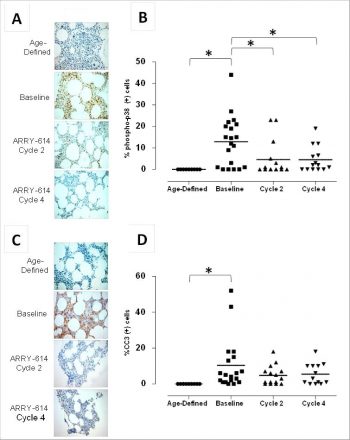
Bone marrow levels of p-p38 and CC3. Clin Cancer Res. 2015 Mar 1; 21(5): 985–994. |
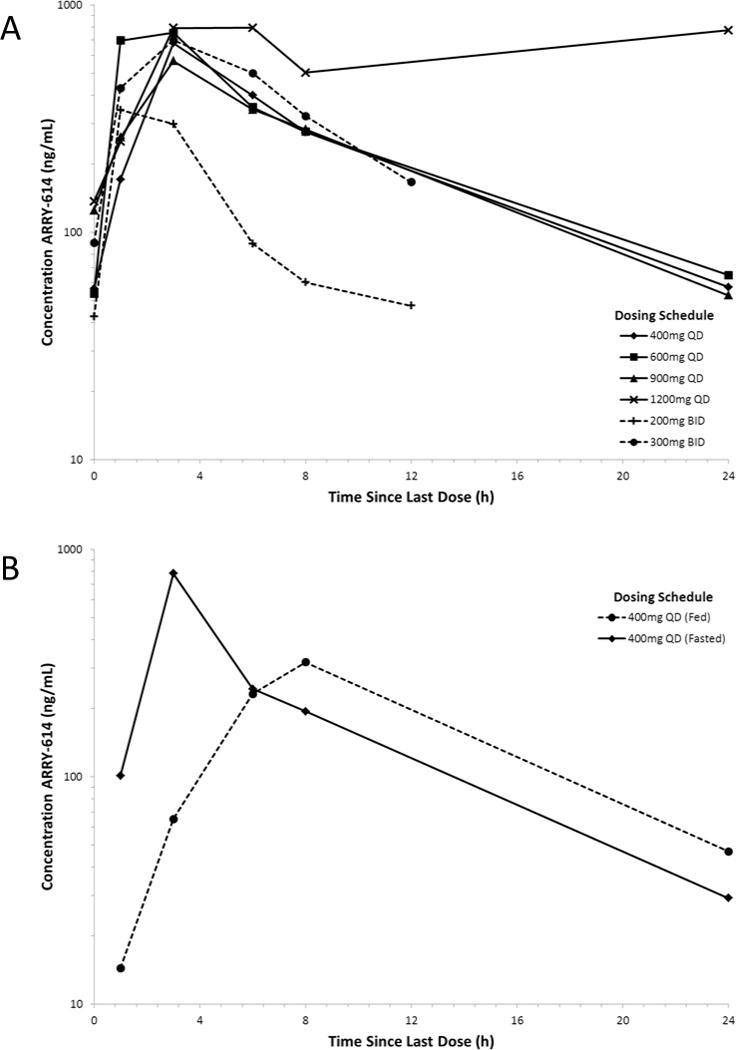
ARRY-614 Plasma Concentration-Time Profiles. Clin Cancer Res. 2015 Mar 1;21(5):985-94. |
Products are for research use only; We do not sell to patients
Copyright 2020 InvivoChem LLC | All Rights Reserved


 COA
COA