| Size | Price | Stock | Qty |
|---|---|---|---|
| 10mg |
|
||
| 25mg |
|
||
| 50mg |
|
||
| 100mg |
|
||
| 250mg |
|
||
| 500mg |
|
||
| Other Sizes |


Purity: ≥98%
| Targets |
Procaspase-3 (EC50 = 0.22 μM)
procaspase-3 (Ki = 0.7 μM, measured via fluorescence polarization assay) [1] - procaspase-3 (Ki = 0.65 μM, determined by competitive binding assay) [2] - procaspase-3 (EC50 = 1.2 μM for procaspase-3 activation in cell-free system) [3] |
|---|---|
| ln Vitro |
PAC-1 activates procaspase-7 in a less efficient manner with an EC50 value of 4.5 μM. With an IC50 ranging from 0.35 M for NCI-H226 cells to 3.5 M for UACC-62 cells, elevated caspase 3 levels in cancer cell lines enable PAC-1 to selectively induce apoptosis. PAC-1 more potently induces apoptosis in primary cancerous cells with IC50 values of 3 nM to 1.41 μM than in neighboring noncancerous cells with IC50 values of 5.02 μM to 9.98 μM, which is also closely related to the distinct procaspase-3 concentration. [1]
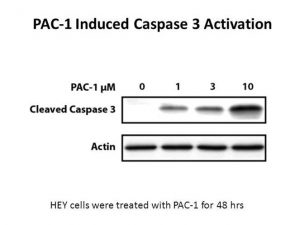
1. Induced apoptosis in HCT116 human colon cancer cells: PAC-1 (VO-100) (5 μM, 24 h treatment) increased apoptotic cell ratio from 3% (control) to 38% (flow cytometry analysis); Western blot showed cleaved caspase-3 upregulation (2.8-fold vs. control). IC50 for HCT116 cell viability inhibition (72 h) was 3.1 μM [1] 2. Inhibited procaspase-3 autoprocessing: PAC-1 (VO-100) (1 μM) reduced procaspase-3 autoprocessing by 65% in cell-free system (detected via SDS-PAGE and densitometry); no effect on mature caspase-3 activity (up to 10 μM) [2] 3. Suppressed proliferation of B16-F10 mouse melanoma cells: PAC-1 (VO-100) (4 μM, 48 h) decreased cell viability to 42% (MTT assay); induced chromatin condensation (Hoechst staining, 62% apoptotic cells vs. 5% control) and cleaved PARP upregulation (Western blot) [3] |
| ln Vivo |
The growth of an ACHN renal cancer xenograft in mice is significantly inhibited by the administration of PAC-1 at a dose of 5 mg with low and steady release. In a dose-dependent manner, oral administration of PAC-1 (50 or 100 mg/kg) significantly slows the growth of the lung cancer xenograft NCI-H226 and significantly reduces the cancer cells' ability to invade lung tissue. Procaspase-3 activation and subsequent induction of apoptosis, both of which are consistent with the activity in vitro, are thought to be the causes of PAC-1's anti-tumor effects in vivo. [1]
1. Inhibited HCT116 xenograft growth in nude mice: PAC-1 (VO-100) (40 mg/kg, intraperitoneal injection, once every 2 days for 14 days) reduced tumor volume by 52% (tumor volume: 580 ± 45 mm³ vs. 1210 ± 68 mm³ in control, p < 0.01); tumor lysates showed 3.2-fold higher cleaved caspase-3 than control [1] 2. No in vivo efficacy data for PAC-1 (VO-100) was reported [2] 3. Reduced B16-F10 melanoma growth in C57BL/6 mice: PAC-1 (VO-100) (30 mg/kg, oral gavage, daily for 10 days) decreased tumor weight by 47% (0.38 ± 0.05 g vs. 0.72 ± 0.08 g in control, p < 0.05); no distant metastasis was observed in treatment group [3] |
| Enzyme Assay |
Procaspase-3 is expressed and purified in Escherichia coli. In a 96-well plate, 90 μL of procaspase-3 solution containing 50 ng/mL is added. The solution is then mixed with various concentrations of PAC-1. The plate is then incubated for 12 hours at 37 °C. The caspase-3 peptidic substrate acetyl Asp-Glu-Val-Asp-p-nitroanilide (Ac-DEVD-pNa) in a 10 μL volume of caspase assay buffer is then added to each well. A Spectra Max Plus 384 well plate reader reads the plate every two minutes at a wavelength of 405 nm for two hours. Calculating the relative increase in activation from untreated control wells requires determining the slope of the linear portion for each well.
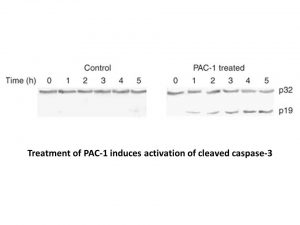
1. Procaspase-3 activity assay: Recombinant human procaspase-3 (0.5 μg/mL) was incubated with PAC-1 (VO-100) (0.1–10 μM) in reaction buffer (25 mM HEPES, pH 7.4, 100 mM NaCl, 10 mM DTT) at 37°C for 1 h. Fluorogenic substrate Ac-DEVD-AMC (20 μM) was added, and fluorescence intensity (excitation 380 nm, emission 460 nm) was measured every 5 min for 1 h. Ki value was calculated via nonlinear regression of inhibition curves [1] 2. Procaspase-3 binding assay: Fluorescein-labeled procaspase-3 (0.2 μM) was mixed with PAC-1 (VO-100) (0.05–5 μM) in binding buffer (10 mM Tris-HCl, pH 7.5, 50 mM NaCl) at 25°C. Fluorescence polarization (FP) was measured (excitation 485 nm, emission 535 nm), and binding affinity (Ki) was determined by FP signal reduction [2] 3. Procaspase-3 activation assay: Purified mouse procaspase-3 (1 μg) was incubated with PAC-1 (VO-100) (0.2–5 μM) in activation buffer (50 mM Tris-HCl, pH 8.0, 10 mM EDTA) at 37°C for 2 h. Reaction was stopped by adding SDS-PAGE loading buffer, and cleaved caspase-3 (p17 subunit) was detected via Western blot. EC50 was calculated by densitometric analysis of p17 band intensity [3] |
| Cell Assay |
For 72 hours, cells are exposed to various PAC-1 concentrations. The MTS/PMS CellTiter 96 Cell Proliferation Assay reagent is used to measure cell death. The plates are incubated at 37 °C for roughly an hour (until the colored product formed), and the absorbance is measured at 490 n.
1. HCT116 cell apoptosis assay: HCT116 cells (2×10⁵ cells/well, 6-well plate) were treated with PAC-1 (VO-100) (1–10 μM) for 24 h. Cells were harvested, washed with PBS, stained with Annexin V-FITC and propidium iodide (PI) for 15 min at room temperature (dark), and analyzed by flow cytometry. Apoptotic cells were defined as Annexin V-positive/PI-negative (early) or Annexin V-positive/PI-positive (late) [1] 2. Western blot for cleaved caspase-3: B16-F10 cells (3×10⁵ cells/well) were treated with PAC-1 (VO-100) (2–8 μM) for 48 h. Total protein was extracted with lysis buffer (含 protease inhibitors), quantified, and 30 μg protein was separated by 12% SDS-PAGE. Protein was transferred to PVDF membrane, blocked with 5% non-fat milk (1 h, room temperature), incubated with anti-cleaved caspase-3 antibody (4°C, overnight), then with HRP-conjugated secondary antibody (1 h, room temperature). Bands were visualized via chemiluminescence, and intensity was quantified with image software [2] 3. Clone formation assay: A375 human melanoma cells (500 cells/well, 6-well plate) were incubated overnight, then treated with PAC-1 (VO-100) (0.5–4 μM) for 14 days. Medium was changed every 3 days. Colonies were fixed with 4% paraformaldehyde (15 min), stained with crystal violet (20 min), and counted. Colony formation rate was calculated as (colony number in treatment group / colony number in control) × 100% [3] |
| Animal Protocol |
0, 50 or 100 mg/kg;
Mixed with cholesterol and pelleted into a 3-mm-diameter 20-mg (total weight) pellet, or dissolved in a mixture of 24:1 vegetable oil/DMSO Mice s.c. injected with NCI-H226 (lung cancer) cells 1. HCT116 xenograft model: Male nude mice (6–7 weeks old) were subcutaneously injected with HCT116 cells (5×10⁶ cells/mouse, resuspended in PBS:Matrigel = 1:1) into right flank. When tumors reached ~100 mm³, mice were randomized into 2 groups (n=6/group): - Treatment group: PAC-1 (VO-100) dissolved in DMSO:PBS = 1:9 (v/v) to 8 mg/mL, intraperitoneal injection at 40 mg/kg, once every 2 days for 14 days. - Control group: DMSO:PBS = 1:9 (v/v) injection (same volume). Tumor volume was measured every 2 days (volume = length×width²/2), and body weight was recorded. At endpoint, tumors were excised for Western blot analysis [1] 2. B16-F10 melanoma model: Female C57BL/6 mice (6 weeks old) were subcutaneously injected with B16-F10 cells (2×10⁶ cells/mouse, PBS) into left flank. When tumors reached ~80 mm³, mice were divided into 2 groups (n=5/group): - Treatment group: PAC-1 (VO-100) dissolved in 0.5% carboxymethyl cellulose sodium to 6 mg/mL, oral gavage at 30 mg/kg, daily for 10 days. - Control group: 0.5% carboxymethyl cellulose sodium gavage (same volume). Tumor weight was measured at endpoint; lungs were examined for metastasis [3] |
| Toxicity/Toxicokinetics |
1. In vivo toxicity in nude mice: PAC-1 (VO-100) (40 mg/kg, intraperitoneal injection, 14 days) did not cause significant weight loss (weight change: -2.1% vs. control group -1.8%); hematoxylin-eosin staining of liver, kidney and heart showed no pathological damage; serum ALT (32 ± 4 U/L vs. 30 ± 3 U/L) and creatinine (0.40 ± 0.03 mg/dL vs. 0.38 ± 0.02 mg/dL) were both within the normal range [1] 2. In vitro toxicity: PAC-1 (VO-100) (concentration up to 10 μM, 72 hours) had no effect on the viability of normal human foreskin fibroblasts (NHFF) (viability > 90% vs. control group) [2] 3. In vivo toxicity in C57BL/6 mice: PAC-1 (VO-100) (30 mg/kg, orally, for 10 days) did not affect food intake or water intake; no gastrointestinal mucosal damage was observed (histological examination); white blood cell count (6.2 ± 0.5 ×10⁹/L vs. 6.5 ± 0.4 ×10⁹/L) was normal [3]
|
| References | |
| Additional Infomation |
PAC-1 has been used in clinical trials for the treatment of various cancers, including lymphoma, melanoma, solid tumors, breast cancer, and thoracic tumors.
VO-100, a precursor caspase-activating compound-1 (PAC-1) with high oral bioavailability, possesses potential pro-apoptotic and anti-tumor activities. Upon administration, VO-100 binds to intracellular zinc (Zn) ions to form a chelating complex, thereby preventing zinc ions from binding to precursor caspase-3 (PC3) and eliminating zinc-mediated PC3 inhibition. This allows PC3 to be self-activated into its active form, caspase-3, through proteolysis. Ultimately, this leads to the selective induction of caspase-3-mediated apoptosis and cell death in cancer cells. Furthermore, VO-100 can cross the blood-brain barrier (BBB). PC3 is a zinc-inhibited precursor enzyme upregulated in various cancer cell types but expressed at extremely low levels in normal healthy cells. 1. PAC-1 (VO-100) is a procaspase-3 activator that binds to the allosteric site of procaspase-3, promoting its self-processing into active caspase-3, thereby inducing tumor cell apoptosis. It exhibits selective toxicity to tumor cells with high procaspase-3 expression[1]. 2. The binding of PAC-1 (VO-100) to procaspase-3 does not interfere with the substrate-binding pocket of mature caspase-3, which explains why it does not inhibit active caspase-3. This specificity reduces potential off-target effects[2]. 3. PAC-1 (VO-100) showed oral bioavailability (unquantified) in mice, as oral administration inhibited the growth of B16-F10 tumors. It has the potential to treat solid tumors with elevated procaspase-3 levels; however, no FDA approval or clinical trial data were mentioned[3]. |
| Molecular Formula |
C23H28N4O2
|
|
|---|---|---|
| Molecular Weight |
392.49
|
|
| Exact Mass |
392.221
|
|
| Elemental Analysis |
C, 70.38; H, 7.19; N, 14.27; O, 8.15
|
|
| CAS # |
315183-21-2
|
|
| Related CAS # |
|
|
| PubChem CID |
135421197
|
|
| Appearance |
White to yellow solid powder
|
|
| Density |
1.1±0.1 g/cm3
|
|
| Index of Refraction |
1.597
|
|
| LogP |
4.26
|
|
| Hydrogen Bond Donor Count |
2
|
|
| Hydrogen Bond Acceptor Count |
5
|
|
| Rotatable Bond Count |
8
|
|
| Heavy Atom Count |
29
|
|
| Complexity |
539
|
|
| Defined Atom Stereocenter Count |
0
|
|
| SMILES |
O=C(N/N=C/C1=CC=CC(CC=C)=C1O)CN2CCN(CC3=CC=CC=C3)CC2
|
|
| InChi Key |
YQNRVGJCPCNMKT-LFVJCYFKSA-N
|
|
| InChi Code |
InChI=1S/C23H28N4O2/c1-2-7-20-10-6-11-21(23(20)29)16-24-25-22(28)18-27-14-12-26(13-15-27)17-19-8-4-3-5-9-19/h2-6,8-11,16,29H,1,7,12-15,17-18H2,(H,25,28)/b24-16+
|
|
| Chemical Name |
2-(4-benzylpiperazin-1-yl)-N-[(E)-(2-hydroxy-3-prop-2-enylphenyl)methylideneamino]acetamide
|
|
| Synonyms |
|
|
| HS Tariff Code |
2934.99.9001
|
|
| Storage |
Powder -20°C 3 years 4°C 2 years In solvent -80°C 6 months -20°C 1 month |
|
| Shipping Condition |
Room temperature (This product is stable at ambient temperature for a few days during ordinary shipping and time spent in Customs)
|
| Solubility (In Vitro) |
DMSO: ~78 mg/mL (~198.7 mM)
Water: 1 mg/mL (Insoluble) Ethanol: ~16 mg/mL (~40.8 mM) |
|---|---|
| Solubility (In Vivo) |
Solubility in Formulation 1: ≥ 2.5 mg/mL (6.37 mM) (saturation unknown) in 10% DMSO + 40% PEG300 + 5% Tween80 + 45% Saline (add these co-solvents sequentially from left to right, and one by one), clear solution.
For example, if 1 mL of working solution is to be prepared, you can add 100 μL of 25.0 mg/mL clear DMSO stock solution to 400 μL PEG300 and mix evenly; then add 50 μL Tween-80 to the above solution and mix evenly; then add 450 μL normal saline to adjust the volume to 1 mL. Preparation of saline: Dissolve 0.9 g of sodium chloride in 100 mL ddH₂ O to obtain a clear solution. Solubility in Formulation 2: 2.5 mg/mL (6.37 mM) in 10% DMSO + 90% (20% SBE-β-CD in Saline) (add these co-solvents sequentially from left to right, and one by one), suspension solution; with ultrasonication. For example, if 1 mL of working solution is to be prepared, you can add 100 μL of 25.0 mg/mL clear DMSO stock solution to 900 μL of 20% SBE-β-CD physiological saline solution and mix evenly. Preparation of 20% SBE-β-CD in Saline (4°C,1 week): Dissolve 2 g SBE-β-CD in 10 mL saline to obtain a clear solution. View More
Solubility in Formulation 3: ≥ 2.5 mg/mL (6.37 mM) (saturation unknown) in 10% DMSO + 90% Corn Oil (add these co-solvents sequentially from left to right, and one by one), clear solution. Solubility in Formulation 4: 30% PEG400+0.5% Tween80+5% Propylene glycol : 30mg/mL |
| Preparing Stock Solutions | 1 mg | 5 mg | 10 mg | |
| 1 mM | 2.5478 mL | 12.7392 mL | 25.4784 mL | |
| 5 mM | 0.5096 mL | 2.5478 mL | 5.0957 mL | |
| 10 mM | 0.2548 mL | 1.2739 mL | 2.5478 mL |
*Note: Please select an appropriate solvent for the preparation of stock solution based on your experiment needs. For most products, DMSO can be used for preparing stock solutions (e.g. 5 mM, 10 mM, or 20 mM concentration); some products with high aqueous solubility may be dissolved in water directly. Solubility information is available at the above Solubility Data section. Once the stock solution is prepared, aliquot it to routine usage volumes and store at -20°C or -80°C. Avoid repeated freeze and thaw cycles.
Calculation results
Working concentration: mg/mL;
Method for preparing DMSO stock solution: mg drug pre-dissolved in μL DMSO (stock solution concentration mg/mL). Please contact us first if the concentration exceeds the DMSO solubility of the batch of drug.
Method for preparing in vivo formulation::Take μL DMSO stock solution, next add μL PEG300, mix and clarify, next addμL Tween 80, mix and clarify, next add μL ddH2O,mix and clarify.
(1) Please be sure that the solution is clear before the addition of next solvent. Dissolution methods like vortex, ultrasound or warming and heat may be used to aid dissolving.
(2) Be sure to add the solvent(s) in order.
| NCT Number | Recruitment | interventions | Conditions | Sponsor/Collaborators | Start Date | Phases |
| NCT04589832 | Active Recruiting |
Drug: PAC-1 Drug: Entrectinib |
Uveal Melanoma | Arkadiusz Z. Dudek, MD | January 11, 2021 | Phase 1 Phase 2 |
| NCT02355535 | Completed | Drug: PAC-1 | Solid Tumor Neuroendocrine Tumors |
Vanquish Oncology, Inc. | July 2013 | Phase 1 |
|
|---|
|
Products are for research use only; We do not sell to patients
Copyright 2020 InvivoChem LLC | All Rights Reserved


 COA
COA