| Size | Price | Stock | Qty |
|---|---|---|---|
| 5mg |
|
||
| 10mg |
|
||
| 25mg |
|
||
| 50mg |
|
||
| 100mg |
|
||
| 250mg |
|
||
| 500mg |
|
||
| 1g |
|
||
| Other Sizes |


Purity: ≥98%
| Targets |
AMPK
AMP-activated protein kinase (AMPK) activator [1] |
|---|---|
| ln Vivo |
O-304 boosts diet-induced intermittent beta cell rest, decreases beta cell prophase, and slightly increases muscle. O-304 decreased both the Hypoglycemic Model Assessment of Insulin Resistance (HOMA-IR) and fasting blood glucose levels in individuals with type 2 diabetes (T2D) included in a Phase IIa proof-of-concept clinical study using metformin [2].
In a Phase IIa clinical trial involving 59 type 2 diabetic (T2D) patients, O304 reduced fasting plasma glucose levels and improved insulin resistance. O304 lowered systemic blood pressure and increased microvascular perfusion in T2D patients. Post hoc analyses of Phase I and IIa clinical trials indicate that O304 potently and reversibly reduced estimated glomerular filtration rate (eGFR) via a hemodynamic effect in both T2D patients on metformin and in obese non-diabetic subjects. O304 reduced eGFR in T2D patients both with and without concurrent anti-hypertensive ACEi/ARB treatment.[1] |
| Animal Protocol |
The report mentions that studies were performed in mice, but no detailed protocol regarding formulation, dosing, frequency, or route of administration is provided.[1]
|
| References | |
| Additional Infomation |
O304 is described as a small molecule direct AMPK activator and is reportedly the only such compound currently in clinical development. Activation of AMPK is thought to have potential benefits for diabetic nephropathy (DKD), including cardionephroprotective effects. The metabolic and hemodynamic effects of O304 (lowering blood glucose, insulin resistance, blood pressure, eGFR/hyperfiltration rate, and increasing microvascular perfusion) are thought to translate into long-term protection of renal function and a reduction in the incidence of DKD. The results of the Phase IIa trial enabled the project coordinator, Betagenon AB, to begin discussions with several large pharmaceutical companies regarding potential licensing agreements. [1]
|
| Molecular Formula |
C16H11CL2N3O2S
|
|---|---|
| Molecular Weight |
380.248440027237
|
| Exact Mass |
378.994
|
| Elemental Analysis |
C, 50.54; H, 2.92; Cl, 18.65; N, 11.05; O, 8.42; S, 8.43
|
| CAS # |
1261289-04-6
|
| Related CAS # |
1261289-04-6
|
| PubChem CID |
50923806
|
| Appearance |
White to off-white solid powder
|
| LogP |
4.1
|
| Hydrogen Bond Donor Count |
1
|
| Hydrogen Bond Acceptor Count |
3
|
| Rotatable Bond Count |
4
|
| Heavy Atom Count |
24
|
| Complexity |
516
|
| Defined Atom Stereocenter Count |
0
|
| SMILES |
ClC1C=CC(=CC=1)CN1C(N=C(NC(C2C=CC(=CC=2)Cl)=O)S1)=O
|
| InChi Key |
WEDWLYRQKUTOAX-UHFFFAOYSA-N
|
| InChi Code |
InChI=1S/C16H11Cl2N3O2S/c17-12-5-1-10(2-6-12)9-21-16(23)20-15(24-21)19-14(22)11-3-7-13(18)8-4-11/h1-8H,9H2,(H,19,20,22,23)
|
| Chemical Name |
4-chloro-N-[2-[(4-chlorophenyl)methyl]-3-oxo-1,2,4-thiadiazol-5-yl]benzamide
|
| Synonyms |
O-304; O304; RefChem:1093583; 1261289-04-6; 4-chloro-N-(2-(4-chlorobenzyl)-3-oxo-2,3-dihydro-1,2,4-thiadiazol-5-yl)benzamide; O 304
|
| HS Tariff Code |
2934.99.9001
|
| Storage |
Powder -20°C 3 years 4°C 2 years In solvent -80°C 6 months -20°C 1 month |
| Shipping Condition |
Room temperature (This product is stable at ambient temperature for a few days during ordinary shipping and time spent in Customs)
|
| Solubility (In Vitro) |
DMSO: 20~30 mg/mL (52.6~78.9 mM)
|
|---|---|
| Solubility (In Vivo) |
Solubility in Formulation 1: ≥ 2.5 mg/mL (6.57 mM) (saturation unknown) in 10% DMSO + 90% Corn Oil (add these co-solvents sequentially from left to right, and one by one), clear solution.
For example, if 1 mL of working solution is to be prepared, you can add 100 μL of 25.0 mg/mL clear DMSO stock solution to 900 μL of corn oil and mix evenly. (Please use freshly prepared in vivo formulations for optimal results.) |
| Preparing Stock Solutions | 1 mg | 5 mg | 10 mg | |
| 1 mM | 2.6298 mL | 13.1492 mL | 26.2985 mL | |
| 5 mM | 0.5260 mL | 2.6298 mL | 5.2597 mL | |
| 10 mM | 0.2630 mL | 1.3149 mL | 2.6298 mL |
*Note: Please select an appropriate solvent for the preparation of stock solution based on your experiment needs. For most products, DMSO can be used for preparing stock solutions (e.g. 5 mM, 10 mM, or 20 mM concentration); some products with high aqueous solubility may be dissolved in water directly. Solubility information is available at the above Solubility Data section. Once the stock solution is prepared, aliquot it to routine usage volumes and store at -20°C or -80°C. Avoid repeated freeze and thaw cycles.
Calculation results
Working concentration: mg/mL;
Method for preparing DMSO stock solution: mg drug pre-dissolved in μL DMSO (stock solution concentration mg/mL). Please contact us first if the concentration exceeds the DMSO solubility of the batch of drug.
Method for preparing in vivo formulation::Take μL DMSO stock solution, next add μL PEG300, mix and clarify, next addμL Tween 80, mix and clarify, next add μL ddH2O,mix and clarify.
(1) Please be sure that the solution is clear before the addition of next solvent. Dissolution methods like vortex, ultrasound or warming and heat may be used to aid dissolving.
(2) Be sure to add the solvent(s) in order.
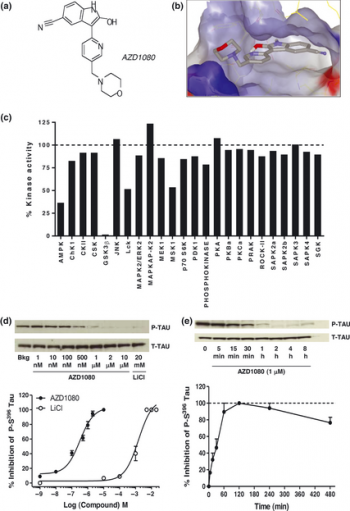
Binding, potency, and selectivity of AZD1080. J Neurochem. 2013 May;125(3):446-56 |
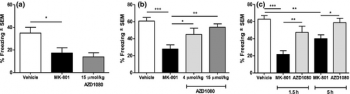
AZD1080 reverses MK-801-induced impairments in mouse model of cognition |
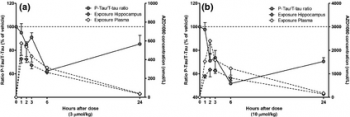
Demonstration of peripheral target engagement in rats and in human |
Products are for research use only; We do not sell to patients
Copyright 2020 InvivoChem LLC | All Rights Reserved


 COA
COA