| Size | Price | Stock | Qty |
|---|---|---|---|
| 1mg |
|
||
| 2mg |
|
||
| 5mg |
|
||
| 10mg |
|
||
| 25mg |
|
||
| 50mg |
|
||
| 100mg |
|
||
| 250mg | |||
| Other Sizes |


Purity: ≥98%
| Targets |
IGF-1R (GI50 = 0.17 μM); InsR (IC50 = 2.8 μM)
Insulin-like Growth Factor 1 Receptor (IGF-1R) (IC50 = 1.7 nM for recombinant human IGF-1R kinase); weak activity against Insulin Receptor (IR, IC50 = 280 nM); no significant activity against EGFR, HER2, MET (IC50 > 1000 nM) [1] - Confirmed IGF-1R as primary target (small cell lung cancer model; no additional IC50/Ki values; consistent with [1]’s target specificity) [2] |
|---|---|
| ln Vitro |
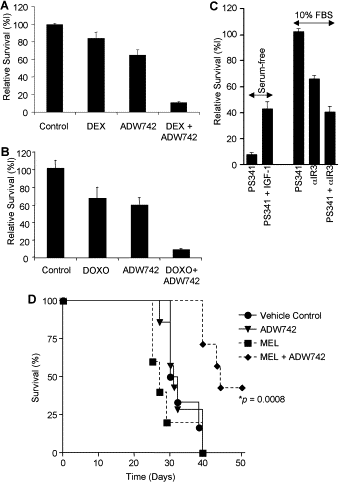
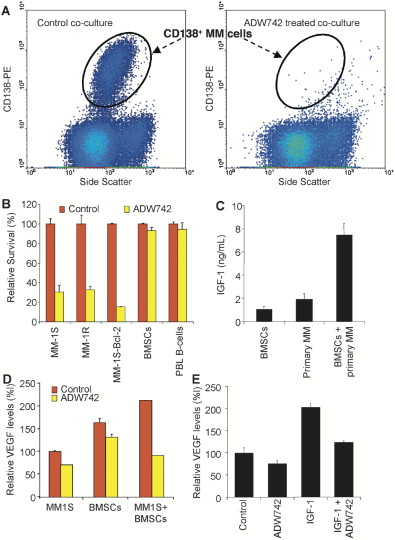
NVP-ADW742 has minimal inhibitory activity against c-Kit, HER1, PDGFR, VEGFR2, or Bcr-Abl p210, with an IC50 greater than 5 μM. It also shows a 6-fold greater selectivity for IGF-1R compared to InsR. The antitumor effects on multiple myeloma (MM) cell lines cannot be overridden by co-culturing with BMSCs because NVP-ADW742 significantly inhibits the serum-stimulated cell proliferation in a variety of tumor cell lines in a dose-dependent manner, with IC50 values of 0.1-0.5 μM for MM cell lines. Additionally, in the presence of serum, NVP-ADW742 prevents tumor cells from responding to IL-6. Furthermore, NVP-ADW742 exhibits activity against primary tumor cells from patients with multiple drug-resistant multiple sclerosis (MM) as well as MM cell lines resistant to traditional (cytotoxic chemotherapy, dexamethasone) or experimental (thalidomide, CC-5013, TRAIL/Apo2L, PS-341) anticancer agents. NVP-ADW742 suppresses the IGF-1-induced secretion of VEGF by multiple tumor types, including thyroid cancer cells and MM cells, and reduces the production of VEGF by tumor cells and bone marrow stromal cells. NVP-ADW742 (0.75 μM) inhibits IGF-1R, making MM cells and prostate cancer cells more susceptible to other anticancer drugs like doxorubicin, melphalan, dexamethasone, TRAIL/Apo2L, or PS-341.[1]
Inhibited proliferation of hematologic malignancy cells: Multiple myeloma U266 (IC50 = 12.3 nM), mantle cell lymphoma Jeko-1 (IC50 = 15.7 nM); 100 nM NVP-ADW742 reduced U266 cell colony formation by 72% (14-day culture) [1] - Suppressed solid tumor cell growth: Breast cancer MCF-7 (IC50 = 18.5 nM), colon cancer HCT116 (IC50 = 22.6 nM); no activity in IGF-1R-negative A549 cells (IC50 > 500 nM) [1] - Blocked IGF-1R downstream signaling: 50 nM NVP-ADW742 decreased p-IGF-1R (Tyr1135/1136) by 90% in U266 cells (2 hours); p-AKT (Ser473) and p-ERK1/2 (Thr202/Tyr204) downregulated by >85% (Western blot) [1] - Enhanced efficacy with STI571 in small cell lung cancer (SCLC): In H69 SCLC cells, 200 nM NVP-ADW742 + 1 μM STI571 reduced viability by 78% (vs. 42% for NVP-ADW742 alone, 35% for STI571 alone); inhibited c-Kit/IGF-1R cross-signaling [2] - Induced apoptosis in U266 cells: 200 nM NVP-ADW742 increased Annexin V-positive cells from 6% to 43% (48 hours); caspase-3 activity elevated by 3.6-fold [1] |
| ln Vivo |
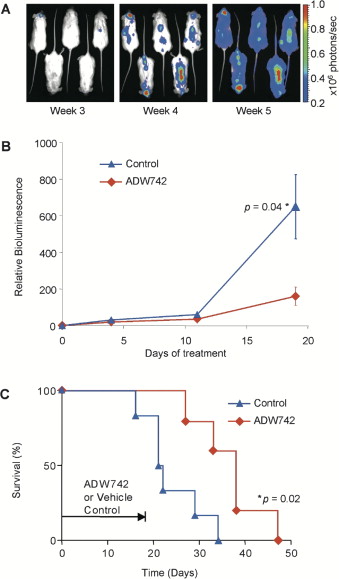
In the mouse model of diffuse mixed myeloma, administration of NVP-ADW742 at 10 mg/kg twice daily significantly inhibits tumor growth, prolongs survival, and enhances the antitumor effect of cytotoxic chemotherapy melphalan.[1]
In nude mice bearing U266 multiple myeloma xenografts: Intraperitoneal injection of NVP-ADW742 (20 mg/kg, twice daily) for 21 days resulted in 81% tumor growth inhibition (TGI); tumor p-IGF-1R levels reduced by 78% (immunohistochemistry) [1] - In nude mice bearing MCF-7 breast cancer xenografts: Oral NVP-ADW742 (30 mg/kg/day) for 28 days achieved 76% TGI; tumor weight reduced by 72% vs. vehicle [1] - In nude mice bearing H69 SCLC xenografts: NVP-ADW742 (15 mg/kg/day, oral) + STI571 (50 mg/kg/day, oral) for 24 days reduced tumor volume by 83% (vs. 45% for NVP-ADW742 alone, 40% for STI571 alone); median survival extended from 30 days (vehicle) to 56 days [2] |
| Enzyme Assay |
The 96-well "Capture ELISAs" assay is used to determine the IC50 value for the effect of NVP-ADW742 on the autophosphorylation of IGF-1R at the cellular level in the presence of increasing concentrations of NVP-ADW742. NWT-21 cells are, in short, seeded into 96-well tissue culture plates in complete growth medium, grown to 70–80% confluency, and then starved in 0.5% FCS medium for a duration of 24 hours. Next, the cells are treated with NVP-ADW742 for 90 minutes, and then they are stimulated for 10 minutes at 37 °C with 10 ng/mL of IGF-I. The cells are then lysed at 4 °C using 50 μL/well RIPA-buffer (50 mM Tris-HCl, pH 7.2, 120 mM NaCl, 1 mM EDTA, 6 mM EGTA, 1% NP-40, 20 mM NaF, 1 mM benzamidine, 15 mM sodium pyrophosphate, 1 mM PMSF, and 0.5 mM Na3VO4) after being rinsed twice with ice-cold PBS. Following that, the lysates from each experiment are put onto black ELISA plates that have been coated with IGF-1R-specific capture antibodies. Following antibody capture, lysates are combined with 40 μL of anti-phosphotyrosine Ab (PY20(AP)) labeled with alkaline phosphatase (AP) and diluted to 0.2 μg/mL in RIPA buffer. The mixture is then incubated for an additional night at 4 °C. The luminescence of the luminescent AP-substrate CDPStar RTU with Emerald II (90 μL/well) is measured using a Packard Top Count Scintillation Counter following washing (PBST) and 45 minutes at room temperature.
IGF-1R kinase activity assay: Recombinant human IGF-1R kinase domain (50 ng/well) was incubated with NVP-ADW742 (0.01-100 nM) in reaction buffer (25 mM HEPES pH 7.5, 10 mM MgCl2, 1 mM DTT, 0.1 mM Na3VO4) at 37°C for 20 minutes. 15 μM ATP and a biotinylated peptide substrate were added, followed by 60-minute incubation at 30°C. Phosphorylated peptide was captured via streptavidin-coated plates and detected with anti-phosphotyrosine antibody; absorbance at 450 nm was measured to calculate IC50 via nonlinear regression [1] |
| Cell Assay |
For 48 hours, cells are exposed to different concentrations of NVP-ADW742, either with or without serum. The MTT assay is utilized to analyze cell survival.
Hematologic malignancy cell proliferation assay (U266/Jeko-1): Cells were seeded in 96-well plates (4×10³ cells/well) and treated with NVP-ADW742 (0.1 nM-1 μM) for 72 hours. Cell viability was measured via MTT assay; absorbance at 570 nm was recorded, and IC50 values were determined via four-parameter logistic fitting [1] - SCLC cell viability assay (H69): Cells were seeded at 5×10³ cells/well, treated with NVP-ADW742 (1-300 nM) alone or with 1 μM STI571 for 96 hours. Viability was assessed via tetrazolium salt reduction assay; combination index (CI = 0.62) indicated synergistic effect [2] - Western blot assay (IGF-1R/AKT/ERK/c-Kit): U266 or H69 cells were treated with NVP-ADW742 (10-200 nM) for 2 hours, lysed in RIPA buffer (with protease/phosphatase inhibitors). Lysates (30 μg protein) were separated by 8% SDS-PAGE, probed with p-IGF-1R, total IGF-1R, p-AKT, p-ERK, p-c-Kit, and GAPDH antibodies; signals detected via chemiluminescence [1][2] - Apoptosis assay (U266): Cells were treated with NVP-ADW742 (50-200 nM) for 48 hours, stained with Annexin V-FITC and propidium iodide, and analyzed by flow cytometry; caspase-3 activity was measured via fluorometric assay [1] |
| Animal Protocol |
Male SCID/NOD mice injected i.v. with MM-1S-Luc + human MM cells
10 mg/kg twice daily Injection i.p. or oral gavage U266 multiple myeloma xenograft model (nude mice): 6-week-old female nude mice were subcutaneously injected with 5×10⁶ U266 cells. When tumors reached 100-120 mm³, mice received NVP-ADW742 (20 mg/kg, intraperitoneal injection) twice daily for 21 days. Drug was dissolved in 5% DMSO + 95% sesame oil; tumor volume (length × width² / 2) was measured every 3 days [1] - MCF-7 breast cancer xenograft model (nude mice): Female nude mice were implanted with 2×10⁶ MCF-7 cells subcutaneously. When tumors reached 150 mm³, mice received NVP-ADW742 (30 mg/kg/day, oral gavage) for 28 days. Drug was dissolved in 0.5% methylcellulose + 0.2% Tween 80; tumor weight was recorded at study end [1] - H69 SCLC xenograft model (nude mice): Male nude mice were subcutaneously injected with 1×10⁷ H69 cells. When tumors reached 100 mm³, mice were randomized to vehicle, NVP-ADW742 (15 mg/kg/day, oral), STI571 (50 mg/kg/day, oral), or combination groups for 24 days. Both drugs were dissolved in 0.5% methylcellulose + 0.2% Tween 80; survival time was recorded [2] |
| ADME/Pharmacokinetics |
In mice: the oral bioavailability of NVP-ADW742 was 42% (30 mg/kg); the plasma half-life (t1/2) was 4.9 hours; and the peak plasma concentration (Cmax) 1.2 hours after oral administration was 3.8 μM [1]. In rats: the clearance rate after intravenous administration (10 mg/kg) was 15 mL/min/kg; and the steady-state volume of distribution (Vss) was 1.1 L/kg [1]. Plasma protein binding: the binding rate to human plasma proteins was 99.1% (determined by ultrafiltration) [1].
|
| Toxicity/Toxicokinetics |
In the 21-day U266 xenograft study (20 mg/kg, twice daily, intraperitoneal injection): no significant weight loss (>8%) was observed; serum ALT (27 ± 4 U/L), AST (50 ± 6 U/L), and BUN (18 ± 3 mg/dL) were all within the normal range [1]
- In the 28-day MCF-7 xenograft study (30 mg/kg/day, oral): 1 out of 8 mice experienced mild diarrhea (which resolved within 5 days); no histopathological changes were observed in the liver, kidneys, and spleen [1] - In the 24-day H69 combination therapy study (15 mg/kg/day, oral): no treatment-related deaths were observed; 2 out of 10 mice in the combination therapy group experienced mild alopecia (which resolved after treatment) [2] |
| References |
|
| Additional Infomation |
NVP-ADW742 is a selective ATP-competitive IGF-1R tyrosine kinase inhibitor designed to target IGF-1R-dependent hematologic malignancies (multiple myeloma, mantle cell lymphoma) and solid tumors (breast cancer, colon cancer) [1]. Its anti-tumor mechanism includes inhibiting IGF-1R autophosphorylation and downstream PI3K-AKT/MEK-ERK signaling pathways, thereby inhibiting cell proliferation and inducing apoptosis [1]. In small cell lung cancer, NVP-ADW742 works synergistically with STI571 (a c-Kit inhibitor) to enhance anti-tumor efficacy by blocking c-Kit/IGF-1R cross-signaling, which is superior to monotherapy [2].
|
| Molecular Formula |
C28H31N5O
|
|
|---|---|---|
| Molecular Weight |
453.58
|
|
| Exact Mass |
453.252
|
|
| Elemental Analysis |
C, 74.14; H, 6.89; N, 15.44; O, 3.53
|
|
| CAS # |
475488-23-4
|
|
| Related CAS # |
|
|
| PubChem CID |
9825149
|
|
| Appearance |
white solid powder
|
|
| Density |
1.3±0.1 g/cm3
|
|
| Boiling Point |
677.5±55.0 °C at 760 mmHg
|
|
| Flash Point |
363.5±31.5 °C
|
|
| Vapour Pressure |
0.0±2.1 mmHg at 25°C
|
|
| Index of Refraction |
1.699
|
|
| LogP |
5.23
|
|
| Hydrogen Bond Donor Count |
1
|
|
| Hydrogen Bond Acceptor Count |
5
|
|
| Rotatable Bond Count |
7
|
|
| Heavy Atom Count |
34
|
|
| Complexity |
645
|
|
| Defined Atom Stereocenter Count |
0
|
|
| SMILES |
NC1=C2C(N(C=C2C3=CC=CC(OCC4=CC=CC=C4)=C3)[C@H]5C[C@@H](C5)CN6CCCC6)=NC=N1
|
|
| InChi Key |
LSFLAQVDISHMNB-UHFFFAOYSA-N
|
|
| InChi Code |
InChI=1S/C28H31N5O/c29-27-26-25(22-9-6-10-24(15-22)34-18-20-7-2-1-3-8-20)17-33(28(26)31-19-30-27)23-13-21(14-23)16-32-11-4-5-12-32/h1-3,6-10,15,17,19,21,23H,4-5,11-14,16,18H2,(H2,29,30,31)
|
|
| Chemical Name |
5-(3-phenylmethoxyphenyl)-7-[3-(pyrrolidin-1-ylmethyl)cyclobutyl]pyrrolo[2,3-d]pyrimidin-4-amine
|
|
| Synonyms |
|
|
| HS Tariff Code |
2934.99.9001
|
|
| Storage |
Powder -20°C 3 years 4°C 2 years In solvent -80°C 6 months -20°C 1 month |
|
| Shipping Condition |
Room temperature (This product is stable at ambient temperature for a few days during ordinary shipping and time spent in Customs)
|
| Solubility (In Vitro) |
DMSO: ~10 mg/mL (~22.0 mM)
Water: 1 mg/mL (Insoluble) Ethanol: ~3 mg/mL (~6.6 mM) |
|---|---|
| Solubility (In Vivo) |
Solubility in Formulation 1: 1.92 mg/mL (4.23 mM) in 10% DMSO + 40% PEG300 + 5% Tween80 + 45% Saline (add these co-solvents sequentially from left to right, and one by one), suspension solution; with sonication.
For example, if 1 mL of working solution is to be prepared, you can add 100 μL of 19.2 mg/mL clear DMSO stock solution to 400 μL PEG300 and mix evenly; then add 50 μL Tween-80 to the above solution and mix evenly; then add 450 μL normal saline to adjust the volume to 1 mL. Preparation of saline: Dissolve 0.9 g of sodium chloride in 100 mL ddH₂ O to obtain a clear solution. Solubility in Formulation 2: 1.92 mg/mL (4.23 mM) in 10% DMSO + 90% (20% SBE-β-CD in Saline) (add these co-solvents sequentially from left to right, and one by one), suspension solution; with ultrasonication. For example, if 1 mL of working solution is to be prepared, you can add 100 μL of 19.2 mg/mL clear DMSO stock solution to 900 μL of 20% SBE-β-CD physiological saline solution and mix evenly. Preparation of 20% SBE-β-CD in Saline (4°C,1 week): Dissolve 2 g SBE-β-CD in 10 mL saline to obtain a clear solution. View More
Solubility in Formulation 3: ≥ 1.92 mg/mL (4.23 mM) (saturation unknown) in 10% DMSO + 90% Corn Oil (add these co-solvents sequentially from left to right, and one by one), clear solution. |
| Preparing Stock Solutions | 1 mg | 5 mg | 10 mg | |
| 1 mM | 2.2047 mL | 11.0234 mL | 22.0468 mL | |
| 5 mM | 0.4409 mL | 2.2047 mL | 4.4094 mL | |
| 10 mM | 0.2205 mL | 1.1023 mL | 2.2047 mL |
*Note: Please select an appropriate solvent for the preparation of stock solution based on your experiment needs. For most products, DMSO can be used for preparing stock solutions (e.g. 5 mM, 10 mM, or 20 mM concentration); some products with high aqueous solubility may be dissolved in water directly. Solubility information is available at the above Solubility Data section. Once the stock solution is prepared, aliquot it to routine usage volumes and store at -20°C or -80°C. Avoid repeated freeze and thaw cycles.
Calculation results
Working concentration: mg/mL;
Method for preparing DMSO stock solution: mg drug pre-dissolved in μL DMSO (stock solution concentration mg/mL). Please contact us first if the concentration exceeds the DMSO solubility of the batch of drug.
Method for preparing in vivo formulation::Take μL DMSO stock solution, next add μL PEG300, mix and clarify, next addμL Tween 80, mix and clarify, next add μL ddH2O,mix and clarify.
(1) Please be sure that the solution is clear before the addition of next solvent. Dissolution methods like vortex, ultrasound or warming and heat may be used to aid dissolving.
(2) Be sure to add the solvent(s) in order.
In vivo antitumor activity of the selective IGF-1R kinase inhibitor NVP-ADW742. Cancer Cell. 2004 Mar;5(3):221-30. |
IGF-1R inhibition sensitizes tumor cells to other anticancer therapies in vitro and in vivo. Cancer Cell. 2004 Mar;5(3):221-30. |
IGF-1R inhibition overcomes the protective effects conferred to MM tumor cells by their local bone microenvironment. Cancer Cell. 2004 Mar;5(3):221-30. |
Products are for research use only; We do not sell to patients
Copyright 2020 InvivoChem LLC | All Rights Reserved


 COA
COA