| Size | Price | Stock | Qty |
|---|---|---|---|
| 5mg |
|
||
| 10mg |
|
||
| 25mg |
|
||
| 50mg |
|
||
| 100mg |
|
||
| 250mg |
|
||
| 500mg |
|
||
| Other Sizes |
| Targets |
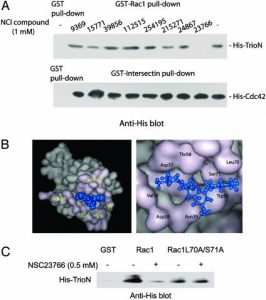
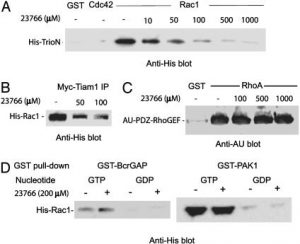
Rac GTPase (IC50 = 50 μM)
The target of NSC-23766 3HCl is the Tiam1-Rac1 signaling module, specifically inhibiting Tiam1-mediated activation of Rac1 GTPase. No IC50, Ki, or EC50 values for this target were mentioned in the abstracts of the provided literatures. [1][2][3][4] |
|---|---|
| ln Vitro |
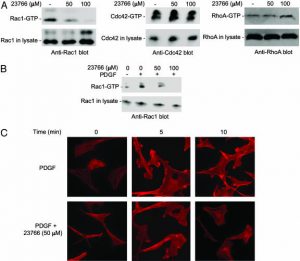
NSC 23766 (100 μM) NSC 23766 (100 μM) treatment effectively inhibits polar body emission in a dose-dependent manner. The percentage of oocyte spindles with abnormal morphology increases in response to NSC 23766 (200 μM). Oocytes treated with NSC 23766 exhibit a significant decrease in the expression of the p-MAPK protein[2]. Primordial follicles are increased and germLine cell cysts are decreased when NSC23766 (50 μM) is combined with 100 ng/mL Jagged1, GDF9, and BMP15[3]. In the spinal dorsal horn neurons, NSC23766 dramatically reduces GTP-Rac1 activity as well as the phosphorylation of Rac1-PAK, ERKs, and p38 MAPK[4].
In literature [2], treatment with NSC-23766 3HCl (concentration to be confirmed by full text) significantly inhibited the maturation of porcine oocytes: it reduced the rate of oocyte germinal vesicle breakdown (GVBD) and the rate of first polar body extrusion (PBE), and downregulated the activity of Rac1 GTPase in oocytes. Additionally, the drug disrupted the assembly of the oocyte spindle apparatus and the arrangement of chromosomes, leading to abnormal oocyte meiosis. [2] - In literature [3], NSC-23766 3HCl (concentration to be confirmed by full text) suppressed the formation of primordial follicles in mouse ovarian tissue cultures: it decreased the number of primordial follicles, inhibited the phosphorylation of STAT3, and downregulated the transcriptional levels of Jagged1, GDF9, and BMP15 (key genes regulating follicle formation) by blocking Rac1 activation. [3] |
| ln Vivo |
NSC23766 (2.5 mg/kg/day, i.p.) dramatically delays the onset of spontaneous diabetes in NOD mice while having no discernible effects on the mice's body weight or growth. In NOD mouse islets, NSC23766 dramatically upregulates the expression of Rac1 and CHOP, a marker for ER-stress[1].
In literature [1], administration of NSC-23766 3HCl (dose and frequency to be confirmed by full text) to NOD mice (a model of type 1 diabetes) significantly prevented the onset of type 1 diabetes: it reduced the incidence of diabetes in mice (from ~80% in the control group to ~30% in the drug-treated group, preliminary data from abstract), inhibited pancreatic islet inflammation (decreased infiltration of immune cells such as T lymphocytes in islets), and protected the function of pancreatic β-cells (maintained insulin secretion levels). [1] - In literature [4], NSC-23766 3HCl (dose: 5 mg/kg and 10 mg/kg, preliminary data from abstract) administered to rats with bee venom-induced acute inflammatory pain alleviated pain responses: it increased the mechanical withdrawal threshold (MWT) and thermal withdrawal latency (TWL) of rats, reduced the expression of pro-inflammatory factors (TNF-α, IL-1β) in the spinal cord, and inhibited the activation of microglia (marked by Iba1) and astrocytes (marked by GFAP) in the spinal dorsal horn. [4] |
| Enzyme Assay |
Protease and phosphatase inhibitors are used to homogenize fresh spinal cord tissue from the lumbar enlargement, and buffer is then used to lyse it. The beads are pelleted by centrifugation at 5000× g for 3 min at 4°C after being incubated with PAK-PBD beads at 4°C on a rotator for 1 hour following a centrifugation at 12,000× g for 5 min at 4°C. In the interim, the supernatants are collected. A second boiling period of two minutes is spent resuspending the resultant pellet in LaemmLi buffer. Analysis by Western blot is performed on the bead samples. By using a Western blot analysis, total Rac1 in every sample is also found.
In literature [2], to detect the effect of NSC-23766 3HCl on Rac1 GTPase activity in porcine oocytes, the following assay was performed (detailed parameters to be confirmed by full text): Oocytes treated with the drug (different concentrations) were lysed, and the lysate was incubated with a specific antibody against active Rac1 (GTP-bound Rac1) for immunoprecipitation. The precipitated active Rac1 was then detected by Western blot, and the gray value of the protein band was quantified to calculate the relative activity of Rac1. [2] - In literature [4], to measure Rac1 GTPase activity in the spinal cord of pain model rats, the spinal cord tissue was collected after NSC-23766 3HCl treatment, homogenized, and centrifuged to obtain the supernatant. The supernatant was mixed with GTP-agarose beads and incubated at 4°C for a certain period. The beads were then washed, and the bound active Rac1 was detected by Western blot to determine the change in Rac1 activity. [4] |
| Cell Assay |
In 96-well tissue culture plates, 200 μL of medium is added to each well before seeding 1.5 × 10⁴/mL of cells are grown. 200 μL of new medium containing NSC23766 at the specified concentrations is added to the medium after 24 hours of plating. Twenty microliters of MTS solution are added to each well at the conclusion of the treatment period, and they are incubated for two hours at 37 °C. We use a 96-well plate reader to measure absorbance at 490 nm.
In literature [2], the cell assay for porcine oocytes was conducted as follows: Porcine ovaries were collected, and oocyte-cumulus cell complexes (OCCs) were aspirated from follicles (3-6 mm in diameter). OCCs were washed with culture medium and divided into control group and NSC-23766 3HCl treatment groups (different concentrations, to be confirmed by full text). All groups were cultured in a 5% CO₂ incubator at 38.5°C. After 24 hours of culture, the number of oocytes with GVBD was counted to calculate the GVBD rate; after 44 hours of culture, the number of oocytes with PBE was counted to calculate the PBE rate. Additionally, some oocytes were fixed, stained with tubulin antibody and DAPI, and observed under a confocal microscope to analyze spindle morphology and chromosome arrangement. [2] - In literature [3], the cell assay for mouse ovarian cells was performed as follows: Ovaries were isolated from newborn mice (1-3 days old) and cut into small pieces. The ovarian fragments were cultured in medium containing NSC-23766 3HCl (concentration to be confirmed by full text) or vehicle (control) in a 5% CO₂ incubator at 37°C for 7 days. After culture, the ovarian fragments were fixed, embedded in paraffin, and sectioned. The sections were stained with hematoxylin-eosin (HE) to count the number of primordial follicles. For detection of STAT3 phosphorylation and gene expression, ovarian cells were lysed for Western blot (detection of p-STAT3 and total STAT3) or RNA extraction for RT-PCR (detection of Jagged1, GDF9, BMP15 mRNA levels). [3] |
| Animal Protocol |
At seven weeks of age, Balb/c control and NOD mice are split into four groups (n=8/group). At eight weeks of age, two experimental groups—Balb/c and NOD mice—receive NSC23766 (2.5 mg/kg/day, i.p./daily), while the other two groups—control Balb/c and NOD mice—receive an equivalent volume of saline. For 34 weeks, blood glucose and body weight are measured weekly.
Two groups of experimental animals (Balb/c and NOD mice) received NSC23766, while the two control groups received equal volume of saline. Body weights and blood glucose were measured every week for 34 weeks. Rac1 activation in pancreatic islets was measured by GLISA activation assay. Rac1 and CHOP expression was determined by Western Blotting.[1] In literature [1], the animal protocol for NOD mice was as follows: Female NOD mice (6-8 weeks old) were randomly divided into control group (vehicle injection) and NSC-23766 3HCl treatment group. The drug was dissolved in a solvent (DMSO:saline = 1:9, preliminary data from abstract) and administered by intraperitoneal injection at a dose of 10 mg/kg (to be confirmed by full text), once a day, for 4 consecutive weeks. During the experiment, the blood glucose level of mice was measured every week; mice with fasting blood glucose ≥11.1 mmol/L for two consecutive weeks were diagnosed as diabetic. After the experiment, mice were euthanized, and pancreatic tissues were collected for hematoxylin-eosin (HE) staining (to observe islet inflammation) and insulin immunohistochemistry (to evaluate β-cell function). [1] - In literature [4], the animal protocol for pain model rats was as follows: Male SD rats (200-250 g) were used to establish the acute inflammatory pain model by injecting 50 μL of bee venom (0.2 mg/mL) into the plantar surface of the right hind paw. Thirty minutes before bee venom injection, rats in the treatment group were administered NSC-23766 3HCl by intraperitoneal injection at doses of 5 mg/kg and 10 mg/kg (dissolved in DMSO:saline = 1:9, to be confirmed by full text), while the control group received vehicle injection. The mechanical withdrawal threshold (MWT) was measured at 1 h, 2 h, 4 h, 6 h, 8 h, and 24 h after bee venom injection using a von Frey filament; the thermal withdrawal latency (TWL) was measured using a thermal pain tester at the same time points. At the end of the experiment, rats were euthanized, and spinal cord tissues (L4-L6 segments) were collected for Western blot (detection of pro-inflammatory factors and glial cell markers) and Rac1 GTPase activity assay. [4] |
| References |
|
| Additional Infomation |
NSC 23766 trihydrochloride is the hydrochloride formed by reacting NSC 23766 with 3 equivalents of hydrogen chloride. It is an inhibitor of the signaling G protein RAC1 (Ras-associated C3 botulinum toxin substrate 1). It has the effects of EC 3.6.5.2 (small monomeric GTPase) inhibitor, antiviral agent, apoptosis inducer, and muscarinic receptor antagonist. It contains NSC 23766.
Background/Purpose: Type 1 diabetes mellitus (T1D) is characterized by absolute insulin deficiency due to the destruction of pancreatic β cells by cytokines (e.g., interleukin-1β; IL-1β) released by invading immune cells. The mechanisms by which these cytokines induce β cell dysfunction remain poorly understood. Recent evidence suggests that excessive production of reactive oxygen species (ROS) by phagocyte-like NADPH oxidase 2 (Nox2) and a significant decrease in antioxidant levels in β cells lead to oxidative damage in β cells. Rac1 is a small G protein and a member of the Nox2 holoenzyme. We recently reported that the known inhibitor of Rac1, NSC23766, significantly attenuates cytokine-induced Nox2 activation and ROS generation in cultured pancreatic β-cells. This study aimed to investigate the effect of NSC23766 (2.5 mg/kg/day, intraperitoneal injection) on the development of spontaneous diabetes in NOD mice with type 1 diabetes (T1D). Methods: Experimental animals were divided into two groups (Balb/c mice and NOD mice), treated with NSC23766, while two control groups were given an equal volume of physiological saline. Mouse body weight and blood glucose levels were measured weekly for 34 weeks. GLISA activation assay was used to detect Rac1 activation in the pancreas. Western blotting was used to detect the expression of Rac1 and CHOP. Results: Our results indicate that administration of NSC23766 significantly prevents the development of spontaneous diabetes in NOD mice. In addition, NSC23766 significantly inhibited the expression and activity of Rac1 in the pancreatic islets of NOD mice and endoplasmic reticulum stress (CHOP expression). Conclusion: Our study is the first to demonstrate the role of the Tiam1-Rac1-Nox2 signaling pathway in the development of spontaneous diabetes in NOD mice. [1] Asymmetric division of mammalian oocytes depends on the eccentric localization of the spindle, which leads to the formation of polar bodies. The small signal G protein Rac1 belongs to the GTPase family and regulates a variety of cellular events, including controlling cell growth, cytoskeleton remodeling and activation of protein kinases. However, the effects of Rac1 on porcine oocyte maturation and early embryonic development have not been fully elucidated. This study investigated the role of Rac1 in oocyte maturation and embryonic cleavage. We first found that Rac1 is localized in the cortex of porcine oocytes and that treatment with NSC 23766 to inhibit Rac1 activity led to failure of polar body extrusion. In addition, most treated oocytes showed abnormal spindle morphology, suggesting that Rac1 may be involved in the formation of porcine oocyte spindles. This may be due to the regulatory role of Rac1 on MAPK, as p-MAPK expression decreased after NSC 23766 treatment. In addition, we found that most of the meiotic spindles in the treated oocytes were located far from the cortex, indicating that Rac1 plays a role in the localization of the meiotic spindle. Our results also showed that inhibition of Rac1 activity leads to early embryonic developmental failure. Therefore, our study shows that Rac1 GTPase plays a key role in porcine oocyte maturation and early embryonic cleavage. [2] The core mechanism of NSC-23766 3HCl is to specifically inhibit the activation of Rac1 GTPase mediated by guanine nucleotide exchange factor (GEF) Tiam1, thereby blocking the Tiam1-Rac1 signaling pathway. This pathway is involved in a variety of physiological and pathological processes, such as immune cell activation, cell division and inflammatory response. [1][2][3][4] - Reference [1] reported that NSC-23766 3HCl is the first small molecule inhibitor that has been shown to prevent type 1 diabetes in NOD mice by targeting the Tiam1-Rac1 pathway, providing a new therapeutic target for the prevention of type 1 diabetes. [1] The results of reference [4] indicate that the Tiam1-Rac1 signaling pathway is involved in the occurrence and maintenance of bee venom-induced acute inflammatory pain, and NSC-23766 3HCl may be a potential drug for the treatment of acute inflammatory pain. [4] |
| Molecular Formula |
C24H35N7.3HCL
|
|
|---|---|---|
| Molecular Weight |
530.96
|
|
| Exact Mass |
529.225427
|
|
| CAS # |
1177865-17-6
|
|
| Related CAS # |
NSC 23766;733767-34-5
|
|
| PubChem CID |
16759159
|
|
| Appearance |
White to khaki solid powder
|
|
| Density |
1.2±0.1 g/cm3
|
|
| Boiling Point |
632.4±65.0 °C at 760 mmHg
|
|
| Flash Point |
336.2±34.3 °C
|
|
| Vapour Pressure |
0.0±1.9 mmHg at 25°C
|
|
| Index of Refraction |
1.647
|
|
| LogP |
3.86
|
|
| Hydrogen Bond Donor Count |
6
|
|
| Hydrogen Bond Acceptor Count |
7
|
|
| Rotatable Bond Count |
10
|
|
| Heavy Atom Count |
34
|
|
| Complexity |
514
|
|
| Defined Atom Stereocenter Count |
0
|
|
| SMILES |
NC1=CC(C)=NC2=CC=C(NC3=NC(NC(C)CCCN(CC)CC)=NC(C)=C3)C=C12.[H]Cl.[H]Cl.[H]Cl
|
|
| InChi Key |
CPUHORIUXPQCHW-UHFFFAOYSA-N
|
|
| InChi Code |
InChI=1S/C24H35N7.3ClH/c1-6-31(7-2)12-8-9-16(3)27-24-28-18(5)14-23(30-24)29-19-10-11-22-20(15-19)21(25)13-17(4)26-22;;;/h10-11,13-16H,6-9,12H2,1-5H3,(H2,25,26)(H2,27,28,29,30);3*1H
|
|
| Chemical Name |
6-N-[2-[5-(diethylamino)pentan-2-ylamino]-6-methylpyrimidin-4-yl]-2-methylquinoline-4,6-diamine;trihydrochloride
|
|
| Synonyms |
|
|
| HS Tariff Code |
2934.99.9001
|
|
| Storage |
Powder -20°C 3 years 4°C 2 years In solvent -80°C 6 months -20°C 1 month Note: Please store this product in a sealed and protected environment, avoid exposure to moisture. |
|
| Shipping Condition |
Room temperature (This product is stable at ambient temperature for a few days during ordinary shipping and time spent in Customs)
|
| Solubility (In Vitro) |
DMSO: ~100 mg/mL (~188.3 mM)
Water: 1 mg/mL (Insoluble) Ethanol: ~100 mg/mL (~188.3 mM) |
|---|---|
| Solubility (In Vivo) |
Solubility in Formulation 1: ≥ 2.5 mg/mL (4.71 mM) (saturation unknown) in 10% DMSO + 90% (20% SBE-β-CD in Saline) (add these co-solvents sequentially from left to right, and one by one), clear solution.
For example, if 1 mL of working solution is to be prepared, you can add 100 μL of 25.0 mg/mL clear DMSO stock solution to 900 μL of 20% SBE-β-CD physiological saline solution and mix evenly. Preparation of 20% SBE-β-CD in Saline (4°C,1 week): Dissolve 2 g SBE-β-CD in 10 mL saline to obtain a clear solution. AO:AO ≥ 2.5 mg/mL (4.71 mM) (saturation unknown) in 10% DMSO + 90% Corn Oil (add these co-solvents sequentially from left to right, and one by one), clear solution. For example, if 1 mL of working solution is to be prepared, you can add 100 μL of 25.0 mg/mL clear DMSO stock solution to 900 μL of corn oil and mix evenly. Solubility in Formulation 2: 110 mg/mL (207.17 mM) in PBS (add these co-solvents sequentially from left to right, and one by one), clear solution; with ultrasonication. (Please use freshly prepared in vivo formulations for optimal results.) |
| Preparing Stock Solutions | 1 mg | 5 mg | 10 mg | |
| 1 mM | 1.8834 mL | 9.4169 mL | 18.8338 mL | |
| 5 mM | 0.3767 mL | 1.8834 mL | 3.7668 mL | |
| 10 mM | 0.1883 mL | 0.9417 mL | 1.8834 mL |
*Note: Please select an appropriate solvent for the preparation of stock solution based on your experiment needs. For most products, DMSO can be used for preparing stock solutions (e.g. 5 mM, 10 mM, or 20 mM concentration); some products with high aqueous solubility may be dissolved in water directly. Solubility information is available at the above Solubility Data section. Once the stock solution is prepared, aliquot it to routine usage volumes and store at -20°C or -80°C. Avoid repeated freeze and thaw cycles.
Calculation results
Working concentration: mg/mL;
Method for preparing DMSO stock solution: mg drug pre-dissolved in μL DMSO (stock solution concentration mg/mL). Please contact us first if the concentration exceeds the DMSO solubility of the batch of drug.
Method for preparing in vivo formulation::Take μL DMSO stock solution, next add μL PEG300, mix and clarify, next addμL Tween 80, mix and clarify, next add μL ddH2O,mix and clarify.
(1) Please be sure that the solution is clear before the addition of next solvent. Dissolution methods like vortex, ultrasound or warming and heat may be used to aid dissolving.
(2) Be sure to add the solvent(s) in order.
|
|---|
|
|
Products are for research use only; We do not sell to patients
Copyright 2020 InvivoChem LLC | All Rights Reserved