| Size | Price | Stock | Qty |
|---|---|---|---|
| 5mg |
|
||
| 10mg |
|
||
| 25mg |
|
||
| 50mg |
|
||
| 100mg |
|
||
| 250mg | |||
| 500mg | |||
| Other Sizes |
| Targets |
IKKβ (IC50 = 60 nM)
The anti-inflammatory drug MLN120B inhibits IKK2 and functions as an NF-kB pathway blocker. It also has an inhibitory effect on LPS-induced NF-kB activation. IKK2 inhibition most effectively affects the transcriptional activity of the NF-kB2 promoter, as evidenced by the IC50 values of NF-kB2-luc2, IL8-luc2, and TNF-AIP3-luc2 reporter transfected cells of 1.4, 14.8 and 27.3 M, respectively. |
|---|---|
| ln Vitro |
The anti-inflammatory drug MLN120B inhibits IKK2 and functions as an NF-kB pathway blocker. It also has an inhibitory effect on LPS-induced NF-kB activation. IKK2 inhibition most effectively affects the transcriptional activity of the NF-kB2 promoter, as evidenced by the IC50 values of NF-kB2-luc2, IL8-luc2, and TNF-AIP3-luc2 reporter transfected cells of 1.4, 14.8 and 27.3 M, respectively.
In RAW264.7 cells transiently transfected with NF-κB reporter constructs (NF-κB2-luc2, IL8-luc2, TNFAIP3-luc2), MLN120B inhibits lipopolysaccharide (LPS)-induced NF-κB activation in a dose-dependent manner. The IC₅₀ values are 1.4 µM for the NF-κB2-luc2 reporter, 14.8 µM for the IL8-luc2 reporter, and 27.3 µM for the TNFAIP3-luc2 reporter. [2] |
| ln Vivo |
Compared to LPS-treated positive controls, the BAL of MLN120B pre-treated mice showed significantly lower levels of the pro-inflammatory chemokine MIP-1β and higher levels of the anti-inflammatory cytokine IL-10.
In NF-κB2-luc2 reporter-transfected mice, pre-treatment with MLN120B (300 mg/kg, orally, 16 and 1 hour prior to LPS challenge) attenuates LPS-induced NF-κB activation in the lungs by approximately 70% at 4 hours post-LPS administration. In the bronchoalveolar lavage (BAL) fluid, pre-treatment with MLN120B significantly decreases levels of the pro-inflammatory chemokine MIP-1β and increases levels of the anti-inflammatory cytokine IL-10 compared to LPS-treated vehicle control mice. [2] |
| Enzyme Assay |
MLN120B is a novel, potent, specific and ATP competitive IKKβ (IκB kinase beta subunit) inhibitor with an IC50 of 60 nM.
|
| Cell Assay |
RAW267.4 cells should be transfected momentarily with NF-kB reporters, and LPS should be used to cause inflammation. These substances' impact on LPS-induced luciferase expression was evaluated.
RAW264.7 cells at 70% confluency are trypsinized and washed. A suspension of 1-3×10⁷ cells in serum-free medium is prepared. NF-κB-luc reporter DNA is mixed with a transfection reagent and incubated. The DNA-transfection reagent mixture is added to the cells, followed by incubation. The cells are then plated into a multi-well plate. LPS solution and serial dilutions of MLN120B (in growth medium) are added to the wells. After overnight incubation, luciferase reporter activity is assayed by bioluminescence imaging following the addition of luciferin substrate. [2] |
| Animal Protocol |
NF-kB2-luc2 transfected mice
300 mg/kg p.o. For efficacy studies in NF-κB2-luc2 reporter-transfected mice, MLN120B is dissolved in 0.5% methylcellulose and administered orally (300 mg/kg) 16 hours and 1 hour prior to intratracheal LPS (1 mg/kg) challenge. Mice are anesthetized and imaged at specified time points after intraperitoneal injection of luciferin to quantify bioluminescence signal from the lungs. Bronchoalveolar lavage (BAL) fluid is collected after imaging for cytokine analysis. [2] |
| References | |
| Additional Infomation |
MLN120B is a potent and selective small molecule IKK-2 inhibitor, IKK-2 being a key kinase in the NF-κB signaling pathway. It is being explored as a potential treatment for inflammatory diseases such as chronic obstructive pulmonary disease (COPD) and asthma. In vivo, high doses (300 mg/kg) of MLN120B showed significant inhibitory effects on NF-κB activation, while low doses (50 mg/kg) had little effect in a described LPS-induced lung inflammation model. [2]
|
| Molecular Formula |
C19H15CLN4O2
|
|
|---|---|---|
| Molecular Weight |
366.81
|
|
| Exact Mass |
366.088
|
|
| Elemental Analysis |
C, 62.22; H, 4.12; Cl, 9.66; N, 15.27; O, 8.72
|
|
| CAS # |
783348-36-7
|
|
| Related CAS # |
1782573-78-7 (2HCl);783348-36-7;1350272-92-2 (HCl);
|
|
| PubChem CID |
9929127
|
|
| Appearance |
Off-white to light yellow solid powder
|
|
| Density |
1.4±0.1 g/cm3
|
|
| Boiling Point |
545.0±50.0 °C at 760 mmHg
|
|
| Flash Point |
283.4±30.1 °C
|
|
| Vapour Pressure |
0.0±1.5 mmHg at 25°C
|
|
| Index of Refraction |
1.752
|
|
| LogP |
3.84
|
|
| Hydrogen Bond Donor Count |
2
|
|
| Hydrogen Bond Acceptor Count |
4
|
|
| Rotatable Bond Count |
3
|
|
| Heavy Atom Count |
26
|
|
| Complexity |
522
|
|
| Defined Atom Stereocenter Count |
0
|
|
| SMILES |
O=C(C1=CC=CN=C1C)NC2=C(OC)C(Cl)=CC3=C2NC4=C3C=CN=C4
|
|
| InChi Key |
ZNOLRTPMNMPLHY-UHFFFAOYSA-N
|
|
| InChi Code |
InChI=1S/C19H15ClN4O2/c1-10-11(4-3-6-22-10)19(25)24-17-16-13(8-14(20)18(17)26-2)12-5-7-21-9-15(12)23-16/h3-9,23H,1-2H3,(H,24,25)
|
|
| Chemical Name |
N-(6-chloro-7-methoxy-9H-pyrido[3,4-b]indol-8-yl)-2-methylpyridine-3-carboxamide
|
|
| Synonyms |
|
|
| HS Tariff Code |
2934.99.03.00
|
|
| Storage |
Powder -20°C 3 years 4°C 2 years In solvent -80°C 6 months -20°C 1 month |
|
| Shipping Condition |
Room temperature (This product is stable at ambient temperature for a few days during ordinary shipping and time spent in Customs)
|
| Solubility (In Vitro) |
|
|||
|---|---|---|---|---|
| Solubility (In Vivo) |
Solubility in Formulation 1: ≥ 2.5 mg/mL (6.82 mM) (saturation unknown) in 10% DMSO + 90% Corn Oil (add these co-solvents sequentially from left to right, and one by one), clear solution.
For example, if 1 mL of working solution is to be prepared, you can add 100 μL of 25.0 mg/mL clear DMSO stock solution to 900 μL of corn oil and mix evenly. Solubility in Formulation 2: ≥ 2.08 mg/mL (5.67 mM) (saturation unknown) in 10% DMSO + 40% PEG300 + 5% Tween80 + 45% Saline (add these co-solvents sequentially from left to right, and one by one), clear solution. For example, if 1 mL of working solution is to be prepared, you can add 100 μL of 20.8 mg/mL clear DMSO stock solution to 400 μL PEG300 and mix evenly; then add 50 μL Tween-80 to the above solution and mix evenly; then add 450 μL normal saline to adjust the volume to 1 mL. Preparation of saline: Dissolve 0.9 g of sodium chloride in 100 mL ddH₂ O to obtain a clear solution. View More
Solubility in Formulation 3: 2.08 mg/mL (5.67 mM) in 10% DMSO + 90% (20% SBE-β-CD in Saline) (add these co-solvents sequentially from left to right, and one by one), suspension solution; with ultrasonication. |
| Preparing Stock Solutions | 1 mg | 5 mg | 10 mg | |
| 1 mM | 2.7262 mL | 13.6310 mL | 27.2621 mL | |
| 5 mM | 0.5452 mL | 2.7262 mL | 5.4524 mL | |
| 10 mM | 0.2726 mL | 1.3631 mL | 2.7262 mL |
*Note: Please select an appropriate solvent for the preparation of stock solution based on your experiment needs. For most products, DMSO can be used for preparing stock solutions (e.g. 5 mM, 10 mM, or 20 mM concentration); some products with high aqueous solubility may be dissolved in water directly. Solubility information is available at the above Solubility Data section. Once the stock solution is prepared, aliquot it to routine usage volumes and store at -20°C or -80°C. Avoid repeated freeze and thaw cycles.
Calculation results
Working concentration: mg/mL;
Method for preparing DMSO stock solution: mg drug pre-dissolved in μL DMSO (stock solution concentration mg/mL). Please contact us first if the concentration exceeds the DMSO solubility of the batch of drug.
Method for preparing in vivo formulation::Take μL DMSO stock solution, next add μL PEG300, mix and clarify, next addμL Tween 80, mix and clarify, next add μL ddH2O,mix and clarify.
(1) Please be sure that the solution is clear before the addition of next solvent. Dissolution methods like vortex, ultrasound or warming and heat may be used to aid dissolving.
(2) Be sure to add the solvent(s) in order.
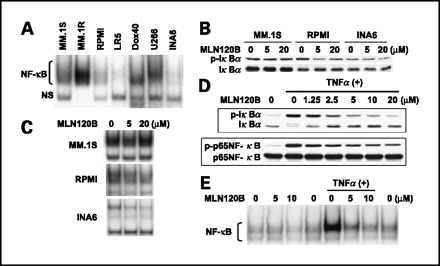
MLN120B inhibits IκBα phosphorylation and NF-κB activation in multiple myeloma cells.Clin Cancer Res.2006 Oct 1;12(19):5887-94. |
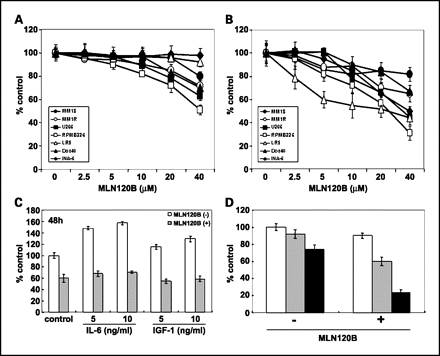
MLN120B inhibits proliferation of multiple myeloma cell lines.Clin Cancer Res.2006 Oct 1;12(19):5887-94. |
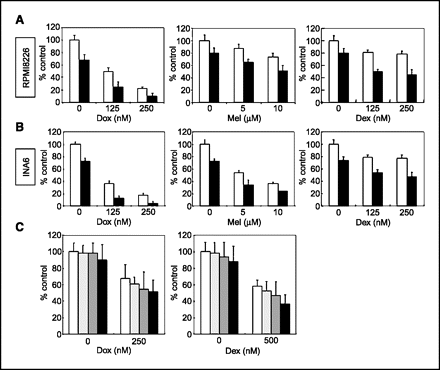
MLN120B enhances cytotoxicity of conventional [dexamethasone (Dex), melphalan (Mel), doxorubicin (Dox)] agents.Clin Cancer Res.2006 Oct 1;12(19):5887-94. |
Products are for research use only; We do not sell to patients
Copyright 2020 InvivoChem LLC | All Rights Reserved