| Size | Price | Stock | Qty |
|---|---|---|---|
| 5mg |
|
||
| 10mg |
|
||
| 25mg |
|
||
| 50mg |
|
||
| 100mg |
|
||
| 250mg |
|
||
| 500mg |
|
||
| Other Sizes |


Purity: ≥98%
| Targets |
The amplitude of KCNQ1 single-channel and whole-cell currents is increased by ML277 (1 μM) [1].
|
|---|---|
| ln Vitro |
The amplitude of KCNQ1 single-channel and whole-cell currents is increased by ML277 (1 μM) [1].
ML277 (1 μM) increased KCNQ1 whole-cell peak tail currents by 8.5 ± 1.8-fold at +60 mV and shifted the half-activation voltage (V1/2) of the conductance-voltage (G-V) relationship by approximately -11.8 mV at 100 nM. At the single-channel level, ML277 (1 μM) increased the amplitude of KCNQ1 openings approximately threefold (from ~0.022 pA to 0.069 ± 0.003 pA at +60 mV), eliminated the characteristic flickery openings, and converted them into more stable, discrete opening bursts with prolonged burst durations. For KCNQ1/KCNE1 complexes of varying stoichiometries (e.g., EQQQQ with a 1:4 KCNE1:KCNQ1 ratio), ML277 still increased single-channel opening amplitudes and shortened the first latency to opening, although the effect was diminished compared to KCNQ1 alone. The drug also robustly increased currents (3.5 to 6-fold in tail currents) and single-channel amplitudes (~3-fold) in KCNQ1 mutants with voltage sensor domains (VSDs) locked in intermediate-open (R2: E160R/R231E) or activated-open (R4: E160R/R237E) states, indicating effects on the pore independent of VSD gating. Channels with VSDs constrained in the resting state (e.g., E160R mutants) still showed a ~2.5-fold increase in tail currents with ML277, suggesting the drug can enhance current even without VSD movement. The ML277-enhanced currents were sensitive to the IKs blocker HMR1556 (IC50 ~3.5-5.9 μM depending on conditions). [1] |
| Cell Assay |
Whole-cell patch-clamp recordings: tsA201 or LM cells were transfected with KCNQ1 (and optionally KCNE1) constructs using a lipid-based transfection reagent. 24-48 hours post-transfection, whole-cell currents were recorded using an amplifier and data acquisition system. The external bath solution contained (in mM): 135 NaCl, 5 KCl, 1 MgCl2, 2.8 NaAcetate, 10 HEPES (pH 7.4). The internal pipette solution contained (in mM): 130 KCl, 5 EGTA, 1 MgCl2, 4 Na2-ATP, 0.1 GTP, 10 HEPES (pH 7.2). Cells were held at -80 or -90 mV, and families of currents were elicited by depolarizing test pulses (e.g., from -90 mV to +60/+100 mV in 10 mV steps for 2-4 s) followed by a step to -40 or -50 mV to record tail currents. ML277 was dissolved in DMSO and diluted >1000-fold in the bath solution. Drug effects were assessed by comparing peak tail current amplitudes, G-V relationships (fitted with a Boltzmann function), and deactivation kinetics before and after drug application. [1]
Cell-attached single-channel recordings: LM cells were used for single-channel experiments. The bath solution contained (in mM): 135 KCl, 1 MgCl2, 1 CaCl2, 10 HEPES, 10 dextrose (pH 7.4). The pipette solution contained (in mM): 6 NaCl, 129 Mes, 1 MgCl2, 5 KCl, 1 CaCl2, 10 HEPES (pH 7.4). Pipettes had high resistance (40-60 MΩ). Single-channel currents were recorded from patches held at various potentials (e.g., pulsed to +60 mV for 4 s from a holding potential of -80 mV). Currents were sampled at 10 kHz and filtered. ML277 effects were analyzed by comparing single-channel amplitudes (from all-points histograms fitted with Gaussian functions), open burst durations, first latencies to opening, and open probability before and after drug application. [1] |
| ADME/Pharmacokinetics |
The free fraction (Fu) of ML277 in human plasma was 0.6% (PPB > 99%), and the free fraction in rat plasma was 0.7% (PPB > 99%), indicating that its plasma protein binding rate was extremely high. The predicted in vivo liver clearance rate (CLHEP) of human liver microsomes was 18.0 mL/min/kg. The predicted in vivo liver clearance rate (CLHEP) of rat liver microsomes was 64.7 mL/min/kg. Mass spectrometry analysis identified its main metabolic pathway as NADPH-dependent oxidation of toluene groups and oxidative O-demethylation of methoxy groups. [2]
|
| References |
|
| Additional Infomation |
ML277 is a potent and selective KCNQ1 (Kv7.1) voltage-gated potassium channel activator. Its mechanism of action includes regulating the gating of the voltage sensor domain (VSD) (shifting the activated potential to a more negative potential and slowing inactivation) and a direct effect on the channel pore, thereby increasing single-channel conductance and stabilizing the open state. The efficacy of this drug is highly dependent on the stoichiometry of the KCNQ1/KCNE1 complex; it has a significant effect on homologous KCNQ1 channels, but its effect is significantly reduced when the KCNQ1 channel is fully saturated with the helper subunit KCNE1 (4:4 stoichiometry). It can rescue the function of certain long QT syndrome type 1 (LQT1) mutant channels and shorten action potential duration in in vitro cardiomyocyte studies (as shown in other studies cited in this article), suggesting its potential therapeutic value for LQT1. This study suggests that ML277 may bind to multiple sites in the KCNQ1 channel, possibly near the S4-S5 junction region and pore structure domain, and its effects on channel gating and conductance may be separable. [1]
|
| Molecular Formula |
C₂₃H₂₅N₃O₄S₂
|
|
|---|---|---|
| Molecular Weight |
471.59
|
|
| Exact Mass |
471.128
|
|
| Elemental Analysis |
C, 58.58; H, 5.34; N, 8.91; O, 13.57; S, 13.60
|
|
| CAS # |
1401242-74-7
|
|
| Related CAS # |
|
|
| PubChem CID |
53347902
|
|
| Appearance |
White to off-white solid powder
|
|
| Density |
1.3±0.1 g/cm3
|
|
| Index of Refraction |
1.631
|
|
| LogP |
4.68
|
|
| Hydrogen Bond Donor Count |
1
|
|
| Hydrogen Bond Acceptor Count |
7
|
|
| Rotatable Bond Count |
6
|
|
| Heavy Atom Count |
32
|
|
| Complexity |
728
|
|
| Defined Atom Stereocenter Count |
1
|
|
| SMILES |
O=C([C@@H]1N(S(=O)(C2=CC=C(C)C=C2)=O)CCCC1)NC3=NC(C4=CC=C(OC)C=C4)=CS3
|
|
| InChi Key |
OXQNLLVUVDAEHC-OAQYLSRUSA-N
|
|
| InChi Code |
InChI=1S/C23H25N3O4S2/c1-16-6-12-19(13-7-16)32(28,29)26-14-4-3-5-21(26)22(27)25-23-24-20(15-31-23)17-8-10-18(30-2)11-9-17/h6-13,15,21H,3-5,14H2,1-2H3,(H,24,25,27)/t21-/m1/s1
|
|
| Chemical Name |
|
|
| Synonyms |
|
|
| HS Tariff Code |
2934.99.9001
|
|
| Storage |
Powder -20°C 3 years 4°C 2 years In solvent -80°C 6 months -20°C 1 month |
|
| Shipping Condition |
Room temperature (This product is stable at ambient temperature for a few days during ordinary shipping and time spent in Customs)
|
| Solubility (In Vitro) |
|
|||
|---|---|---|---|---|
| Solubility (In Vivo) |
Solubility in Formulation 1: ≥ 2.5 mg/mL (5.30 mM) (saturation unknown) in 10% DMSO + 90% Corn Oil (add these co-solvents sequentially from left to right, and one by one), clear solution.
For example, if 1 mL of working solution is to be prepared, you can add 100 μL of 25.0 mg/mL clear DMSO stock solution to 900 μL of corn oil and mix evenly. (Please use freshly prepared in vivo formulations for optimal results.) |
| Preparing Stock Solutions | 1 mg | 5 mg | 10 mg | |
| 1 mM | 2.1205 mL | 10.6024 mL | 21.2049 mL | |
| 5 mM | 0.4241 mL | 2.1205 mL | 4.2410 mL | |
| 10 mM | 0.2120 mL | 1.0602 mL | 2.1205 mL |
*Note: Please select an appropriate solvent for the preparation of stock solution based on your experiment needs. For most products, DMSO can be used for preparing stock solutions (e.g. 5 mM, 10 mM, or 20 mM concentration); some products with high aqueous solubility may be dissolved in water directly. Solubility information is available at the above Solubility Data section. Once the stock solution is prepared, aliquot it to routine usage volumes and store at -20°C or -80°C. Avoid repeated freeze and thaw cycles.
Calculation results
Working concentration: mg/mL;
Method for preparing DMSO stock solution: mg drug pre-dissolved in μL DMSO (stock solution concentration mg/mL). Please contact us first if the concentration exceeds the DMSO solubility of the batch of drug.
Method for preparing in vivo formulation::Take μL DMSO stock solution, next add μL PEG300, mix and clarify, next addμL Tween 80, mix and clarify, next add μL ddH2O,mix and clarify.
(1) Please be sure that the solution is clear before the addition of next solvent. Dissolution methods like vortex, ultrasound or warming and heat may be used to aid dissolving.
(2) Be sure to add the solvent(s) in order.
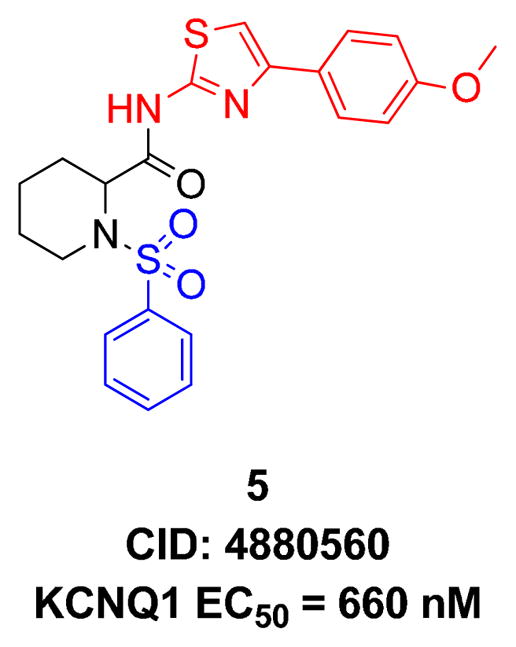
Structure of the initial HTS hit.Bioorg Med Chem Lett.2012 Sep 15;22(18):5936-41. |
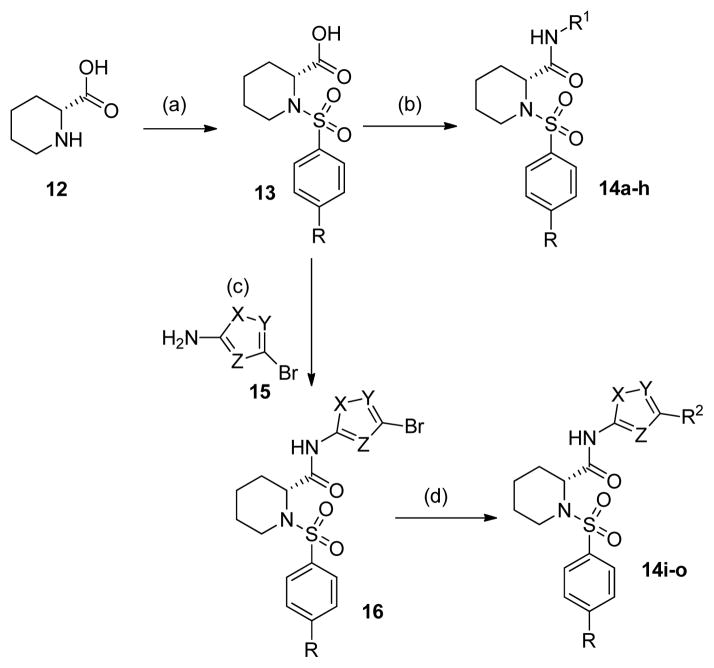
(a)p-TsCl orp-chlorophenylSO2Cl, TEA, DCM (R = CH3, 57–72%; R = Cl, 37 – 43%); (b) R1NH2, HATU, DIEA, DMF; (c) HATU, DIEA, DMF (R = CH3, 12–79%; R = Cl, 19–75%); (d) R2B(OH)2, K3PO4, Pd(OAc)2, THF:H2O, 80 °C. |
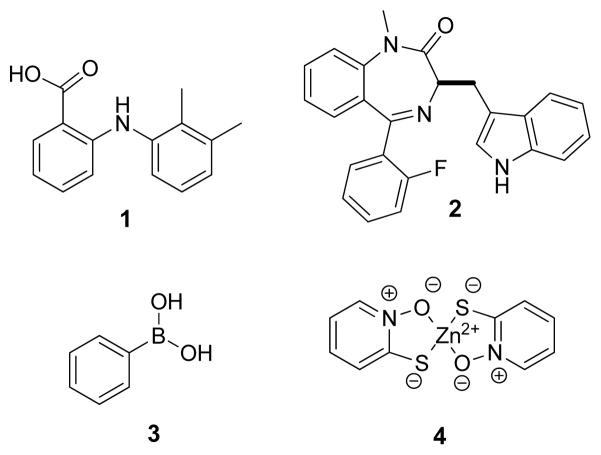
Literature reported activators of KNCQ1.Bioorg Med Chem Lett.2012 Sep 15;22(18):5936-41. |
Products are for research use only; We do not sell to patients
Copyright 2020 InvivoChem LLC | All Rights Reserved


 COA
COA