| Size | Price | Stock | Qty |
|---|---|---|---|
| 1mg |
|
||
| 5mg |
|
||
| 10mg |
|
||
| Other Sizes |


Purity: ≥98%
| Targets |
human SSTR3 ( IC50 = 0.66 nM ); mouse SSTR3 ( IC50 = 0.36 nM )
MK-4256 targets the somatostatin subtype receptor 3 (SSTR3), a G protein-coupled receptor that mediates the effects of somatostatin. Somatostatin receptors are involved in the regulation of hormone secretion, including growth hormone, insulin, and glucagon. MK-4256 is a potent and selective SSTR3 antagonist with IC50 values of 0.66 nM and 0.36 nM in human and mouse receptor binding assays, respectively. By blocking SSTR3, the compound modulates downstream signaling pathways involved in hormone release and glucose metabolism. |
|---|---|
| ln Vitro |
MK-4256 has shown selectivity for other SSTR subtypes in in vitro experiments. In human adsorptive binding assays, MK-4256 has an IC50 of >2 μM for SSTR1 and SSTR2. Although SSTR4 and SSTR5 have IC50 values below 1 μM, they are >500-fold selective. MK-4256 was tested in functional antagonist assays against SSTR4 and SSTR5. IC50 value is greater than 5 μM (at least 5000 times selectivity) [1]. -4256 dilution labeled MK-499 binds to hERG channel, IC50=1.74 μM. In functional patch clamp assays, MK-4256 demonstrated 50% amplification of hERG at a concentration of 3.4 μM [2].
In vitro, MK-4256 demonstrates potent and selective antagonistic activity against SSTR3 with IC50 values of 0.66 nM and 0.36 nM in human and mouse receptor binding assays, respectively. The compound's high potency and selectivity for SSTR3 make it a valuable tool for studying the role of this receptor in hormone regulation and metabolic processes. Specific cellular activity data, such as IC50 values for inhibition of SSTR3-mediated signaling, are not detailed in the available sources. |
| ln Vivo |
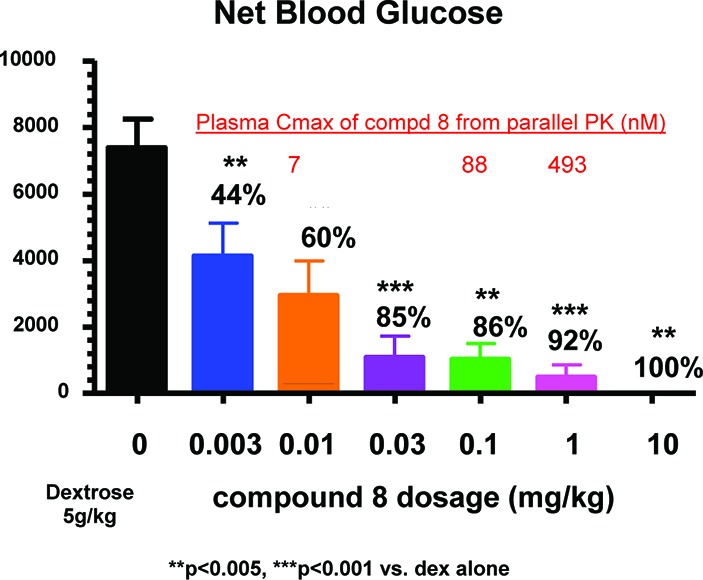
MK-4256 reduces blood glucose excursions in a dose-dependent manner, achieving maximum efficacy at doses as low as 0.03 mg/kg po. MK-4256 exhibits superior SSTR3-mediated glucose-lowering efficacy with minimal low-risk trends in a mouse oGTT model. MK-4256 achieved complete ablation of drift drift (109%) at 1 mg/kg po. MK-4256 reduced drift drift from 0.003 to 10 mg/kg in a dose-dependent manner. MK-4256 At simulated doses of 0.01, 0.1 and 1 mg/kg, MK-4256 reached Cmax of 7, 88 and 493 nM, respectively [1].
Specific in vivo activity data for MK-4256 are not detailed in the available sources. As a potent and selective SSTR3 antagonist, the compound is used in research to study the role of SSTR3 in hormone release and glucose metabolism in vivo. By blocking SSTR3 activation, MK-4256 may modulate endocrine and metabolic functions. However, specific animal model studies have not been described in the available literature. The compound is intended for research use only. |
| Enzyme Assay |
The SSTR3 binding assay for MK-4256 involves incubating the compound with membrane preparations from cells expressing human or mouse SSTR3 and a radiolabeled somatostatin ligand (such as [¹²⁵I]-somatostatin or [¹²⁵I]-Tyr¹¹-somatostatin). After incubation at room temperature for an appropriate period, bound and free ligands are separated by filtration, and the radioactivity is counted. The IC50 for displacement of the radioligand is calculated from the competition curve. Functional antagonism can be assessed using cAMP assays, as SSTR3 is coupled to Gi proteins.
|
| Cell Assay |
To evaluate the cellular activity of MK-4256, cells expressing the human or mouse SSTR3 receptor (such as CHO or HEK293 cells) are seeded in 96-well plates. Cells are pre-incubated with varying concentrations of MK-4256 and then stimulated with a somatostatin receptor agonist. The intracellular cAMP levels are measured using a cAMP assay kit, as SSTR3 activation inhibits adenylyl cyclase and reduces cAMP production. The EC50 for reversal of agonist-induced cAMP inhibition is calculated. The compound's selectivity can be assessed by testing against other somatostatin receptor subtypes (SSTR1, SSTR2, SSTR4, SSTR5).
|
| Animal Protocol |
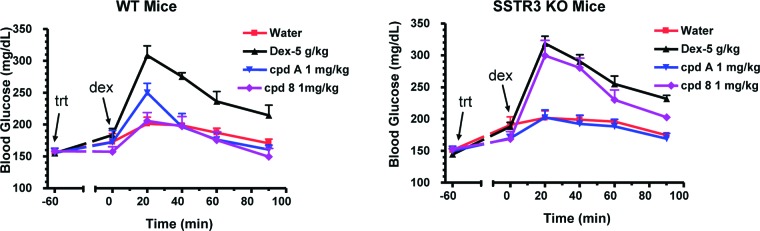
Mice: In SSTR3 KO mice, the impact of a maximally effective dosage of MK-4256 on blood glucose excursion during an oGTT was examined in order to show that the observed glucose lowering by MK-4256 is SSTR3-dependent. When given to age-matched C57BL/6N male WT mice, MK-4256 (1 mg/kg) and compound A (1 mg/kg; des-F-sitagliptin, a DPP-4 inhibitor included as a positive control) significantly reduce blood glucose excursion by 112 and 91%, respectively.
Specific in vivo animal experiment protocols for MK-4256 are not detailed in the available sources. As an SSTR3 antagonist, the compound would typically be evaluated in animal models of metabolic disorders to assess its effects on hormone release and glucose metabolism. Rodents would be administered MK-4256 orally or intraperitoneally, and blood samples would be collected for measurement of hormone levels (such as growth hormone, insulin, and glucagon) and glucose. However, specific protocols are not described in the available literature. |
| ADME/Pharmacokinetics |
Specific pharmacokinetic data for MK-4256 are not provided in the available sources. The compound is a small molecule with a molecular weight of 494.52 and a molecular formula of C27H23FN8O. It is soluble in DMSO at ≥90 mg/mL. As a powder, it is stable at -20°C for 3 years and at 4°C for 2 years. In solvent, it can be stored at -80°C for 6 months or at -20°C for 1 month. Standard pharmacokinetic studies would involve administering the compound to rodents and measuring plasma concentrations over time using LC-MS/MS.
|
| Toxicity/Toxicokinetics |
Specific toxicity data for MK-4256 are not provided in the available sources. As a research compound, it is intended for laboratory use only and is not approved for human therapeutic applications. The compound is available with a purity of ≥98%. Standard safety precautions should be followed when handling this compound, including the use of appropriate personal protective equipment.
|
| References | |
| Additional Infomation |
Somatostatin receptor 3 antagonists; structure can be found in the first article.
MK-4256 is a novel, potent, and selective SSTR3 (somatostatin subtype receptor 3) antagonist with IC50 values of 0.66 nM and 0.36 nM in human and mouse receptor binding assays, respectively. It blocks SSTR3 activation to modulate downstream signaling involved in hormone release and glucose metabolism. The compound has a molecular formula of C27H23FN8O and a molecular weight of 494.52. It is supplied for research purposes with a purity of ≥98%. |
| Molecular Formula |
C27H23FN8O
|
|---|---|
| Molecular Weight |
494.522927522659
|
| Exact Mass |
494.2
|
| Elemental Analysis |
C, 65.58; H, 4.69; F, 3.84; N, 22.66; O, 3.24
|
| CAS # |
1104599-69-0
|
| PubChem CID |
56927659
|
| Appearance |
Light yellow to yellow solid powder
|
| Density |
1.5±0.1 g/cm3
|
| Boiling Point |
826.7±75.0 °C at 760 mmHg
|
| Flash Point |
453.8±37.1 °C
|
| Vapour Pressure |
0.0±3.0 mmHg at 25°C
|
| Index of Refraction |
1.78
|
| LogP |
3.1
|
| Hydrogen Bond Donor Count |
3
|
| Hydrogen Bond Acceptor Count |
7
|
| Rotatable Bond Count |
4
|
| Heavy Atom Count |
37
|
| Complexity |
815
|
| Defined Atom Stereocenter Count |
2
|
| SMILES |
CC1=NC(=NO1)[C@]2(C3=C(C[C@@H](N2)C4=NC=C(N4)C5=CC=C(C=C5)F)C6=CC=CC=C6N3)C7=CN(N=C7)C
|
| InChi Key |
NTIFDLOQPKMIJK-AJTFRIOCSA-N
|
| InChi Code |
InChI=1S/C27H23FN8O/c1-15-31-26(35-37-15)27(17-12-30-36(2)14-17)24-20(19-5-3-4-6-21(19)32-24)11-22(34-27)25-29-13-23(33-25)16-7-9-18(28)10-8-16/h3-10,12-14,22,32,34H,11H2,1-2H3,(H,29,33)/t22-,27-/m1/s1
|
| Chemical Name |
3-[(1R,3R)-3-[5-(4-fluorophenyl)-1H-imidazol-2-yl]-1-(1-methylpyrazol-4-yl)-2,3,4,9-tetrahydropyrido[3,4-b]indol-1-yl]-5-methyl-1,2,4-oxadiazole
|
| Synonyms |
MK4256; MK-4256; MK 4256
|
| HS Tariff Code |
2934.99.9001
|
| Storage |
Powder -20°C 3 years 4°C 2 years In solvent -80°C 6 months -20°C 1 month |
| Shipping Condition |
Room temperature (This product is stable at ambient temperature for a few days during ordinary shipping and time spent in Customs)
|
| Solubility (In Vitro) |
DMSO: ≥ 100 mg/mL (~202.2 mM)
|
|---|---|
| Solubility (In Vivo) |
Solubility in Formulation 1: ≥ 3 mg/mL (6.07 mM) (saturation unknown) in 10% DMSO + 40% PEG300 + 5% Tween80 + 45% Saline (add these co-solvents sequentially from left to right, and one by one), clear solution.
For example, if 1 mL of working solution is to be prepared, you can add 100 μL of 30.0 mg/mL clear DMSO stock solution to 400 μL PEG300 and mix evenly; then add 50 μL Tween-80 to the above solution and mix evenly; then add 450 μL normal saline to adjust the volume to 1 mL. Preparation of saline: Dissolve 0.9 g of sodium chloride in 100 mL ddH₂ O to obtain a clear solution. Solubility in Formulation 2: ≥ 3 mg/mL (6.07 mM) (saturation unknown) in 10% DMSO + 90% Corn Oil (add these co-solvents sequentially from left to right, and one by one), clear solution. For example, if 1 mL of working solution is to be prepared, you can add 100 μL of 30.0 mg/mL clear DMSO stock solution to 900 μL of corn oil and mix evenly. (Please use freshly prepared in vivo formulations for optimal results.) |
| Preparing Stock Solutions | 1 mg | 5 mg | 10 mg | |
| 1 mM | 2.0222 mL | 10.1108 mL | 20.2216 mL | |
| 5 mM | 0.4044 mL | 2.0222 mL | 4.0443 mL | |
| 10 mM | 0.2022 mL | 1.0111 mL | 2.0222 mL |
*Note: Please select an appropriate solvent for the preparation of stock solution based on your experiment needs. For most products, DMSO can be used for preparing stock solutions (e.g. 5 mM, 10 mM, or 20 mM concentration); some products with high aqueous solubility may be dissolved in water directly. Solubility information is available at the above Solubility Data section. Once the stock solution is prepared, aliquot it to routine usage volumes and store at -20°C or -80°C. Avoid repeated freeze and thaw cycles.
Calculation results
Working concentration: mg/mL;
Method for preparing DMSO stock solution: mg drug pre-dissolved in μL DMSO (stock solution concentration mg/mL). Please contact us first if the concentration exceeds the DMSO solubility of the batch of drug.
Method for preparing in vivo formulation::Take μL DMSO stock solution, next add μL PEG300, mix and clarify, next addμL Tween 80, mix and clarify, next add μL ddH2O,mix and clarify.
(1) Please be sure that the solution is clear before the addition of next solvent. Dissolution methods like vortex, ultrasound or warming and heat may be used to aid dissolving.
(2) Be sure to add the solvent(s) in order.
Compound8dose dependently reduces glucose excursion in the mouse oGTT model.ACS Med Chem Lett.2012 May 7;3(6):484-9. |
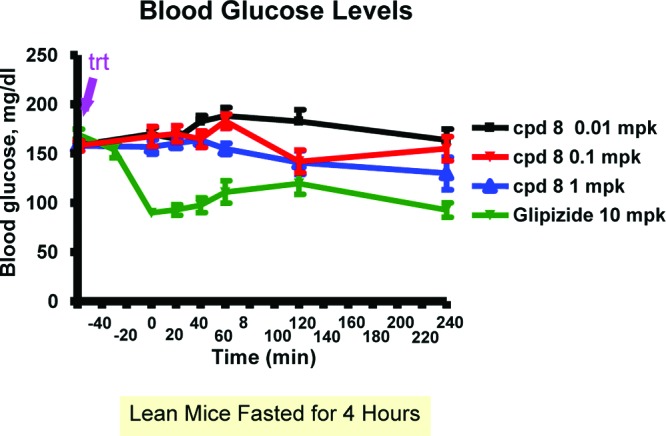
Compound8has minimal hypoglycemia risk.ACS Med Chem Lett.2012 May 7;3(6):484-9. |
Effects of8and DPP-4 inhibitor compound A (des-F sitagliptin) on oGTT glucose levels in SSTR3 KO and WT mice.ACS Med Chem Lett.2012 May 7;3(6):484-9. |
Products are for research use only; We do not sell to patients
Copyright 2020 InvivoChem LLC | All Rights Reserved


 COA
COA