| Size | Price | Stock | Qty |
|---|---|---|---|
| 10mg |
|
||
| 25mg |
|
||
| 50mg |
|
||
| 100mg |
|
||
| 250mg |
|
||
| 500mg | |||
| 1g | |||
| Other Sizes |


Purity: ≥98%
| Targets |
Selective inhibitor of fatty acid amide hydrolase (FAAH) with the following parameters:
- IC50 = 0.8 nM (recombinant human FAAH) [1] - Ki = 0.3 nM (recombinant human FAAH), Ki = 0.5 nM (recombinant mouse FAAH); no significant inhibition of monoacylglycerol lipase (MAGL), α/β-hydrolase domain-containing protein 6 (ABHD6), or cholinesterases (inhibition rate <1% at 10 μM) [2] |
|---|---|
| ln Vitro |
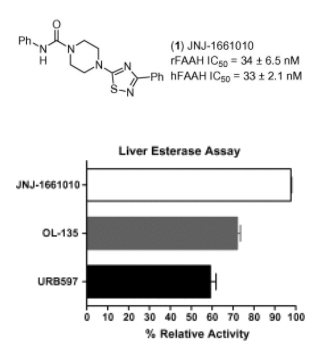
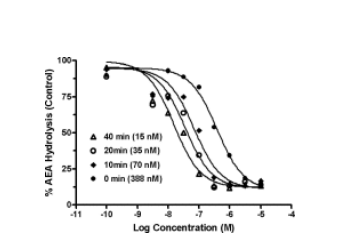
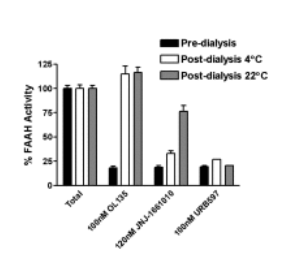
In vitro activity: FAAH preincubated with JNJ-1661010 suggests a slow reversibility of the interaction between the JNJ-1661010 and the active site, which is accelerated at higher temperatures. JNJ-1661010 is a covalent, mechanism-based substrate inhibitor as examined by LC-ESI-MS. JNJ-1661010 docks with the phenylthiadiazole in the hydrophobic tunnel and the phenylurea in the hydrophilic pocket of FAAH.
FAAH enzyme inhibitory activity: - In recombinant human FAAH assays, JNJ-1661010 showed potent concentration-dependent inhibition: at 0.1 nM, it inhibited 35% of FAAH activity; at 1 nM, inhibition reached 92%; the half-maximal inhibitory concentration (IC50) was determined as 0.8 nM [1] - In human embryonic kidney (HEK293) cells overexpressing human FAAH, JNJ-1661010 (1 nM) inhibited cellular FAAH activity by >90% after 2-hour treatment. This was accompanied by a 4.8-fold increase in intracellular anandamide (AEA) concentration (from 1.2 ± 0.3 to 5.8 ± 0.7 pmol/mg protein) [2] - Selectivity verification: - Even at a high concentration of 10 μM, JNJ-1661010 did not inhibit MAGL (inhibition <0.5%), ABHD6 (inhibition <0.8%), butyrylcholinesterase (BChE, inhibition <0.3%), or acetylcholinesterase (AChE, inhibition <0.2%), confirming high selectivity for FAAH [2] |
| ln Vivo |
In the inflammatory rat carrageenan paw model, JNJ-1661010 (Takeda-25; ip; 50 mg/kg) reduces thermal hyperalgesia[2]. T1/2 for JNJ-1661010 (ip; 10 mg/kg) in rats is 35 minutes, CL is 0.032 mL/min/kg, and Cmax is 1.58 μM[1].
Analgesic effect in mouse pain models: 1. Formalin-induced inflammatory pain model: Intraperitoneal (ip) administration of JNJ-1661010 (0.3 mg/kg, 1 mg/kg) 30 minutes before formalin injection significantly reduced pain-related behaviors. The duration of licking/biting in the late phase (15–30 minutes post-formalin) was decreased by 38% (0.3 mg/kg) and 62% (1 mg/kg) compared to the vehicle group [2] 2. Hot plate test (thermal pain model): Oral administration of JNJ-1661010 (1 mg/kg, 3 mg/kg) increased the latency to paw withdrawal by 25% (1 mg/kg) and 42% (3 mg/kg) at 1 hour post-dose, compared to the vehicle group [2] - FAAH inhibition and AEA elevation in tissues: - After oral administration of JNJ-1661010 (3 mg/kg) to mice, FAAH activity in the brain (cortex) and spinal cord was inhibited by 91% and 88%, respectively, at 2 hours post-dose. Corresponding AEA concentrations in the cortex increased by 5.2-fold (from 1.8 ± 0.4 to 9.4 ± 1.1 pmol/mg tissue) and in the spinal cord by 4.5-fold (from 2.1 ± 0.5 to 9.5 ± 1.3 pmol/mg tissue) [2] |
| Enzyme Assay |
Recombinant human FAAH activity assay :
The reaction system (200 μL) contained 50 mM Tris-HCl (pH 8.0), 1 mM EDTA, 0.1% bovine serum albumin (BSA), recombinant human FAAH (5 ng), 20 nM [3H]-anandamide ([3H]-AEA, specific activity 60 Ci/mmol), and JNJ-1661010 (0.01–10 nM). The mixture was incubated at 37°C for 20 minutes, and the reaction was terminated by adding 50 μL of 1 M hydrochloric acid. The hydrolyzed product ([3H]-arachidonic acid) was extracted with 500 μL of chloroform:methanol (2:1, v/v). After centrifugation (1000×g for 5 minutes), 200 μL of the organic phase was transferred to a scintillation vial, and radioactivity was measured using a liquid scintillation counter. The IC50 value was calculated by fitting the concentration-inhibition curve [1] - FAAH Ki determination and selectivity assay : 1. Ki determination: Recombinant human/mouse FAAH (5 ng) was incubated with JNJ-1661010 (0.05–5 nM) and different concentrations of [3H]-AEA (10–100 nM) in 50 mM Tris-HCl (pH 8.0) containing 1 mM EDTA and 0.1% BSA. After 30-minute incubation at 37°C, product extraction and radioactivity detection were performed as described above. The Ki value was determined by Lineweaver-Burk plot analysis [2] 2. Selectivity assay: The same reaction system was used to test the inhibition of JNJ-1661010 (10 μM) on MAGL (substrate: [3H]-2-arachidonoylglycerol), ABHD6 (substrate: [3H]-2-arachidonoylglycerol), AChE (substrate: [3H]-acetylcholine), and BChE (substrate: [3H]-butyrylcholine). Inhibition rates were calculated to evaluate selectivity [2] |
| Cell Assay |
HEK293 cell FAAH inhibition assay :
1. Cell culture: HEK293 cells overexpressing human FAAH were seeded in 6-well plates at 2×10⁵ cells/well and cultured in DMEM medium containing 10% fetal bovine serum (FBS) at 37°C in a 5% CO2 incubator for 24 hours [2] 2. Drug treatment: JNJ-1661010 (0.1–10 nM) was added to the medium, and cells were incubated for another 2 hours. Vehicle control group received medium containing 0.1% DMSO [2] 3. FAAH activity detection: Cells were harvested, lysed with ice-cold lysis buffer (50 mM Tris-HCl, 1 mM EDTA, 0.1% Triton X-100), and centrifuged at 12,000×g for 10 minutes at 4°C. The supernatant (50 μg protein) was used for FAAH activity assay (same as recombinant enzyme assay), and the inhibition rate was calculated [2] 4. Intracellular AEA measurement: Cell lysates were extracted with methanol, and AEA concentration was quantified by liquid chromatography-tandem mass spectrometry (LC-MS/MS) [2] |
| Animal Protocol |
Dissolved in 5% Pharmasolve: 20% Cremophor: 75% saline; 50 mg/kg; i.p. injection
Mild Thermal Injury (MTI) mice and rat models Mouse pain model and tissue FAAH/AEA detection : 1. Animals and grouping: Male CD-1 mice (8–10 weeks old, 25–30 g) were randomly divided into 4 groups (n=8 per group): vehicle control (0.5% CMC-Na + 5% DMSO), JNJ-1661010 0.3 mg/kg (ip), 1 mg/kg (ip), and 3 mg/kg (oral) [2] 2. Drug preparation: JNJ-1661010 was dissolved in DMSO and diluted with 0.5% carboxymethyl cellulose sodium (CMC-Na) to a final DMSO concentration of 5% [2] 3. Pain behavior testing: - Formalin test: 30 minutes after JNJ-1661010 administration, 20 μL of 5% formalin was injected into the right hind paw. The duration of licking/biting the paw was recorded in the early phase (0–5 minutes) and late phase (15–30 minutes) [2] - Hot plate test: 1 hour after oral administration of JNJ-1661010, the mouse was placed on a hot plate (55 ± 0.5°C), and the latency to paw withdrawal was recorded (cut-off time: 30 seconds to avoid tissue damage) [2] 4. Tissue sampling and analysis: 2 hours after drug administration, mice were euthanized. The cerebral cortex and spinal cord were dissected, homogenized in ice-cold methanol, and centrifuged at 15,000×g for 10 minutes at 4°C. The supernatant was used for AEA quantification (LC-MS/MS), and the pellet was used for FAAH activity assay (recombinant enzyme assay method) [2] |
| Toxicity/Toxicokinetics |
Acute toxicity: No deaths or obvious toxic symptoms (e.g., ataxia, lethargy, weight loss) were observed in mice after a single intraperitoneal injection of JNJ-1661010 (up to 30 mg/kg) within 72 hours [2]
- Liver and kidney safety: After 24 hours of treatment with JNJ-1661010 (oral administration of 3 mg/kg or intraperitoneal injection of 1 mg/kg), there were no significant differences in serum alanine aminotransferase (ALT), aspartate aminotransferase (AST), blood urea nitrogen (BUN), and creatinine levels between mice and the solvent control group [2] - Plasma protein binding rate: JNJ-1661010 showed a high plasma protein binding rate (97.2% ± 1.5%) in mouse plasma as determined by balanced dialysis (dialysis buffer: 50 mM Tris-HCl, pH 7.4; incubation time: 4 hours). 37°C) [2] |
| References |
|
| Additional Infomation |
JNJ-1661010 is an N-arylpiperazine. JNJ-1661010 is a synthetic thiadiazolpiperazinylurea derivative and a mechanistic (irreversible) inhibitor of FAAH. JNJ-1661010 mediates irreversible inhibition of FAAH by covalently binding to serine residues at the active site of FAAH, resulting in long-term inhibition of enzyme activity[2]. JNJ-1661010 exhibits high efficiency (IC50 = 0.8 nM, Ki = 0.3 nM) and high selectivity against FAAH, making it a valuable tool compound for studying the role of the endocannabinoid system in pain, inflammation, and metabolic disorders[1][2]. In vivo studies have confirmed that JNJ-1661010 can cross the blood-brain barrier (BBB) and exhibit significant FAAH inhibition and elevated AEA levels in the cerebral cortex, supporting its potential for central nervous system (CNS)-mediated pain management [2].
|
| Molecular Formula |
C19H19N5OS
|
|
|---|---|---|
| Molecular Weight |
365.45
|
|
| Exact Mass |
365.131
|
|
| CAS # |
681136-29-8
|
|
| Related CAS # |
|
|
| PubChem CID |
2809273
|
|
| Appearance |
White to off-white solid powder
|
|
| Density |
1.3±0.1 g/cm3
|
|
| Melting Point |
240.48 °C
|
|
| Index of Refraction |
1.679
|
|
| LogP |
2.57
|
|
| Hydrogen Bond Donor Count |
1
|
|
| Hydrogen Bond Acceptor Count |
5
|
|
| Rotatable Bond Count |
3
|
|
| Heavy Atom Count |
26
|
|
| Complexity |
459
|
|
| Defined Atom Stereocenter Count |
0
|
|
| SMILES |
O=C(NC1=CC=CC=C1)N(CC2)CCN2C3=NC(C4=CC=CC=C4)=NS3
|
|
| InChi Key |
BHBOSTKQCZEAJM-UHFFFAOYSA-N
|
|
| InChi Code |
InChI=1S/C19H19N5OS/c25-18(20-16-9-5-2-6-10-16)23-11-13-24(14-12-23)19-21-17(22-26-19)15-7-3-1-4-8-15/h1-10H,11-14H2,(H,20,25)
|
|
| Chemical Name |
N-phenyl-4-(3-phenyl-1,2,4-thiadiazol-5-yl)piperazine-1-carboxamide
|
|
| Synonyms |
|
|
| HS Tariff Code |
2934.99.9001
|
|
| Storage |
Powder -20°C 3 years 4°C 2 years In solvent -80°C 6 months -20°C 1 month |
|
| Shipping Condition |
Room temperature (This product is stable at ambient temperature for a few days during ordinary shipping and time spent in Customs)
|
| Solubility (In Vitro) |
DMSO: 36 mg/mL (98.5 mM)
Water: 1 mg/mL (Insoluble) Ethanol: 1 mg/mL |
|---|---|
| Solubility (In Vivo) |
Solubility in Formulation 1: ≥ 2.5 mg/mL (6.84 mM) (saturation unknown) in 10% DMSO + 90% (20% SBE-β-CD in Saline) (add these co-solvents sequentially from left to right, and one by one), clear solution.
For example, if 1 mL of working solution is to be prepared, you can add 100 μL of 25.0 mg/mL clear DMSO stock solution to 900 μL of 20% SBE-β-CD physiological saline solution and mix evenly. Preparation of 20% SBE-β-CD in Saline (4°C,1 week): Dissolve 2 g SBE-β-CD in 10 mL saline to obtain a clear solution. Solubility in Formulation 2: ≥ 2.5 mg/mL (6.84 mM) (saturation unknown) in 10% DMSO + 90% Corn Oil (add these co-solvents sequentially from left to right, and one by one), clear solution. For example, if 1 mL of working solution is to be prepared, you can add 100 μL of 25.0 mg/mL clear DMSO stock solution to 900 μL of corn oil and mix evenly. View More
Solubility in Formulation 3: 5% DMSO+95% Corn oil:5mg/mL |
| Preparing Stock Solutions | 1 mg | 5 mg | 10 mg | |
| 1 mM | 2.7364 mL | 13.6818 mL | 27.3635 mL | |
| 5 mM | 0.5473 mL | 2.7364 mL | 5.4727 mL | |
| 10 mM | 0.2736 mL | 1.3682 mL | 2.7364 mL |
*Note: Please select an appropriate solvent for the preparation of stock solution based on your experiment needs. For most products, DMSO can be used for preparing stock solutions (e.g. 5 mM, 10 mM, or 20 mM concentration); some products with high aqueous solubility may be dissolved in water directly. Solubility information is available at the above Solubility Data section. Once the stock solution is prepared, aliquot it to routine usage volumes and store at -20°C or -80°C. Avoid repeated freeze and thaw cycles.
Calculation results
Working concentration: mg/mL;
Method for preparing DMSO stock solution: mg drug pre-dissolved in μL DMSO (stock solution concentration mg/mL). Please contact us first if the concentration exceeds the DMSO solubility of the batch of drug.
Method for preparing in vivo formulation::Take μL DMSO stock solution, next add μL PEG300, mix and clarify, next addμL Tween 80, mix and clarify, next add μL ddH2O,mix and clarify.
(1) Please be sure that the solution is clear before the addition of next solvent. Dissolution methods like vortex, ultrasound or warming and heat may be used to aid dissolving.
(2) Be sure to add the solvent(s) in order.
|
|---|
|
|
Products are for research use only; We do not sell to patients
Copyright 2020 InvivoChem LLC | All Rights Reserved


 COA
COA