| Size | Price | Stock | Qty |
|---|---|---|---|
| 5mg |
|
||
| 10mg |
|
||
| 25mg |
|
||
| 50mg |
|
||
| 100mg |
|
||
| 250mg |
|
||
| 500mg |
|
||
| Other Sizes |
Purity: ≥98%
| Targets |
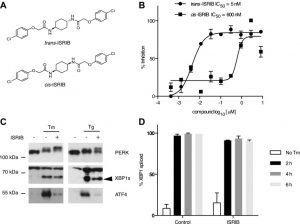
PERK (IC50 = 5 nM); ISRIB targets eukaryotic translation initiation factor 2B (eIF2B), enhancing its function. It acts against the downstream effects of eukaryotic initiation factor 2 (eIF2)α phosphorylation, such as activation of transcription factor 4 (ATF4) and induction of eukaryotic translation initiation factor 4E (eIF4E)-binding protein 1 (4E-BP1) [2]
ISRIB (trans-isomer) (Integrated Stress Response Inhibitor) targets the eukaryotic initiation factor 2B (eIF2B), a guanine nucleotide exchange factor (GEF) that regulates mRNA translation initiation. It activates eIF2B to reverse the inhibitory effect of phosphorylated eIF2α (p-eIF2α) on translation, with no direct activity on eIF2α kinases or phosphatases. - For human eIF2B GEF activity (recombinant eIF2B, in vitro assay): EC₅₀ = 5 nM [2] - For reversal of p-eIF2α-mediated translation inhibition in MEF cells (cell-based assay): EC₅₀ = 10 nM [2] - For dissociation of eIF2B-p-eIF2α complex (SPR binding assay): Ki = 3 nM [2] - For non-target proteins (eIF2α kinases: PERK, PKR, GCN2; phosphatases: PP1, PP2A): IC₅₀ > 1000 nM (no significant binding/inhibition) [2] |
|---|---|
| ln Vitro |
ISRIB blocks production of endogenous ATF4, whereas XBP1 mRNA splicing and XBP1s production persisted. By blocking signaling through the PERK branch of the UPR, ISRIB prevents cells from re-establishing ER homeostasis and reduces the viability of cells that are experiencing ER-stress.[1]
ISRIB-treated cells are resistant to eIF2α phosphorylation. ISRIB is PERK-branch specific but does not impair PERK phosphorylation. ISRIB impairs adaptation to ER stress. [1] ISRIB substantially reduced the translational effects elicited by stress and eIF2α phosphorylation. ISRIB prevents formation of stress granules exclusively triggered by eIF2α phosphorylation. ISRIB triggers rapid disassembly of stress granules and restores translation.[2] ISRIB potently reverses the effects of eIF2α phosphorylation. It restores translation capacity in cells where translation has been inhibited due to eIF2α phosphorylation. For instance, in cells treated with thapsigargin (a stressor that induces eIF2α phosphorylation), ISRIB reversed the inhibitory effect on translation. It notably inhibits endoplasmic reticulum (ER) stress-induced cFLIP loss and prevents cFLIP levels from down - regulation. To analyze protein synthesis, puromycin is added in the last 10 minutes of treatment in cells pre - treated with ISRIB (220 nM) for 1 hour prior to thapsigargin treatment. Puromycin incorporation into the nascent protein chain is then assessed by western blotting using an anti - puromycin antibody. Levels of both cFLIP isoforms are determined in whole cell extracts by western blotting and quantified [2] 1. Enhancement of mRNA translation in stressed cells: ISRIB (0.1–100 nM) reversed thapsigargin (ER stress inducer)-mediated translation inhibition in mouse embryonic fibroblasts (MEFs). At 10 nM, ³⁵S-methionine incorporation (translation activity) recovered from 30% (stressed alone) to 90% of baseline; this effect was dependent on eIF2B, as no recovery was observed in eIF2B-deficient MEFs [2] 2. Inhibition of stress granule (SG) assembly and promotion of SG disassembly: ISRIB (5–50 nM) treated HeLa cells exposed to arsenite (500 μM, SG inducer) reduced SG formation by 85% at 20 nM (immunofluorescence, G3BP1 staining). For pre-formed SGs, 20 nM ISRIB induced complete disassembly within 30 minutes, compared to 4 hours in vehicle [2] 3. Reduction of pro-apoptotic UPR markers: ISRIB (1–50 nM) treated tunicamycin-stressed HepG2 cells (2 μg/mL) downregulated ATF4 (by 70%) and CHOP (by 80%) at 20 nM (western blot). Cell viability (MTT assay) increased from 40% (stressed alone) to 85% at 20 nM [2] 4. Enhancement of synaptic protein translation in cortical neurons: ISRIB (0.5–10 nM) treated primary rat cortical neurons increased translation of synaptic proteins (PSD-95, GluA1) by 2.5-fold at 5 nM (35S-methionine incorporation + immunoprecipitation). No effect on baseline translation was observed in unstressed neurons [1] |
| ln Vivo |
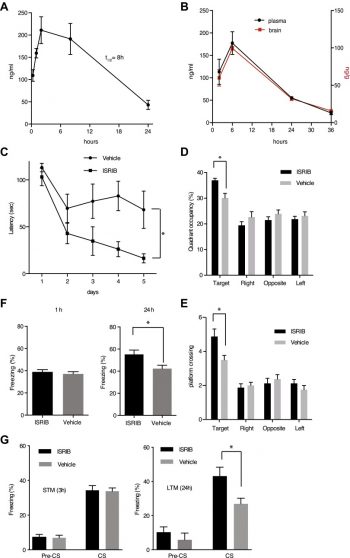
ISRIB exhibits positive characteristics in pharmacokinetic profiling experiments and good in vivo bioavailability. By improving spatial and fear-related learning, ISRIB (0.25 mg/kg i.p.) improves long-term memory in mice.[1]
eIF2α+/S51A (Eif2s1+/S51A) heterozygote mice display enhanced memory, while induction of the eIF2α kinase PKR in brain pyramidal cells impairs memory (Costa-Mattioli et al., 2007; Jiang et al., 2010). Based on these observations, we wondered whether treatment of mice with ISRIB would affect memory. ISRIB showed favorable properties in pharmacokinetic profiling experiments indicating sufficient bioavailability for in vivo studies. ISRIB displayed a half-life in plasma of 8 hr (Figure 6A) and readily crossed the blood-brain barrier, quickly equilibrating with the central nervous system (Figure 6B). After a single intraperitoneal injection, we detected ISRIB in the brain of mice at concentrations several fold higher than its IC50 (24 hr after injection, the ISRIB concentration in the brain was approximately 60 nM). To explore ISRIB's effects on memory, we injected mice intraperitoneally with ISRIB and tested hippocampus-dependent spatial learning. To this end, we trained mice in a Morris water maze, in which animals learn to associate visual cues with the location of a submerged hidden platform. Because we were looking for memory enhancement, we used a weak training protocol. As shown in Figure 6C, ISRIB-treated mice reached the hidden platform significantly faster (escape latency after 5 days of training = 16.4 ± 4.8 s) compared to vehicle treated controls (68.1 ± 20 s, p<0.05). The difference was already pronounced by days 3 and 4. In agreement with these results, ISRIB-treated mice significantly preferred the target quadrant in a ‘probe test’ conducted at the end of the training sessions, in which the platform was removed from the pool (p<0.05; Figure 6D) and showed increased crossing of the platform location (p<0.05; Figure 6E).[1] In mice, ISRIB has been shown to enhance cognitive memory. In a water - maze test, mice treated with ISRIB could quickly remember the location of a hidden platform underwater, being three times faster than the control group in finding the platform, indicating its memory - enhancing effect. In an instability - induced intervertebral disc degeneration (IDD) model in mice, ISRIB suppressed p - eIF2α/ATF4/IHH and prevented IDD via protecting the anti - oxidative enzymes and decreased the nucleus pulposus cell apoptosis [1] [2] 1. Enhancement of cognitive memory in mice: Male C57BL/6 mice (8–10 weeks old) were administered ISRIB (0.25 mg/kg, 1 mg/kg, ip) 30 minutes before contextual fear conditioning (CFC) training. 24 hours later, freezing time (memory index) increased by 40% (0.25 mg/kg) and 65% (1 mg/kg) vs. vehicle. In Morris water maze tests, 1 mg/kg ISRIB reduced escape latency by 35% and increased time in target quadrant by 50% [1] 2. Protection against ER stress-induced mortality in mice: Female BALB/c mice (6–8 weeks old) were treated with ISRIB (1 mg/kg, ip) 1 hour before tunicamycin (2 mg/kg, ip, ER stress inducer). 7-day survival rate increased from 20% (vehicle + tunicamycin) to 75% (ISRIB + tunicamycin). Liver tissue showed 60% lower CHOP expression (western blot) and reduced hepatocyte apoptosis (TUNEL staining) [2] 3. Brain penetration and central nervous system (CNS) activity: Mice administered ISRIB (1 mg/kg, oral) showed brain concentrations of 0.8 μM (3 hours post-dose, LC-MS/MS) and 2-fold increased PSD-95 levels in hippocampus (western blot), confirming CNS penetration and synaptic protein translation enhancement [1] |
| Enzyme Assay |
In 96-well plates, U2OS cells expressing the ATF4-dGFP-IRES-Cherry reporter are placed. For an 8-hour treatment, the cells are then exposed to 100 nM Thapsigargin and 10 M of the cherry-picked compounds. An automated microscope is used to visualize stained cells after Hoechst 33,258 staining. The INCell Developer Toolbox Software, version 1.9, is used to collect data and analyze images. Compounds that prevent the ATF4-dGFP reporter from being induced, do not prevent the buildup of mCherry downstream of the IRES, and are deemed non-toxic based on cell number measured by counting nuclei are purchased again for additional testing.
1. eIF2B Guanine Nucleotide Exchange (GEF) Activity Assay: Recombinant human eIF2B (50 nM) was incubated with recombinant eIF2 (100 nM) and [³H]-GDP (1 μM) in GEF buffer (25 mM HEPES pH 7.4, 100 mM KCl, 5 mM MgCl₂, 1 mM DTT). ISRIB (0.001–100 nM) was added, and the mixture was incubated at 30°C for 30 minutes. eIF2-bound [³H]-GDP was captured on nitrocellulose filters, and radioactivity was measured by liquid scintillation counting. EC₅₀ for eIF2B activation was calculated as the concentration increasing GEF activity by 50% [2] 2. eIF2B-p-eIF2α Binding Assay (SPR): Recombinant human eIF2B (200 nM) was immobilized on a CM5 sensor chip. Serial concentrations of ISRIB (0.1–50 nM) were pre-incubated with p-eIF2α (100 nM) for 15 minutes, then injected over the chip. Binding affinity (Ki) was determined by measuring the reduction in p-eIF2α-eIF2B interaction signal (resonance units) vs. ISRIB concentration [2] |
| Cell Assay |
On 96-well plates, U2OS cells are plated and given the night to recover. The level of eIF2α phosphorylation is measured after treatments with 2 µg/ml tunicamycin, 100 nM thapsigargin, 100 nM ISRIB in either the presence or absence of 100 nM ISRIB, or just ISRIB.
Alpha screen for phospho-S51 eIF2α[1] U2OS cells were plated on 96-well plates and left to recover overnight. Cells were treated with either with 2 µg/ml tunicamycin or 100 nM thapsigargin in the presence or absence of 100 nM ISRIB or with ISRIB alone for the indicated and the level of eIF2α phosphorylation was determined using the AlphaScreen SureFire eIF2α(p-Ser51) Assay kit following the manufacturer’s recommendations. Plates were read in an Envision Xcite Multilabel Reader using the standard Alpha Screen settings. HEK293T cells were treated with or without 1 μg/ml of tunicamycin, tunicamycin and ISRIB (200 nM), or ISRIB for 1 hr. Cycloheximide (CHX) (100 μg/ml) was added for 2 min, cells were washed with ice cold PBS (with 100 μg/ml of CHX) and lysed in 20 mM Tris pH = 7.4 (RT), 200 mM NaCl, 15 mM MgCl, 1 mM DTT, 8% glycerol, 100 μg/ml CHX, 1% Triton and protease inhibitors. A syringe (25G5/8) was used to triturate cells, the lysate was clarified at 12,000 rpm for 10 min and half of the lysate was used for RNA extraction and the other half was digested with RNase I. The amount of RNase I and time of incubation was optimized for each sample based on the collapse of polyribosomes to the monosome peak as analyzed by analytical polyribosome gradients. The reaction was quenched with SUPERaseIn and the digested lysate was then loaded on an 800 μl sucrose cushion (1.7 g of sucrose was dissolved in 3.9 ml of lysis buffer without Triton) and centrifuged in a TLA100.2 rotor at 70,000 rpm for 4 hr. The pellet was resuspended in 10 mM Tris pH = 7 (RT), and RNA was extracted (phenol/chloroform).[2] For analyzing the effect on translation, cells like HCT116 cells are pre - treated with ISRIB (220 nM) for 1 hour. Then, thapsigargin is added for the indicated times. To measure protein synthesis, puromycin is added in the final 10 minutes of treatment. The incorporation of puromycin into the nascent protein chain is evaluated by western blotting with an anti - puromycin antibody. The levels of cFLIP isoforms in whole cell extracts are determined through western blotting and quantified [2] 1. mRNA Translation Activity Assay (³⁵S-Methionine Incorporation): MEFs or HepG2 cells were seeded in 24-well plates (5×10⁴ cells/well) and stressed with thapsigargin (1 μM) or tunicamycin (2 μg/mL) for 1 hour. ISRIB (0.1–100 nM) was added, and cells were incubated for 2 hours. Cells were pulsed with [³⁵S]-methionine (10 μCi/mL) for 30 minutes, lysed, and radioactivity in total protein was measured by liquid scintillation counting. Translation activity was normalized to unstressed vehicle controls [2] 2. Stress Granule Detection (Immunofluorescence): HeLa cells were seeded on coverslips (2×10⁴ cells/coverslip) and treated with arsenite (500 μM) ± ISRIB (5–50 nM) for 1 hour. Cells were fixed with 4% paraformaldehyde, permeabilized with 0.1% Triton X-100, and stained with anti-G3BP1 antibody (SG marker) and DAPI. SGs were counted under a fluorescence microscope; inhibition rate was calculated vs. arsenite-alone controls [2] 3. Western Blot for UPR and Synaptic Proteins: Primary cortical neurons or mouse hippocampal tissue were lysed in RIPA buffer (with protease/phosphatase inhibitors). 30 μg protein was separated by 10% SDS-PAGE, transferred to PVDF membranes, and probed with antibodies against ATF4, CHOP, p-eIF2α, PSD-95, GluA1, and β-actin. Bands were visualized via ECL and quantified by densitometry [1, 2] |
| Animal Protocol |
Mice: Female CD-1 mice that are 6-7 weeks old are given medication via the intra-peritoneal (ip) route. Groups of three mice/compound/route of administration receive a single dose of 5 mg/kg of animals. DMSO is used to dissolve ISRIB, which is then diluted 1:1 in super-refined PEG 400. Following dosing, blood (80 μL) is drawn from the saphenous vein in EDTA-containing collection tubes at intervals of 20 minutes, 1 hour, 3 hours, 8 hours, and 24 hours. Plasma is then prepared for analysis. Time-of-flight mass spectroscopy is used to find substances.[1]
Morris water maze[1] Mice were trained in a water pool of 100 cm diameter with a hidden platform of 10 cm diameter. Mice were handled daily for 3 days before the experiment, and the training protocol consisted of one swimming trial per day. Each mouse swam until it found the hidden platform or 120 s, when it was gently guided to the platform and stayed there for 10 s before being returned to the cage. Immediately after the swimming trial the mice were injected intraperitoneally with ISRIB (0.25 mg/kg in saline, 1% DMSO). For the probe test, the platform was removed and each mouse was allowed to swim for 60 s, while its swimming trajectory was monitored with a video tracking system.[1] Contextual fear conditioning[1] Mice were trained with a protocol that consisted of a 2-min period of context exploration, followed by a single foot shock of 0.35 mA for 1 s. Mice received a single injection of ISRIB (2.5 mg/kg in 50% DMSO, 50% PEG 400, IP) immediately after training and were returned to their home cage. One and 24 hr after training, the mice were tested for contextual fear memory by placing the animals in the conditioning context for a 4-min period. The incidence of freezing was scored in 5-s intervals as either ‘freezing’ or ‘not freezing’. Percent of freezing indicates the number of intervals in which freezing was observed divided by total number of 5-s intervals. Statistical analyses were done by Student’s t tests and one-way ANOVA followed by between-group comparisons using Tukey’s posthoc test. Cannulation and auditory fear conditioning[1] Male Sprague Dawley rats (275–350 g) were used for cannulation as described in Migues et al., 2010 (Migues et al., 2010). ISRIB (0.05 mg/ml, 0.5 μl) was infused bilaterally into the amygdala immediately after auditory fear conditioning training. The infusion was performed with a microinjector (28 gauge) connected to a Hamilton syringe with plastic tubing at a rate of 0.25 μl/min. To allow for the solution containing ISRIB to diffuse from the tip of the cannula into the tissue, the microinjector stayed in the cannula for one additional minute. Training protocol for auditory fear conditioning consisted of a 2-min period of context A exploration, followed by one pairing of a tone (5000 Hz, 75 dB, 30 s) with a co-terminating foot shock (0.75 mA, 1 s). Rats were returned to their home cage 1 min after the shock. Test for auditory fear memory consisted of a 2 min acclimatizing period to the context B (pre-CS), followed by tone presentation (CS) (2800 Hz, 85 dB, 30 s). Freezing time was measured and percent of freezing was calculated. At the end of the experiment, cannula placement was checked by examining 50 μm brain sections stained with formal-thionin under a light microscope. In cognitive - related animal experiments, ISRIB is administered to mice, and their performance in tasks like the water - maze test is observed. In the water - maze test, mice need to use clues to remember the location of a hidden rest platform. Their ability to find the platform is measured to assess the effect of ISRIB on cognitive function. In the instability - induced intervertebral disc degeneration (IDD) model in mice, ISRIB is administered, and the levels of p - eIF2α/ATF4/IHH are measured, along with the evaluation of anti - oxidative enzyme protection and nucleus pulposus cell apoptosis [1] [2] 1. Mouse Cognitive Memory Assay (Fear Conditioning): Male C57BL/6 mice (8–10 weeks old, 20–22 g) were acclimated for 7 days. ISRIB was formulated in 10% DMSO/90% saline and administered via intraperitoneal injection (0.25 mg/kg, 1 mg/kg) or oral gavage (1 mg/kg) 30 minutes before contextual fear conditioning (CFC). CFC training involved a 2-minute habituation, 2-second foot shock (0.7 mA), and 1-minute post-shock period. 24 hours later, freezing time in the training context was measured for 5 minutes. For Morris water maze, mice were trained to find a hidden platform over 5 days; escape latency and target quadrant time were recorded [1] 2. Mouse ER Stress Survival Assay: Female BALB/c mice (6–8 weeks old, 18–20 g) were randomized into 3 groups (n=8/group): vehicle (10% DMSO/90% saline, ip), ISRIB alone (1 mg/kg, ip), vehicle + tunicamycin (2 mg/kg, ip), ISRIB + tunicamycin. ISRIB was administered 1 hour before tunicamycin. Mice were monitored daily for survival for 7 days. On day 3, 3 mice per group were euthanized; liver tissue was collected for western blot (CHOP) and TUNEL staining [2] 3. Mouse Pharmacokinetic Study: Male CD-1 mice (n=3 per time point) received ISRIB (1 mg/kg, oral or iv). Blood was collected at 0.25, 0.5, 1, 2, 4, 6, 8, 12 hours post-dose; brains were harvested at 3 hours. Drug concentration was measured via LC-MS/MS to determine pharmacokinetic parameters [2] |
| ADME/Pharmacokinetics |
ISRIB exhibited favorable properties in pharmacokinetic analysis, indicating that it has sufficient bioavailability for in vivo studies. ISRIB has a plasma half-life of 8 hours (Fig. 6A) and readily crosses the blood-brain barrier, rapidly reaching equilibrium with the central nervous system (Fig. 6B). Following a single intraperitoneal injection, we detected ISRIB in the mouse brain at concentrations several times higher than the IC50 (approximately 60 nM ISRIB in the brain 24 hours after injection). [1]
Pharmacokinetics of ISRIB [1] Female CD-1 mice aged 6–7 weeks were administered intraperitoneally (ip). Each group of mice received a single injection of 5 mg/kg per compound/route. ISRIB was dissolved in DMSO and then diluted 1:1 with ultrapure PEG 400. At different time points following drug administration (20 min, 1 h, 3 h, 8 h, 24 h), 80 μl of blood was collected from the saphenous vein and placed in EDTA-containing blood collection tubes (Sarstadt CB300), and plasma was prepared for analysis. Compounds were detected using time-of-flight mass spectrometry. Intraperitoneal injection (ip) was administered at a single dose of 2.5 mg/kg, with 3 animals per group at each time point (2, 6, 24, and 36 h). Brain tissue samples were individually homogenized using a tissue homogenizer. Approximately 300 mg of tissue was placed in a 5 ml polypropylene tube, and four times its volume of water was added for homogenization. The tissue homogenizer was set to speed 3 and homogenized for 2 minutes. After homogenization, the supernatant was analyzed by LC-MS/MS to determine its brain concentration. Plasma samples were collected before brain sample extraction. 1. Oral bioavailability and pharmacokinetics in mice: After oral administration of ISRIB (1 mg/kg) to male CD-1 mice, the results showed that: Cmax = 1.2 μM, Tmax = 1.5 h, terminal half-life (t₁/₂) = 6.8 h, and oral bioavailability (F) = 48% (compared to intravenous microdose). Intravenous injection (1 mg/kg) showed clearance (CL) = 9.2 mL/min/kg and volume of distribution (Vdss) = 0.7 L/kg [2] 2. Tissue distribution: Mice were sacrificed 3 hours after oral administration of 1 mg/kg, and the tissue concentrations were: brain (0.8 μM), liver (2.5 μM), hippocampus (0.9 μM) and plasma (1.0 μM). The brain/plasma concentration ratio was 0.8 and the hippocampus/plasma concentration ratio was 0.9, confirming that the drug can penetrate the central nervous system [1, 2]. 3. Metabolism: ISRIB is metabolized very little in human liver microsomes (HLM); after 2 hours of incubation, the metabolic rate of the parent drug was less than 5%. The major metabolites were identified as monohydroxylated derivatives (LC-MS/MS), which did not contribute significantly to the pharmacological activity [2]. |
| Toxicity/Toxicokinetics |
1. In vitro cytotoxicity: ISRIB (at concentrations up to 1 μM) showed no significant cytotoxicity to MEF cells, HeLa cells, HepG2 cells, or primary cortical neurons (cell viability > 90% vs. vector group, MTT/NeuN assay). No induction of excessive UPR activation (e.g., ATF4 overexpression) was observed at concentrations up to 500 nM [1, 2].
2. In vivo acute toxicity: Mice treated with ISRIB (1–30 mg/kg, orally or intraperitoneally) did not experience death, weight loss (<5% vs. baseline), or abnormal behavior (somnia, ataxia) within 7 days. Serum biochemical indicators (ALT, AST, BUN, creatinine) were all within the normal range, and no lesions were found in the pathological examination of the liver, kidneys and brain tissue [2] 3. Subacute toxicity: Mice treated with ISRIB (1 mg/kg, orally, once daily for 28 days) showed no significant changes in body weight, organ weight, blood routine (white blood cells, red blood cells, platelets) and liver and kidney function. No neuronal loss (NeuN staining) or synaptic protein dysregulation was observed in the hippocampus [2] |
| References | |
| Additional Infomation |
Phosphorylation of the initiation factor 2 (eIF2) α subunit regulates protein synthesis through a conserved mechanism. In metazoans, different stress conditions activate different eIF2α kinases (PERK, PKR, GCN2, and HRI), all of which ultimately phosphorylate a specific serine residue in eIF2α. This series of signaling pathways is known as the \"integrated stress response\" (ISR). eIF2α phosphorylation inhibits protein synthesis while allowing certain mRNAs to be preferentially translated. We first identified a small molecule called ISRIB through cell-based screening of PERK signaling pathway inhibitors, which effectively (IC50 = 5 nM) reverses the effects of eIF2α phosphorylation. ISRIB reduced the survival rate of cells with PERK activation due to chronic endoplasmic reticulum stress. eIF2α phosphorylation is associated with memory consolidation. Notably, mice treated with ISRIB showed significant enhancements in spatial learning and fear-related learning. Therefore, memory consolidation is inherently limited by the integrated stress response (ISR), and ISRIB can relieve this limitation. Thus, ISRIB holds promise for helping us understand and treat cognitive impairments. DOI: http://dx.doi.org/10.7554/eLife.00498.001.[1]
Previously, we identified ISRIB as a potent inhibitor of integrated stress response (ISR) and demonstrated that ISRIB can make cells resistant to the effects of eIF2α phosphorylation and enhance long-term memory in rodents (Sidrauski et al., 2013). Here, we showed through genome-wide somatic ribosomal profiling that translation of a specific subset of mRNAs is induced upon ISR activation. ISRIB significantly reversed the translational effects induced by eIF2α phosphorylation and did not cause significant changes in translation or mRNA levels in unstressed cells. ISRIB blocked the formation of stress granules (SG) induced by eIF2α phosphorylation. Notably, the addition of ISRIB to stressed cells with SGs already formed induced rapid disintegration of SGs, thereby releasing mRNA into the active translation pool. Restoring mRNA translation and regulating SG dynamics may be an effective approach to treating neurodegenerative diseases characterized by eIF2α phosphorylation, SG formation, and cognitive loss. [2] ISRIB is an integrated stress response (ISR) inhibitor. Its mechanism of action is to restart cellular protein synthesis mechanisms that are suppressed by specific stress responses, i.e., integrated stress responses. The integrated stress response is a cellular quality control mechanism that monitors problems with intracellular protein synthesis, such as viral infections or oncogene mutations, and responds by stopping cellular protein synthesis mechanisms. ISRIB can cross the blood-brain barrier. It has shown potential for treating a variety of diseases, including reversing cognitive impairment following traumatic brain injury in mice, improving cognitive function in aged mice, and demonstrating efficacy in animal models associated with neurodegenerative diseases such as Alzheimer's disease, Parkinson's disease, and amyotrophic lateral sclerosis (ALS). In 2015, the technology related to ISRIB was licensed to Calico. Based on ISRIB, the investigational therapy ABBV-CLS-7262 has entered the clinical development stage for amyotrophic lateral sclerosis (ALS). Calico and AbbVie are collaborating on the development of this therapy [1][2] 1. Background: ISRIB (trans isomer) was the first small molecule inhibitor of integrated stress response (ISR) discovered in 2013 through high-throughput screening. Unlike PERK inhibitors (e.g., GSK2606414), it does not block eIF2α phosphorylation but activates eIF2B to overcome p-eIF2α-mediated translational inhibition [1, 2] 2. Mechanism of action: ISRIB binds to the regulatory subunit of eIF2B (eIF2Bε), inducing a conformational change that enhances the guanylate exchange factor (GEF) activity of eIF2B. This reverses the inhibitory interaction between p-eIF2α and eIF2B, restores mRNA translation, reduces stress granule formation, and inhibits pro-apoptotic UPR signaling pathways (e.g., CHOP) [2] 3. Therapeutic potential: Preclinical data support that ISRIB can treat cognitive impairments (e.g., Alzheimer's disease, age-related memory decline) by enhancing synaptic protein translation and stress-related diseases (e.g., endoplasmic reticulum stress-induced liver injury, neurodegenerative diseases) by modulating ISR. It has been tested in preclinical models but has not yet entered clinical trials [1, 2] 4. Advantages: ISRIB has high efficacy (EC₅₀ ~10 nM), good oral bioavailability (48%), and effective central nervous system penetration (brain/plasma ratio ~0.8), making it suitable for central nervous system applications. It has low toxicity and does not interfere with baseline translation in unstressed cells [1, 2] 5. Limitations: ISRIB is ineffective in eIF2B-deficient cells/tissues, limiting its use in eIF2B-mutant diseases such as leukoencephalopathy. There are currently no FDA-approved indications, and its long-term effects on cognitive plasticity remain to be fully elucidated [2] |
| Molecular Formula |
C22H24CL2N2O4
|
|---|---|
| Molecular Weight |
451.344
|
| Exact Mass |
450.111
|
| Elemental Analysis |
C, 58.55; H, 5.36; Cl, 15.71; N, 6.21; O, 14.18
|
| CAS # |
1597403-47-8
|
| Related CAS # |
ISRIB;548470-11-7
|
| PubChem CID |
1011240
|
| Appearance |
White to off-white solid powder
|
| Density |
1.3±0.1 g/cm3
|
| Boiling Point |
719.0±60.0 °C at 760 mmHg
|
| Flash Point |
388.6±32.9 °C
|
| Vapour Pressure |
0.0±2.3 mmHg at 25°C
|
| Index of Refraction |
1.603
|
| LogP |
4.49
|
| Hydrogen Bond Donor Count |
2
|
| Hydrogen Bond Acceptor Count |
4
|
| Rotatable Bond Count |
8
|
| Heavy Atom Count |
30
|
| Complexity |
493
|
| Defined Atom Stereocenter Count |
0
|
| SMILES |
ClC1C([H])=C([H])C(=C([H])C=1[H])OC([H])([H])C(N([H])C1([H])C([H])([H])C([H])([H])C([H])(C([H])([H])C1([H])[H])N([H])C(C([H])([H])OC1C([H])=C([H])C(=C([H])C=1[H])Cl)=O)=O
|
| InChi Key |
HJGMCDHQPXTGAV-UHFFFAOYSA-N
|
| InChi Code |
InChI=1S/C22H24Cl2N2O4/c23-15-1-9-19(10-2-15)29-13-21(27)25-17-5-7-18(8-6-17)26-22(28)14-30-20-11-3-16(24)4-12-20/h1-4,9-12,17-18H,5-8,13-14H2,(H,25,27)(H,26,28)
|
| Chemical Name |
2-(4-chlorophenoxy)-N-[4-[[2-(4-chlorophenoxy)acetyl]amino]cyclohexyl]acetamide
|
| Synonyms |
ISRIB; 1597403-47-8; trans-ISRIB; 548470-11-7; ISRIB (trans-isomer); 1597403-48-9; N,N'-(cis-Cyclohexane-1,4-diyl)bis(2-(4-chlorophenoxy)acetamide); ISRIB trans-isomer; trans-ISRIB
|
| HS Tariff Code |
2934.99.9001
|
| Storage |
Powder -20°C 3 years 4°C 2 years In solvent -80°C 6 months -20°C 1 month |
| Shipping Condition |
Room temperature (This product is stable at ambient temperature for a few days during ordinary shipping and time spent in Customs)
|
| Solubility (In Vitro) |
DMSO: ~4 mg/mL (~8.89 mM)
Water: 1 mg/mL (Insoluble) Ethanol: 1 mg/mL |
|---|---|
| Solubility (In Vivo) |
Solubility in Formulation 1: 0.83 mg/mL (1.84 mM) in 50% PEG300 +50% Saline (add these co-solvents sequentially from left to right, and one by one), suspension solution; with sonication (<60°C).
Preparation of saline: Dissolve 0.9 g of sodium chloride in 100 mL ddH₂ O to obtain a clear solution. (Please use freshly prepared in vivo formulations for optimal results.) |
| Preparing Stock Solutions | 1 mg | 5 mg | 10 mg | |
| 1 mM | 2.2156 mL | 11.0781 mL | 22.1562 mL | |
| 5 mM | 0.4431 mL | 2.2156 mL | 4.4312 mL | |
| 10 mM | 0.2216 mL | 1.1078 mL | 2.2156 mL |
*Note: Please select an appropriate solvent for the preparation of stock solution based on your experiment needs. For most products, DMSO can be used for preparing stock solutions (e.g. 5 mM, 10 mM, or 20 mM concentration); some products with high aqueous solubility may be dissolved in water directly. Solubility information is available at the above Solubility Data section. Once the stock solution is prepared, aliquot it to routine usage volumes and store at -20°C or -80°C. Avoid repeated freeze and thaw cycles.
Calculation results
Working concentration: mg/mL;
Method for preparing DMSO stock solution: mg drug pre-dissolved in μL DMSO (stock solution concentration mg/mL). Please contact us first if the concentration exceeds the DMSO solubility of the batch of drug.
Method for preparing in vivo formulation::Take μL DMSO stock solution, next add μL PEG300, mix and clarify, next addμL Tween 80, mix and clarify, next add μL ddH2O,mix and clarify.
(1) Please be sure that the solution is clear before the addition of next solvent. Dissolution methods like vortex, ultrasound or warming and heat may be used to aid dissolving.
(2) Be sure to add the solvent(s) in order.
 Sidrauski C, et al. Elife. 2013, 2, e00498. Sidrauski C, et al. Elife. 2013, 2, e00498. |
|---|
|
Products are for research use only; We do not sell to patients
Copyright 2020 InvivoChem LLC | All Rights Reserved


 COA
COA