| Size | Price | Stock | Qty |
|---|---|---|---|
| 5mg |
|
||
| 10mg |
|
||
| 25mg |
|
||
| 50mg |
|
||
| 100mg |
|
||
| 250mg |
|
||
| 500mg | |||
| Other Sizes |


Purity: ≥98%
| Targets |
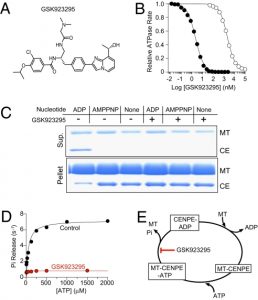
GSK923295 (GSK-923295A) is an allosteric inhibitor specifically targeting centromere-associated protein E (CENP-E), with an IC50 of 3.2 nM for inhibiting CENP-E ATPase activity and a Ki value of 2.1 nM for binding to CENP-E [1]
|
|---|---|
| ln Vitro |
GSK-923295 (GSK923295) is an allosteric inhibitor of CENP-E kinesin motor activity that is unique in its class. With a Ki of 3.2± 0.2 nM for humans and 1.6±0.1 nM for dogs, GSK923295 inhibits CENP-E MT-stimulated ATPase activity without being competitive with either ATP or MT. Inorganic phosphate release is inhibited by GSK923295, and CENP-E motor domain association with microtubules is stabilized[1]. IC50s for GSK923295's broad growth inhibitory activity in a panel of 237 cancer cell lines are 17.2 nM, 55.6 nM, 42 nM, and 51.9 nM for SW48, RKO (BRAF mutant), SW620 (KRAS mutant), and HCT116 (KRAS mutant), respectively. Eight of the eleven mouse xenograft tumor models exhibit significant tumor growth-delay[2]. With a Ki of 3.2 nM, GSK923295 is a strong and specific small molecule inhibitor of human CENPE. With an average growth IC50 of 41 nM, GSK923295 exhibits broad effectiveness against a panel of 19 human neuroblastoma derived cell lines[3].
In human cancer cell lines (HCT116, HeLa, A549, MCF-7, SK-N-BE(2)C neuroblastoma), GSK923295 inhibited proliferation with IC50 values of 4.5 nM (HCT116), 5.8 nM (HeLa), 6.2 nM (A549), 7.1 nM (MCF-7), and 5.3 nM (SK-N-BE(2)C) after 72 hours of treatment [1][3] - GSK923295 (10 nM) induced mitotic arrest at the metaphase-anaphase transition in 85% of HCT116 cells after 24 hours, characterized by chromosome misalignment and disrupted CENP-E localization at kinetochores [1] - In HCT116 cells, GSK923295 (5-15 nM) dose-dependently induced apoptosis, with annexin V-positive cells increasing from 3% to 62% at 12 nM after 48 hours, accompanied by caspase-3 activation and PARP cleavage [1] - Combined with MEK inhibitor U0126 (10 μM), GSK923295 (2 nM) showed synergistic antiproliferative activity in HeLa cells, reducing cell viability by 78% compared to 35% with GSK923295 alone and 20% with U0126 alone (combination index CI = 0.42) [2] - GSK923295 (5 nM) inhibited colony formation of SK-N-BE(2)C neuroblastoma cells by 82%, and downregulated CENP-E-mediated kinetochore-microtubule attachment by 75% [3] - Western blot analysis revealed GSK923295 (5-10 nM) increased γH2AX (DNA damage marker) expression by 3.5-fold, upregulated cleaved caspase-3 by 4.2-fold, and reduced cyclin B1 expression by 68% in various cancer cells [1][3] |
| ln Vivo |
In comparison to the control arm, the xenografts of mice treated with GSK-923295 (GSK923295) exhibit a significant delay in tumor growth (NB-EBc1 p<0.0001; NB-1643 p=0.018; NB-1691 p=0.0018)[3].
In nude mouse HCT116 colon cancer xenograft models, intravenous administration of GSK923295 (20 mg/kg, q.o.d. for 21 days) achieved 73% tumor growth inhibition (TGI), with tumor weight reduced from 1.3 g (vehicle) to 0.35 g [1] - In SK-N-BE(2)C neuroblastoma xenograft models, GSK923295 (15 mg/kg i.v., q.o.d. for 21 days) showed 68% TGI, and tumor tissues exhibited increased TUNEL-positive apoptotic cells (38% vs 7% in vehicle) and reduced Ki-67 proliferation index (23% vs 74%) [3] - Tumor tissues from treated mice showed disrupted kinetochore-CENP-E colocalization and increased mitotic catastrophe (multipolar spindles, chromosome bridges) [1][3] |
| Enzyme Assay |
CENP-E ATPase activity inhibition assay: Recombinant human CENP-E protein (40 nM) was incubated with serial concentrations of GSK923295 (0.5-50 nM), ATP (1 mM), and fluorescently labeled peptide substrate in reaction buffer at 37°C for 60 minutes. Phosphorylated substrate was detected by fluorescence resonance energy transfer (FRET), and IC50 values were calculated from dose-response curves [1]
- CENP-E binding assay: Recombinant CENP-E protein was immobilized on a sensor chip, and serial concentrations of GSK923295 (0.3-30 nM) were injected. Binding affinity was measured by surface plasmon resonance (SPR), and the dissociation constant (Ki) was derived from binding sensorgrams [1] |
| Cell Assay |
Antiproliferative assay: Cancer cells (HCT116, HeLa, A549, MCF-7, SK-N-BE(2)C) were seeded in 96-well plates (3×10³ cells/well) and treated with serial concentrations of GSK923295 (0.1-100 nM) for 72 hours. Cell viability was assessed by MTT assay, and IC50 values were calculated [1][3]
- Cell cycle analysis: HCT116 cells were treated with GSK923295 (5-15 nM) for 24 hours, fixed with 70% ethanol, stained with propidium iodide, and analyzed by flow cytometry to quantify mitotic phase proportion [1] - Apoptosis assay: HCT116 cells were treated with GSK923295 (5-15 nM) for 48 hours, stained with annexin V-FITC/propidium iodide, and analyzed by flow cytometry. Caspase-3 activation and PARP cleavage were detected by Western blot [1] - Synergy assay: HeLa cells were treated with combinations of GSK923295 (0.5-10 nM) and U0126 (2-20 μM) for 72 hours. Cell viability was measured, and combination indices were calculated using the Chou-Talalay method [2] - Colony formation assay: SK-N-BE(2)C cells were treated with GSK923295 (2-8 nM) for 24 hours, seeded in 6-well plates (1×10³ cells/well), and incubated for 14 days. Colonies were stained with crystal violet and counted, with inhibition rates calculated relative to vehicle controls [3] - Immunofluorescence assay: HCT116 cells were treated with GSK923295 (10 nM) for 16 hours, fixed, and stained with anti-CENP-E antibody (for localization) and DAPI (for chromosomes). CENP-E kinetochore localization was visualized by confocal microscopy [1] |
| Animal Protocol |
Dissolved in 4% N,N-dimethylacetamide (DMA)/Cremaphore (50/50) at pH 5.6; 125 mg/kg; i.p. injection
Mice bearing xenografts of the Colo205 colon tumor-cell line HCT116 colon cancer xenograft model: Female nude mice (6-8 weeks old) were subcutaneously implanted with 5×10⁶ HCT116 cells. When tumors reached 100-150 mm3, mice were randomized (n=8/group) and treated with: (1) vehicle (DMSO + cremophor EL + sterile saline) i.v., (2) GSK923295 (20 mg/kg) i.v. every other day for 21 days. Tumor volume and body weight were measured every 3 days [1] - SK-N-BE(2)C neuroblastoma xenograft model: Female nude mice (6-8 weeks old) were subcutaneously implanted with 5×10⁶ SK-N-BE(2)C cells. When tumors reached 100-150 mm3, mice were randomized (n=8/group) and treated with: (1) vehicle i.v., (2) GSK923295 (15 mg/kg) i.v. every other day for 21 days. Tumor tissues were collected for histopathological and immunofluorescence analysis [3] - GSK923295 was dissolved in DMSO first, then diluted with cremophor EL and sterile saline to prepare final injection solutions, with DMSO concentration ≤5% [1][3] |
| Toxicity/Toxicokinetics |
GSK923295 (0.1-100 nM) showed low cytotoxicity against normal human foreskin fibroblasts (NHF) and primary human neural progenitor cells, with cell viability > 85% after 72 hours of treatment at a concentration of 20 nM [1][3]
- In mice treated with GSK923295 (15-20 mg/kg, intravenously, every other day for 21 days), transient mild weight loss (<5%) was observed, with no obvious histopathological abnormalities in the liver, kidneys, heart, or spleen [1][3] - At therapeutic concentrations, the human plasma protein binding rate of GSK923295 was 91% [1] |
| References |
|
| Additional Infomation |
GSK-923295 is a small-molecule mitotic kinase centromere-associated protein E (CENP-E) inhibitor and the third novel drug candidate developed within the broad strategic alliance between Cytokinetics and GlaxoSmithKline (GSK). GSK-923295 exhibits broad-spectrum activity against various human tumor xenograft models grown in nude mice, including colon cancer, breast cancer, ovarian cancer, lung cancer, and other tumor models. GSK-923295 is the first CENP-E-specific drug candidate to enter human clinical trials, currently undergoing Phase I human clinical trials by GSK.
CENP-E inhibitor GSK-923295A is a small-molecule mitotic kinase centromere-associated protein E (CENP-E) inhibitor with potential antitumor activity. After administration, GSK-923295A binds to CENP-E and inhibits its activity, thereby preventing cell division, inducing cell cycle arrest, and ultimately inhibiting cell proliferation. CENP-E is a centromere-associated mitotic kinetic protein that plays a crucial role in chromosome movement during mitosis and regulates the transition of the cell cycle from metaphase to anaphase. Drug Indications Its use in the treatment of cancer/tumors (unspecified) and solid tumors is under investigation. Mechanism of Action GSK-923295 is an inhibitor of the mitotic kinetic protein centromere-associated protein E (CENP-E). CENP-E plays a vital role in chromosome movement during early cell division or mitosis, integrating the mechanisms of mitotic spindle movement with mitotic checkpoint regulators that control the transition of the cell cycle from metaphase to anaphase. CENP-E inhibitors can induce cell cycle arrest during cell replication, leading to apoptosis or cell death. GSK923295 (GSK-923295A) is the first allosteric inhibitor of CENP-E, a kinesiology protein that is crucial for kinetochore-microtubule connections and metaphase-anaphase transitions during mitosis [1]. Its antitumor mechanism involves binding to the allosteric site of CENP-E, inhibiting its ATPase activity, disrupting kinetochore-microtubule alignment, inducing mitotic arrest and mitotic catastrophe, and ultimately triggering caspase-dependent apoptosis [1][3]. It has synergistic antiproliferative activity with MEK/ERK pathway inhibitors, as MEK inhibition can enhance the sensitivity of cancer cells to CENP-E-targeted therapy by reducing mitotic checkpoint adaptation [2]. Transcriptome analysis showed that CENP-E is a novel therapeutic target for neuroblastoma, and GSK923295 exhibited potent activity against both neuroblastoma cells and xenograft tumors [3]. It has potential clinical application value in treating solid tumors (colon cancer, lung cancer, breast cancer) and neuroblastoma, and has good selectivity for cancer cells and low toxicity [1][2][3]. |
| Molecular Formula |
C32H38CLN5O4
|
|
|---|---|---|
| Molecular Weight |
592.13
|
|
| Exact Mass |
591.261
|
|
| CAS # |
1088965-37-0
|
|
| Related CAS # |
|
|
| PubChem CID |
46898058
|
|
| Appearance |
White to yellow solid powder
|
|
| Density |
1.25
|
|
| Melting Point |
197-198℃
|
|
| LogP |
5.295
|
|
| Hydrogen Bond Donor Count |
3
|
|
| Hydrogen Bond Acceptor Count |
6
|
|
| Rotatable Bond Count |
12
|
|
| Heavy Atom Count |
42
|
|
| Complexity |
870
|
|
| Defined Atom Stereocenter Count |
2
|
|
| SMILES |
C[C@@H](C1=CC=CN2C1=NC(=C2)C3=CC=C(C=C3)C[C@@H](CNC(=O)CN(C)C)NC(=O)C4=CC(=C(C=C4)OC(C)C)Cl)O
|
|
| InChi Key |
WHMXDBPHBVLYRC-OFVILXPXSA-N
|
|
| InChi Code |
InChI=1S/C32H38ClN5O4/c1-20(2)42-29-13-12-24(16-27(29)33)32(41)35-25(17-34-30(40)19-37(4)5)15-22-8-10-23(11-9-22)28-18-38-14-6-7-26(21(3)39)31(38)36-28/h6-14,16,18,20-21,25,39H,15,17,19H2,1-5H3,(H,34,40)(H,35,41)/t21-,25-/m0/s1
|
|
| Chemical Name |
3-chloro-N-[(2S)-1-[[2-(dimethylamino)acetyl]amino]-3-[4-[8-[(1S)-1-hydroxyethyl]imidazo[1,2-a]pyridin-2-yl]phenyl]propan-2-yl]-4-propan-2-yloxybenzamide
|
|
| Synonyms |
|
|
| HS Tariff Code |
2934.99.9001
|
|
| Storage |
Powder -20°C 3 years 4°C 2 years In solvent -80°C 6 months -20°C 1 month |
|
| Shipping Condition |
Room temperature (This product is stable at ambient temperature for a few days during ordinary shipping and time spent in Customs)
|
| Solubility (In Vitro) |
DMSO: 100 mg/mL (168.9 mM)
Water: 1 mg/mL (Insoluble) Ethanol: 100 mg/mL (168.9 mM) |
|---|---|
| Solubility (In Vivo) |
Solubility in Formulation 1: ≥ 3 mg/mL (5.07 mM) (saturation unknown) in 10% DMSO + 40% PEG300 + 5% Tween80 + 45% Saline (add these co-solvents sequentially from left to right, and one by one), clear solution.
For example, if 1 mL of working solution is to be prepared, you can add 100 μL of 30.0 mg/mL clear DMSO stock solution to 400 μL PEG300 and mix evenly; then add 50 μL Tween-80 to the above solution and mix evenly; then add 450 μL normal saline to adjust the volume to 1 mL. Preparation of saline: Dissolve 0.9 g of sodium chloride in 100 mL ddH₂ O to obtain a clear solution. Solubility in Formulation 2: 3 mg/mL (5.07 mM) in 10% DMSO + 90% (20% SBE-β-CD in Saline) (add these co-solvents sequentially from left to right, and one by one), suspension solution; with ultrasonication. For example, if 1 mL of working solution is to be prepared, you can add 100 μL of 30.0 mg/mL clear DMSO stock solution to 900 μL of 20% SBE-β-CD physiological saline solution and mix evenly. Preparation of 20% SBE-β-CD in Saline (4°C,1 week): Dissolve 2 g SBE-β-CD in 10 mL saline to obtain a clear solution. View More
Solubility in Formulation 3: ≥ 3 mg/mL (5.07 mM) (saturation unknown) in 10% DMSO + 90% Corn Oil (add these co-solvents sequentially from left to right, and one by one), clear solution. |
| Preparing Stock Solutions | 1 mg | 5 mg | 10 mg | |
| 1 mM | 1.6888 mL | 8.4441 mL | 16.8882 mL | |
| 5 mM | 0.3378 mL | 1.6888 mL | 3.3776 mL | |
| 10 mM | 0.1689 mL | 0.8444 mL | 1.6888 mL |
*Note: Please select an appropriate solvent for the preparation of stock solution based on your experiment needs. For most products, DMSO can be used for preparing stock solutions (e.g. 5 mM, 10 mM, or 20 mM concentration); some products with high aqueous solubility may be dissolved in water directly. Solubility information is available at the above Solubility Data section. Once the stock solution is prepared, aliquot it to routine usage volumes and store at -20°C or -80°C. Avoid repeated freeze and thaw cycles.
Calculation results
Working concentration: mg/mL;
Method for preparing DMSO stock solution: mg drug pre-dissolved in μL DMSO (stock solution concentration mg/mL). Please contact us first if the concentration exceeds the DMSO solubility of the batch of drug.
Method for preparing in vivo formulation::Take μL DMSO stock solution, next add μL PEG300, mix and clarify, next addμL Tween 80, mix and clarify, next add μL ddH2O,mix and clarify.
(1) Please be sure that the solution is clear before the addition of next solvent. Dissolution methods like vortex, ultrasound or warming and heat may be used to aid dissolving.
(2) Be sure to add the solvent(s) in order.
|
|---|
|
Products are for research use only; We do not sell to patients
Copyright 2020 InvivoChem LLC | All Rights Reserved


 COA
COA