| Size | Price | Stock | Qty |
|---|---|---|---|
| 5mg |
|
||
| 10mg |
|
||
| 25mg |
|
||
| 50mg |
|
||
| 100mg |
|
||
| 250mg |
|
||
| 500mg | |||
| Other Sizes |


Purity: ≥98%
| Targets |
IGF-1R (IC50 = 27 nM); IR (IC50 = 25 nM)
Insulin-like Growth Factor 1 Receptor (IGF-1R) (IC50 = 2.8 nM for recombinant human IGF-1R kinase; no activity against IR, EGFR, HER2, IC50 > 1000 nM) [1] - Confirmed IGF-1R as primary target (glioma model; no additional IC50/Ki values; consistent with [1]’s target specificity) [2] |
|---|---|
| ln Vitro |
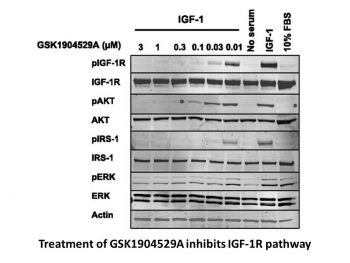
GSK1904529A is an ATP-competitive, reversible inhibitor with 1.6 nM and 1.3 nM, respectively, for enzyme-inhibitor binding values against IGF-1R and IR. At concentrations greater than 0.01 μM, GSK1904529A strongly inhibits the ligand-induced phosphorylation of IGF-1R and IR, subsequently obstructing downstream signaling (AKT, IRS-1, and ERK). NIH-3T3/LISN, TC-71, SK-N-MC, SK-ES, and RD-ES cells are all potently inhibited by GSK1904529A, with IC50 values of 60 nM, 35 nM, 43 nM, 61 nM, and 62 nM, respectively. Other Ewing's sarcoma and multiple myeloma cell lines, such as NCI-H929, MOLP-8, LP-1, and KMS-12-BM, are also inhibited by GSK1904529A. GSK1904529A is sensitive to the cell lines COLO 205, MCF-7, and NCI-H929; these lines experience cell cycle arrest at the G1 phase.[1]
Inhibited proliferation of IGF-1R-dependent cancer cells: Lung cancer H460 (IC50 = 15.3 nM), breast cancer MCF-7 (IC50 = 12.7 nM), colon cancer HCT116 (IC50 = 18.5 nM); no activity in IGF-1R-negative SK-OV-3 cells (IC50 > 500 nM) [1] - Suppressed IGF-1R downstream signaling: 100 nM GSK1904529A reduced p-IGF-1R (Tyr1135/1136) by 92% in H460 cells (2 hours); p-AKT (Ser473) and p-ERK1/2 (Thr202/Tyr204) downregulated by >85% (Western blot) [1] - Inhibited glioma cell growth and induced apoptosis: U87 glioma cells (IC50 = 22.6 nM), U251 glioma cells (IC50 = 25.8 nM); 200 nM GSK1904529A increased Annexin V-positive U87 cells from 7% to 45% (48 hours); caspase-3 activity elevated by 3.8-fold [2] - Reduced glioma cell migration: 150 nM GSK1904529A decreased U87 cell migration by 68% (Transwell assay, 24 hours); 200 nM reduced MMP-9 expression by 72% (qPCR) [2] |
| ln Vivo |
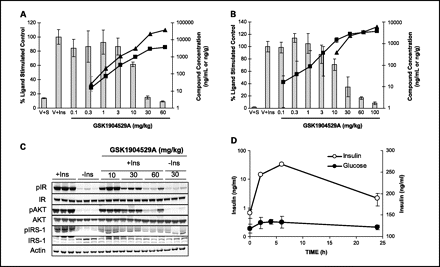
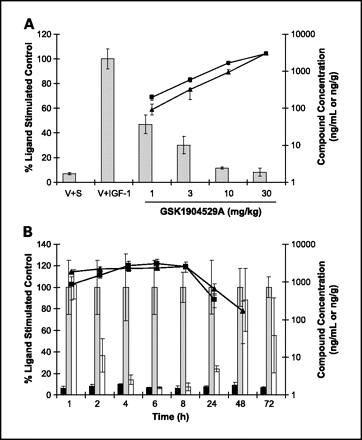
GSK1904529A shows that a dose of 30 mg/kg (orally, twice daily) in tumor-bearing NIH-3T3/LISN mice results in 98% tumor growth inhibition, and a dose of 75 mg/kg (once daily) in xenograft mice COLO 205. At a dose of 30 mg/kg, GSK1904529A inhibits tumor growth in HT29 and BxPC3 xenografts moderately and without causing any side effects. GSK1904529A, meanwhile, has very little effect on blood glucose levels. GSK1904529A fully prevents IGF-1R phosphorylation at a blood concentration of about 3.5 μM. Prostate, colon, breast, pancreatic, ovarian, and sarcomas are among the IGF-1R-dependent tumors for which GSK1904529A has been linked to treatment.[1]
In nude mice bearing H460 lung cancer xenografts: Oral GSK1904529A (30 mg/kg/day) for 28 days resulted in 83% tumor growth inhibition (TGI); tumor p-IGF-1R levels reduced by 80% (immunohistochemistry) [1] - In nude mice bearing U87 glioma subcutaneous xenografts: Intraperitoneal injection of GSK1904529A (25 mg/kg, twice daily) for 21 days achieved 78% TGI; tumor weight reduced by 75% vs. vehicle [2] - In C57BL/6 mice with U87 glioma orthotopic xenografts: Intraperitoneal GSK1904529A (20 mg/kg, twice daily) for 28 days extended median survival from 26 days (vehicle) to 52 days [2] |
| Enzyme Assay |
In DMSO stock solution, GSK1904529A is dissolved at a concentration of 10 mM. To calculate IC50, proteins tagged with glutathione S-transferase and encoding the intracellular domain of IGF-1R (amino acids 957–1367) and IR (amino acids 979–1382) are expressed by baculoviruses. The process of preincubating the enzyme (at a final concentration of 2.7 μM) in 50 mM HEPES (pH 7.5), 10 mM MgCl2, 0.1 mg/mL bovine serum albumin, and 2 mM ATP activates kinases. Distilled in DMSO, 100 nL/well of GSK1904529A is poured into the assay plates. Included kinase reactions (10 μL) The following ingredients are included: 500 nM substrate peptide (biotin-aminohexylAEEEEYMMMMAKKKK-NH2; QPC), 3 mM DTT, 0.1 mg/mL bovine serum albumin, 1 mM CHAPS, 10 mM MgCl2, 10 μM ATP, and 0.5 nM activated enzyme. After an hour at room temperature with 33 μM EDTA, reactions are terminated. Time-resolved fluorescence resonance energy transfer using 7 nM streptavidin Surelight allophycocyanin and 1 nM europium-conjugated phosphotyrosine antibodies is used to measure phosphorylation of peptides. A multilabel reader reads plates.
IGF-1R kinase activity assay: Recombinant human IGF-1R kinase domain (50 ng/well) was incubated with GSK1904529A (0.01-100 nM) in reaction buffer (25 mM HEPES pH 7.5, 10 mM MgCl2, 1 mM DTT) at 30°C for 15 minutes. 10 μM ATP and a fluorescent peptide substrate were added, followed by 60-minute incubation at 30°C. Kinase activity was measured via homogeneous time-resolved fluorescence (HTRF; excitation 340 nm, emission 665 nm); IC50 values were calculated via nonlinear regression [1] |
| Cell Assay |
In 96-well plates, cells are seeded, allowed to grow overnight at 37 °C, and then exposed to different concentrations of GSK1904529A for a full 72 hours. On collagen-coated 96-well tissue culture plates, cells are seeded for the NIH-3T3/LISN and given a 24-hour window to adhere. Serum-free medium is used in place of the tissue culture medium, and the cells are treated with either DMSO or GSK1904529A for two hours. Following the addition of IGF-I (30 ng/mL), the cells are incubated for 72 hours at 37 °C. The CellTiter-Glo Luminescent Cell Viability Assay is used to quantify the proliferation of cells. The IC50 values are established.
Cancer cell proliferation assay (H460/MCF-7/HCT116): Cells were seeded in 96-well plates (5×10³ cells/well) and treated with GSK1904529A (0.1 nM-1 μM) for 72 hours. Cell viability was measured via tetrazolium-based colorimetric assay; absorbance at 570 nm was recorded, and IC50 values were determined via four-parameter logistic fitting [1] - Glioma cell apoptosis assay (U87): Cells were seeded in 6-well plates (2×10⁵ cells/well) and treated with GSK1904529A (50-200 nM) for 48 hours. Cells were stained with Annexin V-FITC and propidium iodide, then analyzed by flow cytometry; caspase-3 activity was measured via fluorometric assay with a specific substrate [2] - Glioma cell migration assay (U87): Cells were seeded in the upper chamber of Transwell inserts (1×10⁴ cells/insert) and treated with GSK1904529A (100-200 nM). After 24 hours, cells that migrated to the lower chamber were fixed with methanol, stained with crystal violet, and counted manually [2] - Western blot assay (IGF-1R/AKT/ERK): H460 cells were treated with GSK1904529A (10-200 nM) for 2 hours, lysed in RIPA buffer (with protease/phosphatase inhibitors). Lysates (30 μg protein) were separated by 8% SDS-PAGE, transferred to PVDF membranes, and probed with antibodies against p-IGF-1R, total IGF-1R, p-AKT, p-ERK, and GAPDH. Signals were detected via chemiluminescence [1] |
| Animal Protocol |
NIH-3T3/LISN, COLO 205, HT29, and BxPC3 cells are implanted s.c. into the right flank of 8- to 10-wk-old female nu/nu CD-1athymic mice ~30 mg/kg Orally administered H460 lung cancer xenograft model (nude mice): 6-week-old female nude mice were subcutaneously injected with 5×10⁶ H460 cells. When tumors reached 100-120 mm³, mice were randomized to vehicle (0.5% methylcellulose + 0.2% Tween 80) or GSK1904529A groups (30 mg/kg/day, oral gavage). Treatments were administered once daily for 28 days; tumor volume (length × width² / 2) and body weight were measured every 3 days [1] - U87 glioma subcutaneous model (nude mice): Female nude mice were implanted with 2×10⁶ U87 cells subcutaneously. When tumors reached 150 mm³, mice received GSK1904529A (25 mg/kg, intraperitoneal injection) twice daily for 21 days. Drug was dissolved in 10% DMSO + 40% PEG400 + 50% normal saline; tumor samples were collected for histology [2] - U87 glioma orthotopic model (C57BL/6 mice): 1×10⁵ U87 cells were injected into the right striatum of 7-week-old mice. Seven days later, mice received GSK1904529A (20 mg/kg, intraperitoneal injection) twice daily for 28 days. Brain tumor volume was assessed via MRI; survival time was recorded [2] |
| ADME/Pharmacokinetics |
In mice: the oral bioavailability of GSK1904529A was 45% (30 mg/kg); the plasma half-life (t1/2) was 5.2 hours; and the maximum plasma concentration (Cmax) was 3.9 μM 1.3 hours after oral administration [1]. In rats: the clearance rate after intravenous administration (10 mg/kg) was 14 mL/min/kg; and the steady-state volume of distribution (Vss) was 1.0 L/kg [1]. Plasma protein binding: the binding rate to human plasma proteins was 99.3% (determined by ultrafiltration) [1].
|
| Toxicity/Toxicokinetics |
In the 28-day H460 xenograft study (30 mg/kg/day, orally): no significant weight loss (>8%) was observed; serum ALT (28 ± 4 U/L), AST (51 ± 6 U/L), and BUN (19 ± 3 mg/dL) were all within the normal range [1]
- In the 21-day U87 subcutaneous transplantation study (25 mg/kg, twice daily, intraperitoneal injection): 1 out of 8 mice experienced mild peritoneal irritation (which subsided after treatment); no histopathological changes were observed in the liver, kidneys, or brain tissue [2] - In the 28-day U87 orthotopic transplantation study (20 mg/kg, twice daily, intraperitoneal injection): no treatment-related deaths were observed; 2 out of 10 mice experienced mild alopecia (which recovered after treatment) [2] |
| References |
|
| Additional Infomation |
N-(2,6-difluorophenyl)-5-[3-[2-[5-ethyl-2-methoxy-4-[4-(4-methanesulfonyl-1-piperazinyl)-1-piperidinyl]anilino]-4-pyrimidinyl]-2-imidazo[1,2-a]pyridinyl]-2-methoxybenzamide belongs to the benzamide class of compounds.
GSK1904529A is a selective ATP-competitive IGF-1R tyrosine kinase inhibitor designed to target IGF-1R signaling-dependent cancers (lung cancer, breast cancer, colon cancer, glioma)[1][2]. - Its antitumor activity is mediated by inhibiting IGF-1R autophosphorylation and downstream PI3K-AKT/MEK-ERK pathways, thereby inhibiting cancer cell proliferation and inducing apoptosis[1]. - In gliomas, GSK1904529A not only inhibits tumor growth but also reduces cell migration, suggesting its potential to prevent glioma invasion [2] |
| Molecular Formula |
C44H47F2N9O5S
|
|
|---|---|---|
| Molecular Weight |
851.96
|
|
| Exact Mass |
851.338
|
|
| Elemental Analysis |
C, 62.03; H, 5.56; F, 4.46; N, 14.80; O, 9.39; S, 3.76
|
|
| CAS # |
1089283-49-7
|
|
| Related CAS # |
|
|
| PubChem CID |
25124816
|
|
| Appearance |
Light yellow to yellow solid powder
|
|
| Density |
1.4±0.1 g/cm3
|
|
| Index of Refraction |
1.672
|
|
| LogP |
4.69
|
|
| Hydrogen Bond Donor Count |
2
|
|
| Hydrogen Bond Acceptor Count |
14
|
|
| Rotatable Bond Count |
12
|
|
| Heavy Atom Count |
61
|
|
| Complexity |
1530
|
|
| Defined Atom Stereocenter Count |
0
|
|
| SMILES |
FC1C([H])=C([H])C([H])=C(C=1C(=C([H])[H])C(C1=C(C([H])=C([H])C(=C1[H])C1=C(C2([H])C([H])=C([H])N=C(C([H])=C2[H])[N+](=C([H])[H])C2=C(C([H])=C(C(=C2[H])C([H])([H])C([H])([H])[H])N2C([H])([H])C([H])([H])C([H])(C([H])([H])C2([H])[H])N2C([H])([H])C([H])([H])N(C(C([H])(C([H])([H])[H])O[H])=O)C([H])([H])C2([H])[H])OC([H])([H])[H])N2C([H])=C([H])C([H])([H])C([H])([H])C2([H])N1[H])OC([H])([H])[H])=O)F
|
|
| InChi Key |
MOSKATHMXWSZTQ-UHFFFAOYSA-N
|
|
| InChi Code |
InChI=1S/C44H47F2N9O5S/c1-5-28-26-35(38(60-3)27-36(28)53-19-15-30(16-20-53)52-21-23-54(24-22-52)61(4,57)58)49-44-47-17-14-34(48-44)42-40(50-39-11-6-7-18-55(39)42)29-12-13-37(59-2)31(25-29)43(56)51-41-32(45)9-8-10-33(41)46/h6-14,17-18,25-27,30H,5,15-16,19-24H2,1-4H3,(H,51,56)(H,47,48,49)
|
|
| Chemical Name |
N-(2,6-difluorophenyl)-5-[3-[2-[5-ethyl-2-methoxy-4-[4-(4-methylsulfonylpiperazin-1-yl)piperidin-1-yl]anilino]pyrimidin-4-yl]imidazo[1,2-a]pyridin-2-yl]-2-methoxybenzamide
|
|
| Synonyms |
|
|
| HS Tariff Code |
2934.99.9001
|
|
| Storage |
Powder -20°C 3 years 4°C 2 years In solvent -80°C 6 months -20°C 1 month |
|
| Shipping Condition |
Room temperature (This product is stable at ambient temperature for a few days during ordinary shipping and time spent in Customs)
|
| Solubility (In Vitro) |
DMSO: ~124 mg/mL (~145.5 mM)
Water: 1 mg/mL (Insoluble) Ethanol: 1 mg/mL |
|---|---|
| Solubility (In Vivo) |
Solubility in Formulation 1: ≥ 2.75 mg/mL (3.23 mM) (saturation unknown) in 10% DMSO + 40% PEG300 +5% Tween-80 + 45% Saline (add these co-solvents sequentially from left to right, and one by one), clear solution.
For example, if 1 mL of working solution is to be prepared, you can add 100 μL of 27.5 mg/mL clear DMSO stock solution to 400 μL PEG300 and mix evenly; then add 50 μL Tween-80 + to the above solution and mix evenly; then add 450 μL normal saline to adjust the volume to 1 mL. Preparation of saline: Dissolve 0.9 g of sodium chloride in 100 mL ddH₂ O to obtain a clear solution. (Please use freshly prepared in vivo formulations for optimal results.) |
| Preparing Stock Solutions | 1 mg | 5 mg | 10 mg | |
| 1 mM | 1.1738 mL | 5.8688 mL | 11.7376 mL | |
| 5 mM | 0.2348 mL | 1.1738 mL | 2.3475 mL | |
| 10 mM | 0.1174 mL | 0.5869 mL | 1.1738 mL |
*Note: Please select an appropriate solvent for the preparation of stock solution based on your experiment needs. For most products, DMSO can be used for preparing stock solutions (e.g. 5 mM, 10 mM, or 20 mM concentration); some products with high aqueous solubility may be dissolved in water directly. Solubility information is available at the above Solubility Data section. Once the stock solution is prepared, aliquot it to routine usage volumes and store at -20°C or -80°C. Avoid repeated freeze and thaw cycles.
Calculation results
Working concentration: mg/mL;
Method for preparing DMSO stock solution: mg drug pre-dissolved in μL DMSO (stock solution concentration mg/mL). Please contact us first if the concentration exceeds the DMSO solubility of the batch of drug.
Method for preparing in vivo formulation::Take μL DMSO stock solution, next add μL PEG300, mix and clarify, next addμL Tween 80, mix and clarify, next add μL ddH2O,mix and clarify.
(1) Please be sure that the solution is clear before the addition of next solvent. Dissolution methods like vortex, ultrasound or warming and heat may be used to aid dissolving.
(2) Be sure to add the solvent(s) in order.
|
Effect of GSK1904529A on IR phosphorylation and glucose metabolism. Clin Cancer Res. 2009 May 1;15(9):3058-67. |
Effect of GSK1904529A on IGF-IR phosphorylation in vivo. Clin Cancer Res. 2009 May 1;15(9):3058-67. |
Products are for research use only; We do not sell to patients
Copyright 2020 InvivoChem LLC | All Rights Reserved


 COA
COA