| Size | Price | Stock | Qty |
|---|---|---|---|
| 5mg |
|
||
| 10mg |
|
||
| 25mg |
|
||
| 50mg |
|
||
| 100mg |
|
||
| 250mg |
|
||
| 500mg | |||
| Other Sizes |


Purity: ≥98%
| Targets |
The targets of Galeterone (TOK-001) include cytochrome P450 17A1 (CYP17A1) and androgen receptor (AR). For CYP17A1, the inhibition constant (Ki) for C17,20-lyase activity is 1.9 nM, and the Ki for 17α-hydroxylase activity is 36 nM [2];
it inhibits the transcriptional activity of AR, with a half-maximal inhibitory concentration (EC50) of approximately 2 μM in the AR reporter gene assay using LNCaP cells [3]. |
|---|---|
| ln Vitro |
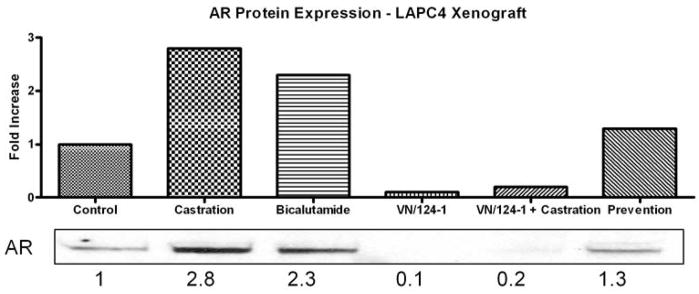
Galeterone (TOK-001) inhibits CYP17 lyase with an IC50 of 47 nM [1]. Galeterone (TOK-001) is both a CYP17A1 inhibitor and an androgen receptor antagonist, and the similarity of these binding modes is most likely responsible for its dual mechanism of action.This CYP17A1 binds abiraterone and galeterone (TOK-001) with absorbance decreasing at 402 nm and increasing at 424 nm, consistent with nitrogen binding to the heme iron (type II interaction) with Kd of <100 nM[2]. When LNCaP cells are cultured in medium supplemented with charcoal-stripped serum (CSS, T<1 nM) followed by treatment with increasing concentrations of Galeterone (TOK-001), the steady-state levels of AR protein are markedly decreased (up to 84% at 15 μM Galeterone). In LAPC-4 cells, abiraterone alcohol reduced AR expression more than Galeterone (TOK-001) at concentrations above 1 μM. Treating LNCaP cells with 20 μM TOK-001 for 24 hours reduces AR mRNA levels by 38% [3].
1. Inhibition of CYP17A1 enzyme activity: In the in vitro assay with recombinant human CYP17A1, Galeterone (TOK-001) exhibited an IC50 of 2.5 nM for C17,20-lyase activity and an IC50 of 46 nM for 17α-hydroxylase activity, significantly suppressing the activity of key enzymes in the androgen synthesis pathway [1] 2. Regulation of AR activity in prostate cancer cells: In LNCaP prostate cancer cells, treatment with Galeterone (TOK-001) (1-10 μM) significantly reduced the mRNA expression levels of AR target genes (e.g., prostate-specific antigen PSA, TMPRSS2) (detected by RT-PCR, showing a 50%-80% decrease compared to the control group). Meanwhile, Western blot analysis revealed a dose-dependent reduction in AR protein expression [3] 3. Inhibition of prostate cancer cell proliferation: In LNCaP and C4-2B (AR-dependent prostate cancer cells), the IC50 values of Galeterone (TOK-001) for inhibiting cell proliferation after 72 hours of treatment were 1.8 μM and 2.3 μM, respectively. In contrast, it had no significant inhibitory effect on the proliferation of PC-3 (AR-negative prostate cancer cells) (IC50 > 20 μM), indicating that its antiproliferative activity is AR-dependent [3] 4. Induction of apoptosis in prostate cancer cells: In LNCaP cells, after 48 hours of treatment with Galeterone (TOK-001) (10 μM), flow cytometry with Annexin V-FITC/PI double staining showed that the proportion of apoptotic cells (early + late apoptosis) increased from 3.2% in the control group to 18.5% [3]. |
| ln Vivo |
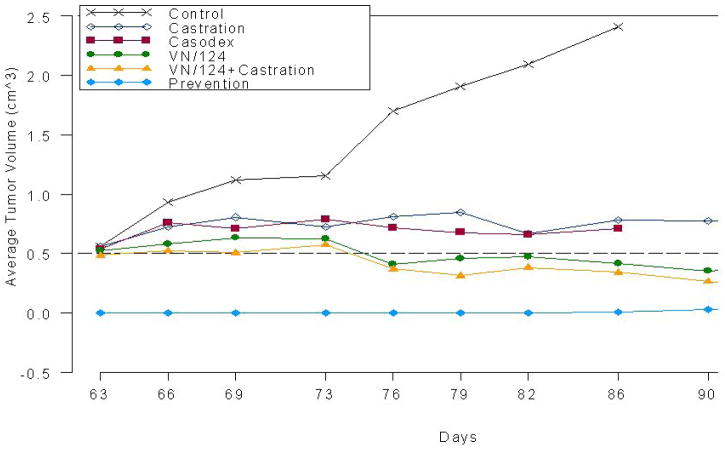
Galeterone (TOK-001) at a dose of 0.15 mmol/kg is administered subcutaneously twice a day to mice that have been injected with LAPC-4 tumors. On day 31, the average tumor volume was lower in the TOK-001-treated mice than in the control group (p = 0.0001). The administration of galeterone (TOK-001) resulted in a noteworthy decrease in the tumor development rate as compared to the control group (p<0.0001). Following excision, the final tumor weights of animals treated with Galeterone (TOK-001) exhibit a substantial reduction (p<0.05) in comparison to animals treated with control and castration.
In the LAPC-4 human prostate cancer xenograft model in nude mice, oral administration of Galeterone (TOK-001) showed significant antitumor activity. Specifically, daily oral administration of 10 mg/kg Galeterone (TOK-001) for 28 consecutive days resulted in a tumor growth inhibition rate (TGI) of 45%; at a daily oral dose of 100 mg/kg, the TGI reached 78%, and the tumor volume continued to shrink during the administration period (from 142 mm³ before administration to 89 mm³ at the end of the experiment). In contrast, oral administration of abiraterone at the same dose (100 mg/kg) resulted in a TGI of 62%, with the tumor volume decreasing from 138 mm³ to 101 mm³. At the end of the experiment, the tumor weight in the 100 mg/kg Galeterone (TOK-001) group was significantly lower than that in the vehicle control group (0.32 g vs 0.85 g, P < 0.01), and no signs of tumor recurrence were observed [1] In this model, immunohistochemical detection of Ki-67 (a cell proliferation marker) expression in tumor tissues showed that the proportion of Ki-67-positive cells in the 100 mg/kg Galeterone (TOK-001) group (12%) was significantly lower than that in the vehicle control group (35%) and the 100 mg/kg abiraterone group (18%), indicating that Galeterone (TOK-001) can effectively inhibit tumor cell proliferation in vivo [1]. |
| Enzyme Assay |
1. CYP17A1 C17,20-lyase activity assay: Recombinant human CYP17A1, NADPH-cytochrome P450 reductase, and cytochrome b5 were mixed with the substrate (e.g., 17α-hydroxypregnenolone) in a buffer solution. Different concentrations of Galeterone (TOK-001) or vehicle control were added, and the mixture was incubated at 37°C for a specific period. After incubation, a stop solution was added to terminate the reaction. The amount of the product (e.g., dehydroepiandrosterone, DHEA) was detected by HPLC or LC-MS, and the inhibition rate of enzyme activity at different drug concentrations was calculated. The IC50 value was obtained through non-linear regression analysis [1]
2. CYP17A1 binding assay (based on X-ray crystallography): Purified human CYP17A1 protein was incubated with Galeterone (TOK-001) at 4°C overnight to form a protein-drug complex. The complex was then crystallized using the hanging-drop vapor diffusion method. X-ray diffraction data of the crystals were collected, and the structure of the CYP17A1-Galeterone (TOK-001) complex was resolved. The binding mode and key interaction sites (e.g., hydrogen bonds, hydrophobic interactions) between Galeterone (TOK-001) and the active site of CYP17A1 were analyzed to confirm the inhibitory mechanism [2] 3. AR transcriptional activity assay (reporter gene assay): LNCaP cells were transfected with an AR-responsive luciferase reporter plasmid (containing AR binding elements upstream of the luciferase gene) and a Renilla luciferase plasmid (as an internal control). After 24 hours of transfection, the cells were treated with different concentrations of Galeterone (TOK-001) or vehicle control, and dihydrotestosterone (DHT) was added to activate AR. After 24 hours of treatment, the cells were lysed, and the luciferase activity was detected using a dual-luciferase reporter assay system. The relative luciferase activity (firefly luciferase activity/Renilla luciferase activity) was calculated to evaluate the inhibitory effect of Galeterone (TOK-001) on AR transcriptional activity [3]. |
| Cell Assay |
1. Prostate cancer cell proliferation assay (MTT method): LNCaP or C4-2B cells were seeded into 96-well plates at a density of 3×10³ cells per well and cultured for 24 hours. Different concentrations of Galeterone (TOK-001) (0.1 μM, 1 μM, 5 μM, 10 μM, 20 μM) or vehicle control were added to the wells, and the cells were further cultured for 72 hours. After incubation, MTT reagent was added to each well, and the plates were incubated at 37°C for 4 hours. The supernatant was removed, and DMSO was added to dissolve the formazan crystals. The absorbance was measured at a specific wavelength using a microplate reader, and the cell viability was calculated as (absorbance of drug-treated group/absorbance of control group) × 100%. The IC50 value was obtained by fitting the dose-response curve [3]
2. Western blot assay for AR and target proteins: LNCaP cells were seeded into 6-well plates and cultured until they reached 70%-80% confluency. The cells were treated with different concentrations of Galeterone (TOK-001) (1 μM, 5 μM, 10 μM) or vehicle control for 24 hours. The cells were then lysed using a lysis buffer containing a protease inhibitor cocktail, and the total protein concentration was determined using a protein assay kit. Equal amounts of protein were separated by SDS-PAGE and transferred to a PVDF membrane. The membrane was blocked with a blocking buffer and then incubated with primary antibodies against AR, PSA, and β-actin (internal control) overnight at 4°C. After washing, the membrane was incubated with a horseradish peroxidase-conjugated secondary antibody for 1 hour at room temperature. The protein bands were visualized using an enhanced chemiluminescence reagent, and the band intensity was quantified using image analysis software to evaluate the relative expression levels of AR and PSA [3] 3. RT-PCR assay for AR target gene expression: LNCaP cells were treated with Galeterone (TOK-001) (5 μM, 10 μM) or vehicle control for 24 hours. Total RNA was extracted from the cells using an RNA extraction kit, and the RNA concentration and purity were determined using a spectrophotometer. cDNA was synthesized from the total RNA using a reverse transcription kit. PCR amplification was performed using specific primers for PSA, TMPRSS2, and GAPDH (internal control). The PCR products were separated by agarose gel electrophoresis, and the band intensity was quantified. The relative mRNA expression levels of PSA and TMPRSS2 were calculated as (band intensity of target gene/band intensity of GAPDH) × 100% [3]. |
| Animal Protocol |
Dissolved in a 0.3% solution of hydroxypropyl cellulose in saline; 50 mg/kg; s.c. injection
Male severe combined immunodeficient (SCID) mice inoculated subcutaneously (s.c.) with LAPC4 cells 1. LAPC-4 human prostate cancer xenograft model establishment and drug administration: Male nude mice (or SCID mice) aged 6-8 weeks were used. LAPC-4 human prostate cancer cells were suspended in a mixture of culture medium and Matrigel, and 1×10⁷ cells were subcutaneously injected into the right back of each mouse. When the tumor volume reached approximately 100-150 mm³, the mice were randomly divided into 4 groups (n=6-8 per group): vehicle control group (0.5% methylcellulose + 0.1% Tween 80), low-dose Galeterone (TOK-001) group (10 mg/kg), high-dose Galeterone (TOK-001) group (100 mg/kg), and abiraterone group (100 mg/kg). All drugs were administered by oral gavage once a day for 21-28 consecutive days. During the experiment, the body weight and tumor volume of the mice were measured every 2-3 days. The tumor volume was calculated using the formula: V = length × width² / 2. At the end of the experiment, the mice were euthanized, and the tumors were excised and weighed. The tumor growth inhibition rate (TGI) was calculated as [1 - (tumor weight of drug-treated group / tumor weight of control group)] × 100% [1] 2. Immunohistochemical analysis of tumor tissues: The excised tumor tissues were fixed in formalin, embedded in paraffin, and cut into 4-μm-thick sections. The sections were deparaffinized with xylene and rehydrated with gradient ethanol. Antigen retrieval was performed by boiling the sections in a citrate buffer. The sections were blocked with a blocking buffer and then incubated with a primary antibody against Ki-67 overnight at 4°C. After washing, the sections were incubated with a biotin-conjugated secondary antibody and then with streptavidin-horseradish peroxidase. The sections were stained with 3,3'-diaminobenzidine (DAB) and counterstained with hematoxylin. The number of Ki-67-positive cells and the total number of cells in 5 random high-power fields (400×) were counted, and the proportion of Ki-67-positive cells was calculated [1]. |
| ADME/Pharmacokinetics |
1. In vitro metabolic stability assay: Galeterone (TOK-001) was mixed with rat or human liver microsomes in a buffer containing NADPH and incubated at 37°C. Samples were taken at different time points (0, 15, 30, 60, 90 minutes) and protein precipitation reagent was added to terminate the reaction. After centrifugation, the supernatant was taken and analyzed by LC-MS/MS to determine the concentration of remaining Galeterone (TOK-001). The in vitro half-life (t1/2) of the drug was calculated based on the concentration-time curve. The results showed that the in vitro metabolic half-life of Galeterone (TOK-001) was significantly longer than that of its precursor VN/124-1, indicating that its metabolic stability was improved [1]. 2. Rat pharmacokinetic study: Male Sprague-Dawley rats were fasted for 12 hours before administration. Galeterone (TOK-001) was orally administered to rats at a dose of 10 mg/kg. Blood samples were collected from the orbital venous plexus at different time points after administration (0.25, 0.5, 1, 2, 4, 6, 8, 12, and 24 hours), and plasma was separated by centrifugation. The concentration of Galeterone (TOK-001) in plasma was determined by liquid chromatography-tandem mass spectrometry (LC-MS/MS). Pharmacokinetic parameters were calculated using pharmacokinetic software: peak plasma concentration (Cmax) was 856 ng/mL, time to peak concentration (Tmax) was 1.2 h, area under the plasma concentration-time curve (AUC0-24h) from 0 to 24 hours was 3240 ng·h/mL, and oral bioavailability was approximately 38% [1]
3. Plasma protein binding assay: Galitol (TOK-001) was incubated with rat or human plasma at 37°C for 1 hour to reach equilibrium. The mixture was then transferred to an ultrafiltration tube and centrifuged to separate the free drug (in the filtrate) and the protein-bound drug (on the filter membrane). The concentration of free galitol (TOK-001) in the filtrate was determined by LC-MS/MS. The plasma protein binding rate was calculated as [1 - (free drug concentration / total drug concentration)] × 100%. The results showed that the human plasma protein binding rate of Galiteron (TOK-001) was greater than 95% [1]. |
| Toxicity/Toxicokinetics |
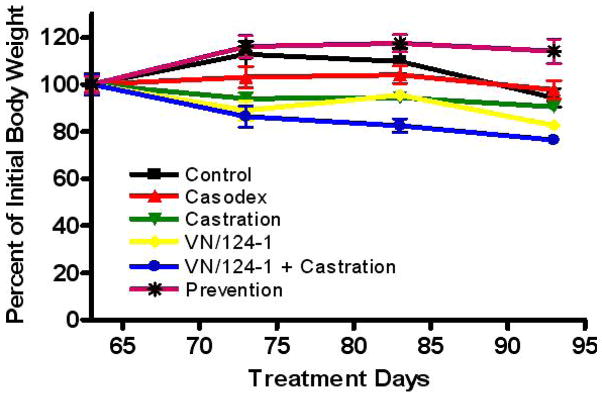
1. General toxicity observation in vivo: In the LAPC-4 xenograft model experiment, the body weight of mice in each group was monitored daily. The results showed that, compared with the solvent control group, the body weight of mice in the Galeterone (TOK-001) treatment group (low-dose group and high-dose group) did not decrease significantly (body weight change rate within ±10%). No obvious toxic symptoms (such as reduced activity, rough hair, diarrhea or lethargy) were observed in mice in the Galeterone (TOK-001) treatment group [1] 2. Hematological and biochemical index detection: At the end of the animal experiment, blood samples were collected from mice to detect hematological indexes (such as white blood cell count, red blood cell count, platelet count) and serum biochemical indexes (such as alanine aminotransferase ALT, aspartate aminotransferase AST, creatinine CRE). The results showed that there were no significant differences in these parameters between the Galeterone (TOK-001) treatment group and the carrier control group, indicating that at the tested dose, Galeterone (TOK-001) did not cause significant hematologic or hepatotoxic/nephrotoxicity [1].
|
| References |
|
| Additional Infomation |
Galeterone is a 3-hydroxysteroid with androgenic activity. Gallidone has been used in clinical trials for the treatment of prostate cancer. Gallidone is a small molecule androgen receptor modulator and CYP17 lyase inhibitor with high oral bioavailability and potential anti-androgenic activity. Gallidone has three distinct mechanisms of action: 1) as an androgen receptor antagonist; 2) as a CYP17 lyase inhibitor; and 3) by reducing the overall level of androgen receptors in prostate cancer tumors. All of these mechanisms may contribute to the attenuation of androgen-dependent growth signaling. Cytochrome P450 enzyme CYP17 (P450C17 or CYP17A1) is located in the endoplasmic reticulum (ER) and possesses 17α-hydroxylase and 17,20-lyase activities, playing a crucial role in the steroidogenic pathway that produces progesterone, mineralocorticoids, glucocorticoids, androgens, and estrogens.
1. Galeterone (TOK-001) is a metabolically stable analogue of VN/124-1, designed to address the problem of poor metabolic stability of VN/124-1. VN/124-1 has been structurally modified (e.g., by introducing specific functional groups) to improve its resistance to hepatic metabolism, thereby enhancing its in vivo efficacy and pharmacokinetic properties [1] 2. The inhibitory mechanism of Galeterone (TOK-001) on CYP17A1 is related to its binding to the active site of the enzyme. X-ray crystallography analysis showed that galetone (TOK-001) binds to heme iron in the active site of CYP17A1 through its nitrogen-containing functional group and forms hydrophobic interactions with surrounding amino acid residues (e.g., Leu360, Ile363), thereby blocking the binding of the substrate to the enzyme and inhibiting enzyme activity [2]. 3. Galeterone (TOK-001) exerts its antitumor effect through a dual mechanism: it not only inhibits CYP17A1 to reduce androgen synthesis (indirect anti-AR effect), but also directly binds to AR and inhibits its transcriptional activity, thereby inhibiting the growth of AR-dependent prostate cancer cells. This dual mechanism makes it effective in prostate cancer models, even where the efficacy of abiraterone is limited [3]. 4. In the LAPC-4 xenograft model, a dose of 100 mg/kg of Galeterone (TOK-001) showed superior antitumor efficacy compared to the same dose of abiraterone, as evidenced by higher TGI values and greater tumor volume reduction. This suggests that Galeterone (TOK-001) may be a potential alternative to abiraterone for the treatment of castration-resistant prostate cancer (CRPC) [1]. |
| Molecular Formula |
C26H32N2O
|
|
|---|---|---|
| Molecular Weight |
388.55
|
|
| Exact Mass |
388.251
|
|
| CAS # |
851983-85-2
|
|
| Related CAS # |
|
|
| PubChem CID |
11188409
|
|
| Appearance |
White to off-white solid powder
|
|
| Density |
1.3±0.1 g/cm3
|
|
| Boiling Point |
564.5±60.0 °C at 760 mmHg
|
|
| Melting Point |
189-190℃
|
|
| Flash Point |
295.2±32.9 °C
|
|
| Vapour Pressure |
0.0±1.6 mmHg at 25°C
|
|
| Index of Refraction |
1.693
|
|
| LogP |
6.28
|
|
| Hydrogen Bond Donor Count |
1
|
|
| Hydrogen Bond Acceptor Count |
2
|
|
| Rotatable Bond Count |
1
|
|
| Heavy Atom Count |
29
|
|
| Complexity |
743
|
|
| Defined Atom Stereocenter Count |
6
|
|
| SMILES |
C[C@]12CC[C@@H](CC1=CC[C@@H]3[C@@H]2CC[C@]4([C@H]3CC=C4N5C=NC6=CC=CC=C65)C)O
|
|
| InChi Key |
PAFKTGFSEFKSQG-PAASFTFBSA-N
|
|
| InChi Code |
InChI=1S/C26H32N2O/c1-25-13-11-18(29)15-17(25)7-8-19-20-9-10-24(26(20,2)14-12-21(19)25)28-16-27-22-5-3-4-6-23(22)28/h3-7,10,16,18-21,29H,8-9,11-15H2,1-2H3/t18-,19-,20-,21-,25-,26-/m0/s1
|
|
| Chemical Name |
(3S,8R,9S,10R,13S,14S)-17-(1H-benzo[d]imidazol-1-yl)-10,13-dimethyl-2,3,4,7,8,9,10,11,12,13,14,15-dodecahydro-1H-cyclopenta[a]phenanthren-3-ol
|
|
| Synonyms |
Galeterone; NX41765; NX 41765; TOK001; NX-41765; VN 1241; TOK-001; TOK 001; VN-1241; VN-1241
|
|
| HS Tariff Code |
2934.99.9001
|
|
| Storage |
Powder -20°C 3 years 4°C 2 years In solvent -80°C 6 months -20°C 1 month |
|
| Shipping Condition |
Room temperature (This product is stable at ambient temperature for a few days during ordinary shipping and time spent in Customs)
|
| Solubility (In Vitro) |
DMSO: 24 mg/mL (61.8 mM)
Water: 1 mg/mL (Insoluble) Ethanol: 40 mg/mL (102.9 mM) |
|---|---|
| Solubility (In Vivo) |
Solubility in Formulation 1: ≥ 2.5 mg/mL (6.43 mM) (saturation unknown) in 10% DMSO + 40% PEG300 + 5% Tween80 + 45% Saline (add these co-solvents sequentially from left to right, and one by one), clear solution.
For example, if 1 mL of working solution is to be prepared, you can add 100 μL of 25.0 mg/mL clear DMSO stock solution to 400 μL PEG300 and mix evenly; then add 50 μL Tween-80 to the above solution and mix evenly; then add 450 μL normal saline to adjust the volume to 1 mL. Preparation of saline: Dissolve 0.9 g of sodium chloride in 100 mL ddH₂ O to obtain a clear solution. Solubility in Formulation 2: ≥ 2.5 mg/mL (6.43 mM) (saturation unknown) in 10% DMSO + 90% (20% SBE-β-CD in Saline) (add these co-solvents sequentially from left to right, and one by one), clear solution. For example, if 1 mL of working solution is to be prepared, you can add 100 μL of 25.0 mg/mL clear DMSO stock solution to 900 μL of 20% SBE-β-CD physiological saline solution and mix evenly. Preparation of 20% SBE-β-CD in Saline (4°C,1 week): Dissolve 2 g SBE-β-CD in 10 mL saline to obtain a clear solution. View More
Solubility in Formulation 3: ≥ 2.5 mg/mL (6.43 mM) (saturation unknown) in 10% DMSO + 90% Corn Oil (add these co-solvents sequentially from left to right, and one by one), clear solution. Solubility in Formulation 4: 0.5% hydroxyethyl cellulose: 30 mg/mL |
| Preparing Stock Solutions | 1 mg | 5 mg | 10 mg | |
| 1 mM | 2.5737 mL | 12.8684 mL | 25.7367 mL | |
| 5 mM | 0.5147 mL | 2.5737 mL | 5.1473 mL | |
| 10 mM | 0.2574 mL | 1.2868 mL | 2.5737 mL |
*Note: Please select an appropriate solvent for the preparation of stock solution based on your experiment needs. For most products, DMSO can be used for preparing stock solutions (e.g. 5 mM, 10 mM, or 20 mM concentration); some products with high aqueous solubility may be dissolved in water directly. Solubility information is available at the above Solubility Data section. Once the stock solution is prepared, aliquot it to routine usage volumes and store at -20°C or -80°C. Avoid repeated freeze and thaw cycles.
Calculation results
Working concentration: mg/mL;
Method for preparing DMSO stock solution: mg drug pre-dissolved in μL DMSO (stock solution concentration mg/mL). Please contact us first if the concentration exceeds the DMSO solubility of the batch of drug.
Method for preparing in vivo formulation::Take μL DMSO stock solution, next add μL PEG300, mix and clarify, next addμL Tween 80, mix and clarify, next add μL ddH2O,mix and clarify.
(1) Please be sure that the solution is clear before the addition of next solvent. Dissolution methods like vortex, ultrasound or warming and heat may be used to aid dissolving.
(2) Be sure to add the solvent(s) in order.
| NCT Number | Recruitment | interventions | Conditions | Sponsor/Collaborators | Start Date | Phases |
| NCT02729376 | Completed | Drug: galeterone | Healthy | LTN PHARMACEUTICALS, INC. | March 2016 | Phase 1 |
| NCT04098081 | Recruiting | Drug: galeterone Drug: Gemcitabine |
Advanced Pancreatic Cancer | University of Maryland, Baltimore | December 12, 2019 | Phase 2 |
| NCT02438007 | Terminated | Drug: Galeterone Drug: Enzalutamide |
Prostate Cancer | LTN PHARMACEUTICALS, INC. | June 2015 | Phase 3 |
| NCT01709734 | Terminated | Drug: galeterone | Prostate Cancer | LTN PHARMACEUTICALS, INC | December 2012 | Phase 2 |
|
|---|
|
|
Products are for research use only; We do not sell to patients
Copyright 2020 InvivoChem LLC | All Rights Reserved


 COA
COA