| Size | Price | Stock | Qty |
|---|---|---|---|
| 5mg |
|
||
| 10mg |
|
||
| 25mg |
|
||
| 50mg |
|
||
| 100mg |
|
||
| 250mg |
|
||
| 500mg |
|
||
| Other Sizes |


Purity: ≥98%
| Targets |
FLT3 (IC50 = 0.4 nM); FLT3 (IC50 = 0.6 nM); Mer (IC50 = 1 nM); Aurora B (IC50 = 6 nM); RET (IC50 = 9 nM)
Colony-Stimulating Factor 1 Receptor (CSF1R) [1] |
|---|---|
| ln Vitro |
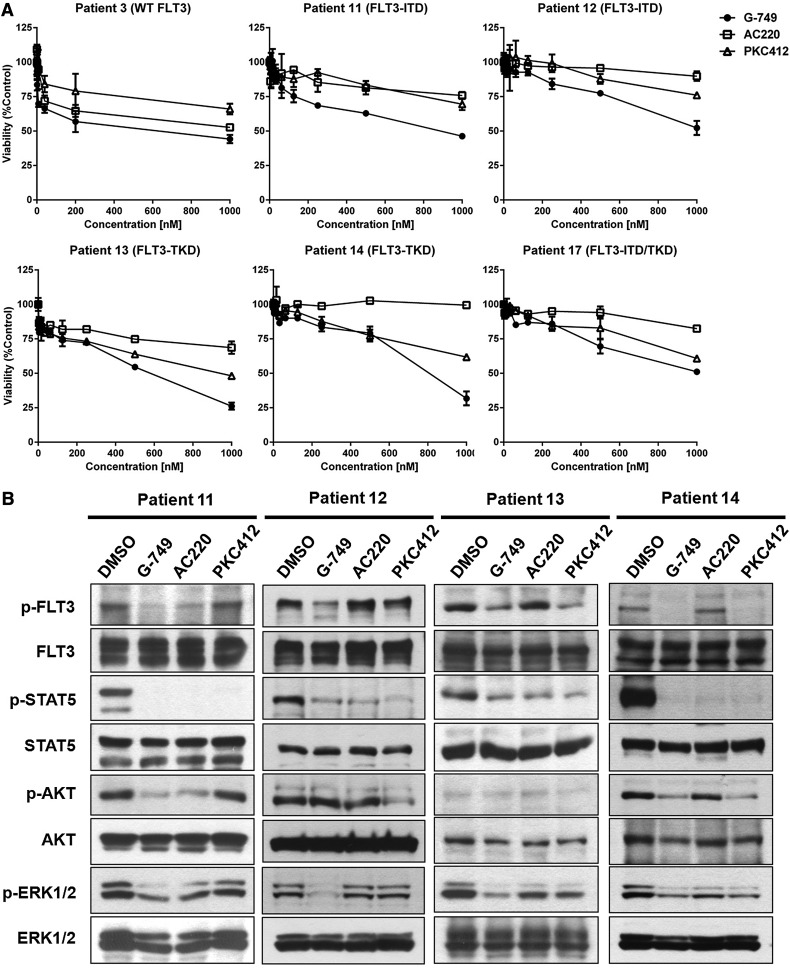
G-749 can effectively prevent FLT3 autophosphorylation in FLT3-WT-bearing RS4-11 cells, FLT3-ITD-bearing MV4-11, and Molm-14 cells, with an IC50 of less than 8 nM. G-749 induces apoptosis in leukemia cells to demonstrate antiproliferative activity. G-749 demonstrates potent inhibitory activity with an IC50 of less than 10 nM in BaF3 cell lines that stably express FLT3-ITD/N676D, FLT3-ITD/F691L, FLT3-D835Y, or FLT3-D835Y/N676D, thereby surmounting drug resistance. G-749 also shows strong antileukemia activity in blasts from AML patients.[1]
Denfivontinib (G-749) inhibited CSF1R phosphorylation in CSF1-stimulated human monocytes and tenosynovial giant cell tumor (TGCT)-derived cells, which abrogated downstream AKT and ERK1/2 signaling pathways [1] It exhibited concentration-dependent antiproliferative effects on CSF1R-positive cells, with no significant growth inhibition observed in CSF1R-negative cell lines [1] Western blot analysis confirmed reduced phosphorylation of CSF1R and its downstream effectors in treated cells compared to untreated controls [1] |
| ln Vivo |
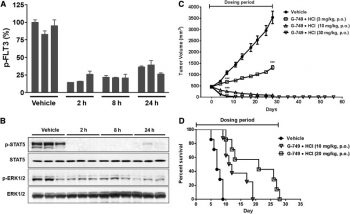
G-749 (30 mg/kg p.o.) significantly reduces tumor growth and inhibits the FLT3 pathway in MV4-11 xenograft mice. Using Molm-14 cells in an orthogonal model of bone marrow engraftment, G-749 (20 mg/kg p.o.) also reduces tumor growth and improves survival.[1]
Oral administration of Denfivontinib (G-749) induced dose-dependent tumor regression in patient-derived TGCT xenograft models in nude mice [1] Tumor tissue analysis revealed decreased CSF1R phosphorylation and reduced Ki-67 (proliferation marker) expression in treated mice, indicating suppressed tumor cell proliferation [1] |
| Enzyme Assay |
The Lance Ultra time-resolved fluorescence resonance energy transfer (TR-FRET) system from Perkin-Elmer is used for activity assays. In summary, 10 ng/mL FLT3 enzyme, a serially diluted G-749, 80 nM of ULight-poly-GT peptide substrate, and varying concentrations of ATP (8.5 µM to 1088 μM) are combined with kinase assay buffer (50 mM HEPES pH 7.5, 10 mM MgCl2, 1 mM EGTA, 2 mM DTT, and 0.01% Tween-20) and added to a 384-well OptiPlate-384 in a volume of 10 μL. After a maximum of one hour of room temperature incubation, 5 μL of 10 mM EDTA is added to halt the kinase reaction. The particular Eu-labeled anti-phosphopeptide antibody is then added in a volume of 5 μL diluted in LANCE Detection Buffer to a final concentration of 2 nM. Assay plates are incubated at 23°C for 30 minutes after that, and the LANCE signal is measured using an EnVision Multilabel Reader. The 320 nm excitation wavelength is used, and the 615 nm donor and 665 nm acceptor emission wavelengths are tracked. GradPad Prism 5 is used to perform nonlinear regression analysis in order to determine the IC50.
A fluorescence-based kinase inhibition assay was conducted to assess the activity of Denfivontinib (G-749) against recombinant human CSF1R kinase domain [1] The assay mixture contained the kinase domain, fluorescently labeled peptide substrate, ATP, and serial concentrations of the compound; after incubation at 37°C for a specified period, the phosphorylation of the substrate was detected to calculate inhibition efficiency [1] |
| Cell Assay |
The test inhibitor concentrations are applied to the cells for 72 hours at 37°C after they are seeded at a density of 2 ×10 4 cells per well. After being produced from HS-5 cell culture for five days under standard culture conditions, the conditioned medium (CM) is centrifuged to remove any remaining debris and is then used right away. At a final concentration of 35%, the CM is added to the entire medium. In coculture experiments, 1 ×10 4 HS-5 monolayers and 5 ×10 4 AML blast cells are plated in 24-well plates, which are then cultured for a minimum of 48 hours prior to the inhibitors being exposed. Utilizing an ATPLite assay, cell viability is assessed.
Human monocytes and TGCT-derived cell lines were plated in 96-well plates and cultured overnight; cells were treated with Denfivontinib (G-749) at concentrations ranging from 0.01 μM to 10 μM in the presence or absence of recombinant CSF1 [1] After 72 hours of incubation, cell viability was measured using a tetrazolium-based assay, and cells were lysed for immunoblotting to analyze CSF1R, AKT, and ERK1/2 phosphorylation levels [1] |
| Animal Protocol |
MV4-11 xenograft mouse model and Molm-14 orthogonal mouse model
~30 mg/kg p.o. Female athymic nude mice were subcutaneously implanted with patient-derived TGCT tissue fragments; when tumors reached 150-200 mm³, mice were randomized into four groups (n=8/group): vehicle control, 10 mg/kg, 30 mg/kg, or 100 mg/kg Denfivontinib (G-749) [1] The compound was formulated in 0.5% hydroxypropyl cellulose + 0.1% Tween 80 in water and administered orally once daily for 28 days [1] Tumor volume was measured twice weekly with calipers, and body weight was recorded every 3 days to monitor general health [1] At study conclusion, tumors were harvested, fixed, and embedded for immunohistochemical staining of CSF1R phosphorylation and Ki-67 [1] |
| References | |
| Additional Infomation |
Danfivontinib is an orally bioavailable FMS-like tyrosine kinase 3 (FLT3; CD135; STK1; FLK2) inhibitor that inhibits both wild-type and mutant FLT3, exhibiting potential antitumor activity. After administration, danfivontinib binds to FLT3 and inhibits its activity, including FLT3-ITD (internal tandem repeat), FLT3-D835Y, and other mutants. This inhibits the overactivation of FLT3, thereby suppressing the proliferation of FLT3-overexpressing tumor cells. FLT3 is a class III receptor tyrosine kinase (RTK) that is overexpressed or mutated in most B-cell lineage tumors and acute myeloid leukemia, playing a crucial role in tumor cell proliferation. Furthermore, denfivontinib also exhibits weak inhibitory activity against receptor tyrosine kinases AXL (UFO), Mer, Ret, vascular endothelial growth factor receptor 1 (VEGFR1), Fms, fibroblast growth factor receptor (FGFR) 1 and 3, and serine/threonine kinases Aurora B and C.
Denfivontinib (G-749) is a highly selective small molecule inhibitor of CSF1R, with a selectivity more than 100-fold higher than that of 468 other kinases tested [1]. TGCT is driven by the at(1;2)(p13;q37) chromosomal translocation, leading to CSF1 overexpression, which in turn recruits macrophages expressing CSF1R and promotes tumor growth [1]. This preclinical study provides evidence for the clinical development of Denfivontinib (G-749) for the treatment of advanced testicular germ cell tumors [1]. |
| Molecular Formula |
C25H25BRN6O2
|
|
|---|---|---|
| Molecular Weight |
521.41
|
|
| Exact Mass |
520.122
|
|
| Elemental Analysis |
C, 57.59; H, 4.83; Br, 15.32; N, 16.12; O, 6.14
|
|
| CAS # |
1457983-28-6
|
|
| Related CAS # |
|
|
| PubChem CID |
78357765
|
|
| Appearance |
White to off-white solid powder
|
|
| Density |
1.487±0.06 g/cm3
|
|
| Index of Refraction |
1.701
|
|
| LogP |
2.86
|
|
| Hydrogen Bond Donor Count |
3
|
|
| Hydrogen Bond Acceptor Count |
7
|
|
| Rotatable Bond Count |
6
|
|
| Heavy Atom Count |
34
|
|
| Complexity |
716
|
|
| Defined Atom Stereocenter Count |
0
|
|
| SMILES |
O=C1C2=C(N=C(NC3CCN(C)CC3)N=C2NC4=CC=C(OC5=CC=CC=C5)C=C4)C(Br)=CN1
|
|
| InChi Key |
SXWMIXPJPNCXQQ-UHFFFAOYSA-N
|
|
| InChi Code |
InChI=1S/C25H25BrN6O2/c1-32-13-11-17(12-14-32)29-25-30-22-20(26)15-27-24(33)21(22)23(31-25)28-16-7-9-19(10-8-16)34-18-5-3-2-4-6-18/h2-10,15,17H,11-14H2,1H3,(H,27,33)(H2,28,29,30,31)
|
|
| Chemical Name |
8-bromo-2-[(1-methylpiperidin-4-yl)amino]-4-(4-phenoxyanilino)-6H-pyrido[4,3-d]pyrimidin-5-one
|
|
| Synonyms |
|
|
| HS Tariff Code |
2934.99.9001
|
|
| Storage |
Powder -20°C 3 years 4°C 2 years In solvent -80°C 6 months -20°C 1 month |
|
| Shipping Condition |
Room temperature (This product is stable at ambient temperature for a few days during ordinary shipping and time spent in Customs)
|
| Solubility (In Vitro) |
DMSO: ~24 mg/mL (~46.0 mM)
Water: 1 mg/mL (Insoluble) Ethanol: 1 mg/mL |
|---|---|
| Solubility (In Vivo) |
Solubility in Formulation 1: ≥ 2.5 mg/mL (4.79 mM) (saturation unknown) in 10% DMSO + 40% PEG300 + 5% Tween80 + 45% Saline (add these co-solvents sequentially from left to right, and one by one), clear solution.
For example, if 1 mL of working solution is to be prepared, you can add 100 μL of 25.0 mg/mL clear DMSO stock solution to 400 μL PEG300 and mix evenly; then add 50 μL Tween-80 to the above solution and mix evenly; then add 450 μL normal saline to adjust the volume to 1 mL. Preparation of saline: Dissolve 0.9 g of sodium chloride in 100 mL ddH₂ O to obtain a clear solution. Solubility in Formulation 2: 2.5 mg/mL (4.79 mM) in 10% DMSO + 90% (20% SBE-β-CD in Saline) (add these co-solvents sequentially from left to right, and one by one), suspension solution; with ultrasonication. For example, if 1 mL of working solution is to be prepared, you can add 100 μL of 25.0 mg/mL clear DMSO stock solution to 900 μL of 20% SBE-β-CD physiological saline solution and mix evenly. Preparation of 20% SBE-β-CD in Saline (4°C,1 week): Dissolve 2 g SBE-β-CD in 10 mL saline to obtain a clear solution. View More
Solubility in Formulation 3: ≥ 2.5 mg/mL (4.79 mM) (saturation unknown) in 10% DMSO + 90% Corn Oil (add these co-solvents sequentially from left to right, and one by one), clear solution. |
| Preparing Stock Solutions | 1 mg | 5 mg | 10 mg | |
| 1 mM | 1.9179 mL | 9.5894 mL | 19.1788 mL | |
| 5 mM | 0.3836 mL | 1.9179 mL | 3.8358 mL | |
| 10 mM | 0.1918 mL | 0.9589 mL | 1.9179 mL |
*Note: Please select an appropriate solvent for the preparation of stock solution based on your experiment needs. For most products, DMSO can be used for preparing stock solutions (e.g. 5 mM, 10 mM, or 20 mM concentration); some products with high aqueous solubility may be dissolved in water directly. Solubility information is available at the above Solubility Data section. Once the stock solution is prepared, aliquot it to routine usage volumes and store at -20°C or -80°C. Avoid repeated freeze and thaw cycles.
Calculation results
Working concentration: mg/mL;
Method for preparing DMSO stock solution: mg drug pre-dissolved in μL DMSO (stock solution concentration mg/mL). Please contact us first if the concentration exceeds the DMSO solubility of the batch of drug.
Method for preparing in vivo formulation::Take μL DMSO stock solution, next add μL PEG300, mix and clarify, next addμL Tween 80, mix and clarify, next add μL ddH2O,mix and clarify.
(1) Please be sure that the solution is clear before the addition of next solvent. Dissolution methods like vortex, ultrasound or warming and heat may be used to aid dissolving.
(2) Be sure to add the solvent(s) in order.
In vivo antitumor activity of G-749 in xenograft and engrafted mouse model. Blood. 2014 Apr 3; 123(14): 2209–2219. |
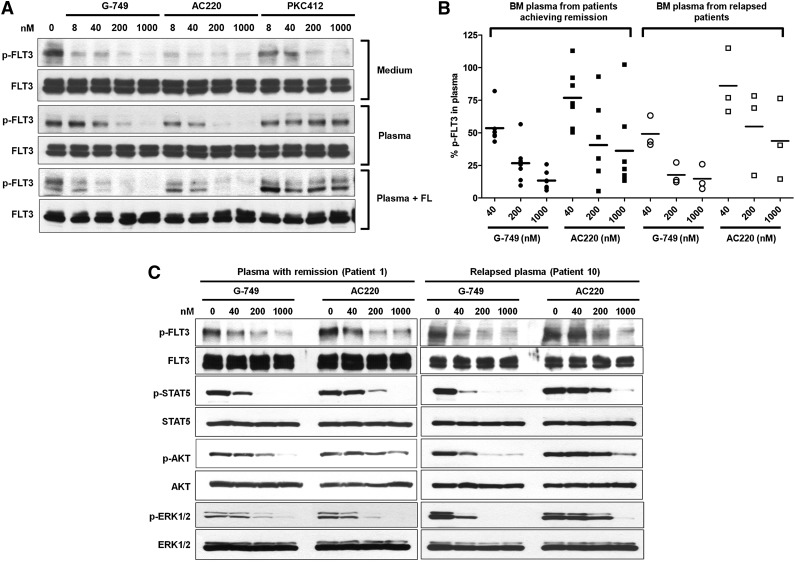
Potent inhibition of G-749 in AML patient plasma milieu. Blood. 2014 Apr 3;123(14):2209-19. |
Potent inhibition of G-749 against patient blasts harboring FLT3-ITD or FLT3-D835Y. Blood. 2014 Apr 3;123(14):2209-19. |
Products are for research use only; We do not sell to patients
Copyright 2020 InvivoChem LLC | All Rights Reserved


 COA
COA