| Size | Price | Stock | Qty |
|---|---|---|---|
| 10mg |
|
||
| 25mg |
|
||
| 50mg |
|
||
| 100mg |
|
||
| 250mg |
|
||
| 500mg |
|
||
| Other Sizes |


Purity: ≥98%
| Targets |
exocytosis; Golgi; ARF-1
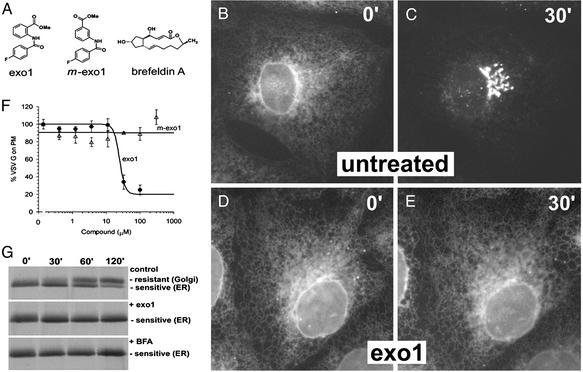
Exo1 modifies the GTPase activity of Golgi ARF1. Exo1 offers a separate method of interfering with Golgi activity because it blocks a portion of the membrane events that BFA blocks, although it appears to target a different protein target and likely has different side effects. Exo1 Disrupts Golgi structures to disrupt vesicular traffic from the ER to the Golgi apparatus. Exo1 has an IC50 of about 20 μM, which inhibits exocytosis. Exo1 inhibits newly synthesized proteins like VSVGts-GFP, transferrin, and MHC class I from acquiring endoglycosidase H resistance[1]. |
|---|---|
| ln Vitro |
Exo1 modifies the GTPase activity of Golgi ARF1. Exo1 offers a separate method of interfering with Golgi activity because it blocks a portion of the membrane events that BFA blocks, although it appears to target a different protein target and likely has different side effects. Exo1 Disrupts Golgi structures to disrupt vesicular traffic from the ER to the Golgi apparatus. Exo1 has an IC50 of about 20 μM, which inhibits exocytosis. Exo1 inhibits newly synthesized proteins like VSVGts-GFP, transferrin, and MHC class I from acquiring endoglycosidase H resistance[1].
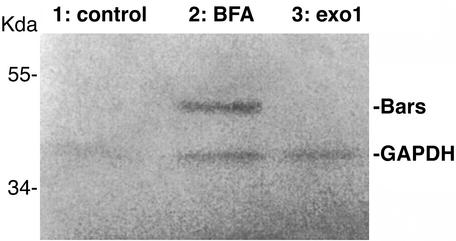
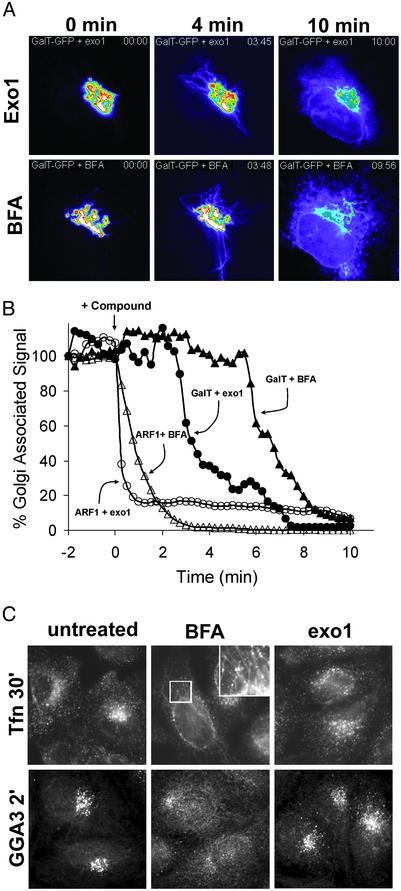
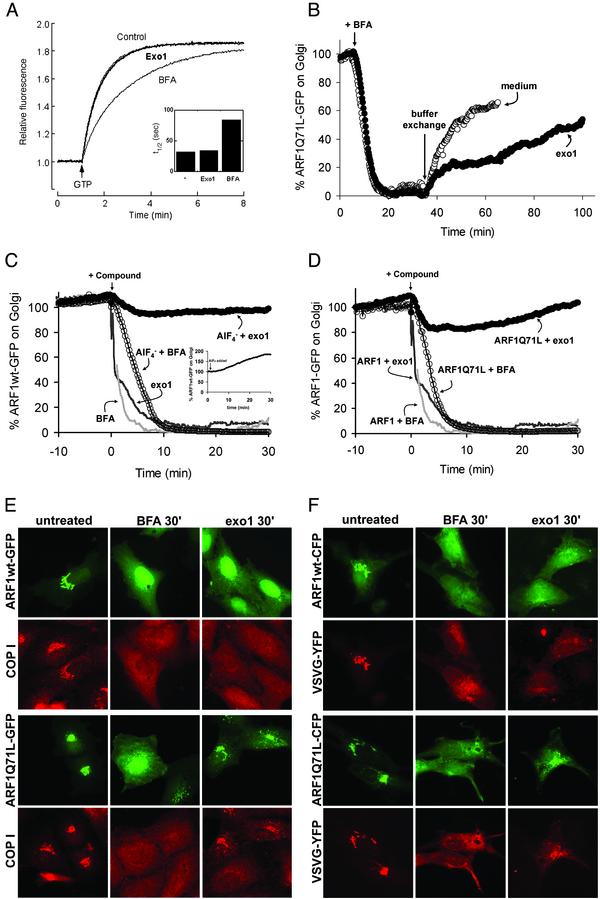
Exo1 inhibits exocytosis with an IC₅₀ of ≈20 µM in a VSVGts-GFP traffic assay using BSC1 cells [1] Exo1 (100 µM) induces rapid redistribution of Golgi content (e.g., GalT-GFP) back to the endoplasmic reticulum (ER), similar to BFA, as observed by time-lapse fluorescence microscopy [1] Exo1 treatment causes rapid dissociation of ARF1-GFP and coatomer protein I (COPI) from Golgi membranes with a half-life of less than 1 minute, similar to BFA [1] Unlike BFA, Exo1 (100 µM) does not induce rapid release of trans-Golgi network (TGN)-associated coat proteins (GGA3, AP-1, AP-3, clathrin) within 2 minutes of treatment [1] Unlike BFA, Exo1 does not tubulate endosomal membranes labeled with internalized transferrin [1] Exo1 (100 µM) does not interfere with the guanine nucleotide exchange activity of several ARF-GEFs in an in vitro exchange assay [1] Pre-treatment with AlF₄ (AlCl₃ + NaF) blocks the ability of Exo1 (100 µM) to induce dissociation of wild-type ARF1-GFP from Golgi membranes [1] A GTPase-deficient ARF1 mutant (ARF1[Q71L]-GFP) shows reduced sensitivity to Exo1 (100 µM), exhibiting only a transient and incomplete dissociation from Golgi membranes, and prevents COPI dissociation [1] Expression of ARF1[Q71L] rescues ER export of VSVGts-GFP and prevents Golgi collapse in the presence of Exo1 (100 µM) [1] Exo1 (100 µM) does not induce ADP-ribosylation of CtBP/Bars50, whereas BFA does [1] The effects of Exo1 on the Golgi are reversible; Golgi markers reappear in the perinuclear area 30 minutes after compound removal [1] |
| Enzyme Assay |
Tryptophan Fluorescence Assay for GDP/GTP Exchange.[1]
The fluorescence assay for measuring GTP binding to ARF1D17 stimulated by sec7 domain of ARF nucleotide binding site opener (ARNO) mutated in positions F190Y, A191S, S198M, and P208D was performed as described. ARF1D17 (5 mM) with 100 nM recombinant ARNO sec7 domain was assayed with 100 mM of Exo1 or 10 mM of BFA. Guanine Nucleotide Exchange Assays[1] Whole membrane. Golgi membranes containing 5 mg of protein and different amounts of compound were incubated with 4 mM myristoylated recombinant ARF1 and 100 mM GTP[g-35S] at 30°C for 15 min. Radioactivity that bound to filters was measured by scintillation counting, and the result was corrected by the amount that bound in the absence of recombinant ARF (background was <20% of total). Recombinant GFB1, BFA-Inhibited ARF-GEF 1, and ARFs[1] Reactions were performed at 30°C in the presence of 50 mM Hepes (pH 7.5), 100 mM KCl, 1 mM MgCl2, 1 mM DTT, 1.5 mg/ml of azolectin vesicles, and 4 mM 5'-[g-thio]-triphosphate (GTP[gS]) spiked with [35S]GTP[gS] (1250 Ci/mmol) to a final specific activity of 3 ´ 105 cpm/pmol, as described. Reactions contained either DMSO (final concentration 2.5%) or the indicated concentrations of BFA or Exo1 dissolved in DMSO. Reactions were initiated by addition of either 2 mM bovine ARF3/1 or 2 mM recombinant myristoylated human ARF5. Reactions (15 ml) were terminated by dilution into 2 ml of ice-cold wash buffer (50 mM Hepes, pH 7.5/100 mM KCl/10 mM MgCl2). Bound ARF-GTP[gS] was quantified by filtering samples through 0.45 mM nitrocellulose membranes, followed by four rinses with 2 ml of wash buffer. Dried filters in 3 ml of liquid scintillant were analyzed in an LS 6500. The amount of GEF-dependent GTP loaded on ARFs was calculated after subtracting background values measured in assays containing only azolectin vesicles, only M1, and only ARF-GEF.[1] Bovine ARFs (mixture of ARF3 and ARF1) and recombinant myristoylated human ARF5 were purified as described. A hexahistidine-tagged fragment containing the Sec7 domain of the BFA-inhibited ARF-GEF 1 was purified as described. A GST-tagged form of GBF1 was constructed by subcloning a fragment encoding full-length GBF1 into a modified version of pCEP4 expressing GST. Monolayers of HEK-293 expressing GST-GBF1 were extracted in lysis buffer (PBS/0.1% Triton X-100/1 mM PMSF) containing a mixture of protease inhibitors. GST-GFB1 was partially purified by using Glutathione-Sepharose as per the manufacturer’s instructions. Beads recovered by centrifugation at 1,500 ´ g were washed twice with 2 vol of lysis buffer and once with buffer lacking detergent. Bound material was eluted with wash buffer containing 10 mM glutathione and assayed as described previously. A guanine nucleotide exchange assay was performed using a recombinant SEC7 domain of an ARF-GEF. GTP loading onto ARF1 was monitored by the increase in relative fluorescence (e.g., using mant-GTP). The effect of Exo1 (100 µM) was tested alongside BFA (10 µM). Exo1 showed no inhibition of the exchange rate, whereas BFA inhibited it by 60% [1] In vitro GTPase-activating protein (GAP)-stimulated ARF1-GTP hydrolysis was tested for sensitivity to Exo1 and was found to be not sensitive [1] |
| Cell Assay |
Endoglycosidase H (Endo H) Sensitivity[1].
Cells (106) grown in a 6-cm dish were transduced with VSVGts-GFP adenovirus overnight at 40°C. Afterward, the cells were pulse-labeled with 140 mCi 35S-trans (ICN) for 30 min at 40°C followed by incubation with or without 100 mM Exo1 or 5 mM BFA for various times at 32°C and processed for endo H sensitivity of newly synthesized proteins. Time-Lapse Fluorescence Microscopy[1] Cells were plated on 25-mm glass coverslips and transfected with the appropriate GFP fusion proteins. After 16-24 h at 37°C, fluorescence images were acquired at 37°C in living cells with a Nikon E300 inverted microscope (20 ´ 0.45 numerical aperture objective lens) by using a Hamamatsu ER charge-coupled device camera under control of METAMORPH. For dissociation experiments, images were collected 10 min before and 30 min after adding Exo1. To measure the amount of GFP signal associated with membranes, we first applied a threshold to each image such that only signals above the cytosolic background were considered to determine integrated intensity. The signal in the first image (100%) was used to normalize the values of the remaining time points. No corrections were imposed to correct for possible photobleaching, because no significant changes were detected during this interval. In most cases we present the averaged values corresponding to 4-6 cells from three independent experiments. High-throughput phenotypic screen: BSC1 cells were mixed with VSVGts-GFP adenovirus and plated in 384-well plates. Compounds (from a library) were added via pin-transfer. Cells were incubated at 40°C (non-permissive for VSVGts-GFP exit), then shifted to 32°C to allow synchronous export. After fixation, images were acquired by automated fluorescence microscopy and visually scored for inhibition of VSVGts-GFP traffic [1] Dose-response assay: BSC1 cells expressing VSVGts-GFP were incubated at 40°C with different concentrations of Exo1, then shifted to 32°C for 3 hours. The relative efficiency of VSVGts-GFP delivery to the cell surface was measured to determine IC₅₀ [1] Time-lapse fluorescence microscopy: BSC1 cells expressing organelle markers (e.g., ARF1-GFP, GalT-GFP, GGA3-GFP) were treated with Exo1 (100 µM) or BFA (5 µM). Images were captured at intervals to monitor the dynamics of protein dissociation and organelle morphology changes (e.g., Golgi tubulation and collapse) [1] Endoglycosidase H resistance assay: Cells were pulse-labeled, chased in the presence or absence of Exo1 (100 µM) or BFA (5 µM), and lysed. VSVGts-GFP was immunoprecipitated and treated with endoglycosidase H to assess acquisition of resistance, indicating passage through the Golgi [1] Immunofluorescence and organelle marker analysis: Fixed cells were stained with antibodies against various organelle markers (e.g., transferrin for endosomes, cathepsin D for lysosomes, GM130 for Golgi matrix) to assess the specificity of Exo1 effects [1] ARF1 reloading assay: Cells expressing ARF1[Q71L]-GFP were pretreated with BFA to release it from Golgi. After BFA washout, cells were incubated with control medium or Exo1 (100 µM), and relocalization of ARF1[Q71L]-GFP to the Golgi was monitored over time [1] |
| References | |
| Additional Infomation |
2-[[(4-fluorophenyl)-oxymethyl]amino]benzoate belongs to the benzamide class of compounds.
Exo1 was identified from a phenotypic screening of 10,240 drug-like molecules that are inhibitors of the exocytotic pathway [1]. Its closely related analog 3-(4-fluorobenzoylamino)-benzoate (m-Exo1) did not show significant activity in this assay, indicating structure-activity specificity [1]. A small structure-activity relationship (SAR) study of 234 related compounds failed to identify a more effective analog [1]. Exo1 has been proposed as a complementary research tool to BFA because it affects some BFA-sensitive events (endoplasmic reticulum-Golgi transport), but with a different mechanism of action and lacks some of the effects of BFA (e.g., trans-Golgi network/endosome tubularization, CtBP/Bars50 ADP ribosylation). [1] The proposed main mechanism is that Exo1 interferes with the ARF1 GTPase cycle downstream of GTP loading, possibly by enhancing the ineffective cycle of GTP hydrolysis or by preventing the formation of the effective ARF1-GTP-GAP-cargo-COPI complex required for vesicle formation. [1] |
| Molecular Formula |
C15H12FNO3
|
|
|---|---|---|
| Molecular Weight |
273.26
|
|
| Exact Mass |
273.08
|
|
| Elemental Analysis |
C, 65.93; H, 4.43; F, 6.95; N, 5.13; O, 17.56
|
|
| CAS # |
75541-83-2
|
|
| Related CAS # |
|
|
| PubChem CID |
310557
|
|
| Appearance |
White to off-white solid powder
|
|
| Density |
1.298 g/cm3
|
|
| Boiling Point |
333.9ºC at 760 mmHg
|
|
| Flash Point |
155.8ºC
|
|
| LogP |
2.937
|
|
| Hydrogen Bond Donor Count |
1
|
|
| Hydrogen Bond Acceptor Count |
4
|
|
| Rotatable Bond Count |
4
|
|
| Heavy Atom Count |
20
|
|
| Complexity |
353
|
|
| Defined Atom Stereocenter Count |
0
|
|
| SMILES |
O=C(OC)C1=CC=CC=C1NC(C2=CC=C(F)C=C2)=O
|
|
| InChi Key |
KIAPWMKFHIKQOZ-UHFFFAOYSA-N
|
|
| InChi Code |
InChI=1S/C15H12FNO3/c1-20-15(19)12-4-2-3-5-13(12)17-14(18)10-6-8-11(16)9-7-10/h2-9H,1H3,(H,17,18)
|
|
| Chemical Name |
methyl 2-[(4-fluorobenzoyl)amino]benzoate
|
|
| Synonyms |
|
|
| HS Tariff Code |
2934.99.9001
|
|
| Storage |
Powder -20°C 3 years 4°C 2 years In solvent -80°C 6 months -20°C 1 month |
|
| Shipping Condition |
Room temperature (This product is stable at ambient temperature for a few days during ordinary shipping and time spent in Customs)
|
| Solubility (In Vitro) |
|
|||
|---|---|---|---|---|
| Solubility (In Vivo) |
Solubility in Formulation 1: ≥ 2.5 mg/mL (9.15 mM) (saturation unknown) in 10% DMSO + 90% Corn Oil (add these co-solvents sequentially from left to right, and one by one), clear solution.
For example, if 1 mL of working solution is to be prepared, you can add 100 μL of 25.0 mg/mL clear DMSO stock solution to 900 μL of corn oil and mix evenly. (Please use freshly prepared in vivo formulations for optimal results.) |
| Preparing Stock Solutions | 1 mg | 5 mg | 10 mg | |
| 1 mM | 3.6595 mL | 18.2976 mL | 36.5952 mL | |
| 5 mM | 0.7319 mL | 3.6595 mL | 7.3190 mL | |
| 10 mM | 0.3660 mL | 1.8298 mL | 3.6595 mL |
*Note: Please select an appropriate solvent for the preparation of stock solution based on your experiment needs. For most products, DMSO can be used for preparing stock solutions (e.g. 5 mM, 10 mM, or 20 mM concentration); some products with high aqueous solubility may be dissolved in water directly. Solubility information is available at the above Solubility Data section. Once the stock solution is prepared, aliquot it to routine usage volumes and store at -20°C or -80°C. Avoid repeated freeze and thaw cycles.
Calculation results
Working concentration: mg/mL;
Method for preparing DMSO stock solution: mg drug pre-dissolved in μL DMSO (stock solution concentration mg/mL). Please contact us first if the concentration exceeds the DMSO solubility of the batch of drug.
Method for preparing in vivo formulation::Take μL DMSO stock solution, next add μL PEG300, mix and clarify, next addμL Tween 80, mix and clarify, next add μL ddH2O,mix and clarify.
(1) Please be sure that the solution is clear before the addition of next solvent. Dissolution methods like vortex, ultrasound or warming and heat may be used to aid dissolving.
(2) Be sure to add the solvent(s) in order.
| NCT Number | Recruitment | interventions | Conditions | Sponsor/Collaborators | Start Date | Phases |
| NCT04491240 | Completed | Drug: EXO 1 inhalation Drug: EXO 2 inhalation |
Covid19 COVID-19 |
State-Financed Health Facility "Samara Regional Medical Center Dinasty" |
July 20, 2020 | Phase 1 Phase 2 |
Exit of VSVGts-GFP from the ER is inhibited by Exo1.
Exo1 does not induce the ADP-ribosylation of Bars50.Proc Natl Acad Sci U S A.2003 May 27;100(11):6469-74. |
Exo1 induces tubulation and collapse of the Golgi apparatus but not endosomes and TGN. |
Exo1 acts on ARF1-GTPase through a different mechanism compared with BFA.Proc Natl Acad Sci U S A.2003 May 27;100(11):6469-74. |
Products are for research use only; We do not sell to patients
Copyright 2020 InvivoChem LLC | All Rights Reserved


 COA
COA