| Size | Price | Stock | Qty |
|---|---|---|---|
| 5mg |
|
||
| 10mg |
|
||
| 25mg |
|
||
| 50mg |
|
||
| 100mg |
|
||
| 250mg |
|
||
| 500mg | |||
| Other Sizes |
Purity: ≥98%
| Targets |
Multikinase inhibitor with potent activity against Aurora A kinase (Ki = 1.8 nM), Aurora B kinase (IC₅₀ = 45 nM), VEGFR2 (IC₅₀ = 26 nM), FGFR1 (IC₅₀ = 15 nM), and PDGFRβ (IC₅₀ = 22 nM) [1]
- In multiple myeloma (MM) cells, it selectively inhibits Aurora A kinase (EC₅₀ = 5 nM for inhibiting Aurora A-mediated TPX2 phosphorylation) and shows minimal activity against Aurora B (EC₅₀ > 500 nM) [2] |
|---|---|
| ln Vitro |
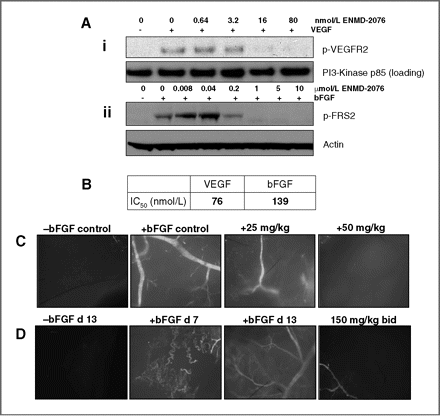
ENMD-2076 is specific for Aurora A over Aurora B (IC50=350 nM). ENMD-2076 inhibits HUVEC proliferation at an IC50 of 0.15 mM. The IC50 values for 10 human leukemia cell lines range from 0.025 to 0.53 mM. In this panel, MV4:11 cells are the most responsive by a factor of more than 4. The lymphoma-derived U937 cell line treated with ENMD-2076 demonstrates a dose-dependent increase in G2-M-phase arrest and apoptosis. ENMD-2076 suppresses cellular Flt3 ligand (FL)-induced Flt3 autophosphorylation in THP-1 cells, which have been demonstrated to express FL-responsive wild-type Flt-3 (18), with an IC50 of 28 nM. ENMD-2076 inhibits stem cell factor (SCF)-induced Kit autophosphorylation in MO7e cells with an IC50 of 40 nM. ENMD-2076 inhibits VEGFR2/KDR autophosphorylation with an IC50 of 7 nM [1].
Antiproliferative activity against solid tumor cell lines [1]: ENMD-2076 exhibited broad antiproliferative effects, with IC₅₀ values ranging from 18 nM to 45 nM across solid tumors: - HCT116 (colorectal cancer): IC₅₀ = 22 nM - MCF-7 (breast cancer): IC₅₀ = 30 nM - A549 (lung cancer): IC₅₀ = 45 nM - SK-OV-3 (ovarian cancer): IC₅₀ = 18 nM - Induction of G2/M arrest and apoptosis in solid tumors [1]: HCT116 cells treated with ENMD-2076 (25 nM) for 24 h showed 60% G2/M phase accumulation (vs. 14% control, PI staining). MCF-7 cells treated with 30 nM for 48 h had 40% annexin V-positive apoptotic cells, with 3.2-fold increased cleaved caspase-3 (western blot). - Antiangiogenic activity [1]: ENMD-2076 (50 nM) inhibited HUVEC tube formation by 75% (Matrigel assay) and reduced HUVEC migration by 65% (Boyden chamber assay). It also downregulated VEGFR2 phosphorylation (Tyr1175) by 80% in HUVECs (western blot). - Antiproliferative activity against multiple myeloma cells [2]: Against MM cell lines (MM.1S, RPMI-8226, U266), ENMD-2076 had IC₅₀ values of 12 nM, 18 nM, and 25 nM, respectively (72-h MTT assay). It was 5-fold more potent against MM cells than normal bone marrow stromal cells (IC₅₀ = 125 nM). - Mechanism in multiple myeloma [2]: MM.1S cells treated with ENMD-2076 (20 nM) for 24 h showed 70% reduced Aurora A-mediated TPX2 phosphorylation (western blot), 55% G2/M arrest, and 35% apoptosis. It also inhibited STAT3 phosphorylation (Tyr705) by 60%, a key survival pathway in MM. |
| ln Vivo |
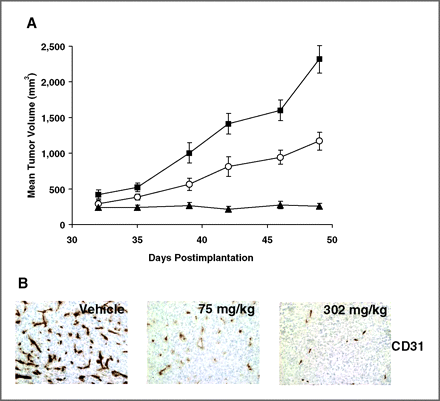
Treatment with ENMD-2076 leads to statistically significant tumor growth or regression inhibition that is dose dependent. Furthermore, as fast-growing tumors like A375 melanoma and slow-growing tumors like HT29 colon carcinoma are similarly inhibited by ENMD-2076, there is no correlation between tumor growth rate and antitumor efficacy, which is theoretically expected for a mitotic kinase inhibitor. With the exception of the A375 model, studies have not found any weight loss or indications of morbidity at daily doses of up to 302 mg/kg (equivalent to 200 mg/kg of the free base) for ENMD-2076.
Solid tumor xenograft models [1]: - HCT116 colorectal cancer (nude mice): Oral ENMD-2076 (50 mg/kg daily) for 14 days achieved 75% TGI. Tumor volume: 190 ± 25 mm³ (treated) vs. 760 ± 40 mm³ (control, p < 0.001). Tumor CD31 staining (angiogenesis marker) was reduced by 65%. - MCF-7 breast cancer (nude mice): Oral ENMD-2076 (60 mg/kg daily) for 18 days resulted in 70% TGI and 40% reduced tumor weight (0.25 ± 0.03 g vs. 0.62 ± 0.05 g, control). - Multiple myeloma xenograft model [2]: SCID mice bearing MM.1S xenografts were treated with oral ENMD-2076 (40 mg/kg daily) for 21 days. This reduced tumor burden by 80% (measured via human κ-light chain ELISA) and prolonged median survival by 50% (35 days vs. 23 days, control). Immunohistochemistry showed 75% reduced phospho-TPX2 and 60% reduced phospho-STAT3 in tumors. |
| Enzyme Assay |
Aurora A kinase activity assay (HTRF format) [1,2]:
- [1] Recombinant Aurora A (complexed with TPX2) was incubated with ENMD-2076 (0.01–500 nM), ATP (10 μM), and a biotinylated TPX2 peptide in kinase buffer (50 mM Tris-HCl, 10 mM MgCl₂, 1 mM DTT, pH 7.5) at 30°C for 60 min. Reaction was stopped with EDTA; phosphorylated substrate was detected via streptavidin-europium cryptate and XL665-conjugated phospho-antibody. Ki was calculated via competitive binding model.
- [2] For MM-related assays, recombinant Aurora A was incubated with ENMD-2076 (0.1–100 nM) and histone H3 peptide; IC₅₀ was determined via FRET signal fitting.
- VEGFR2 kinase activity assay [1]: Recombinant VEGFR2 was incubated with ENMD-2076 (0.1–1000 nM), ATP (20 μM), and a biotinylated VEGFR2 peptide in the same buffer at 37°C for 45 min. Phosphorylated substrate was detected via HTRF; IC₅₀ was calculated from dose-response curves. |
| Cell Assay |
Solid tumor cell proliferation and apoptosis assays [1]:
- Proliferation: Cells (2×10³/well, 96-well plate) were treated with ENMD-2076 (1–200 nM) for 72 h; viability was measured via MTT assay (absorbance 570 nm). IC₅₀ = concentration inhibiting 50% viability.
- Apoptosis: MCF-7 cells (5×10⁵/well) were treated with 30 nM ENMD-2076 for 48 h, stained with annexin V-FITC/PI, and analyzed via flow cytometry.
- Cell cycle: HCT116 cells were treated with 25 nM for 24 h, fixed with ethanol, stained with PI/RNase, and analyzed via flow cytometry.
- HUVEC tube formation assay [1]: Matrigel-coated 96-well plates were seeded with HUVECs (1×10⁴/well) + ENMD-2076 (50 nM). After 6 h at 37°C, tubes were visualized via phase-contrast microscopy; number of complete tubes was counted. Inhibition % = [1 - (treated/control tube count)] × 100%. - Multiple myeloma cell assays [2]: - Proliferation: MM cells (3×10³/well) were treated with ENMD-2076 (1–100 nM) for 72 h; viability was measured via MTT. - Western blot: MM.1S cells were treated with 20 nM for 24 h, lysed in RIPA buffer; proteins were probed with anti-phospho-TPX2, anti-phospho-STAT3, and anti-β-actin antibodies. |
| Animal Protocol |
Dissolved in water or ENMD-2076 free base in CMC-Tween vehicle (0.075% carboxymethylcellulose, 0.085% Tween 80 in water); 300 mg/kg; Oral gavage Tumor models including HCT-116, HT29, CT-26, A375, MDA-MB-231, H929, OPM-2, MV4;11 and HL60 are established in CB.17 SCID or NCr nude mice.
Solid tumor xenograft models [1]: - HCT116 model: Female nude mice (6–7 weeks) were subcutaneously injected with 5×10⁶ HCT116 cells (PBS/Matrigel 1:1). When tumors reached 100–150 mm³, mice (n=8/group) received oral ENMD-2076 (50 mg/kg, dissolved in 0.5% CMC + 0.1% Tween 80) daily for 14 days. Tumor volume = length×width²/2; weight was measured twice weekly. - MCF-7 model: Mice were implanted with 1×10⁷ MCF-7 cells; ENMD-2076 (60 mg/kg oral) was given daily for 18 days. Tumors were excised for CD31 staining. - Multiple myeloma xenograft model [2]: SCID mice (6–8 weeks) were intravenously injected with 5×10⁶ MM.1S cells. After 7 days, mice (n=6/group) received oral ENMD-2076 (40 mg/kg, dissolved in 0.5% CMC + 0.1% Tween 80) daily for 21 days. Tumor burden was measured via serum human κ-light chain ELISA; survival was monitored for 40 days. |
| ADME/Pharmacokinetics |
Oral bioavailability[1]: In male Sprague-Dawley rats, the oral bioavailability of ENMD-2076 (20 mg/kg) was 35%. Cmax = 1.2 μg/mL, 1.5 h; terminal half-life t₁/₂ = 5.2 h. Intravenous pharmacokinetics (rat)[1]: The clearance of ENMD-2076 (5 mg/kg) after intravenous injection was CL = 14 mL/min/kg, steady-state volume of distribution Vss = 5.0 L/kg, t₁/₂ = 4.8 h. Plasma protein binding[1]: The plasma protein binding rate was 96% in humans, 95% in rats, and 94% in mice, as determined by equilibrium dialysis (37°C, 4 h, drug concentration 1 μg/mL).
- Metabolic stability[1]: In human liver microsomes, t₁/₂ = 4.5 hours (moderate stability); major metabolite = monohydroxylated derivatives (accounting for 55% of total metabolites, mediated by CYP3A4). |
| Toxicity/Toxicokinetics |
Acute oral toxicity (mice) [1]: A single oral dose of ENMD-2076 up to 2000 mg/kg did not cause death. Mild activity reduction occurred at doses ≥1500 mg/kg (recovered within 24 hours); no weight loss occurred at doses ≤1000 mg/kg. Chronic toxicity (rats) [1]: Oral administration of ENMD-2076 (50 mg/kg daily for 28 days) caused mild myelosuppression (white blood cell count ↓18%), but red blood cell/platelet counts and liver and kidney markers (ALT, AST, BUN, creatinine) were normal. No organ damage was observed. Toxicity in a multiple myeloma model [2]: SCID mice treated with 40 mg/kg ENMD-2076 did not show significant weight loss (<5%) or organ toxicity (normal liver and kidney histopathology).
|
| References |
|
| Additional Infomation |
ENMD-2076, an Aurora A kinase/tyrosine kinase inhibitor, is a small synthetic molecule with high oral bioavailability and potential anti-angiogenic and anti-tumor activities. ENMD-2076 selectively binds to and inhibits non-specific tyrosine kinases and Aurora kinases (AKs). Inhibition of AKs may lead to arrest of cell division and proliferation and may induce apoptosis in tumor cells overexpressing AKs; the anti-angiogenic activity is related to the inhibition of angiogenic tyrosine kinases. AKs are serine/threonine kinases that play an important role in the control of mitotic checkpoints during mitosis and are important regulators of cell division and proliferation. Mechanism of action [1,2]: - [1] Dual mechanism: (1) Inhibition of Aurora A/B (inducing mitotic arrest/apoptosis); (2) Inhibition of VEGFR2/FGFR1 (inhibiting angiogenesis). - [2] In multiple myeloma (MM): Targeting Aurora A (disrupting mitosis) and STAT3 (blocking survival signals) overcomes the dependence of MM cells on these pathways.
- Clinical significance [1,2]: - [1] Its oral activity and dual anti-angiogenic/anti-proliferative effects make it suitable for solid tumors (colorectal cancer, breast cancer). - [2] It has a potent effect on MM cells (including drug-resistant cell lines) and low cytotoxicity to normal cells, supporting its use in relapsed/refractory MM. |
| Molecular Formula |
C21H25N7
|
|---|---|
| Molecular Weight |
375.470103025436
|
| Exact Mass |
375.217
|
| CAS # |
934353-76-1
|
| Related CAS # |
ENMD-2076 Tartrate;1453868-32-0
|
| PubChem CID |
16041424
|
| Appearance |
White to light yellow solid powder
|
| Density |
1.3±0.1 g/cm3
|
| Boiling Point |
535.0±50.0 °C at 760 mmHg
|
| Flash Point |
277.4±30.1 °C
|
| Vapour Pressure |
0.0±1.4 mmHg at 25°C
|
| Index of Refraction |
1.704
|
| LogP |
1.31
|
| Hydrogen Bond Donor Count |
2
|
| Hydrogen Bond Acceptor Count |
6
|
| Rotatable Bond Count |
5
|
| Heavy Atom Count |
28
|
| Complexity |
499
|
| Defined Atom Stereocenter Count |
0
|
| SMILES |
CC1=CC(=NN1)NC2=CC(=NC(=N2)/C=C/C3=CC=CC=C3)N4CCN(CC4)C
|
| InChi Key |
BLQYVHBZHAISJM-CMDGGOBGSA-N
|
| InChi Code |
InChI=1S/C21H25N7/c1-16-14-20(26-25-16)23-19-15-21(28-12-10-27(2)11-13-28)24-18(22-19)9-8-17-6-4-3-5-7-17/h3-9,14-15H,10-13H2,1-2H3,(H2,22,23,24,25,26)/b9-8+
|
| Chemical Name |
(E)-N-(5-methyl-1H-pyrazol-3-yl)-6-(4-methylpiperazin-1-yl)-2-styrylpyrimidin-4-amine.
|
| Synonyms |
ENMD 2076; ENMD-2076; ENMD2076.
|
| HS Tariff Code |
2934.99.9001
|
| Storage |
Powder -20°C 3 years 4°C 2 years In solvent -80°C 6 months -20°C 1 month |
| Shipping Condition |
Room temperature (This product is stable at ambient temperature for a few days during ordinary shipping and time spent in Customs)
|
| Solubility (In Vitro) |
DMSO: 105 mg/mL (279.6 mM)
Water: 1 mg/mL (2.7 mM) (Insoluble) Ethanol: 1 mg/mL |
|---|---|
| Solubility (In Vivo) |
Solubility in Formulation 1: ≥ 2.5 mg/mL (6.66 mM) (saturation unknown) in 10% DMSO + 40% PEG300 + 5% Tween80 + 45% Saline (add these co-solvents sequentially from left to right, and one by one), clear solution.
For example, if 1 mL of working solution is to be prepared, you can add 100 μL of 25.0 mg/mL clear DMSO stock solution to 400 μL PEG300 and mix evenly; then add 50 μL Tween-80 to the above solution and mix evenly; then add 450 μL normal saline to adjust the volume to 1 mL. Preparation of saline: Dissolve 0.9 g of sodium chloride in 100 mL ddH₂ O to obtain a clear solution. Solubility in Formulation 2: 2.5 mg/mL (6.66 mM) in 10% DMSO + 90% (20% SBE-β-CD in Saline) (add these co-solvents sequentially from left to right, and one by one), suspension solution; with ultrasonication. For example, if 1 mL of working solution is to be prepared, you can add 100 μL of 25.0 mg/mL clear DMSO stock solution to 900 μL of 20% SBE-β-CD physiological saline solution and mix evenly. Preparation of 20% SBE-β-CD in Saline (4°C,1 week): Dissolve 2 g SBE-β-CD in 10 mL saline to obtain a clear solution. View More
Solubility in Formulation 3: ≥ 2.5 mg/mL (6.66 mM) (saturation unknown) in 10% DMSO + 90% Corn Oil (add these co-solvents sequentially from left to right, and one by one), clear solution. Solubility in Formulation 4: 0.5% CMC+0.25% Tween 80:30mg/mL |
| Preparing Stock Solutions | 1 mg | 5 mg | 10 mg | |
| 1 mM | 2.6633 mL | 13.3166 mL | 26.6333 mL | |
| 5 mM | 0.5327 mL | 2.6633 mL | 5.3267 mL | |
| 10 mM | 0.2663 mL | 1.3317 mL | 2.6633 mL |
*Note: Please select an appropriate solvent for the preparation of stock solution based on your experiment needs. For most products, DMSO can be used for preparing stock solutions (e.g. 5 mM, 10 mM, or 20 mM concentration); some products with high aqueous solubility may be dissolved in water directly. Solubility information is available at the above Solubility Data section. Once the stock solution is prepared, aliquot it to routine usage volumes and store at -20°C or -80°C. Avoid repeated freeze and thaw cycles.
Calculation results
Working concentration: mg/mL;
Method for preparing DMSO stock solution: mg drug pre-dissolved in μL DMSO (stock solution concentration mg/mL). Please contact us first if the concentration exceeds the DMSO solubility of the batch of drug.
Method for preparing in vivo formulation::Take μL DMSO stock solution, next add μL PEG300, mix and clarify, next addμL Tween 80, mix and clarify, next add μL ddH2O,mix and clarify.
(1) Please be sure that the solution is clear before the addition of next solvent. Dissolution methods like vortex, ultrasound or warming and heat may be used to aid dissolving.
(2) Be sure to add the solvent(s) in order.
| NCT Number | Recruitment | interventions | Conditions | Sponsor/Collaborators | Start Date | Phases |
| NCT00806065 | Completed | Drug: ENMD-2076 | Multiple Myeloma | CASI Pharmaceuticals, Inc. | December 2008 | Phase 1 |
| NCT00904787 | Completed | Drug: ENMD-2076 | Relapsed or Refractory Hematological Malignancies |
CASI Pharmaceuticals, Inc. | April 2009 | Phase 1 |
| NCT01104675 | Completed | Drug: ENMD-2076 | Ovarian Cancer Fallopian Cancer |
CASI Pharmaceuticals, Inc. | April 2010 | Phase 2 |
| NCT00658671 | Completed | Drug: ENMD-2076 | Advanced Cancer | CASI Pharmaceuticals, Inc. | April 2008 | Phase 1 |
Antiangiogenic action of ENMD-2076. Mol Cancer Ther. 2011 Jan;10(1):126-37. |
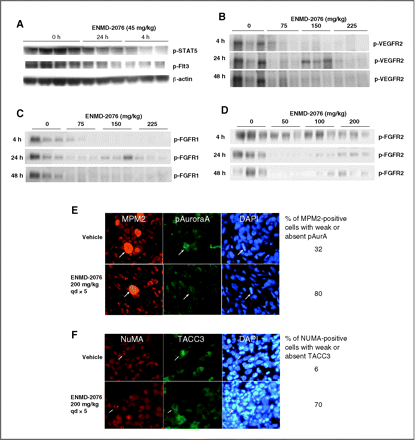
ENMD-2076 inhibits Flt3, VEGFR2/KDR, FGFR-1/2, and Aurora A in vivo. Mol Cancer Ther. 2011 Jan;10(1):126-37. |
ENMD-2076 inhibits blood vessel formation and impacts the growth of established MDA-MB-231 tumors. Mol Cancer Ther. 2011 Jan;10(1):126-37. |
Products are for research use only; We do not sell to patients
Copyright 2020 InvivoChem LLC | All Rights Reserved


 COA
COA