| Size | Price | Stock | Qty |
|---|---|---|---|
| 2mg |
|
||
| 5mg |
|
||
| 10mg |
|
||
| 25mg |
|
||
| 50mg |
|
||
| 100mg |
|
||
| 250mg | |||
| 500mg | |||
| Other Sizes |
Purity: ≥98%
| Targets |
GADD45β/MKK7; NF-κB
GADD45β-MKK7 protein-protein interaction (EC₅₀ = 0.025 μM for disrupting the interaction in HTRF assay); the compound does not inhibit kinase activity of MKK7 or JNK directly (≤5% inhibition at 1 μM) [1] |
|---|---|
| ln Vitro |
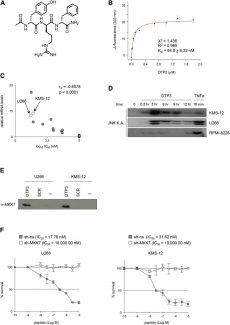
DTP3 physically interacts with MKK7, both in isolation and within the complex with GADD45β, and dissociates the GADD45β/MKK7 complex via an allosteric mechanism. Without being toxic to healthy cells, DTP3 selectively kills cells and triggers apoptosis in MM cells with functional MKK7 and increased GADD45β expression. Additionally, DTP3 exhibits synergistic activity with bortezomib in two different MM cell lines, showing a combination index of 0.21 in U266 cells and of 0.56 in KMS-12 cells. [1]
Disruption of GADD45β-MKK7 interaction: DTP3 potently inhibited the binding of recombinant GADD45β to MKK7 with an EC₅₀ of 25 nM (HTRF assay). In immunoprecipitation experiments using MV4-11 cell lysates, DTP3 (0.05–0.2 μM) reduced GADD45β-MKK7 complex formation by 60–85% without affecting total GADD45β or MKK7 protein levels [1] - Cell proliferation inhibition: In FLT3-mutant acute myeloid leukemia (AML) cell lines (MV4-11, MOLM-13), DTP3 suppressed cell viability with IC₅₀ values of 0.08 μM (MV4-11) and 0.12 μM (MOLM-13) (72-hour CellTiter-Glo assay). In FLT3-wild-type AML lines (HL-60, U937), it had IC₅₀ >1 μM. Normal human bone marrow stromal cells (HS-5) showed >90% viability at 0.5 μM DTP3 [1] - JNK pathway suppression: Pre-treatment of MV4-11 cells with DTP3 (0.1 μM, 2 hours) blocked FLT3 inhibitor-induced JNK phosphorylation (p-JNK1/2) by ≥90% and reduced downstream c-Jun phosphorylation (p-c-Jun) by ≥85% (Western blot). Total JNK and c-Jun levels remained unchanged [1] - Apoptosis induction: In MV4-11 cells, DTP3 (0.15 μM, 48 hours) increased apoptotic cell percentage from 2.7% (vehicle) to 42.3% (Annexin V/PI staining), accompanied by upregulation of cleaved caspase-3, cleaved PARP, and Bax, and downregulation of Bcl-2 [1] - In vitro toxicity on normal cells: DTP3 (0.01–1 μM) did not reduce viability of human peripheral blood mononuclear cells (PBMCs) (>95% viability at all concentrations) or induce lactate dehydrogenase (LDH) release, indicating low cytotoxicity to normal hematopoietic cells [2] |
| ln Vivo |
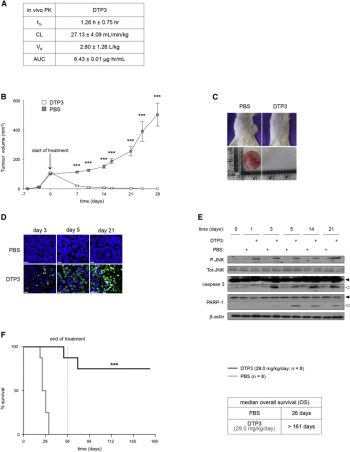
DTP3 (14.5 mg/kg/day) displays strong antitumor activity against MM in mouse plasmacytoma model. [1]
AML xenograft efficacy: NOD/SCID mice (female, 6–8 weeks) bearing MV4-11 (FLT3-ITD mutant) xenografts (100–120 mm³) were treated with DTP3 (10 mg/kg, 20 mg/kg, intraperitoneal injection, once every 2 days) or vehicle (5% DMSO/20% PEG400/75% saline) for 21 days. The 20 mg/kg dose reduced tumor volume by 78% (mean volume: 195 ± 22 mm³ vs 885 ± 65 mm³ in vehicle) and extended median survival from 28 days (vehicle) to 45 days. IHC of tumors showed ≥80% reduction in p-JNK and Ki-67 [1] - Acute in vivo toxicity: ICR mice (male, 8-week-old) were administered DTP3 via intraperitoneal injection at doses of 50 mg/kg, 100 mg/kg, or 200 mg/kg (n=5/group) once daily for 7 days. No mortality or clinical signs (e.g., lethargy, weight loss) were observed. Serum ALT, AST, BUN, and creatinine levels were within normal ranges, and histopathology of liver, kidney, spleen, and heart showed no treatment-related lesions [2] |
| Enzyme Assay |
Tryptophan fluorescence quenching analysis, used after a nonlinear regression algorithm has been used to fit the fluorescence data, is used to determine the stoichiometry and KD value of the DTP3/MKK7 interaction.
HTRF assay for GADD45β-MKK7 interaction: Recombinant human GADD45β (labeled with Eu³⁺-cryptate) and MKK7 (labeled with XL665) were incubated in reaction buffer (25 mM Tris-HCl pH 7.5, 100 mM NaCl, 0.1% BSA, 1 mM DTT) with serial dilutions of DTP3 (0.001–1 μM) at room temperature for 1 hour. The HTRF signal (excitation 337 nm, emission 620 nm and 665 nm) was measured, and the ratio of 665 nm/620 nm was used to calculate the EC₅₀ for disrupting GADD45β-MKK7 binding [1] - GST pull-down assay: GST-tagged MKK7 (1 μg) was immobilized on glutathione-sepharose beads and incubated with His-tagged GADD45β (0.5 μg) and DTP3 (0.01–0.5 μM) in binding buffer (25 mM Tris-HCl pH 7.4, 150 mM NaCl, 0.5% Triton X-100, 1 mM DTT) at 4°C overnight. Beads were washed 3 times, and bound GADD45β was detected by Western blot using anti-His antibody. Band intensity was quantified to assess inhibition of GADD45β-MKK7 interaction [1] |
| Cell Assay |
[3H]Assays for thymidine incorporation are carried out according to established protocols. Briefly, cell lines are seeded into 96-well plates at 1.0x10⁴ cells per well and either left untreated or treated daily with the indicated concentrations of peptides. They are then maintained in complete RPMI-1640 medium at 37°C in 5% CO2, splitting them with medium as necessary. Cells are incubated for an additional 16 hours with 0.037 MBq/well of [3H]thymidine at 24, 72, or 144 hours. Following this, they are harvested onto glass fiber filter mats using a 96-well plate automated Tomtec cell harvester, and their liquid scintillation spectroscopy data is analyzed using a LKB Wallac Trilux Microbeta 3-counter. Values are expressed as the proportion of counts per minute (cpm) measured in the treated cultures to the corresponding untreated cultures. The mean compound concentration causing a 50% inhibition of [3H]thymidine uptake as compared to the uptake measured in untreated cells is known as the IC50 value, which is calculated using either 5 or 7 concentrations of the compound. Trypan blue exclusion assays are performed. Briefly, 2.0x10⁵ cells from lentivirus-infected cell lines are seeded into the wells of 48-well plates in complete medium, and they are then cultured at 37°C in 5% CO2, splitting them as necessary during the assays. Trypan blue is used to count cells, and cell viability is monitored over a period of up to 8 days. The numbers of live infected cells in the cultures are extrapolated, as needed, from the cell counts by taking into account the percentages of eGFP+ cells, using flow cytometry. The percentage of live infected cells present in the cultures at the indicated times compared to the number of live infected cells present in the same cultures on day 0 is used to express values.
Cell viability assay (CellTiter-Glo): AML cells (5×10³/well, 96-well plate) were incubated overnight, then treated with DTP3 (0.001–1 μM) for 72 hours at 37°C (5% CO₂). CellTiter-Glo reagent was added, and luminescence was measured. IC₅₀ values were calculated via nonlinear regression [1] - Western blot for signaling and apoptosis proteins: MV4-11 cells (1×10⁶/well, 6-well plate) were treated with DTP3 (0.05–0.2 μM) for 24 hours. Cells were lysed in RIPA buffer (with protease/phosphatase inhibitors), and lysates (20 μg protein) were run on SDS-PAGE. Blots were probed with antibodies against p-JNK1/2 (Thr183/Tyr185), total JNK1/2, cleaved caspase-3, cleaved PARP, Bax, Bcl-2, and β-actin. Band intensity was quantified via densitometry [1] - Immunoprecipitation (Co-IP) in cells: MV4-11 cells (5×10⁶) were treated with DTP3 (0.1 μM) for 16 hours, then lysed in Co-IP buffer (25 mM Tris-HCl pH 7.4, 150 mM NaCl, 1% NP-40, protease/phosphatase inhibitors). Lysates were incubated with anti-GADD45β antibody overnight at 4°C, followed by protein A/G beads for 2 hours. Beads were washed, and co-immunoprecipitated MKK7 was detected by Western blot using anti-MKK7 antibody [1] - Normal cell toxicity assay: Human PBMCs were isolated from healthy donors and seeded in 96-well plates (1×10⁵/well). Cells were treated with DTP3 (0.01–1 μM) for 72 hours, and viability was measured via trypan blue exclusion. LDH release in culture supernatants was measured using an LDH assay kit to assess cytotoxicity [2] |
| Animal Protocol |
NOD/SCID mice bearing U266 or KMS-11 MM cells
14.5 mg/kg/day Administered using Alzet osmotic pumps AML xenograft model: Female NOD/SCID mice were subcutaneously injected with 5×10⁶ MV4-11 cells (suspended in 100 μL PBS/Matrigel, 1:1) into the right flank. When tumors reached 100–120 mm³, mice were randomized into 3 groups (n=8/group): (1) vehicle (5% DMSO/20% PEG400/75% saline, intraperitoneal injection, once every 2 days); (2) DTP3 10 mg/kg (same formulation, intraperitoneal injection, once every 2 days); (3) DTP3 20 mg/kg (same formulation, intraperitoneal injection, once every 2 days). Tumor volume was measured twice weekly (volume = length × width² × 0.5). Mice were monitored for survival, and tumors were harvested for IHC after 21 days [1] - Acute toxicity study: Male ICR mice (8-week-old, n=5/group) were randomized into 4 groups: (1) vehicle (5% DMSO/20% PEG400/75% saline, intraperitoneal injection, daily); (2) DTP3 50 mg/kg (intraperitoneal injection, daily); (3) DTP3 100 mg/kg (intraperitoneal injection, daily); (4) DTP3 200 mg/kg (intraperitoneal injection, daily). Treatments were administered for 7 days. Mice were weighed daily, and blood samples were collected on day 8 for serum biochemistry. Major organs (liver, kidney, spleen, heart) were fixed in 10% formalin for histopathological analysis [2] |
| ADME/Pharmacokinetics |
Plasma pharmacokinetics: Male SD rats (n=3 at each time point) were intraperitoneally injected with DTP3 (20 mg/kg, solvent control). Blood samples (50 μL) were collected at 0.25, 0.5, 1, 2, 4, 6, 8 and 24 hours after administration. Plasma was separated by centrifugation, and DTP3 concentration was determined by LC-MS/MS. The main pharmacokinetic parameters included: terminal half-life (T₁/₂) = 4.5 ± 0.6 h; area under the curve (AUC₀₋∞) = 28.3 ± 3.2 μg·h/mL; clearance (CL) = 12.1 ± 1.5 mL/h/kg [2]
- Oral bioavailability: No oral administration data or bioavailability calculations were reported [1, 2] - Tissue distribution: In rats (intraperitoneal injection of 20 mg/kg), DTP3 accumulated most in the liver (liver-to-plasma ratio = 3.8 2 hours after administration) and spleen (spleen-to-plasma ratio = 2.5), and less in the brain (brain-to-plasma ratio = 0.12) [2] |
| Toxicity/Toxicokinetics |
Maximum tolerated dose (MTD): In ICR mice, no death or treatment-related toxicity was observed with an MTD ≥200 mg/kg of DTP3 administered intraperitoneally (repeated over 7 days) [2]
- Plasma protein binding: DTP3 is approximately 91% bound to human plasma proteins (as determined by balanced dialysis) [2] - Chronic toxicity: No chronic toxicity studies of 28 days or longer have been reported [1, 2] - Drug interactions: No data on CYP enzyme inhibition or induction have been reported [1, 2] |
| References | |
| Additional Infomation |
Mechanism of action: DTP3 is a first-in-class GADD45β-MKK7 protein-protein interaction inhibitor. It binds to the MKK7 interaction domain of GADD45β, blocking MKK7 activation and subsequent JNK pathway activation—avoiding the off-target kinase inhibition common in conventional JNK inhibitors [1]
- Therapeutic potential: This compound is being evaluated for the treatment of FLT3-mutant acute myeloid leukemia (AML), as FLT3 inhibitors typically induce JNK-dependent resistance, which DTP3 reverses by blocking GADD45β-MKK7-mediated JNK activation [1] - Safety: Preclinical models have shown that DTP3 has very low toxicity to normal hematopoietic cells and major organs, supporting its potential for clinical translation [2] |
| Molecular Formula |
C26H35N7O5
|
|
|---|---|---|
| Molecular Weight |
525.6
|
|
| Exact Mass |
525.269
|
|
| Elemental Analysis |
C, 59.41; H, 6.71; N, 18.65; O, 15.22
|
|
| CAS # |
1809784-29-9
|
|
| Related CAS # |
DTP3 TFA;2759216-46-9
|
|
| PubChem CID |
86295191
|
|
| Appearance |
White to off-white solid powder
|
|
| Density |
1.4±0.1 g/cm3
|
|
| Index of Refraction |
1.637
|
|
| LogP |
-0.43
|
|
| Hydrogen Bond Donor Count |
7
|
|
| Hydrogen Bond Acceptor Count |
6
|
|
| Rotatable Bond Count |
14
|
|
| Heavy Atom Count |
38
|
|
| Complexity |
819
|
|
| Defined Atom Stereocenter Count |
3
|
|
| SMILES |
O=C([C@@H](CCC/N=C(\N)/N)NC([C@@H](CC1C=CC(=CC=1)O)NC(C)=O)=O)N[C@@H](C(N)=O)CC1C=CC=CC=1
|
|
| InChi Key |
AOUZPXZGMZUQQS-YPAWHYETSA-N
|
|
| InChi Code |
InChI=1S/C26H35N7O5/c1-16(34)31-22(15-18-9-11-19(35)12-10-18)25(38)32-20(8-5-13-30-26(28)29)24(37)33-21(23(27)36)14-17-6-3-2-4-7-17/h2-4,6-7,9-12,20-22,35H,5,8,13-15H2,1H3,(H2,27,36)(H,31,34)(H,32,38)(H,33,37)(H4,28,29,30)/t20-,21-,22-/m1/s1
|
|
| Chemical Name |
(2R)-2-[[(2R)-2-acetamido-3-(4-hydroxyphenyl)propanoyl]amino]-N-[(2R)-1-amino-1-oxo-3-phenylpropan-2-yl]-5-(diaminomethylideneamino)pentanamide
|
|
| Synonyms |
|
|
| HS Tariff Code |
2934.99.9001
|
|
| Storage |
Powder -20°C 3 years 4°C 2 years In solvent -80°C 6 months -20°C 1 month Note: Please store this product in a sealed and protected environment (e.g. under nitrogen), avoid exposure to moisture and light. |
|
| Shipping Condition |
Room temperature (This product is stable at ambient temperature for a few days during ordinary shipping and time spent in Customs)
|
| Solubility (In Vitro) |
|
|||
|---|---|---|---|---|
| Solubility (In Vivo) |
Solubility in Formulation 1: ≥ 2.5 mg/mL (4.76 mM) (saturation unknown) in 10% DMSO + 40% PEG300 + 5% Tween80 + 45% Saline (add these co-solvents sequentially from left to right, and one by one), clear solution.
For example, if 1 mL of working solution is to be prepared, you can add 100 μL of 25.0 mg/mL clear DMSO stock solution to 400 μL PEG300 and mix evenly; then add 50 μL Tween-80 to the above solution and mix evenly; then add 450 μL normal saline to adjust the volume to 1 mL. Preparation of saline: Dissolve 0.9 g of sodium chloride in 100 mL ddH₂ O to obtain a clear solution. Solubility in Formulation 2: ≥ 2.5 mg/mL (4.76 mM) (saturation unknown) in 10% DMSO + 90% (20% SBE-β-CD in Saline) (add these co-solvents sequentially from left to right, and one by one), clear solution. For example, if 1 mL of working solution is to be prepared, you can add 100 μL of 25.0 mg/mL clear DMSO stock solution to 900 μL of 20% SBE-β-CD physiological saline solution and mix evenly. Preparation of 20% SBE-β-CD in Saline (4°C,1 week): Dissolve 2 g SBE-β-CD in 10 mL saline to obtain a clear solution. View More
Solubility in Formulation 3: ≥ 2.5 mg/mL (4.76 mM) (saturation unknown) in 10% DMSO + 90% Corn Oil (add these co-solvents sequentially from left to right, and one by one), clear solution. |
| Preparing Stock Solutions | 1 mg | 5 mg | 10 mg | |
| 1 mM | 1.9026 mL | 9.5129 mL | 19.0259 mL | |
| 5 mM | 0.3805 mL | 1.9026 mL | 3.8052 mL | |
| 10 mM | 0.1903 mL | 0.9513 mL | 1.9026 mL |
*Note: Please select an appropriate solvent for the preparation of stock solution based on your experiment needs. For most products, DMSO can be used for preparing stock solutions (e.g. 5 mM, 10 mM, or 20 mM concentration); some products with high aqueous solubility may be dissolved in water directly. Solubility information is available at the above Solubility Data section. Once the stock solution is prepared, aliquot it to routine usage volumes and store at -20°C or -80°C. Avoid repeated freeze and thaw cycles.
Calculation results
Working concentration: mg/mL;
Method for preparing DMSO stock solution: mg drug pre-dissolved in μL DMSO (stock solution concentration mg/mL). Please contact us first if the concentration exceeds the DMSO solubility of the batch of drug.
Method for preparing in vivo formulation::Take μL DMSO stock solution, next add μL PEG300, mix and clarify, next addμL Tween 80, mix and clarify, next add μL ddH2O,mix and clarify.
(1) Please be sure that the solution is clear before the addition of next solvent. Dissolution methods like vortex, ultrasound or warming and heat may be used to aid dissolving.
(2) Be sure to add the solvent(s) in order.
| NCT Number | Recruitment | interventions | Conditions | Sponsor/Collaborators | Start Date | Phases |
| NCT00244673 | Completed | Biological: DTP3/4+OPV+MV versus OPV+MV or DTP4+OPV4 versus OPV4 |
Mortality Hospitalization |
Bandim Health Project | October 2005 | Phase 4 |
The High Target Specificity of DTP3 in Cells. Cancer Cell. 2014 Oct 13; 26(4): 495–508. |
Products are for research use only; We do not sell to patients 

|


 COA
COA