| Size | Price | Stock | Qty |
|---|---|---|---|
| 5mg |
|
||
| 10mg |
|
||
| 25mg |
|
||
| 50mg |
|
||
| 100mg |
|
||
| Other Sizes |


Purity: ≥98%
| Targets |
AChE (IC50 = 226 µM); μ Opioid Receptor/MOR
Corydaline targets multiple proteins. It acts as an acetylcholinesterase (AChE) inhibitor with an IC50 of 226 µM. It is a μ-opioid receptor agonist with a Ki of 1.23 µM. It also inhibits CYP2C19 and CYP2C9 and has anti-angiogenic activity. Its diverse targets contribute to its various pharmacological activities. |
|---|---|
| ln Vitro |
Corydaline treatment (12.5-50 μM; 24 hours) reduces COX-2 production and activation of JNK MAPK and P38 MAPK, but not ERK MAPK, which prevents EV71 replication [2].
In vitro, corydaline acts as an acetylcholinesterase inhibitor with an IC50 of 226 µM. It is a μ-opioid receptor agonist with a Ki of 1.23 µM. It inhibits the replication of enterovirus 71 with an IC50 of 25.23 µM and has anti-angiogenic activity. These activities have been demonstrated in various cell-based assays. |
| ln Vivo |
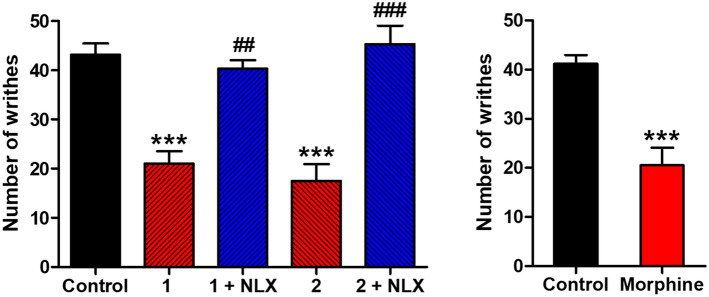
Corydanine (10 mg/kg; subcutaneous; once) therapy revealed analgesic effects by dramatically decreasing writhing behavior in mice [3].
In vivo, corydaline has demonstrated antiallergic, antinociceptive, and gastric emptying activities. It has shown potential in inhibiting the replication of certain viruses, making it a promising candidate for further antiviral research. However, specific details of in vivo efficacy studies are not extensively detailed in the available literature. |
| Enzyme Assay |
Enterovirus 71 (EV71) is a huge threat to the worldwide public health and there is no approved antiviral drug for EV71-induced disease therapy. Corydaline exists antiallergic and antinociceptive activities, but the anti-EV71 activity of corydaline is still not reported. In this study, corydaline could suppress the expression of viral structural and non-structural proteins. Furthermore, corydaline inhibits EV71 replication by suppressing the COX-2 expression and the phosphorylation of JNK MAPK and P38 MAPK but not ERK MAPK in vitro. Based on these findings, corydaline could be a potential lead or supplement for the development of new anti-EV71 agents in the future[2].
Pain remains a key therapeutic area with intensive efforts directed toward finding effective and safer analgesics in light of the ongoing opioid crisis. Amongst the neurotransmitter systems involved in pain perception and modulation, the mu-opioid receptor (MOR), a G protein-coupled receptor, represents one of the most important targets for achieving effective pain relief. Most clinically used opioid analgesics are agonists to the MOR, but they can also cause severe side effects. Medicinal plants represent important sources of new drug candidates, with morphine and its semisynthetic analogues as well-known examples as analgesic drugs. In this study, combining in silico (pharmacophore-based virtual screening and docking) and pharmacological (in vitro binding and functional assays, and behavioral tests) approaches, we report on the discovery of two naturally occurring plant alkaloids, corydine and corydaline, as new MOR agonists that produce antinociceptive effects in mice after subcutaneous administration via a MOR-dependent mechanism. Furthermore, corydine and corydaline were identified as G protein-biased agonists to the MOR without inducing β-arrestin2 recruitment upon receptor activation. Thus, these new scaffolds represent valuable starting points for future chemical optimization towards the development of novel opioid analgesics, which may exhibit improved therapeutic profiles[3]. The in vitro enzyme assay for corydaline measures its ability to inhibit acetylcholinesterase (AChE) activity. These cell-free assays use purified AChE and a chromogenic substrate. The compound's inhibitory potency (IC50) is determined by measuring the reduction in enzyme activity. Its binding to μ-opioid receptors can be assessed using radioligand displacement assays. |
| Cell Assay |
Western Blot analysis [2]
Cell Types: Vero cells infected with EV71 Tested Concentrations: 12.5μM, 25μM, 50μM Incubation Duration: 24 hrs (hours) Experimental Results: The phosphorylation and expression of P38MAPK and JNKMAPK were diminished. COX-2. In vitro cellular assays for corydaline assess its antiviral and anti-inflammatory effects. Cells infected with enterovirus 71 are treated with corydaline, and viral replication is measured. Its effects on opioid receptor signaling can be assessed in cells expressing μ-opioid receptors. These assays demonstrate the compound's functional activity in a relevant cellular context. |
| Animal Protocol |
Animal/Disease Models: Male CD1 mice (30-35 g, 7-8 weeks old) were injected with acetic acid [3].
Doses: 10 mg/kg. Route of Administration: subcutaneousadministration; primary Experimental Results:demonstrated anti-nociceptive effect on mice. In vivo animal studies for corydaline have been conducted to evaluate its antinociceptive, antiallergic, and antiviral activities. However, specific details of these studies are not extensively detailed in the available literature. It is a research compound and is not approved for clinical use. |
| ADME/Pharmacokinetics |
Specific pharmacokinetic data for corydaline are not extensively detailed in the available literature. As a natural alkaloid, its pharmacokinetic properties would be important for its in vivo efficacy. However, specific parameters such as half-life and bioavailability are not provided. It is intended for research use only.
|
| Toxicity/Toxicokinetics |
Specific toxicity data for corydaline are not extensively detailed in the available literature. As a natural product, it is generally considered to have low toxicity. However, comprehensive toxicological studies would be required to establish its safety profile for therapeutic use. It is intended for research purposes only.
|
| References | |
| Additional Infomation |
Corydaline is an isoquinoline alkaloid, belonging to the isoquinoline class of compounds. It has been reported to exist in Broomia spp., Corydalis yanhusuo, and other organisms with relevant data.
Corydaline (CAS 518-69-4) is an isoquinoline alkaloid from Corydalis tubers with acetylcholinesterase inhibitory (IC50 = 226 µM), μ-opioid receptor agonistic (Ki = 1.23 µM), and antiviral (IC50 = 25.23 µM against EV71) activities. It has antiallergic, antinociceptive, and gastric emptying activities. It has a molecular formula of C22H27NO4 and a molecular weight of 369.45. It is a research compound and is not approved for clinical use. |
| Molecular Formula |
C22H27NO4
|
|---|---|
| Molecular Weight |
369.4541
|
| Exact Mass |
369.194
|
| Elemental Analysis |
C, 71.52; H, 7.37; N, 3.79; O, 17.32
|
| CAS # |
518-69-4
|
| Related CAS # |
Corydaline; 518-69-4
|
| PubChem CID |
101301
|
| Appearance |
White to light yellow solid
|
| Density |
1.2±0.1 g/cm3
|
| Boiling Point |
482.3±45.0 °C at 760 mmHg
|
| Melting Point |
135°
|
| Flash Point |
135.7±25.9 °C
|
| Vapour Pressure |
0.0±1.2 mmHg at 25°C
|
| Index of Refraction |
1.600
|
| Source |
Originated from plants: Papaveraceae Corydalis yanhusuo W. T. Wang
|
| LogP |
4.19
|
| Hydrogen Bond Donor Count |
0
|
| Hydrogen Bond Acceptor Count |
5
|
| Rotatable Bond Count |
4
|
| Heavy Atom Count |
27
|
| Complexity |
503
|
| Defined Atom Stereocenter Count |
2
|
| SMILES |
O(C([H])([H])[H])C1=C(C([H])=C([H])C2=C1C([H])([H])N1C([H])([H])C([H])([H])C3=C([H])C(=C(C([H])=C3[C@@]1([H])[C@@]2([H])C([H])([H])[H])OC([H])([H])[H])OC([H])([H])[H])OC([H])([H])[H]
|
| InChi Key |
VRSRXLJTYQVOHC-YEJXKQKISA-N
|
| InChi Code |
InChI=1S/C22H27NO4/c1-13-15-6-7-18(24-2)22(27-5)17(15)12-23-9-8-14-10-19(25-3)20(26-4)11-16(14)21(13)23/h6-7,10-11,13,21H,8-9,12H2,1-5H3/t13-,21+/m0/s1
|
| Chemical Name |
(13S,13aR)-2,3,9,10-tetramethoxy-13-methyl-5,8,13,13a-tetrahydro-6H-isoquinolino[3,2-a]isoquinoline
|
| Synonyms |
Corydalin; BRN 0096972; NSC 406036; BRN-0096972; NSC-406036; BRN0096972; NSC406036
|
| HS Tariff Code |
2934.99.9001
|
| Storage |
Powder -20°C 3 years 4°C 2 years In solvent -80°C 6 months -20°C 1 month |
| Shipping Condition |
Room temperature (This product is stable at ambient temperature for a few days during ordinary shipping and time spent in Customs)
|
| Solubility (In Vitro) |
DMSO : ~33.33 mg/mL (~90.22 mM)
|
|---|---|
| Solubility (In Vivo) |
Solubility in Formulation 1: ≥ 2.5 mg/mL (6.77 mM) (saturation unknown) in 10% DMSO + 40% PEG300 +5% Tween-80 + 45% Saline (add these co-solvents sequentially from left to right, and one by one), clear solution.
For example, if 1 mL of working solution is to be prepared, you can add 100 μL of 25.0 mg/mL clear DMSO stock solution to 400 μL PEG300 and mix evenly; then add 50 μL Tween-80 + to the above solution and mix evenly; then add 450 μL normal saline to adjust the volume to 1 mL. Preparation of saline: Dissolve 0.9 g of sodium chloride in 100 mL ddH₂ O to obtain a clear solution. (Please use freshly prepared in vivo formulations for optimal results.) |
| Preparing Stock Solutions | 1 mg | 5 mg | 10 mg | |
| 1 mM | 2.7067 mL | 13.5336 mL | 27.0673 mL | |
| 5 mM | 0.5413 mL | 2.7067 mL | 5.4135 mL | |
| 10 mM | 0.2707 mL | 1.3534 mL | 2.7067 mL |
*Note: Please select an appropriate solvent for the preparation of stock solution based on your experiment needs. For most products, DMSO can be used for preparing stock solutions (e.g. 5 mM, 10 mM, or 20 mM concentration); some products with high aqueous solubility may be dissolved in water directly. Solubility information is available at the above Solubility Data section. Once the stock solution is prepared, aliquot it to routine usage volumes and store at -20°C or -80°C. Avoid repeated freeze and thaw cycles.
Calculation results
Working concentration: mg/mL;
Method for preparing DMSO stock solution: mg drug pre-dissolved in μL DMSO (stock solution concentration mg/mL). Please contact us first if the concentration exceeds the DMSO solubility of the batch of drug.
Method for preparing in vivo formulation::Take μL DMSO stock solution, next add μL PEG300, mix and clarify, next addμL Tween 80, mix and clarify, next add μL ddH2O,mix and clarify.
(1) Please be sure that the solution is clear before the addition of next solvent. Dissolution methods like vortex, ultrasound or warming and heat may be used to aid dissolving.
(2) Be sure to add the solvent(s) in order.
|
|
|
Products are for research use only; We do not sell to patients
Copyright 2020 InvivoChem LLC | All Rights Reserved


 COA
COA