| Size | Price | Stock | Qty |
|---|---|---|---|
| 5mg |
|
||
| 10mg |
|
||
| 25mg |
|
||
| 50mg |
|
||
| 100mg |
|
||
| 250mg |
|
||
| 500mg | |||
| Other Sizes |


Purity: ≥98%
| Targets |
Cystic Fibrosis Transmembrane Conductance Regulator (CFTR) (IC50 for CFTR-mediated chloride transport inhibition: 1.3 μM; IC50 for cholera toxin-induced fluid secretion inhibition: 2.4 μM)[1][2]
|
|---|---|
| ln Vitro |
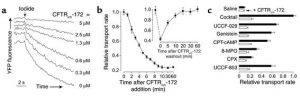
Inhibition by CFTR(inh)-172 is complete in around 10 minutes (t1/2=4 min) and is reversed after roughly 5 minutes at t1/2. CFTRinh-172 suppresses FRT after 24 hours at doses up to 100 μM[1] Cells are non-toxic. CFTR(inh)-172 does not modify the CFTR unitary conductance (8 pS) but reduces the open probability by >90% at Ki=0.6 μM. This effect is due to increasing the average channel off time without changing the average channel on time. The Ki value of wild-type, G551D, and G1349D CFTR for blocking Cl- current is approximately 0.5 μM; however, for vF508 CFTR, the Ki is drastically lowered to 0.2 μM [2].
In human bronchial epithelial cells (Calu-3) and colonic epithelial cells (T84), CFTRinh-172 (0.1-10 μM) dose-dependently inhibited CFTR-mediated chloride transport with an IC50 of 1.3 μM, as measured by Ussing chamber assay. It also blocked cholera toxin-induced intestinal epithelial fluid secretion, with an IC50 of 2.4 μM[1] - In HEK293 cells stably expressing recombinant human CFTR and Xenopus laevis oocytes injected with CFTR cRNA, CFTRinh-172 (0.5-5 μM) suppressed CFTR channel activity by altering gating mechanism. At 1 μM, it reduced CFTR-mediated current by >90%, prolonged channel closed time, and did not compete with ATP binding to CFTR. The inhibition was reversible after drug washout[2] |
| ln Vivo |
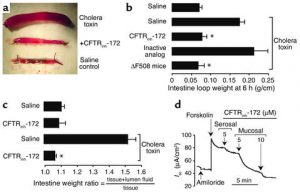
In mice, cholera toxin-induced small intestinal fluid secretion was reduced by almost 90% after a single intraperitoneal injection of CFTR(inh)-172 (250 μg/kg) within 6 hours. In mouse models, CFTR(inh)-172 is not harmful at high concentrations. While inactive CFTRinh-172 analogues do not suppress fluid secretion, CFTRinh-172 dramatically decreases fluid secretion into the saline control circuit [1].
In a mouse model of cholera toxin-induced diarrhea, intraperitoneal administration of CFTRinh-172 (1 mg/kg, 5 mg/kg, 10 mg/kg) dose-dependently reduced intestinal fluid secretion. The 10 mg/kg dose decreased intestinal weight/length ratio (a marker of fluid accumulation) by 70% compared to vehicle control. Oral administration of 50 mg/kg also exhibited significant inhibitory effect on cholera toxin-induced fluid secretion[1] |
| Enzyme Assay |
CFTR channel gating assay: Recombinant human CFTR was expressed in HEK293 cells or Xenopus laevis oocytes. Gradient concentrations of CFTRinh-172 (0.1-5 μM) were added to the extracellular solution. Whole-cell patch-clamp (HEK293 cells) or two-electrode voltage clamp (oocytes) was used to record CFTR-mediated currents. Channel gating parameters (open time, closed time, open probability) were analyzed to evaluate the effect of the drug on CFTR gating mechanism[2]
|
| Cell Assay |
Chloride transport inhibition assay: Calu-3 or T84 cells were seeded on permeable supports and cultured until confluent. CFTRinh-172 (0.1 μM, 1 μM, 10 μM) was added to the apical or basolateral medium, and CFTR was activated by forskolin. Transepithelial chloride current was measured by Ussing chamber to quantify inhibition efficiency[1]
- Cholera toxin-induced fluid secretion assay: T84 cells were seeded in 24-well plates and treated with CFTRinh-172 (0.5 μM, 2.5 μM, 5 μM) for 30 minutes, then stimulated with cholera toxin. After 24 hours, the volume of culture medium above the cell monolayer was measured to assess fluid secretion inhibition[1] - CFTR current patch-clamp assay: HEK293 cells transfected with CFTR plasmid were plated on glass coverslips. CFTRinh-172 (0.5 μM, 1 μM, 3 μM) was applied to the extracellular solution, and CFTR currents were recorded under voltage-clamp conditions. Current amplitude and gating kinetics were analyzed to determine the inhibitory effect[2] |
| Animal Protocol |
Dissolved in 20 μg/6 h; i.p. administration
An adult mouse model of Vibrio cholerae-induced diarrhea Cholera toxin-induced diarrhea mouse model: Male CD-1 mice (20-25 g) were randomly divided into treatment and control groups. CFTRinh-172 was dissolved in dimethyl sulfoxide (DMSO) and diluted with saline (final DMSO concentration <5%), administered via intraperitoneal injection (1 mg/kg, 5 mg/kg, 10 mg/kg) or oral gavage (50 mg/kg) 30 minutes before intraperitoneal injection of cholera toxin. Four hours later, mice were euthanized, and the small intestine was removed to measure intestinal weight/length ratio as an indicator of fluid accumulation[1] |
| References |
|
| Additional Infomation |
See also: CFTRinh-172 (Note moved here).
CFTRinh-172 is a thiazolidinone CFTR inhibitor, discovered through high-throughput screening, and is primarily used as a tool for studying CFTR function[1][2] - Its core mechanism is to alter the gating of CFTR channels rather than blocking ATP binding; specifically, it prolongs the closed state of the channels to inhibit the transport of chloride ions across the epithelial cell membrane[2] - It exhibits potent inhibitory activity against both endogenous and recombinant CFTR and can potentially be used to treat secretory diarrhea (e.g., cholera) by blocking intestinal fluid secretion[1] - The inhibitory effect of this drug on CFTR is reversible, thus it is suitable for in vitro and in vivo studies requiring temporary blocking of CFTR function[2] |
| Molecular Formula |
C18H10F3NO3S2
|
|
|---|---|---|
| Molecular Weight |
409.4
|
|
| Exact Mass |
409.005
|
|
| CAS # |
307510-92-5
|
|
| Related CAS # |
|
|
| PubChem CID |
1554208
|
|
| Appearance |
Light yellow to yellow solid powder
|
|
| Density |
1.6±0.1 g/cm3
|
|
| Boiling Point |
555.7±60.0 °C at 760 mmHg
|
|
| Flash Point |
289.9±32.9 °C
|
|
| Vapour Pressure |
0.0±1.6 mmHg at 25°C
|
|
| Index of Refraction |
1.698
|
|
| LogP |
4.51
|
|
| Hydrogen Bond Donor Count |
1
|
|
| Hydrogen Bond Acceptor Count |
8
|
|
| Rotatable Bond Count |
3
|
|
| Heavy Atom Count |
27
|
|
| Complexity |
657
|
|
| Defined Atom Stereocenter Count |
0
|
|
| SMILES |
C1=CC(=CC(=C1)N2C(=O)/C(=C/C3=CC=C(C=C3)C(=O)O)/SC2=S)C(F)(F)F
|
|
| InChi Key |
JIMHYXZZCWVCMI-ZSOIEALJSA-N
|
|
| InChi Code |
InChI=1S/C18H10F3NO3S2/c19-18(20,21)12-2-1-3-13(9-12)22-15(23)14(27-17(22)26)8-10-4-6-11(7-5-10)16(24)25/h1-9H,(H,24,25)/b14-8-
|
|
| Chemical Name |
4-{[(5Z)-4-Oxo-2-sulfanylidene-3-[3-(trifluoromethyl)phenyl]-1,3-thiazolidin-5-ylidene]methyl}benzoic acid
|
|
| Synonyms |
|
|
| HS Tariff Code |
2934.99.9001
|
|
| Storage |
Powder -20°C 3 years 4°C 2 years In solvent -80°C 6 months -20°C 1 month |
|
| Shipping Condition |
Room temperature (This product is stable at ambient temperature for a few days during ordinary shipping and time spent in Customs)
|
| Solubility (In Vitro) |
DMSO: 82 mg/mL (200.3 mM)
Water: 1 mg/mL (Insoluble) Ethanol: 1 mg/mL |
|---|---|
| Solubility (In Vivo) |
Solubility in Formulation 1: 2.5 mg/mL (6.11 mM) in 10% DMSO + 40% PEG300 + 5% Tween80 + 45% Saline (add these co-solvents sequentially from left to right, and one by one), suspension solution; with sonication.
For example, if 1 mL of working solution is to be prepared, you can add 100 μL of 25.0 mg/mL clear DMSO stock solution to 400 μL PEG300 and mix evenly; then add 50 μL Tween-80 to the above solution and mix evenly; then add 450 μL normal saline to adjust the volume to 1 mL. Preparation of saline: Dissolve 0.9 g of sodium chloride in 100 mL ddH₂ O to obtain a clear solution. Solubility in Formulation 2: ≥ 2.5 mg/mL (6.11 mM) (saturation unknown) in 10% DMSO + 90% Corn Oil (add these co-solvents sequentially from left to right, and one by one), clear solution. For example, if 1 mL of working solution is to be prepared, you can add 100 μL of 25.0 mg/mL clear DMSO stock solution to 900 μL of corn oil and mix evenly. (Please use freshly prepared in vivo formulations for optimal results.) |
| Preparing Stock Solutions | 1 mg | 5 mg | 10 mg | |
| 1 mM | 2.4426 mL | 12.2130 mL | 24.4260 mL | |
| 5 mM | 0.4885 mL | 2.4426 mL | 4.8852 mL | |
| 10 mM | 0.2443 mL | 1.2213 mL | 2.4426 mL |
*Note: Please select an appropriate solvent for the preparation of stock solution based on your experiment needs. For most products, DMSO can be used for preparing stock solutions (e.g. 5 mM, 10 mM, or 20 mM concentration); some products with high aqueous solubility may be dissolved in water directly. Solubility information is available at the above Solubility Data section. Once the stock solution is prepared, aliquot it to routine usage volumes and store at -20°C or -80°C. Avoid repeated freeze and thaw cycles.
Calculation results
Working concentration: mg/mL;
Method for preparing DMSO stock solution: mg drug pre-dissolved in μL DMSO (stock solution concentration mg/mL). Please contact us first if the concentration exceeds the DMSO solubility of the batch of drug.
Method for preparing in vivo formulation::Take μL DMSO stock solution, next add μL PEG300, mix and clarify, next addμL Tween 80, mix and clarify, next add μL ddH2O,mix and clarify.
(1) Please be sure that the solution is clear before the addition of next solvent. Dissolution methods like vortex, ultrasound or warming and heat may be used to aid dissolving.
(2) Be sure to add the solvent(s) in order.
|
|---|
|
Products are for research use only; We do not sell to patients
Copyright 2020 InvivoChem LLC | All Rights Reserved


 COA
COA