| Size | Price | Stock | Qty |
|---|---|---|---|
| 10mg |
|
||
| 25mg |
|
||
| 50mg |
|
||
| 100mg |
|
||
| 250mg |
|
||
| 500mg | |||
| Other Sizes |


| Targets |
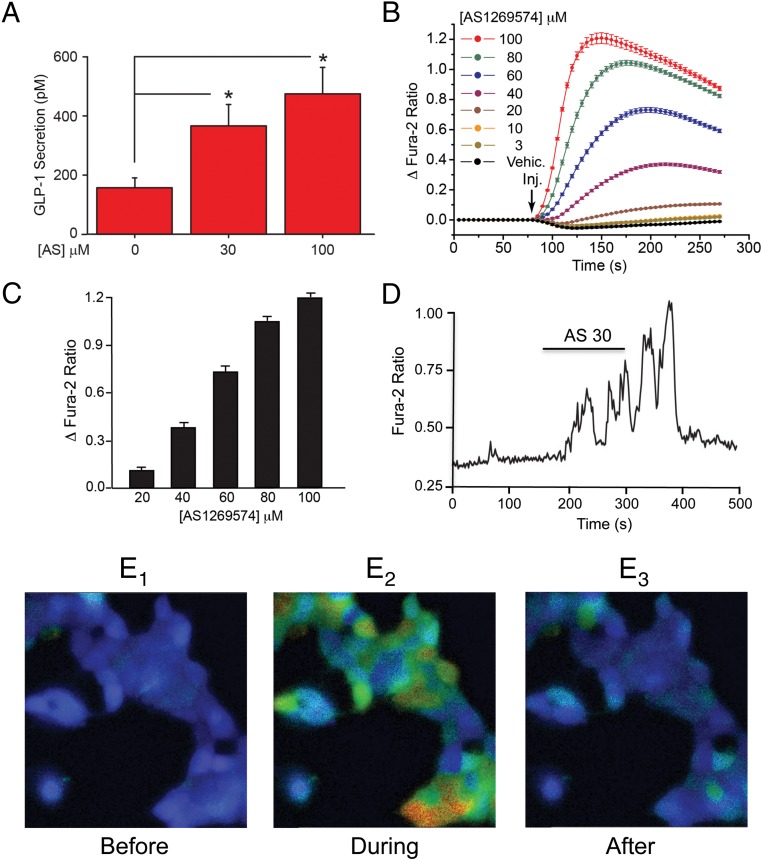
AS1269574 targets GPR119, a G protein-coupled receptor that is predominantly expressed in pancreatic β-cells and enteroendocrine cells. It acts as a potent agonist with an EC50 of 2.5 μM in HEK293 cells expressing human GPR119. GPR119 activation leads to increased cAMP levels, which enhances glucose-stimulated insulin secretion and GLP-1 secretion. The compound also activates the TRPA1 cation channel, contributing to its effects on GLP-1 secretion. AS1269574 shows no activity toward β-adrenergic or GLP-1 receptors.
|
|---|---|
| ln Vitro |
In vitro, AS1269574 increases cAMP levels in HEK293 cells transfected with human GPR119 with an EC50 of 2.5 μM. It enhances insulin secretion in the mouse pancreatic β-cell line MIN-6 only under high-glucose (16.8 mM) conditions. The compound also activates the TRPA1 cation channel and stimulates GLP-1 secretion. These in vitro activities demonstrate its potent GPR119 agonist activity and its ability to enhance glucose-dependent insulin secretion and GLP-1 release.
|
| ln Vivo |
AS1269574 significantly lowered blood glucose AUC 2 hours after injection (AUC0-2h)[1].
In vivo, AS1269574 enhances glucose-stimulated insulin secretion in mice. It has been shown to have a hypoglycemic effect in vivo. The compound's ability to stimulate GLP-1 secretion and enhance glucose-dependent insulin secretion makes it a potential candidate for the treatment of type 2 diabetes. However, specific details of in vivo studies, such as the animal models used and the dosing regimens, are not extensively detailed in the available literature. |
| Enzyme Assay |
The in vitro receptor binding assay for AS1269574 typically measures its ability to activate GPR119 in cell-free or membrane-based systems. These assays often measure cAMP accumulation in membrane preparations from cells expressing GPR119. The compound's potency (EC50) is determined by measuring the increase in cAMP levels in response to various concentrations of the compound. These cell-free assays provide a direct measure of the compound's agonist activity at GPR119.
|
| Cell Assay |
In vitro cellular assays for AS1269574 assess its ability to activate GPR119-mediated signaling in intact cells. HEK293 cells transiently expressing human GPR119 are treated with various concentrations of the compound, and cAMP accumulation is measured. In MIN-6 mouse pancreatic β-cells, insulin secretion is measured under low- and high-glucose conditions. GLP-1 secretion can also be measured in enteroendocrine cell lines. These assays demonstrate the compound's functional activity at GPR119 and its effects on insulin and GLP-1 secretion.
|
| Animal Protocol |
Animal/Disease Models: 8weeks old ICR mice [1]
Doses: 100 mg/kg Route of Administration: Po Experimental Results: Blood glucose AUC was Dramatically diminished after 2 hrs (hrs (hours)) of administration (AUC0-2h). Similarly, mouse plasma insulin AUC0-2h was Dramatically higher. In vivo animal studies for AS1269574 have been conducted in mouse models to assess its effects on glucose metabolism. Mice are administered the compound, and glucose-stimulated insulin secretion is measured. Blood glucose levels are monitored to assess the compound's hypoglycemic effect. These studies demonstrate the compound's ability to enhance insulin secretion and lower blood glucose in vivo, supporting its potential for the study of type 2 diabetes. |
| ADME/Pharmacokinetics |
AS1269574 is orally active, supporting its administration as an oral therapeutic agent. However, detailed pharmacokinetic parameters such as half-life, Cmax, and bioavailability are not extensively detailed in the available literature. As a small molecule GPR119 agonist, its pharmacokinetic properties would be important for its in vivo efficacy. The compound's oral bioavailability is a key feature for its potential development as a therapeutic agent for type 2 diabetes.
|
| Toxicity/Toxicokinetics |
Specific toxicity data for AS1269574 are not extensively detailed in the available literature. As a GPR119 agonist that enhances insulin secretion, its toxicity profile is likely related to its mechanism of action, potentially affecting glucose homeostasis. However, the compound's glucose-dependent effect on insulin secretion may contribute to a favorable safety profile by reducing the risk of hypoglycemia. Preclinical toxicology studies would typically be conducted to assess the compound's safety margin, but these specific data are not provided.
|
| References | |
| Additional Infomation |
AS-1269574 is an organic bromine compound.
AS1269574 is a research compound that has been investigated for its potential in the study of type 2 diabetes. It is a potent, orally active GPR119 agonist that enhances glucose-stimulated insulin secretion and GLP-1 secretion. Its glucose-dependent mechanism of action, where it only induces insulin secretion under high-glucose conditions, is a key feature that may reduce the risk of hypoglycemia. The compound is not approved for clinical use and is intended for research purposes only. |
| Molecular Formula |
C13H14BRN3O
|
|---|---|
| Molecular Weight |
308.173761844635
|
| Exact Mass |
307.032
|
| Elemental Analysis |
C, 50.67; H, 4.58; Br, 25.93; N, 13.64; O, 5.19
|
| CAS # |
330981-72-1
|
| PubChem CID |
5332859
|
| Appearance |
Light yellow to yellow solid powder
|
| Density |
1.5±0.1 g/cm3
|
| Boiling Point |
386.9±42.0 °C at 760 mmHg
|
| Flash Point |
187.8±27.9 °C
|
| Vapour Pressure |
0.0±0.9 mmHg at 25°C
|
| Index of Refraction |
1.648
|
| LogP |
2.32
|
| Hydrogen Bond Donor Count |
2
|
| Hydrogen Bond Acceptor Count |
4
|
| Rotatable Bond Count |
4
|
| Heavy Atom Count |
18
|
| Complexity |
246
|
| Defined Atom Stereocenter Count |
0
|
| SMILES |
CC1=CC(=NCCO)N=C(C2=CC=C(C=C2)Br)N1
|
| InChi Key |
DUKPGOOUJNUIOI-UHFFFAOYSA-N
|
| InChi Code |
InChI=1S/C13H14BrN3O/c1-9-8-12(15-6-7-18)17-13(16-9)10-2-4-11(14)5-3-10/h2-5,8,18H,6-7H2,1H3,(H,15,16,17)
|
| Chemical Name |
2-[[2-(4-bromophenyl)-6-methylpyrimidin-4-yl]amino]ethanol
|
| Synonyms |
AS1269574; AS-1269574; AS 1269574
|
| HS Tariff Code |
2934.99.9001
|
| Storage |
Powder -20°C 3 years 4°C 2 years In solvent -80°C 6 months -20°C 1 month Note: This product requires protection from light (avoid light exposure) during transportation and storage. |
| Shipping Condition |
Room temperature (This product is stable at ambient temperature for a few days during ordinary shipping and time spent in Customs)
|
| Solubility (In Vitro) |
DMSO : ~250 mg/mL (~811.24 mM)
|
|---|---|
| Solubility (In Vivo) |
Solubility in Formulation 1: ≥ 2.08 mg/mL (6.75 mM) (saturation unknown) in 10% DMSO + 40% PEG300 + 5% Tween80 + 45% Saline (add these co-solvents sequentially from left to right, and one by one), clear solution.
For example, if 1 mL of working solution is to be prepared, you can add 100 μL of 20.8 mg/mL clear DMSO stock solution to 400 μL PEG300 and mix evenly; then add 50 μL Tween-80 to the above solution and mix evenly; then add 450 μL normal saline to adjust the volume to 1 mL. Preparation of saline: Dissolve 0.9 g of sodium chloride in 100 mL ddH₂ O to obtain a clear solution. Solubility in Formulation 2: ≥ 2.08 mg/mL (6.75 mM) (saturation unknown) in 10% DMSO + 90% (20% SBE-β-CD in Saline) (add these co-solvents sequentially from left to right, and one by one), clear solution. For example, if 1 mL of working solution is to be prepared, you can add 100 μL of 20.8 mg/mL clear DMSO stock solution to 900 μL of 20% SBE-β-CD physiological saline solution and mix evenly. Preparation of 20% SBE-β-CD in Saline (4°C,1 week): Dissolve 2 g SBE-β-CD in 10 mL saline to obtain a clear solution. View More
Solubility in Formulation 3: ≥ 2.08 mg/mL (6.75 mM) (saturation unknown) in 10% DMSO + 90% Corn Oil (add these co-solvents sequentially from left to right, and one by one), clear solution. |
| Preparing Stock Solutions | 1 mg | 5 mg | 10 mg | |
| 1 mM | 3.2450 mL | 16.2248 mL | 32.4496 mL | |
| 5 mM | 0.6490 mL | 3.2450 mL | 6.4899 mL | |
| 10 mM | 0.3245 mL | 1.6225 mL | 3.2450 mL |
*Note: Please select an appropriate solvent for the preparation of stock solution based on your experiment needs. For most products, DMSO can be used for preparing stock solutions (e.g. 5 mM, 10 mM, or 20 mM concentration); some products with high aqueous solubility may be dissolved in water directly. Solubility information is available at the above Solubility Data section. Once the stock solution is prepared, aliquot it to routine usage volumes and store at -20°C or -80°C. Avoid repeated freeze and thaw cycles.
Calculation results
Working concentration: mg/mL;
Method for preparing DMSO stock solution: mg drug pre-dissolved in μL DMSO (stock solution concentration mg/mL). Please contact us first if the concentration exceeds the DMSO solubility of the batch of drug.
Method for preparing in vivo formulation::Take μL DMSO stock solution, next add μL PEG300, mix and clarify, next addμL Tween 80, mix and clarify, next add μL ddH2O,mix and clarify.
(1) Please be sure that the solution is clear before the addition of next solvent. Dissolution methods like vortex, ultrasound or warming and heat may be used to aid dissolving.
(2) Be sure to add the solvent(s) in order.
|
|
|
Products are for research use only; We do not sell to patients
Copyright 2020 InvivoChem LLC | All Rights Reserved