| Size | Price | Stock | Qty |
|---|---|---|---|
| 25mg |
|
||
| 50mg |
|
||
| 100mg |
|
||
| 250mg |
|
||
| 500mg |
|
||
| 1g | |||
| Other Sizes |


Purity: ≥98%
| Targets |
Anagrelide HCl targets cyclic AMP phosphodiesterase III (PDEIII). It inhibits PDEIII, which can also inhibit platelet aggregation. The primary mechanism by which anagrelide reduces platelet count is through a decrease in megakaryocyte maturation and hypermaturation. In cell culture studies, anagrelide suppressed expression of transcription factors including GATA-1 and FOG-1 required for megakaryocytopoiesis.
|
|---|---|
| ln Vitro |
Anagrelide is an oral imidazoquinazoline agent with an anti-cyclic AMP phosphodiesterase activity and inhibits platelet aggregation in both humans and animals. Anagrelide works by inhibiting the maturation of platelets from megakaryocytes.
Cell Assay: Anagrelide is an established platelet-reducing drug. Studies have also investigated the effects of anagrelide on platelets, indicating that platelet function is as important as platelet counts in ET In vitro studies demonstrated that at therapeutic concentrations, Anagrelide profoundly affects megakaryocyte maturation: posttreatment bone marrow megakaryocytes were morphologically smaller, and in vitro experiments showed a decrease in size, perimeter, surface irregularity, and average optical density of megakaryocytes.[1] At lower concentrations, a significant left shift in megakaryocytic maturation was observed, along with decreased cell size and ploidy.[1] At much higher concentrations (10‑fold higher than therapeutic levels), Anagrelide inhibited in vitro megakaryocyte colony growth and colony size, but at therapeutic levels it did not affect the numbers of erythroid (BFU‑E), megakaryocytic (CFU‑M), or granulocytic‑monocytic (CFU‑GM) progenitors recovered from bone marrow aspirates of ET patients.[1] At current dose levels used to treat thrombocytosis, functional platelet abnormalities have not been observed.[1] In vitro, Anagrelide HCl inhibits cyclic AMP phosphodiesterase. It suppresses the expression of transcription factors GATA-1 and FOG-1 required for megakaryocytopoiesis. It also inhibits ADP- and collagen-induced platelet aggregation. Significant inhibition of platelet aggregation is observed only at doses higher than those required to reduce platelet count. |
| ln Vivo |
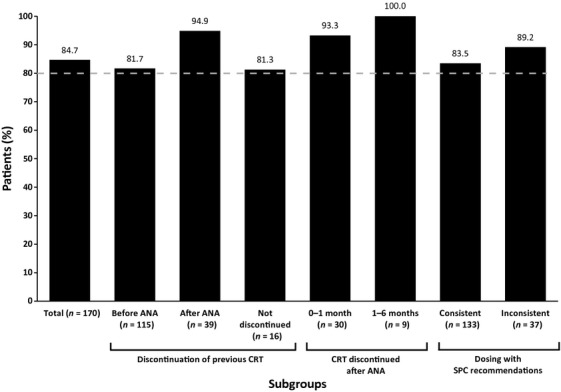
In vivo, Anagrelide reduced platelet count by 50% or to less than 600,000/mm³ in more than 80% of patients with clonal thrombocytosis (including ET, PV, CGL). In a cohort of 335 ET patients (median age 60 years), the response rate was >90% regardless of prior therapy, with durable responses (median response duration >2 years). More than 90% of responding patients required <4 mg/day of anagrelide to achieve a response in 2–4 weeks, and the median maintenance dose was approximately 2–2.5 mg/day.[1]
In another study of 20 ET patients, the overall response rate was 84%, mean time to response approximately 5 months, mean maintenance dose 2 mg/day.[1] Preclinical animal studies showed that Anagrelide induced reversible, dose‑dependent decreases in peripheral vascular resistance and blood pressure, and increases in heart rate and ventricular contractility.[1] In vivo, Anagrelide HCl reduces platelet production through a decrease in megakaryocyte maturation. It is used for the treatment of thrombocythemia secondary to myeloproliferative neoplasms to reduce elevated platelets and the risk of thrombosis and to reduce associated symptoms. The mechanism by which it reduces blood platelet count is still under investigation. |
| Enzyme Assay |
Non-cellular enzyme assays for Anagrelide HCl involve measuring its inhibition of PDEIII activity using purified PDEIII enzyme and appropriate substrates. These assays confirm the compound's activity as a PDEIII inhibitor.
|
| Cell Assay |
For cell‑based assays, bone marrow aspirates were obtained from ET patients treated with and responding to Anagrelide. The numbers of erythroid (BFU‑E), megakaryocytic (CFU‑M), and granulocytic‑monocytic (CFU‑GM) progenitors were recovered and cultured. No decrease in progenitor numbers was observed. Additionally, plasma from these patients did not inhibit autologous CFU‑M formation. However, at much higher concentrations of anagrelide (10‑fold above therapeutic levels), an inhibitory effect on autologous CFU‑M growth was seen.[1]
In vitro experiments on megakaryocyte morphology: posttreatment bone marrow biopsy specimens were examined, and megakaryocytes were found to be smaller. In separate in vitro experiments, Anagrelide induced a decrease in size, perimeter, surface irregularity, and average optical density of megakaryocytes. Another study showed a significant left shift in megakaryocytic maturation, decreased cell size, and reduced ploidy at lower concentrations of anagrelide.[1] In vitro cell-based assays for Anagrelide HCl are conducted using megakaryocyte cell cultures to assess its effects on megakaryocyte maturation and platelet production. Cells are treated with the compound, and the expression of transcription factors such as GATA-1 and FOG-1 is measured. Platelet production and maturation markers are assessed. |
| Animal Protocol |
In vivo animal studies for Anagrelide HCl are conducted in animal models of thrombocythemia to evaluate its efficacy in reducing platelet counts. The compound is administered orally, and platelet counts are monitored. These studies are essential for validating its in vivo efficacy.
|
| ADME/Pharmacokinetics |
Anagrelide is well absorbed from the gastrointestinal tract and has excellent bioavailability. When ingested without food, peak plasma levels occur in about 1 hour, and the plasma half‑life is approximately 1.5 hours. The drug undergoes extensive metabolism, with most metabolites excreted in the urine within the first 24 hours.[1]
Anagrelide HCl is an orally active compound with a molecular weight of 256.09 g/mol. It is well-absorbed from the gastrointestinal tract and is metabolized in the liver. Its pharmacokinetic properties have been studied in clinical settings. It is a prescription drug for the treatment of thrombocythemia. |
| Toxicity/Toxicokinetics |
Effects During Pregnancy and Lactation
◉ Overview of Use During Lactation There is currently no information regarding the use of anagrelide during lactation. The manufacturer advises against using this medication during lactation and for one week after the last dose. ◉ Effects on Breastfed Infants As of the revision date, no published information was found. ◉ Effects on Lactation and Breast Milk As of the revision date, no published information was found. In preclinical animal studies, Anagrelide induced reversible, dose‑dependent decreases in peripheral vascular resistance and blood pressure, and increases in heart rate and ventricular contractility. Observed toxic effects in animals included mild diarrhea and traumatic epistaxis.[1] In human clinical studies, the most frequent side effect is headache (occurring in more than one‑third of patients). Other vasodilation‑related side effects include fluid retention or edema (24% of patients), dizziness (15%), and postural hypotension at high single‑dose levels.[1] Cardiac effects include palpitations or forceful heart beats (27% of patients), tachycardia and other arrhythmias (<10%), and congestive heart failure (2%).[1] Less common side effects: diarrhea, abdominal pain, nausea, and transient rash. Rare events: lower extremity hyperpigmentation, pulmonary fibrosis, and abnormal liver function test results.[1] Overall, 16% of 424 evaluable thrombocytopenic patients with myeloproliferative disorders (including 262 with ET) discontinued Anagrelide treatment because of side effects.[1] Anagrelide HCl has an established safety profile from its clinical use. Common side effects include headache, palpitations, and diarrhea. It can also cause fluid retention and anemia. Comprehensive toxicological data are available from its clinical use. Anagrelide HCl is an approved drug for the treatment of thrombocythemia. |
| References |
Semin Thromb Hemost.1997;23(4):379-83;N Engl J Med.1988 May 19;318(20):1292-4.
|
| Additional Infomation |
Anagrelene hydrochloride is the hydrochloride salt of anagrelene. It is an antifibrinolytic drug and a platelet aggregation inhibitor. It contains the anagrelene molecule. Anhydrous anagrelene hydrochloride is the hydrochloride salt of a synthetic quinazoline derivative. Anagrelene hydrochloride reduces platelet production by inhibiting megakaryocyte maturation. Anagrelene inhibits cyclic adenosine monophosphate phosphodiesterase, as well as ADP- and collagen-induced platelet aggregation. At therapeutic doses, it does not affect white blood cell counts or coagulation parameters. Anagrelene is used to treat essential thrombocytosis to reduce elevated platelet counts and the risk of thrombosis. (NCI04) Anagrel is used to treat essential thrombocythemia to reduce elevated platelet counts and the risk of thrombosis. (NCI04)
See also: Anagrel (note moved to). Drug Indications Xagrid is indicated for reducing elevated platelet counts in high-risk patients with essential thrombocythemia (ET) who are unable to tolerate current treatment or whose current treatment is unable to reduce the elevated platelet count to an acceptable level. High-risk patients: High-risk ET is defined as having one or more of the following characteristics: > 60 years of age; or a platelet count > 1000 x 10⁹/L; or a history of thrombotic events. Anagrelide is an oral imidazoquinazoline derivative (hydrochloride salt) being reviewed by the U.S. FDA as a platelet‑lowering agent for essential thrombocythemia (ET). It is available in 0.5‑ and 1.0‑mg oral capsules.[1] Mechanism of action: does not affect CFU‑M production from less committed progenitors; instead interferes with megakaryocyte maturation, reducing platelet production. Does not significantly affect platelet survival.[1] Efficacy: In 942 patients treated between 1985 and 1995 (58% ET), anagrelide reduced platelet count by 50% or to <600,000/mm³ in >80% of patients, with similar responses across disease groups.[1] Current indications: For "high‑risk" ET patients (age >60 years or previous thrombosis), anagrelide may be considered as an alternative to hydroxyurea due to concerns about hydroxyurea’s leukemogenic potential. It is believed to be nonmutagenic and nontumorigenic. For "low‑risk" patients with extreme thrombocytosis or cardiovascular risk factors, anagrelide may be a reasonable treatment option. Avoid in pregnant women; use carefully in elderly and those with heart disease. Single dose should not exceed 2 mg, total daily dose not exceed 10 mg. Acetaminophen and dose reduction help control headaches.[1] Anagrelide HCl is a synthetic quinazoline derivative that inhibits PDEIII and reduces platelet production through a decrease in megakaryocyte maturation. It is used for the treatment of thrombocythemia secondary to myeloproliferative neoplasms. Anagrelide HCl is an approved drug. |
| Molecular Formula |
C10H7CL2N3O.HCL
|
|
|---|---|---|
| Molecular Weight |
292.55
|
|
| Exact Mass |
290.973
|
|
| CAS # |
58579-51-4
|
|
| Related CAS # |
Anagrelide;68475-42-3;Anagrelide hydrochloride monohydrate;823178-43-4
|
|
| PubChem CID |
135413494
|
|
| Appearance |
White to off-white solid powder
|
|
| Density |
1.77g/cm3
|
|
| Boiling Point |
376.5ºC at 760 mmHg
|
|
| Melting Point |
>280ºC
|
|
| Flash Point |
181.5ºC
|
|
| LogP |
2.43
|
|
| Hydrogen Bond Donor Count |
2
|
|
| Hydrogen Bond Acceptor Count |
2
|
|
| Rotatable Bond Count |
0
|
|
| Heavy Atom Count |
17
|
|
| Complexity |
360
|
|
| Defined Atom Stereocenter Count |
0
|
|
| SMILES |
ClC1=C(CN(C2)C3=NC2=O)C(N3)=CC=C1Cl.Cl
|
|
| InChi Key |
TVWRQCIPWUCNMI-UHFFFAOYSA-N
|
|
| InChi Code |
InChI=1S/C10H7Cl2N3O.ClH/c11-6-1-2-7-5(9(6)12)3-15-4-8(16)14-10(15)13-7;/h1-2H,3-4H2,(H,13,14,16);1H
|
|
| Chemical Name |
Imidazo(2,1-b)quinazolin-2(3H)-one, 6,7-dichloro-1,5-dihydro-, monohydrochloride
|
|
| Synonyms |
|
|
| HS Tariff Code |
2934.99.9001
|
|
| Storage |
Powder -20°C 3 years 4°C 2 years In solvent -80°C 6 months -20°C 1 month Note: Please store this product in a sealed and protected environment, avoid exposure to moisture. |
|
| Shipping Condition |
Room temperature (This product is stable at ambient temperature for a few days during ordinary shipping and time spent in Customs)
|
| Solubility (In Vitro) |
DMSO: 14 mg/mL (47.9 mM)
Water: 1 mg/mL (Insoluble) Ethanol: 1 mg/mL |
|---|---|
| Solubility (In Vivo) |
Solubility in Formulation 1: 0.77 mg/mL (2.63 mM) in 10% DMSO + 40% PEG300 + 5% Tween80 + 45% Saline (add these co-solvents sequentially from left to right, and one by one), suspension solution; with sonication.
For example, if 1 mL of working solution is to be prepared, you can add 100 μL of 7.7 mg/mL clear DMSO stock solution to 400 μL PEG300 and mix evenly; then add 50 μL Tween-80 to the above solution and mix evenly; then add 450 μL normal saline to adjust the volume to 1 mL. Preparation of saline: Dissolve 0.9 g of sodium chloride in 100 mL ddH₂ O to obtain a clear solution. Solubility in Formulation 2: 0.77 mg/mL (2.63 mM) in 10% DMSO + 90% (20% SBE-β-CD in Saline) (add these co-solvents sequentially from left to right, and one by one), suspension solution; with ultrasonication. For example, if 1 mL of working solution is to be prepared, you can add 100 μL of 7.7 mg/mL clear DMSO stock solution to 900 μL of 20% SBE-β-CD physiological saline solution and mix evenly. Preparation of 20% SBE-β-CD in Saline (4°C,1 week): Dissolve 2 g SBE-β-CD in 10 mL saline to obtain a clear solution. View More
Solubility in Formulation 3: ≥ 0.77 mg/mL (2.63 mM) (saturation unknown) in 10% DMSO + 90% Corn Oil (add these co-solvents sequentially from left to right, and one by one), clear solution. |
| Preparing Stock Solutions | 1 mg | 5 mg | 10 mg | |
| 1 mM | 3.4182 mL | 17.0911 mL | 34.1822 mL | |
| 5 mM | 0.6836 mL | 3.4182 mL | 6.8364 mL | |
| 10 mM | 0.3418 mL | 1.7091 mL | 3.4182 mL |
*Note: Please select an appropriate solvent for the preparation of stock solution based on your experiment needs. For most products, DMSO can be used for preparing stock solutions (e.g. 5 mM, 10 mM, or 20 mM concentration); some products with high aqueous solubility may be dissolved in water directly. Solubility information is available at the above Solubility Data section. Once the stock solution is prepared, aliquot it to routine usage volumes and store at -20°C or -80°C. Avoid repeated freeze and thaw cycles.
Calculation results
Working concentration: mg/mL;
Method for preparing DMSO stock solution: mg drug pre-dissolved in μL DMSO (stock solution concentration mg/mL). Please contact us first if the concentration exceeds the DMSO solubility of the batch of drug.
Method for preparing in vivo formulation::Take μL DMSO stock solution, next add μL PEG300, mix and clarify, next addμL Tween 80, mix and clarify, next add μL ddH2O,mix and clarify.
(1) Please be sure that the solution is clear before the addition of next solvent. Dissolution methods like vortex, ultrasound or warming and heat may be used to aid dissolving.
(2) Be sure to add the solvent(s) in order.
| NCT Number | Recruitment | interventions | Conditions | Sponsor/Collaborators | Start Date | Phases |
| NCT02076815 | Completed | Drug: Anagrelide retard Drug: Thromboreductin |
Essential Thrombocythemia | AOP Orphan Pharmaceuticals AG | February 2014 | Phase 3 |
| NCT02125318 | Completed | Drug: Anagrelide CR | Thrombocytosis Myeloproliferative Neoplasms |
Galena Biopharma, Inc. | May 2014 | Phase 2 |
| NCT01552928 | Completed Has Results | Drug: Anagrelide 0.5 mg Drug: Anagrelide 2.5 mg |
Healthy | Shire | March 29, 2012 | Phase 1 |
| NCT01352585 | Completed Has Results | Drug: Anagrelide hydrochloride | Essential Thrombocythemia (ET) | Shire | July 19, 2011 |
|
|---|
|
Products are for research use only; We do not sell to patients
Copyright 2020 InvivoChem LLC | All Rights Reserved


 COA
COA