| Size | Price | Stock | Qty |
|---|---|---|---|
| 10mg |
|
||
| 50mg |
|
||
| 100mg |
|
||
| 250mg | |||
| 500mg | |||
| Other Sizes |


| Targets |
Anabasine targets nicotinic acetylcholine receptors (nAChRs), acting as a full agonist. It induces depolarization of TE671 cells endogenously expressing human fetal muscle-type nAChRs with an EC50 of 0.7 µM. By binding to and activating nAChRs, it stimulates the central and peripheral nervous systems. Its insecticidal activity is also mediated through its action on insect nAChRs.
|
|---|---|
| ln Vitro |
In vitro, anabasine acts as a full agonist of nicotinic acetylcholine receptors (nAChRs). It induces depolarization of TE671 cells endogenously expressing human fetal muscle-type nAChRs with an EC50 of 0.7 µM. These activities have been demonstrated in cell-based assays using cell lines expressing nAChRs. Its potency and efficacy as an nAChR agonist are key features of its pharmacological profile.
|
| ln Vivo |
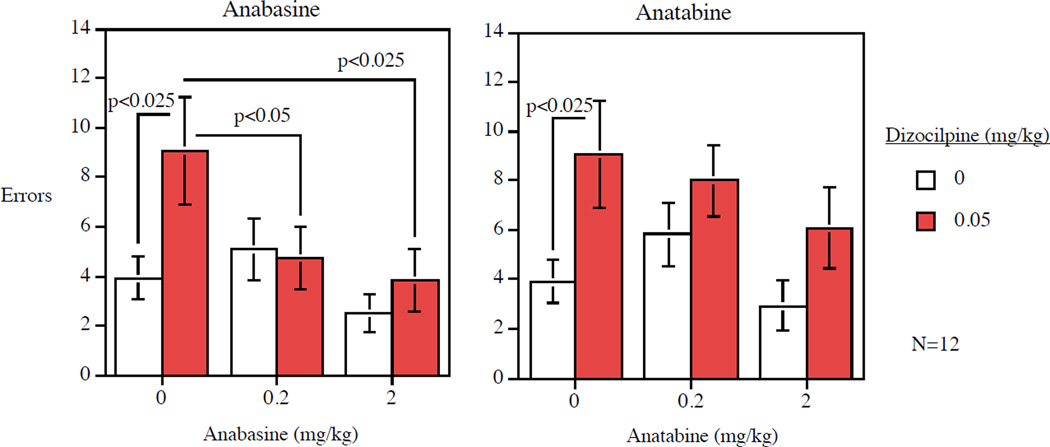
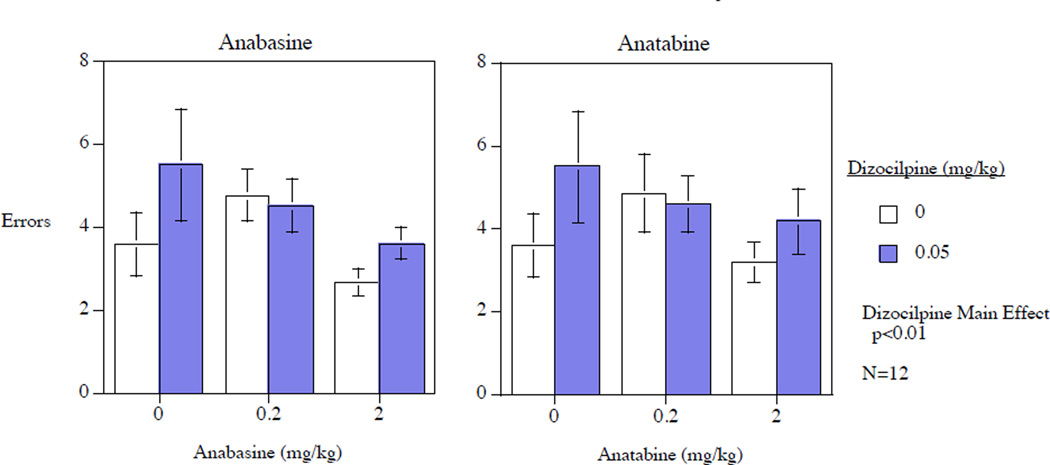
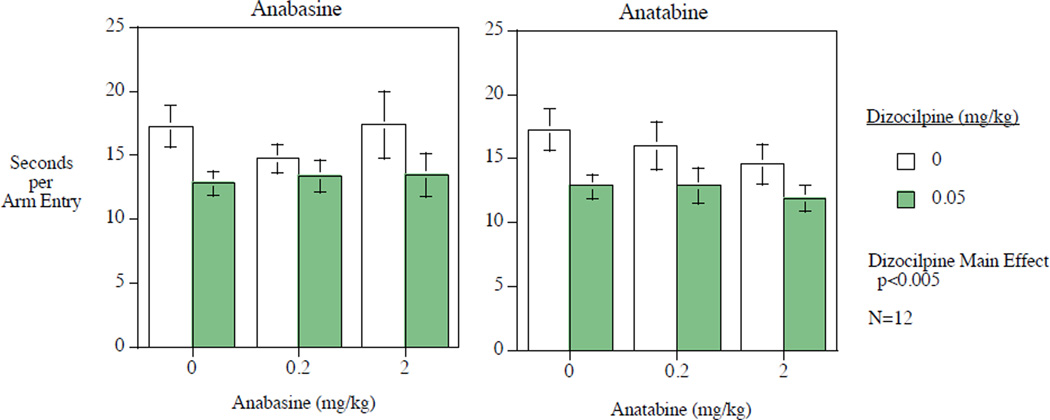
Anabasine effectively restored damage at doses of 0.2 mg/kg (p<0.05) and 2 mg/kg (p<0.025). When taken alone, nectarine did not have any meaningful influence on response latency. In fact, the 0.06 mg/kg neocostalis dose significantly (p<0.05) aggravated dezocycline-induced impairment. None of these neophylline doses per se changed the accuracy of the selection. Individual dose comparisons showed that the 0.06 mg/kg dose of chrysanthine with dizozepine (6.7±2.6) resulted in a significant increase of non-responsive trials (p<0.05) compared to dizozepine alone (2.1±0.8) [1].
In vivo, anabasine acts as an agonist at nAChRs, stimulating the central and peripheral nervous systems. At low doses, it produces excitatory effects, but at higher concentrations, it can cause neuromuscular blockade and respiratory failure. It has been used as a botanical pesticide. Its toxicity in mammals is related to its potent agonist activity at nAChRs. |
| Enzyme Assay |
The in vitro receptor binding assay for anabasine typically involves radioligand displacement studies using membrane preparations from cells or tissues expressing nAChRs. The compound's affinity for nAChRs is determined by measuring its ability to displace a specific radiolabeled ligand. Its functional activity as an agonist is assessed using electrophysiological techniques or calcium imaging in cells expressing nAChRs.
|
| Cell Assay |
In vitro cellular assays for anabasine assess its functional activity as an nAChR agonist. Cells expressing nAChRs, such as TE671 cells, are treated with anabasine, and depolarization or calcium influx is measured. These assays demonstrate the compound's ability to activate nAChRs and its potency (EC50). Its insecticidal activity can be assessed in insect cell lines or whole insects.
|
| Animal Protocol |
In vivo animal studies for anabasine have been conducted to assess its toxicity and insecticidal activity. Its effects on the nervous system have been studied in animal models. However, specific details of these studies are not extensively detailed in the available literature. It is a research compound and is not approved for clinical use.
|
| ADME/Pharmacokinetics |
Absorption, Distribution and Excretion
Anabasine is readily absorbed through the skin and mucous membranes. Metabolism/Metabolites The in vitro metabolite of (-)-methylanabasine in rats, rabbits, and guinea pigs is (-)-anabasine, which is then metabolized to 1'-N-hydroxyanabasine and anabassine 1'-δ-nitroketone. Metabolites of the lung microsomal components are similar. Specific pharmacokinetic data for anabasine are not extensively detailed in the available literature. As a small alkaloid, it is absorbed and distributed throughout the body. It is metabolized and excreted. Its pharmacokinetic properties are similar to those of nicotine. However, specific parameters are not provided in the search results. |
| Toxicity/Toxicokinetics |
Interactions
Anabasin enhances the sedative effects of risapene, apomorphine, and 5-hydroxytryptophan in frogs and inhibits the uptake of serotonin by human platelets. Anabasine is a toxic compound. In small doses, it produces excitatory effects, but in higher concentrations, it can cause neuromuscular blockade and respiratory failure. Its toxicity is related to its potent agonist activity at nAChRs. It is a skin and eye irritant. It should be handled with caution. |
| References | |
| Additional Infomation |
(S)-Anabasin is the (S)-enantiomer of anabasin. (-)-Anabasin has been reported to be found in Nicotiana suaveolens, Verbascum songaricum, and other organisms with relevant data. Anabasin is a nicotine analogue, an alkaloid found in Nicotiana glauca, composed of a pyridine ring with a piperidine-2-yl substitution at the 3-position. Anabasin was once used as an industrial insecticide; due to the presence of trace amounts of anabasin in tobacco smoke, the detection of anabasin in urine can serve as an indicator of exposure to tobacco smoke. A piperidine-based plant-based insecticide. See also: Tobacco leaves (partial). Mechanism of Action: ...Anabasin acts on the ganglia of the insect central nervous system, promoting transsynaptic transmission. Low concentrations promote nerve conduction, while high concentrations block nerve conduction.
Anabassine has a neuromuscular blocking effect on isolated rat phrenic nerve-diaphragm, an effect partially antagonized by neostigmine. It is a depolarizing muscle relaxant with some characteristics of competitive muscle relaxants. Therapeutic Use Experimental Use: Anabassine (2 mg/kg/day, intraperitoneal injection, for 10 days) inhibited the inhibitory effect of co-administered hydrocortisone on the adrenocortical-pituitary system in rats. It also inhibited aseptic inflammation in rats (subplantar formalin injection); this anti-inflammatory activity appears to be due to activation of the adrenocortical-hypothalamic-pituitary system. Activation of the hormonal function of the adrenocortical-pituitary system may be helpful in patients with inflammation receiving glucocorticoid therapy. Anabasine is a piperidine alkaloid and a full agonist of nicotinic acetylcholine receptors (nAChRs). It induces depolarization of TE671 cells with an EC50 of 0.7 µM. It has insecticidal activity and is used in neuroscience research. It is not approved for clinical use and is intended for research purposes only. |
| Molecular Formula |
C10H14N2
|
|---|---|
| Molecular Weight |
162.2316
|
| Exact Mass |
162.116
|
| CAS # |
494-52-0
|
| Related CAS # |
(±) Anabasine;13078-04-1;Anabasine hydrochloride;53912-89-3
|
| PubChem CID |
205586
|
| Appearance |
Colorless to light yellow liquid
|
| Density |
1,0455 g/cm3
|
| Boiling Point |
270-272°C
|
| Melting Point |
9°C
|
| Flash Point |
93°C
|
| Vapour Pressure |
0.00662mmHg at 25°C
|
| Index of Refraction |
1.5430
|
| Source |
Originated from plants: Solanaceae Nicotiana tabacum L.
|
| LogP |
2.225
|
| Hydrogen Bond Donor Count |
1
|
| Hydrogen Bond Acceptor Count |
2
|
| Rotatable Bond Count |
1
|
| Heavy Atom Count |
12
|
| Complexity |
136
|
| Defined Atom Stereocenter Count |
1
|
| SMILES |
N1CCCC[C@H]1C1C=NC=CC=1
|
| InChi Key |
MTXSIJUGVMTTMU-JTQLQIEISA-N
|
| InChi Code |
InChI=1S/C10H14N2/c1-2-7-12-10(5-1)9-4-3-6-11-8-9/h3-4,6,8,10,12H,1-2,5,7H2/t10-/m0/s1
|
| Chemical Name |
3-[(2S)-piperidin-2-yl]pyridine
|
| HS Tariff Code |
2934.99.9001
|
| Storage |
Powder -20°C 3 years 4°C 2 years In solvent -80°C 6 months -20°C 1 month Note: This product requires protection from light (avoid light exposure) during transportation and storage. |
| Shipping Condition |
Room temperature (This product is stable at ambient temperature for a few days during ordinary shipping and time spent in Customs)
|
| Solubility (In Vitro) |
DMSO : ~100 mg/mL (~616.41 mM)
|
|---|---|
| Solubility (In Vivo) |
Solubility in Formulation 1: ≥ 2.5 mg/mL (15.41 mM) (saturation unknown) in 10% DMSO + 40% PEG300 + 5% Tween80 + 45% Saline (add these co-solvents sequentially from left to right, and one by one), clear solution.
For example, if 1 mL of working solution is to be prepared, you can add 100 μL of 25.0 mg/mL clear DMSO stock solution to 400 μL PEG300 and mix evenly; then add 50 μL Tween-80 to the above solution and mix evenly; then add 450 μL normal saline to adjust the volume to 1 mL. Preparation of saline: Dissolve 0.9 g of sodium chloride in 100 mL ddH₂ O to obtain a clear solution. Solubility in Formulation 2: ≥ 2.5 mg/mL (15.41 mM) (saturation unknown) in 10% DMSO + 90% (20% SBE-β-CD in Saline) (add these co-solvents sequentially from left to right, and one by one), clear solution. For example, if 1 mL of working solution is to be prepared, you can add 100 μL of 25.0 mg/mL clear DMSO stock solution to 900 μL of 20% SBE-β-CD physiological saline solution and mix evenly. Preparation of 20% SBE-β-CD in Saline (4°C,1 week): Dissolve 2 g SBE-β-CD in 10 mL saline to obtain a clear solution. View More
Solubility in Formulation 3: ≥ 2.5 mg/mL (15.41 mM) (saturation unknown) in 10% DMSO + 90% Corn Oil (add these co-solvents sequentially from left to right, and one by one), clear solution. |
| Preparing Stock Solutions | 1 mg | 5 mg | 10 mg | |
| 1 mM | 6.1641 mL | 30.8204 mL | 61.6409 mL | |
| 5 mM | 1.2328 mL | 6.1641 mL | 12.3282 mL | |
| 10 mM | 0.6164 mL | 3.0820 mL | 6.1641 mL |
*Note: Please select an appropriate solvent for the preparation of stock solution based on your experiment needs. For most products, DMSO can be used for preparing stock solutions (e.g. 5 mM, 10 mM, or 20 mM concentration); some products with high aqueous solubility may be dissolved in water directly. Solubility information is available at the above Solubility Data section. Once the stock solution is prepared, aliquot it to routine usage volumes and store at -20°C or -80°C. Avoid repeated freeze and thaw cycles.
Calculation results
Working concentration: mg/mL;
Method for preparing DMSO stock solution: mg drug pre-dissolved in μL DMSO (stock solution concentration mg/mL). Please contact us first if the concentration exceeds the DMSO solubility of the batch of drug.
Method for preparing in vivo formulation::Take μL DMSO stock solution, next add μL PEG300, mix and clarify, next addμL Tween 80, mix and clarify, next add μL ddH2O,mix and clarify.
(1) Please be sure that the solution is clear before the addition of next solvent. Dissolution methods like vortex, ultrasound or warming and heat may be used to aid dissolving.
(2) Be sure to add the solvent(s) in order.
| NCT Number | Recruitment | interventions | Conditions | Sponsor/Collaborators | Start Date | Phases |
| NCT01303081 | Completed | Behavioral: Individual Rewards Behavioral: Fixed Deposits Behavioral: Chosen Deposits |
Tobacco Use Disorder | University of Pennsylvania | 2011-06 | Not Applicable |
| NCT01526265 | Completed | Behavioral: Usual Care Behavioral: Individual Rewards Behavioral: Fixed Deposits |
Tobacco Use Disorder | University of Pennsylvania | 2012-02 | Not Applicable |
| NCT04605458 | Recruiting | Combination Product: Contingency Management Combination Product: Standard Care |
Smoking Cessation | Medical University of South Carolina | 2020-11-25 | Not Applicable |
| NCT03473483 | Withdrawn | Other: SREC | Cardiovascular Risk Factor Nicotine Dependence Nicotine Dependence, Cigarettes Nicotine Withdrawal Tobacco Toxicity |
University of California, San Francisco | 2022-08-01 | Not Applicable |
| NCT05881304 | Recruiting | Device: Standardized research e-cigarette (SREC) | Electronic Cigarette Use | Massachusetts General Hospital | 2024-06-03 | Not Applicable |
|
|
|
Products are for research use only; We do not sell to patients
Copyright 2020 InvivoChem LLC | All Rights Reserved