

| Size | Price | Stock | Qty |
|---|---|---|---|
| 5mg |
|
||
| 10mg |
|
||
| 25mg |
|
||
| 50mg |
|
||
| 100mg |
|
||
| 250mg | |||
| Other Sizes |
Purity: ≥98%
| Targets |
δ Opioid Receptor/DOR
Delta opioid receptor (DOR) (Ki = 0.8 nM; EC50 for GTPγS binding = 2.2 nM; EC50 for cAMP inhibition = 4.3 nM) [1] |
|---|---|
| ln Vitro |
In vitro activity: ADL-5859 (0-10 μM) hydrochloride inhibits 32% and 37% of the activities of the ε and κ opioid receptors, respectively, and exhibits activities to the δ opioid receptor with a Ki and an EC50 value of 0.84 and 20 nM[1].
ADL-5859 (0-100 μM) hydrochloride shows inhibitory activity to the hERG channel with an IC50 value of 78 μM[1]. ADL-5859 (0-100 μM) hydrochloride inhibits the activity of the drug metabolizing enzyme cytochrome P450 2D6 (CYP2D6) in vitro with an IC50 value of 43 μM[2]. Receptor binding assay showed that ADL5859 HCl exhibited high affinity for DOR with a Ki value of 0.8 nM, and negligible affinity for mu (Ki > 1000 nM) and kappa (Ki > 1000 nM) opioid receptors [1] - Functional GTPγS binding assay demonstrated that the compound acted as a full agonist at DOR, with an EC50 of 2.2 nM and a maximum effect (Emax) comparable to the reference agonist SNC80 [1] - cAMP accumulation assay revealed that ADL5859 HCl potently inhibited forskolin-stimulated cAMP production in DOR-expressing cells, with an EC50 of 4.3 nM [1] - The compound showed no significant activity at a panel of 45 off-target receptors, ion channels, and enzymes at a concentration of 10 μM [1] |
| ln Vivo |
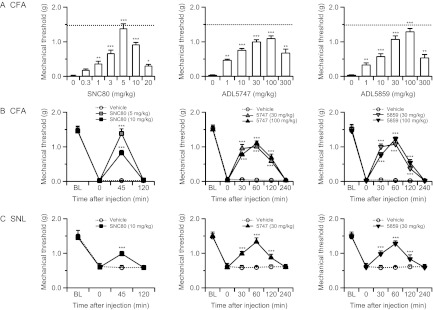
ADL-5859 (0.3–10 mg/kg; p.o. once) hydrochloride exhibits strong antidepressant-like effects and reverses hyperalgesia in rats with inflamed paws[1].
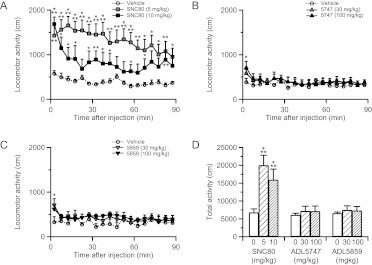
In the mouse tail-flick assay (thermal pain model), oral administration of ADL5859 HCl produced dose-dependent analgesia with an ED50 value of 1.2 mg/kg [1] - In the mouse hot-plate assay (thermal pain model), oral dosing of the compound exhibited analgesic effects with an ED50 of 0.9 mg/kg, and the analgesic activity was antagonized by the selective DOR antagonist naltrindole (3 mg/kg, i.p.) [1] - In the rat formalin test (inflammatory pain model), oral administration of ADL5859 HCl (0.3-3 mg/kg) significantly reduced both phase I (0-5 min) and phase II (15-30 min) paw licking responses, with maximum inhibition of 68% and 75% respectively at 3 mg/kg [1] - No significant sedation or motor impairment was observed in mice at doses up to 30 mg/kg (oral) in the rotarod test [1] |
| Enzyme Assay |
Receptor binding assay: Membrane preparations from cells expressing human DOR, mu opioid receptor (MOR), or kappa opioid receptor (KOR) were incubated with [3H]-naltrindole (for DOR) or corresponding radioligands (for MOR/KOR) in the presence of serial dilutions of ADL5859 HCl. After incubation at 25°C for 90 min, the mixtures were filtered through glass fiber filters to separate bound and free radioligands. The filters were washed, and radioactivity was measured using a scintillation counter. Ki values were calculated using nonlinear regression analysis [1]
- GTPγS binding assay: Membranes from DOR-expressing cells were incubated with [35S]-GTPγS, GDP, and various concentrations of ADL5859 HCl at 30°C for 60 min. The reaction mixtures were filtered, washed, and radioactivity was quantified. EC50 and Emax values were determined by fitting the data to a four-parameter logistic equation [1] - cAMP accumulation assay: DOR-expressing cells were seeded in 96-well plates and preincubated with serum-free medium for 2 h. The cells were treated with serial dilutions of ADL5859 HCl for 30 min, followed by addition of forskolin (10 μM) and incubation for another 30 min. The cells were lysed, and cAMP levels were measured using a competitive binding assay. EC50 values were calculated from concentration-response curves [1] |
| Cell Assay |
DOR-expressing cell culture: Cells were maintained in appropriate growth medium supplemented with essential nutrients and incubated at 37°C in a humidified atmosphere containing 5% CO2. Cells were passaged every 2-3 days to maintain exponential growth. For assays, cells were seeded at a density of 5×10⁴ cells/well (for cAMP assay) or used for membrane preparation (for binding and GTPγS assays) at 80-90% confluence [1]
- Off-target screening assay: Cells or membrane preparations expressing various off-target proteins (receptors, ion channels, enzymes) were incubated with ADL5859 HCl at 10 μM. Activity at each target was measured using target-specific assays (e.g., radioligand binding, enzyme activity assays), and results were expressed as percentage inhibition or activation relative to control [1] |
| Animal Protocol |
Suspended in 0.5% methyl cellulose solution or dissolved in 5% sorbitol; 10 mg/kg; oral or i.v. injection
Male ICR (CD-1) subjected to nociceptin-induced allodynia test or hot plate test, and Male SD rats subjected to formalin-induced paw-licking response Mouse tail-flick assay: Male CD-1 mice (20-25 g) were acclimated for 3 days before testing. ADL5859 HCl was dissolved in a vehicle consisting of 10% DMSO, 10% cremophor EL, and 80% saline. The compound was administered orally at doses of 0.1, 0.3, 1, 3, and 10 mg/kg (volume: 10 mL/kg). Tail-flick latency was measured using a thermal stimulus (55°C) at 30, 60, 90, and 120 min post-administration. The ED50 value was calculated as the dose producing a 50% increase in tail-flick latency compared to vehicle-treated controls [1] - Mouse hot-plate assay: Female CD-1 mice (20-25 g) were acclimated and treated with oral doses of ADL5859 HCl (0.3, 1, 3, 10 mg/kg) or vehicle. Hot-plate temperature was set at 55°C, and paw withdrawal latency was measured at 30, 60, 90, and 120 min post-dosing. For antagonism studies, naltrindole was administered intraperitoneally 15 min before ADL5859 HCl dosing [1] - Rat formalin test: Male Sprague-Dawley rats (150-200 g) were acclimated and received oral doses of ADL5859 HCl (0.3, 1, 3 mg/kg) or vehicle. Thirty minutes later, 50 μL of 5% formalin was injected subcutaneously into the plantar surface of the right hind paw. Paw licking time was recorded during phase I (0-5 min) and phase II (15-30 min) after formalin injection [1] - Mouse rotarod test: Male CD-1 mice (20-25 g) were trained to remain on a rotating rod (10 rpm) for 120 s. Twenty-four hours later, mice were treated with ADL5859 HCl (10, 30 mg/kg, oral) or vehicle. Rotarod performance was measured at 60 min post-dosing, with a maximum test duration of 120 s [1] |
| ADME/Pharmacokinetics |
Oral bioavailability in rats: After oral administration of 10 mg/kg of ADL5859 HCl, the absolute oral bioavailability was 42% [1] - Plasma pharmacokinetics in rats: Intravenous injection (1 mg/kg) resulted in a clearance of 18 mL/min/kg, a steady-state volume of distribution (Vss) of 1.2 L/kg, and a terminal half-life (t1/2) of 5.8 h. After oral administration (10 mg/kg), the Cmax was 89 ng/mL, the Tmax was 1.5 h, and the terminal half-life was 6.2 h [1] - Metabolic stability: ADL5859 HCl showed good stability in both human and rat liver microsomes, with in vitro half-lives of 45 min (human) and 68 min (rat), respectively [1] - Plasma protein binding: The plasma protein binding of this compound in human plasma was 83% [1]
|
| Toxicity/Toxicokinetics |
Acute toxicity: No deaths were observed in mice after oral administration of ADL5859 HCl at doses up to 200 mg/kg[1] - No significant changes in clinical symptoms, body weight, or organ weight were observed in rats after oral administration of 30 mg/kg/day for 7 consecutive days[1] - No hepatotoxicity or nephrotoxicity was observed in rats after administration of 30 mg/kg/day for 7 consecutive days, and serum ALT, AST, BUN, and creatinine levels were normal[1]
|
| References |
|
| Additional Infomation |
ADL5859 HCl is a spirocyclic benzamide derivative designed for the treatment of pain and is a potent, selective, and orally bioavailable delta opioid receptor agonist [1]. The analgesic effect of this compound is achieved by specifically activating delta opioid receptors (DORs), which has been demonstrated by its antagonism with naltrexindole, a selective DOR antagonist [1]. The spirochromene-piperidine skeleton of ADL5859 HCl gives it high DOR affinity, selectivity, and orally bioavailability [1].
|
| Molecular Formula |
C24H29CLN2O3
|
|
|---|---|---|
| Molecular Weight |
428.95
|
|
| Exact Mass |
428.186
|
|
| Elemental Analysis |
C, 67.20; H, 6.81; Cl, 8.26; N, 6.53; O, 11.19
|
|
| CAS # |
850173-95-4
|
|
| Related CAS # |
850305-06-5 (ADL 5859 free base)
|
|
| PubChem CID |
46931003
|
|
| Appearance |
White to off-white solid powder
|
|
| LogP |
4.951
|
|
| Hydrogen Bond Donor Count |
3
|
|
| Hydrogen Bond Acceptor Count |
4
|
|
| Rotatable Bond Count |
4
|
|
| Heavy Atom Count |
30
|
|
| Complexity |
601
|
|
| Defined Atom Stereocenter Count |
0
|
|
| SMILES |
Cl.O=C(N(CC)CC)C1C=CC(C2C3C(=CC=CC=3O)OC3(CCNCC3)C=2)=CC=1
|
|
| InChi Key |
ZFNLSWREIULTDO-UHFFFAOYSA-N
|
|
| InChi Code |
InChI=1S/C24H28N2O3.ClH/c1-3-26(4-2)23(28)18-10-8-17(9-11-18)19-16-24(12-14-25-15-13-24)29-21-7-5-6-20(27)22(19)21;/h5-11,16,25,27H,3-4,12-15H2,1-2H3;1H
|
|
| Chemical Name |
N,N-diethyl-4-(5-hydroxyspiro[chromene-2,4'-piperidine]-4-yl)benzamide;hydrochloride
|
|
| Synonyms |
|
|
| HS Tariff Code |
2934.99.9001
|
|
| Storage |
Powder -20°C 3 years 4°C 2 years In solvent -80°C 6 months -20°C 1 month Note: Please store this product in a sealed and protected environment, avoid exposure to moisture. |
|
| Shipping Condition |
Room temperature (This product is stable at ambient temperature for a few days during ordinary shipping and time spent in Customs)
|
| Solubility (In Vitro) |
|
|||
|---|---|---|---|---|
| Solubility (In Vivo) |
Solubility in Formulation 1: ≥ 2.75 mg/mL (6.41 mM) (saturation unknown) in 10% DMSO + 40% PEG300 + 5% Tween80 + 45% Saline (add these co-solvents sequentially from left to right, and one by one), clear solution.
For example, if 1 mL of working solution is to be prepared, you can add 100 μL of 27.5 mg/mL clear DMSO stock solution to 400 μL PEG300 and mix evenly; then add 50 μL Tween-80 to the above solution and mix evenly; then add 450 μL normal saline to adjust the volume to 1 mL. Preparation of saline: Dissolve 0.9 g of sodium chloride in 100 mL ddH₂ O to obtain a clear solution. Solubility in Formulation 2: ≥ 2.75 mg/mL (6.41 mM) (saturation unknown) in 10% DMSO + 90% (20% SBE-β-CD in Saline) (add these co-solvents sequentially from left to right, and one by one), clear solution. For example, if 1 mL of working solution is to be prepared, you can add 100 μL of 27.5 mg/mL clear DMSO stock solution to 900 μL of 20% SBE-β-CD physiological saline solution and mix evenly. Preparation of 20% SBE-β-CD in Saline (4°C,1 week): Dissolve 2 g SBE-β-CD in 10 mL saline to obtain a clear solution. View More
Solubility in Formulation 3: 0.5% hydroxyethyl cellulose+0.1% Tween 80: 30 mg/mL |
| Preparing Stock Solutions | 1 mg | 5 mg | 10 mg | |
| 1 mM | 2.3313 mL | 11.6564 mL | 23.3127 mL | |
| 5 mM | 0.4663 mL | 2.3313 mL | 4.6625 mL | |
| 10 mM | 0.2331 mL | 1.1656 mL | 2.3313 mL |
*Note: Please select an appropriate solvent for the preparation of stock solution based on your experiment needs. For most products, DMSO can be used for preparing stock solutions (e.g. 5 mM, 10 mM, or 20 mM concentration); some products with high aqueous solubility may be dissolved in water directly. Solubility information is available at the above Solubility Data section. Once the stock solution is prepared, aliquot it to routine usage volumes and store at -20°C or -80°C. Avoid repeated freeze and thaw cycles.
Calculation results
Working concentration: mg/mL;
Method for preparing DMSO stock solution: mg drug pre-dissolved in μL DMSO (stock solution concentration mg/mL). Please contact us first if the concentration exceeds the DMSO solubility of the batch of drug.
Method for preparing in vivo formulation::Take μL DMSO stock solution, next add μL PEG300, mix and clarify, next addμL Tween 80, mix and clarify, next add μL ddH2O,mix and clarify.
(1) Please be sure that the solution is clear before the addition of next solvent. Dissolution methods like vortex, ultrasound or warming and heat may be used to aid dissolving.
(2) Be sure to add the solvent(s) in order.
| NCT Number | Recruitment | interventions | Conditions | Sponsor/Collaborators | Start Date | Phases |
| NCT00603265 | Completed | Drug: ADL5859 Drug: Duloxetine |
Peripheral Neuropathy Neuropathic Pain |
Cubist Pharmaceuticals LLC, a subsidiary of Merck & Co., Inc. (Rahway, New Jersey USA) |
November 2007 | Phase 2 |
 |
|---|
 |
 |
Products are for research use only; We do not sell to patients
Copyright 2020 InvivoChem LLC | All Rights Reserved


 COA
COA