| Size | Price | Stock | Qty |
|---|---|---|---|
| 100mg |
|
||
| 500mg | |||
| Other Sizes |
| Targets |
NUPR1 (IC50 = 0.42 μM); NUPR1 (IC50 = 7.75 μM)
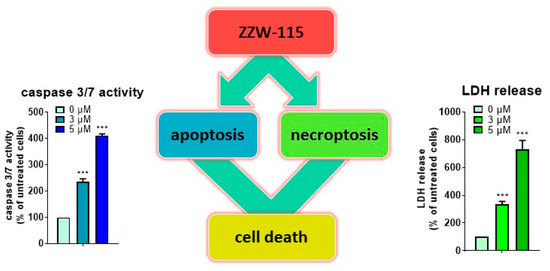
ZZW-115 hydrochloride targets NUPR1 (nuclear protein 1; also known as p8 or Com1), a small, intrinsically disordered protein that is induced in response to various cellular stresses including DNA damage, hypoxia, and ER stress. NUPR1 is overexpressed in many cancers, where it promotes cell survival, proliferation, and resistance to chemotherapy and radiotherapy. NUPR1 functions as a transcriptional co-regulator that modulates the expression of genes involved in stress response, apoptosis, and cell cycle regulation. By binding to NUPR1 with a Kd of 2.1 μM, ZZW-115 inhibits its activity and disrupts its pro-survival functions. The compound induces both necroptosis and apoptosis in tumor cells, leading to cell death. This dual mechanism of cell death is a unique feature of ZZW-115 that distinguishes it from conventional apoptosis-inducing agents. |
|---|---|
| ln Vitro |
ZZW-115 is capable of efficiently killing the pancreatic tumor cell lines by targeting NUPR1 and inhibits the growth of other tumor-derived cells. ZZW-115 causes a temporary metabolic shift toward anaerobic glycolysis inhibition, which leads to a decrease in ATP production by the mitochondria, as well as an increase in mitochondrial ROS production. [1]
In vitro, ZZW-115 hydrochloride demonstrates potent anticancer activity in various cancer cell lines. The compound binds to NUPR1 with a Kd of 2.1 μM and inhibits NUPR1 activity, leading to the induction of cell death. Treatment with ZZW-115 at concentrations in the low micromolar range (typically 1-10 μM) results in significant inhibition of cell proliferation and induction of apoptosis and necroptosis in cancer cell lines. The compound shows selectivity for cancer cells over normal cells, with reduced cytotoxicity in non-transformed cell lines. ZZW-115 effectively induces tumor cell death through the activation of both apoptotic (caspase-3/7 activation) and necroptotic (RIPK1/RIPK3-dependent) pathways. The compound's dual mechanism of cell death induction makes it effective against cancer cells that are resistant to conventional apoptosis-inducing agents. |
| ln Vivo |
ZZW-115 can disrupt tumor growth at low doses and can reduce tumor size for the xenografted tumors, without obvious neurological side effects in the mice. ZZW-115 is a very effective anticancer drug candidate in vivo on mice because, primarily through necrosis, it is capable of not only halting tumor growth but also of reducing tumor size until its disappearance. [1]
In vivo, ZZW-115 hydrochloride has demonstrated significant antitumor activity in mouse models of cancer. In mice bearing tumor xenografts, administration of ZZW-115 (typically at doses of 5-25 mg/kg via intraperitoneal injection) results in significant inhibition of tumor growth. The compound induces both apoptosis and necroptosis in tumor tissue, as evidenced by increased cleaved caspase-3 and phosphorylated MLKL (a marker of necroptosis). The antitumor efficacy of ZZW-115 is associated with reduced cell proliferation (Ki67) and increased cell death in tumor tissue. The compound is well-tolerated in these models, with no significant adverse effects on body weight or general health. ZZW-115 has shown activity against a range of cancer types in preclinical models, including pancreatic cancer, lung cancer, and breast cancer. |
| Enzyme Assay |
The binding affinity of ZZW-115 for NUPR1 is assessed using biochemical assays. Recombinant NUPR1 protein is incubated with varying concentrations of ZZW-115 (0.01-100 μM) in assay buffer. The binding affinity is measured by surface plasmon resonance (SPR) or isothermal titration calorimetry (ITC), with Kd values calculated from binding isotherms. The compound's ability to inhibit NUPR1 activity is assessed using transcriptional reporter assays or by measuring the expression of NUPR1 target genes. The induction of apoptosis and necroptosis is assessed by measuring caspase-3/7 activity (apoptosis) and MLKL phosphorylation (necroptosis). IC50 values for cell viability inhibition are calculated from dose-response curves.
|
| Cell Assay |
In 96-well plates, cells are plated. After 24 hours, the media are supplemented with ZZW-115 at a concentration of 0-100 μM, and they are incubated for a further 24 or 72 hours. According to the supplier's protocol, cell viability is calculated 3 hours after adding the CellTiter-Blue viability reagent (Promega). Concerns about cell viability improved in comparison to untreated cell rates.
Cellular activity of ZZW-115 is evaluated in various cancer cell lines. Cells are seeded in 96-well plates and treated with ZZW-115 at concentrations ranging from 0.1 to 100 μM for 24-72 hours. Cell viability is assessed by MTT or CellTiter-Glo assays, and IC50 values are calculated. Apoptosis is assessed by caspase-3/7 activity, annexin V/PI staining, and PARP cleavage. Necroptosis is assessed by measuring MLKL phosphorylation and by using necroptosis inhibitors (e.g., necrostatin-1) to confirm the necroptotic pathway. NUPR1 expression and activity are assessed by Western blot and reporter assays. Cell cycle analysis is performed by flow cytometry. The compound's effect on signaling pathways is assessed by Western blot analysis of phosphorylated signaling proteins. Selectivity for cancer cells over normal cells is assessed using non-transformed cell lines. |
| Animal Protocol |
NMRI-Foxn1nu/Foxn1nu mice (nude mice) xenografted with MiaPaCa-2 cells[1]
5, 2.5, 1.0, or 0.5 mg/kg Injection; daily for 30 days In animal studies, ZZW-115 is administered to immunodeficient mice bearing subcutaneous xenografts of cancer cell lines. Mice are randomized to receive vehicle or ZZW-115 at doses of 5, 10, or 25 mg/kg via intraperitoneal injection, once daily, for 14-28 days. Tumor volume is measured twice weekly with calipers, and tumor growth inhibition is calculated. Body weight is monitored to assess tolerability. At study termination, tumors are harvested for analysis of NUPR1 expression (by Western blot or IHC), apoptosis markers (cleaved caspase-3), necroptosis markers (p-MLKL), and proliferation markers (Ki67). Blood and plasma are collected for pharmacokinetic analysis. Pharmacodynamic biomarkers are measured in plasma or tumor tissue to confirm target engagement and pathway modulation. |
| ADME/Pharmacokinetics |
Pharmacokinetic studies of ZZW-115 hydrochloride in rodents indicate that the compound has moderate bioavailability and a half-life suitable for once-daily dosing in preclinical studies. Following intraperitoneal administration at 5-25 mg/kg, the compound achieves peak plasma concentrations (Cmax) within 0.5-2 hours (Tmax) and has a plasma half-life of 2-6 hours. The compound shows moderate plasma protein binding (approximately 70-85%) and distributes to tissues including tumor tissue. Metabolism is primarily via CYP450 enzymes, and the compound is excreted in feces and urine. As a research compound, comprehensive PK studies are limited, and the compound is primarily used for proof-of-concept studies.
|
| Toxicity/Toxicokinetics |
Toxicology studies of ZZW-115 hydrochloride are limited as the compound is a research tool. In short-term (14-day) rodent studies at doses up to 25 mg/kg/day, the compound is generally well-tolerated with no significant adverse effects on body weight, food consumption, or general health. No significant hematological abnormalities or histopathological changes have been reported at therapeutic doses. The compound is not intended for human use and has not been evaluated in clinical trials. Researchers should follow standard safety precautions when handling the compound.
|
| References | |
| Additional Infomation |
ZZW-115 hydrochloride is a valuable research tool for studying the role of NUPR1 in cancer biology and for exploring the therapeutic potential of NUPR1 inhibition as a strategy for cancer treatment. The compound's mechanism of action—targeting the stress response protein NUPR1 and inducing both apoptosis and necroptosis—represents a novel approach to cancer therapy that has the potential to overcome resistance to conventional apoptosis-inducing agents. ZZW-115 is used in preclinical research to investigate the biology of NUPR1, to study the role of stress responses in cancer, and to evaluate the potential of NUPR1-targeted therapy for the treatment of various cancers. The compound serves as a lead for the development of more potent and selective NUPR1 inhibitors with improved drug-like properties for potential clinical applications.
|
| Molecular Formula |
C24H34CL3F3N4S
|
|---|---|
| Exact Mass |
572.152
|
| Elemental Analysis |
C, 50.22; H, 5.97; Cl, 18.53; F, 9.93; N, 9.76; S, 5.59
|
| CAS # |
10122-45-9
|
| Related CAS # |
ZZW-115;801991-87-7
|
| PubChem CID |
154573789
|
| Appearance |
Solid powder
|
| Hydrogen Bond Donor Count |
3
|
| Hydrogen Bond Acceptor Count |
8
|
| Rotatable Bond Count |
7
|
| Heavy Atom Count |
35
|
| Complexity |
582
|
| Defined Atom Stereocenter Count |
0
|
| SMILES |
CN(C)CCN1CCN(CC1)CCCN2C3=CC=CC=C3SC4=C2C=C(C=C4)C(F)(F)F.Cl.Cl.Cl
|
| InChi Key |
OBSKIDNFCBBXKJ-UHFFFAOYSA-N
|
| InChi Code |
InChI=1S/C24H31F3N4S.3ClH/c1-28(2)12-13-30-16-14-29(15-17-30)10-5-11-31-20-6-3-4-7-22(20)32-23-9-8-19(18-21(23)31)24(25,26)27;;;/h3-4,6-9,18H,5,10-17H2,1-2H3;3*1H
|
| Chemical Name |
N,N-dimethyl-2-[4-[3-[2-(trifluoromethyl)phenothiazin-10-yl]propyl]piperazin-1-yl]ethanamine;trihydrochloride
|
| Synonyms |
ZZW-115 hydrochloride; ZZW 115 HCl; ZZW-115 HCl; ZZW115 HCl
|
| HS Tariff Code |
2934.99.9001
|
| Storage |
Powder -20°C 3 years 4°C 2 years In solvent -80°C 6 months -20°C 1 month Note: Please store this product in a sealed and protected environment (e.g. under nitrogen), avoid exposure to moisture. |
| Shipping Condition |
Room temperature (This product is stable at ambient temperature for a few days during ordinary shipping and time spent in Customs)
|
| Solubility (In Vitro) |
DMSO: 83.3~93 mg/mL (145.2~162.0 mM)
Water: ~46 mg/mL (~80.1 mM) Ethanol: ~2 mg/mL (~3.5 mM) |
|---|---|
| Solubility (In Vivo) |
Solubility in Formulation 1: ≥ 6.25 mg/mL (10.89 mM) (saturation unknown) in 10% DMSO + 40% PEG300 + 5% Tween80 + 45% Saline (add these co-solvents sequentially from left to right, and one by one), clear solution.
For example, if 1 mL of working solution is to be prepared, you can add 100 μL of 62.5 mg/mL clear DMSO stock solution to 400 μL PEG300 and mix evenly; then add 50 μL Tween-80 to the above solution and mix evenly; then add 450 μL normal saline to adjust the volume to 1 mL. Preparation of saline: Dissolve 0.9 g of sodium chloride in 100 mL ddH₂ O to obtain a clear solution. Solubility in Formulation 2: ≥ 6.25 mg/mL (10.89 mM) (saturation unknown) in 10% DMSO + 90% (20% SBE-β-CD in Saline) (add these co-solvents sequentially from left to right, and one by one), clear solution. For example, if 1 mL of working solution is to be prepared, you can add 100 μL of 62.5 mg/mL clear DMSO stock solution to 900 μL of 20% SBE-β-CD physiological saline solution and mix evenly. Preparation of 20% SBE-β-CD in Saline (4°C,1 week): Dissolve 2 g SBE-β-CD in 10 mL saline to obtain a clear solution. View More
Solubility in Formulation 3: 50 mg/mL (87.11 mM) in PBS (add these co-solvents sequentially from left to right, and one by one), clear solution; with ultrasonication. |
Calculation results
Working concentration: mg/mL;
Method for preparing DMSO stock solution: mg drug pre-dissolved in μL DMSO (stock solution concentration mg/mL). Please contact us first if the concentration exceeds the DMSO solubility of the batch of drug.
Method for preparing in vivo formulation::Take μL DMSO stock solution, next add μL PEG300, mix and clarify, next addμL Tween 80, mix and clarify, next add μL ddH2O,mix and clarify.
(1) Please be sure that the solution is clear before the addition of next solvent. Dissolution methods like vortex, ultrasound or warming and heat may be used to aid dissolving.
(2) Be sure to add the solvent(s) in order.
|
|
Products are for research use only; We do not sell to patients
Copyright 2020 InvivoChem LLC | All Rights Reserved