| Size | Price | Stock | Qty |
|---|---|---|---|
| 5mg |
|
||
| 10mg |
|
||
| 25mg |
|
||
| 50mg |
|
||
| 100mg |
|
||
| 250mg | |||
| 500mg | |||
| Other Sizes |


Purity: ≥98%
| Targets |
bacterial WalR response regulator
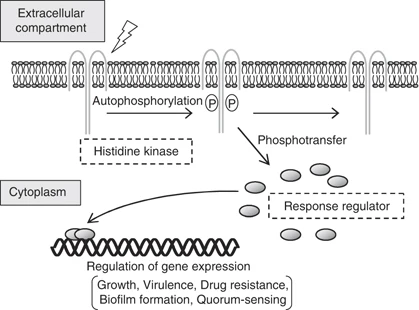
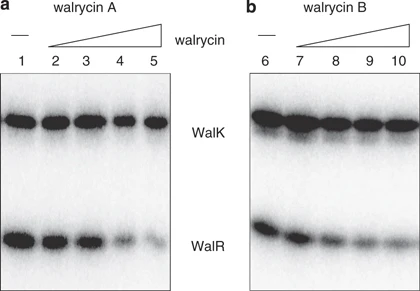
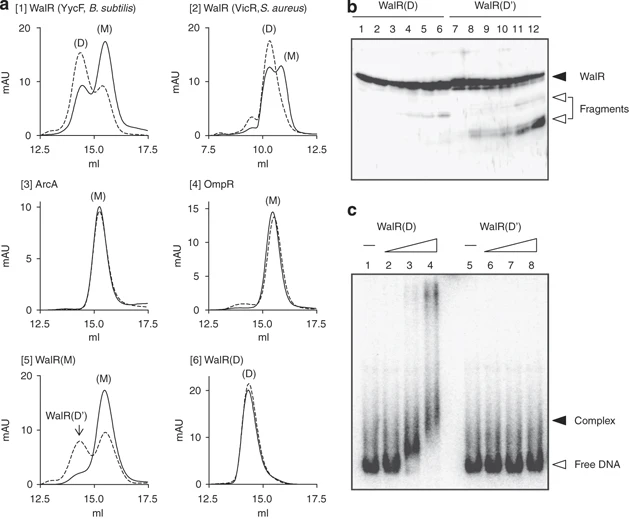
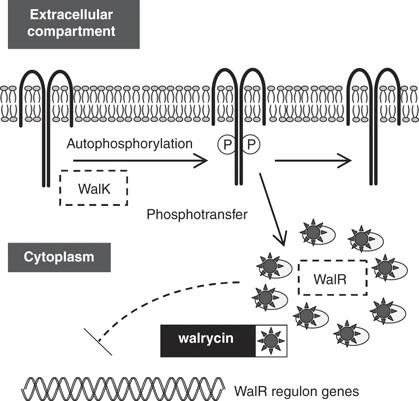
Walrycin B targets the WalR response regulator, a key component of the WalRK two-component signal transduction system essential for bacterial cell wall homeostasis and viability. WalR is a response regulator that controls the expression of genes involved in cell wall metabolism, autolysis, and biofilm formation. By inhibiting WalR, Walrycin B disrupts bacterial cell wall homeostasis, leading to bacterial death. |
|---|---|
| ln Vitro |
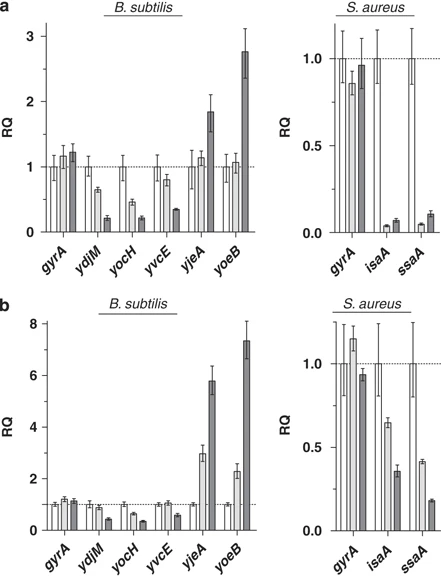
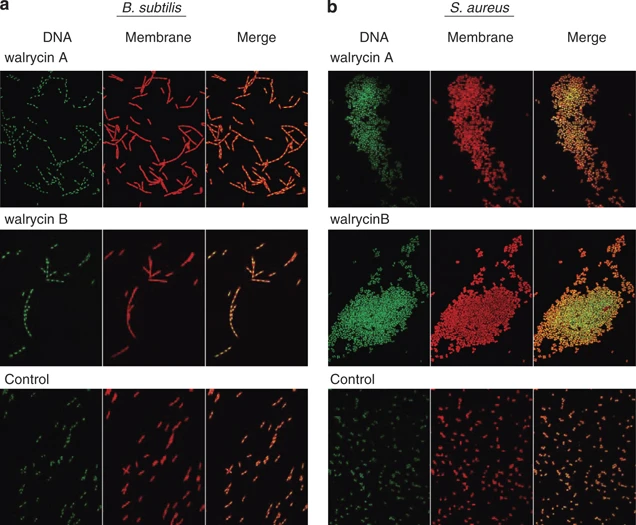
In vitro, Walrycin B shows potent antibacterial activity against Staphylococcus aureus N315 with an MIC of 3.13 µg/mL and against Bacillus subtilis 168 with an MIC of 0.39 µg/mL. It is an analog of toxoflavin. The compound's activity against biofilm-forming pathogens suggests potential for treating biofilm-associated infections. It also demonstrates promising efficacy in inhibiting viral replication.
|
| ln Vivo |
In vivo, Walrycin B demonstrates promising efficacy in inhibiting viral replication. Its antibacterial activity has been characterized in vitro, but detailed in vivo efficacy data in animal models of bacterial infection is limited in publicly available sources. The compound is primarily used as a research tool for studying WalR function and bacterial cell wall homeostasis.
|
| Enzyme Assay |
In vitro enzyme/receptor binding assays for Walrycin B measure binding to the WalR response regulator using surface plasmon resonance (SPR) or isothermal titration calorimetry (ITC). WalR DNA-binding activity can be assessed using electrophoretic mobility shift assays (EMSA) or fluorescence polarization assays. Various concentrations of Walrycin B are added. IC50 values are calculated from dose-response curves.
|
| Cell Assay |
For in vitro cellular assays, bacterial cultures of S. aureus and B. subtilis are used. Minimum inhibitory concentration (MIC) is determined by broth microdilution according to CLSI guidelines. Bacterial growth is measured by optical density at 600 nm. Biofilm formation is assessed by crystal violet staining. These assays confirm the compound's antibacterial activity.
|
| Animal Protocol |
In vivo animal studies for Walrycin B would utilize models of bacterial infection, such as murine sepsis or skin infection models. The compound would be administered orally or intraperitoneally. Bacterial load in tissues would be measured. Survival would be monitored. Efficacy would be compared to vehicle and reference antibiotics. However, detailed in vivo data is limited.
|
| ADME/Pharmacokinetics |
Walrycin B has molecular weight of 337.26 g/mol and molecular formula C14H10F3N5O2. It is also known as 1,6-dimethyl-3-(4-(trifluoromethyl)phenyl)pyrimido[5,4-e][1,2,4]triazine-5,7(1H,6H)-dione. Purity is ≥98%. It is typically stored at -20°C. Pharmacokinetic properties such as oral bioavailability and half-life would need to be determined in preclinical studies.
|
| Toxicity/Toxicokinetics |
Preclinical toxicity of Walrycin B has not been extensively documented. As an antibacterial agent targeting WalR, potential adverse effects would be evaluated in standard toxicology studies. The compound's selectivity for bacterial WalR over human proteins is important for its safety profile. No significant toxicity has been reported.
|
| References |
|
| Additional Infomation |
Walrycin B is a novel antibacterial compound targeting the WalR response regulator. It shows potent activity against S. aureus and B. subtilis. It is an analog of toxoflavin. It also demonstrates antiviral activity. It is available for research purposes only.
|
| Molecular Formula |
C14H10F3N5O2
|
|---|---|
| Molecular Weight |
337.2622
|
| Exact Mass |
337.078
|
| Elemental Analysis |
C, 49.86; H, 2.99; F, 16.90; N, 20.77; O, 9.49
|
| CAS # |
878419-78-4
|
| Related CAS # |
878419-78-4;
|
| PubChem CID |
3164070
|
| Appearance |
Yellow to orange solid powder
|
| Density |
1.6±0.1 g/cm3
|
| Boiling Point |
383.1±52.0 °C at 760 mmHg
|
| Flash Point |
185.5±30.7 °C
|
| Vapour Pressure |
0.0±0.9 mmHg at 25°C
|
| Index of Refraction |
1.645
|
| LogP |
-1.24
|
| Hydrogen Bond Donor Count |
0
|
| Hydrogen Bond Acceptor Count |
6
|
| Rotatable Bond Count |
1
|
| Heavy Atom Count |
24
|
| Complexity |
674
|
| Defined Atom Stereocenter Count |
0
|
| SMILES |
O=C1N(C)C(=O)C2=NC(C3C=CC(C(F)(F)F)=CC=3)=NN(C2=N1)C
|
| InChi Key |
XRVMPTWWKLKLPB-UHFFFAOYSA-N
|
| InChi Code |
InChI=1S/C14H10F3N5O2/c1-21-12(23)9-11(19-13(21)24)22(2)20-10(18-9)7-3-5-8(6-4-7)14(15,16)17/h3-6H,1-2H3
|
| Chemical Name |
1,6-dimethyl-3-(4-(trifluoromethyl)phenyl)pyrimido[5,4-e][1,2,4]triazine-5,7(1H,6H)-dione
|
| HS Tariff Code |
2934.99.9001
|
| Storage |
Powder -20°C 3 years 4°C 2 years In solvent -80°C 6 months -20°C 1 month |
| Shipping Condition |
Room temperature (This product is stable at ambient temperature for a few days during ordinary shipping and time spent in Customs)
|
| Solubility (In Vitro) |
DMSO : 11.5~40 mg/mL (34.10~118.6 mM)
Ethanol : ~2 mg/mL |
|---|---|
| Solubility (In Vivo) |
Solubility in Formulation 1: 2.5 mg/mL (7.41 mM) in 10% DMSO + 40% PEG300 + 5% Tween80 + 45% Saline (add these co-solvents sequentially from left to right, and one by one), suspension solution; with sonication.
For example, if 1 mL of working solution is to be prepared, you can add 100 μL of 25.0 mg/mL clear DMSO stock solution to 400 μL PEG300 and mix evenly; then add 50 μL Tween-80 to the above solution and mix evenly; then add 450 μL normal saline to adjust the volume to 1 mL. Preparation of saline: Dissolve 0.9 g of sodium chloride in 100 mL ddH₂ O to obtain a clear solution. Solubility in Formulation 2: 2.5 mg/mL (7.41 mM) in 10% DMSO + 90% Corn Oil (add these co-solvents sequentially from left to right, and one by one), clear solution; with ultrasonication. For example, if 1 mL of working solution is to be prepared, you can add 100 μL of 25.0 mg/mL clear DMSO stock solution to 900 μL of corn oil and mix evenly. (Please use freshly prepared in vivo formulations for optimal results.) |
| Preparing Stock Solutions | 1 mg | 5 mg | 10 mg | |
| 1 mM | 2.9651 mL | 14.8254 mL | 29.6507 mL | |
| 5 mM | 0.5930 mL | 2.9651 mL | 5.9301 mL | |
| 10 mM | 0.2965 mL | 1.4825 mL | 2.9651 mL |
*Note: Please select an appropriate solvent for the preparation of stock solution based on your experiment needs. For most products, DMSO can be used for preparing stock solutions (e.g. 5 mM, 10 mM, or 20 mM concentration); some products with high aqueous solubility may be dissolved in water directly. Solubility information is available at the above Solubility Data section. Once the stock solution is prepared, aliquot it to routine usage volumes and store at -20°C or -80°C. Avoid repeated freeze and thaw cycles.
Calculation results
Working concentration: mg/mL;
Method for preparing DMSO stock solution: mg drug pre-dissolved in μL DMSO (stock solution concentration mg/mL). Please contact us first if the concentration exceeds the DMSO solubility of the batch of drug.
Method for preparing in vivo formulation::Take μL DMSO stock solution, next add μL PEG300, mix and clarify, next addμL Tween 80, mix and clarify, next add μL ddH2O,mix and clarify.
(1) Please be sure that the solution is clear before the addition of next solvent. Dissolution methods like vortex, ultrasound or warming and heat may be used to aid dissolving.
(2) Be sure to add the solvent(s) in order.
|
|
|
|
|
|
Products are for research use only; We do not sell to patients
Copyright 2020 InvivoChem LLC | All Rights Reserved


 COA
COA