| Size | Price | Stock | Qty |
|---|---|---|---|
| 5mg |
|
||
| 10mg |
|
||
| 25mg |
|
||
| 50mg |
|
||
| 100mg |
|
||
| 250mg |
|
||
| 500mg |
|
||
| Other Sizes |


Purity: ≥98%
| Targets |
ALK (IC50 = 2-10 nM)
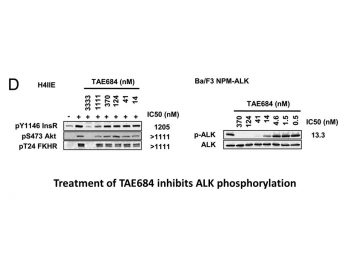
NPM-ALK (IC50 for inhibition of NPM-ALK autophosphorylation in cells: <10 nM after 4h treatment in Karpas-299 and SU-DHL-1 cells)[1] ALK (in Ba/F3 cells expressing EML4-ALK L1196M mutant: IC50 = 2.7 nM for native EML4-ALK vs 1.2 nM for mutant; in vitro Ki against wild-type ALK = 0.7 nM, against L1196M ALK = 8.2 nM for crizotinib, but for NVP-TAE684 no direct Ki given; cellular potency against native EML4-ALK IC50 = 1.2 nM, against L1196M mutant IC50 = 2.7 nM)[2] TAE684 targets anaplastic lymphoma kinase (ALK) and nucleophosmin-anaplastic lymphoma kinase (NPM-ALK). It is a potent and selective ALK inhibitor with an IC50 of 3 nM. The compound binds to and inhibits ALK and NPM-ALK tyrosine kinases, leading to a disruption of ALK- and NPM-ALK mediated signaling. TAE684 is 100-fold more sensitive for ALK than for InsR and also inhibits LRRK2 kinase. |
|---|---|
| ln Vitro |
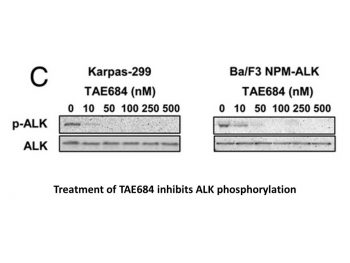
TAE684 shows no appreciable cross-reactivity with other kinases. With an effective concentration of 3 nM, TAE684 significantly suppresses the growth of Ba/F3 NPM-ALK cells while leaving the Ba/F3 cells viable at 1 μM. TAE684 also, at an IC50 of 2-4 nM, prevents the growth of human ALCL cell lines that express NPM-ALK, such as Karpas-299 and SU-DHL-1. According to molecular modeling, TAE684's kinase-selectivity may be significantly influenced by L258, potentially. In response to TAE684, NPM-ALK phosphorylation is rapidly and persistently inhibited. In ALCL patient cell lines and NPM-ALK-expressing Ba/F3 cells, TAE684 causes apoptosis and G1 phase arrest. In H3122 CR cells, which harbor the fusion oncogene EML4-ALK, TAE684 significantly overcomes Crizotinib-resistance by reducing cell growth, inhibiting ALK phosphorylation, and triggering apoptosis.[2] The mALK R1279Q mutant's induction of neurite outgrowth could be totally prevented by TAE684 at 30 nM.[3]
NVP-TAE684 selectively inhibited proliferation of Ba/F3 NPM-ALK cells with an IC50 of 3 nM, without affecting parental Ba/F3 cells up to 1 μM.[1] It inhibited proliferation of human ALCL cell lines Karpas-299 and SU-DHL-1 with IC50 values of 2-5 nM.[1] Growth inhibition correlated with dose-dependent reduction of NPM-ALK (Y664) autophosphorylation in Karpas-299, SU-DHL-1, and Ba/F3 NPM-ALK cells; significant reduction observed with IC50 <10 nM after 4h treatment.[1] TAE684 was highly selective for ALK-driven proliferation: 100- to 1000-fold higher concentrations required to inhibit other tyrosine kinases in a panel of 35 Ba/F3 cells transformed by various TEL-fusion kinases.[1] TAE684 inhibited STAT3 and STAT5 phosphorylation in a dose-dependent manner in Ba/F3 NPM-ALK and Karpas-299 cells; at 4h, phosphorylation decreased significantly at 10 nM and completely inhibited at ≥50 nM.[1] Kinetic experiments at 50 nM showed significant reduction in NPM-ALK and STAT3 phosphorylation as early as 15 min, sustained up to 48h.[1] TAE684 dose-dependently reduced phosphorylation of ERK and Akt in Karpas-299 cells.[1] TAE684 induced apoptosis in Ba/F3 NPM-ALK cells (85-95% Annexin V-positive at 48h) and SU-DHL-1 cells (70-80% at 48h), but less in Karpas-299 (20-30% at 72h with 50 nM).[1] TAE684 induced G1 phase arrest in Karpas-299 cells: after 72h at 25 nM, 72% of cells in G1 vs 26% control; S phase reduced from 60% to 14%.[1] In crizotinib-resistant H3122 CR cells (EML4-ALK L1196M gatekeeper mutant), NVP-TAE684 markedly reduced cell survival at 100 nM and suppressed phosphorylation of ALK, AKT, and ERK, inducing apoptosis. It was highly active against both sensitive H3122 and resistant H3122 CR cells, with IC50 values of 1.2 nM (native EML4-ALK) and 2.7 nM (L1196M mutant) in Ba/F3 cells.[2] In a panel of 704 cancer cell lines, both H3122 and H3122 CR cells were among the 1% most sensitive to 200 nM TAE684.[2] In vitro, TAE684 blocks the growth of ALCL-derived and ALK-dependent cell lines with IC50 values between 2 and 10 nM. It is a selective NPM-ALK phosphorylation inhibitor. TAE684 induces cell cycle arrest and apoptosis. These in vitro studies confirm its potent and selective activity against ALK and its effects on ALK-dependent cancer cell growth. |
| ln Vivo |
In the Karpas-299 lymphoma model, treatment with TAE684 at 3 and 10 mg/kg for 4 weeks resultsed in a significant delay in the development of lymphomas and a 100- to 1,000-fold reduction in luminescence signal, without any indication of compound- or disease-related toxicity. In established Karpas-299 lymphomas, TAE684 treatment also reduces CD30 expression and causes disease regression.[1] TAE684 exhibits remarkable antitumor activity in relation to H3122 CR xenograft tumors.[2] Moreover, TAE684 treatment ameliorates the rough eye phenotype of both ALK mutants, particularly ALKR1275Q, while Crizotinib has negligible impact on either phenotype.[3]
NVP-TAE684 showed good bioavailability and half-life in vivo. After oral dose of 20 mg/kg (formulated in 10% 1-methyl-2-pyrrolidinone/90% PEG 300), maximum plasma level (Cmax) of 800-1000 nM, bioavailability (BAV) 60-70%, elimination half-life (T1/2) ~12 h.[1] In a Karpas-299-luciferized i.v. xenograft model (SCID-beige mice), treatment with TAE684 at 3 and 10 mg/kg once daily by oral gavage starting 72h after cell injection resulted in 100-fold reduction of bioluminescence signal after 2 weeks, and 100- to 1000-fold reduction after 4 weeks; 1 mg/kg was ineffective. No signs of toxicity observed at 10 mg/kg.[1] In Ba/F3 NPM-ALK allograft model, TAE684 (10 mg/kg) caused >99% reduction in bioluminescence signal and 80% reduction in spleen weight compared to vehicle, with no effect on Ba/F3 BCR-ABL-induced disease, demonstrating specificity.[1] In established Karpas-299 lymphomas (treatment started 12 days post-injection), TAE684 at 3, 5, and 10 mg/kg p.o. daily induced dose-dependent regression with 1000-fold reduction in bioluminescence after 2 weeks.[1] Short-term treatment (10 mg/kg for 3 days) of mice with established palpable Karpas-299 lymphomas reduced phosphorylation of NPM-ALK and STAT3 in excised lymph nodes, and significantly reduced CD30 expression by immunohistochemistry.[1] In vivo, NVP-TAE684 (10 mg/kg) showed impressive activity against H3122 CR xenograft tumors (crizotinib-resistant, L1196M mutant), while crizotinib was ineffective.[2] In vivo, TAE684 has been studied for its antitumor activity in preclinical models. By inhibiting ALK and NPM-ALK signaling, it inhibits tumor cell growth in ALK- and NPM-ALK overexpressing tumors. Its potent and selective activity makes it a valuable tool for studying the role of ALK in cancer and for developing new ALK-targeted therapies. |
| Enzyme Assay |
As a stock solution, 10 mM of GSK1904529A is dissolved in DMSO. The IC50 is determined using proteins tagged with glutathione S-transferase that are expressed by bacteria and encode the intracellular domain of IGF-1R (amino acids 957–1367) and IR (amino acids 979–1382). In order to activate kinases, the enzyme must be preincubated in 50 mM HEPES (pH 7.5), 10 mM MgCl2, 0.1 mg/mL bovine serum albumin, and 2 mM ATP at a final concentration of 2.7 μM. The assay plates are filled with 100 nL/well of diluted GSK1904529A, which has been diluted in DMSO. Kinase reactions that were present (in 10 μL) 0.5 nM activated enzyme, 500 nM substrate peptide (biotin-aminohexylAEEEEYMMMMAKKKK-NH2; QPC), 3 mM DTT, 0.1 mg/mL bovine serum albumin, 1 mM CHAPS, 10 mM MgCl2, and 10 μM ATP. After one hour at room temperature, reactions are terminated using 33 μM EDTA. Using 1 nM europium-conjugated phosphotyrosine antibodies and 7 nM streptavidin Surelight allophycocyanin, time-resolved fluorescence resonance energy transfer is used to measure phosphorylation of peptides. A multilabel reader is used to read plates.
Homology modeling of ALK was performed using the insulin receptor kinase (InsR) structure (PDB ID: 1IR3) as template due to 45% sequence identity between InsR and ALK kinase domains. NVP-TAE684 was docked into the ALK model using GOLD (version 1.3) with standard default settings. All atom types and charges were assigned in GOLD. One hundred thousand independent genetic algorithm (GA) runs were performed for flexible ligand docking of TAE684, with the search radius set to 10 Å.[1] For in vitro kinase assays comparing crizotinib and AP26113 against wild-type and L1196M ALK, ATP Km values were determined: wild-type ALK Km=30.7 μM, L1196M ALK Km=27.2 μM. Crizotinib showed Ki of 0.7 nM against wild-type ALK and 8.2 nM against L1196M. AP26113 showed Ki of 0.09 nM and 0.08 nM, respectively. (Note: TAE684 not directly assayed here, but referenced for structural comparison.)[2] Non-cellular enzyme assays for TAE684 involve measuring its inhibition of ALK activity using purified ALK kinase and appropriate substrates. The compound's IC50 of 3 nM is determined in these assays. Selectivity is assessed by testing the compound against other kinases, including InsR. These assays confirm the compound's potency and selectivity for ALK. |
| Cell Assay |
In 384-well plates, cells are seeded with 2.5×10⁴ cells per well, and they are then incubated for two to three days with TAE684 or DMSO serial dilutions. The Bright-Glo Luciferase Assay System is used to measure luciferase expression, which is a proxy for cell proliferation and survival. To generate IC50 values, use the XLFit software.
Cell Proliferation Assays.[1] Luciferase-expressing Karpas-299, SU-DHL-1, and Ba/F3 cells and transformed Ba/F3 stably expressing NPM-ALK, BCR-ABL, or TEL-kinase fusion constructs were plated in 384-well plates (25,000 cells per well) and incubated with serial dilutions of TAE684 or DMSO for 2–3 days. Luciferase expression was used as a measure of cell proliferation/survival and was evaluated with the Bright-Glo Luciferase Assay System. IC50 values were generated by using XLFit software. Flow Cytometry.[1] Ba/F3 NPM-ALK, Karpas-299, and SU-DHL-1 cells were treated with DMSO or various concentrations of TAE684 for 24, 48, and 72 h before analysis of cell cycle distribution and apoptosis by flow cytometry. Samples were analyzed on a Becton-Dickinson LSRII Flow Cytometer Cell proliferation assay: Ba/F3 NPM-ALK, Karpas-299, SU-DHL-1, and transformed Ba/F3 cells expressing various TEL-kinase fusions were plated in 384-well plates (25,000 cells/well) and incubated with serial dilutions of NVP-TAE684 or DMSO for 2-3 days. Luciferase expression was used as measure of cell proliferation/survival, evaluated with a luciferase assay system. IC50 values were generated using curve-fitting software.[1] Western blot analysis: Cells treated with DMSO or increasing concentrations of TAE684 for indicated times were lysed, and proteins were separated by SDS-PAGE, transferred to membranes, and immunoblotted with antibodies against p-ALK (Y664), total ALK, p-STAT3, STAT3, p-STAT5, STAT5, p-ERK, ERK, p-Akt, Akt, and actin.[1] Flow cytometry for apoptosis and cell cycle: Ba/F3 NPM-ALK, Karpas-299, and SU-DHL-1 cells were treated with DMSO or TAE684 for 24, 48, and 72 h. Apoptosis was assessed by Annexin V and 7-AAD staining; cell cycle distribution by propidium iodide (PI) staining, analyzed on a flow cytometer.[1] siRNA knockdown: H3122 parental and H3122 CR cells were transfected with siRNA targeting ALK or control siRNA. Cell viability was measured after 72 h, and protein lysates were immunoblotted for p-ALK and total ALK to confirm knockdown.[2] Cell viability assay for resistance studies: Cells seeded in 96-well plates were treated with crizotinib, TAE684, AP26113, or 17-AAG for 72 h, and cell survival analyzed using a luminescence-based viability assay (CellTiter-Glo).[2] In vitro cell-based assays for TAE684 are conducted using ALCL-derived and ALK-dependent cell lines. Cells are treated with the compound, and cell proliferation is measured to determine IC50 values between 2 and 10 nM. Cell cycle analysis and apoptosis assays are performed to evaluate the compound's functional effects. These experiments are crucial for confirming its mechanism of action. |
| Animal Protocol |
In order to conduct in vivo compound efficacy studies, female Fox Chase SCIDBeige mice are injected with 1×10⁶ Karpas-299-, Ba/F3 NPM-ALK-, or BCR-ABL-expressing cells via the tail vein 72 hours later. TAE684 resuspended in 10% 1-methyl-2-pyrrolidinone/90% PEG 300 solution is given to mice (n = 10 per group) at 1, 3, and 10 mg/kg once daily for three weeks, or the vehicle solution is given at the same dosing schedule. Bioluminescence imaging is used once a week to track the progression of the disease and the effectiveness of the compound. The disease is confirmed to be widespread by bioluminescence imaging on day 12, at which point dosing is started in order to assess the effectiveness of TAE684 on established disease. For three days, mice with established lymphomas are given either vehicle solution or TAE684 (10 mg/kg) in order to analyze the downstream molecular effects in vivo. Upon completion of therapy, lymph nodes are removed from the mice and subjected to immunoblotting and histological examination.
In Vivo Experiments.[1] For in vivo compound efficacy studies, treatment was initiated 72 h after tail vein injection of 1 × 10⁶ Karpas-299-, Ba/F3 NPM-ALK- or BCR-ABL-expressing cells into female Fox Chase SCIDBeige mice. Mice (n = 10 per group) were administered either TAE684 resuspended in 10% 1-methyl-2-pyrrolidinone/90% PEG 300 solution at 1, 3, and 10 mg/kg once daily for 3 weeks or the vehicle solution at the same dosing schedule. Disease progression and compound efficacy was monitored weekly with bioluminescence imaging. To determine the efficacy of TAE684 on established disease, dosing was initiated on day 12, at which time the disease confirmed to be widespread by bioluminescence imaging. For analysis of downstream molecular effects in vivo, mice with established lymphomas were administered vehicle solution or TAE684 (10 mg/kg) for 3 days. At the end of treatment, mice were killed, and lymph nodes were extracted for immunoblotting and histological analysis. For in vivo efficacy studies, female SCID-beige mice (6-8 weeks old) were injected intravenously with 1×10^6 Karpas-299-luc cells, Ba/F3 NPM-ALK cells, or Ba/F3 BCR-ABL cells. Treatment was initiated 72 h later. NVP-TAE684 was resuspended in 10% 1-methyl-2-pyrrolidinone/90% PEG 300 solution and administered orally once daily at doses of 1, 3, and 10 mg/kg for 3 weeks. Vehicle control received the same dosing schedule. Disease progression and efficacy were monitored weekly by bioluminescence imaging.[1] To assess efficacy on established disease, dosing was initiated on day 12 after Karpas-299 cell injection, when bioluminescence imaging confirmed widespread disease. Mice were treated with TAE684 at 3, 5, and 10 mg/kg p.o. daily.[1] For short-term molecular analysis, mice with established palpable Karpas-299 lymphomas were administered vehicle or TAE684 (10 mg/kg) for 3 days. Four hours after the third dose, mice were sacrificed, and lymph nodes were extracted for immunoblotting and histological analysis (CD30 immunohistochemistry).[1] For xenograft studies with H3122 CR cells, mice bearing tumors were treated with TAE684 (dose not specified in main text) and showed in vivo activity against crizotinib-resistant tumors (referenced to SI Appendix, Fig. S9).[2] In vivo animal studies for TAE684 are typically conducted in rodent models of ALK-driven cancers to evaluate its antitumor efficacy. The compound can be administered via various routes depending on the experimental design. Tumor growth is monitored, and ALK signaling is assessed following treatment. These studies are essential for validating the compound's in vivo efficacy. |
| ADME/Pharmacokinetics |
After oral administration of NVP-TAE684 at 20 mg/kg formulated as a solution in 10% 1-methyl-2-pyrrolidinone/90% PEG 300, the maximum plasma concentration (Cmax) was 800-1000 nM, measured at 7 hours post-dose. Bioavailability (BAV) ranged between 60% and 70%, and elimination half-life (T1/2) was approximately 12 hours.[1]
TAE684 has a molecular weight of 614.21 g/mol. It is a potent and selective ALK inhibitor. Detailed pharmacokinetic parameters such as half-life and bioavailability are not extensively documented in standard summaries but would be evaluated in preclinical studies. Its cell-permeable nature allows it to reach its intracellular target effectively. |
| Toxicity/Toxicokinetics |
No significant compound- or disease-related toxicity was observed in mice treated with NVP-TAE684 at 10 mg/kg once daily for up to 4 weeks.[1]
Comprehensive toxicological data for TAE684 are limited as it is primarily a research compound. It is intended for laboratory use only and is not for human consumption. As with all research chemicals, appropriate safety precautions should be taken when handling TAE684. Its safety profile in vivo has not been extensively characterized beyond its use in preclinical cancer models. |
| References |
|
| Additional Infomation |
5-Chloro-N2-[2-methoxy-4-[4-(4-methyl-1-piperazinyl)-1-piperidinyl]phenyl]-N4-(2-propyl-2-ylsulfonylphenyl)pyrimidine-2,4-diamine belongs to the piperidine class of compounds.
ALK inhibitor TAE684 is a small molecule receptor tyrosine kinase (RTK) inhibitor that inhibits anaplastic lymphoma kinase (ALK) and nucleolar phosphoprotein-anaplastic lymphoma kinase (NPM-ALK), exhibiting potential antitumor activity. After administration, TAE684 binds to and inhibits the activity of ALK and NPM-ALK tyrosine kinases, thereby blocking ALK and NPM-ALK-mediated signaling pathways and ultimately inhibiting the growth of tumor cells overexpressing ALK and NPM-ALK. ALK belongs to the insulin receptor superfamily and plays an important role in the development of the nervous system. ALK dysregulation and gene rearrangement are associated with various tumors. NPM-ALK is an oncogenic fusion protein associated with ALK-positive anaplastic large cell lymphoma. ALK mutations are also associated with acquired resistance to small molecule tyrosine kinase inhibitors. NVP-TAE684 induces down-regulation of CD30 expression, suggesting CD30 may be used as a biomarker of therapeutic NPM-ALK kinase activity inhibition.[1] NPM-ALK-positive ALCLs account for 50-60% of cases; TAE684 targets this oncogenic driver.[1] TAE684 is highly selective over InsR in cellular assays despite high sequence homology; this may be explained by differences in three-dimensional structure or ATP concentrations.[1] In the context of crizotinib resistance in EML4-ALK-positive NSCLC, NVP-TAE684 effectively overcomes the gatekeeper L1196M mutation, which confers resistance via steric interference. This positions TAE684 as a second-generation ALK inhibitor.[2] TAE684 (NVP-TAE684) is a potent and selective ALK inhibitor with an IC50 of 3 nM. It blocks the growth of ALCL-derived and ALK-dependent cell lines with IC50 values between 2 and 10 nM and is 100-fold more selective for ALK than for InsR. TAE684 induces cell cycle arrest and apoptosis. TAE684 is not an approved drug and is available as a research compound. |
| Molecular Formula |
C30H40CLN7O3S
|
|
|---|---|---|
| Molecular Weight |
614.2
|
|
| Exact Mass |
613.26
|
|
| Elemental Analysis |
C, 58.66; H, 6.56; Cl, 5.77; N, 15.96; O, 7.81; S, 5.22
|
|
| CAS # |
761439-42-3
|
|
| Related CAS # |
|
|
| PubChem CID |
16038120
|
|
| Appearance |
Pale yellow solid powder
|
|
| Density |
1.3±0.1 g/cm3
|
|
| Boiling Point |
791.0±70.0 °C at 760 mmHg
|
|
| Flash Point |
432.2±35.7 °C
|
|
| Vapour Pressure |
0.0±2.8 mmHg at 25°C
|
|
| Index of Refraction |
1.622
|
|
| LogP |
2.71
|
|
| Hydrogen Bond Donor Count |
2
|
|
| Hydrogen Bond Acceptor Count |
10
|
|
| Rotatable Bond Count |
9
|
|
| Heavy Atom Count |
42
|
|
| Complexity |
940
|
|
| Defined Atom Stereocenter Count |
0
|
|
| SMILES |
ClC1=C([H])N=C(N=C1N([H])C1=C([H])C([H])=C([H])C([H])=C1S(C([H])(C([H])([H])[H])C([H])([H])[H])(=O)=O)N([H])C1C([H])=C([H])C(=C([H])C=1OC([H])([H])[H])N1C([H])([H])C([H])([H])C([H])(C([H])([H])C1([H])[H])N1C([H])([H])C([H])([H])N(C([H])([H])[H])C([H])([H])C1([H])[H]
|
|
| InChi Key |
QQWUGDVOUVUTOY-UHFFFAOYSA-N
|
|
| InChi Code |
InChI=1S/C30H40ClN7O3S/c1-21(2)42(39,40)28-8-6-5-7-26(28)33-29-24(31)20-32-30(35-29)34-25-10-9-23(19-27(25)41-4)37-13-11-22(12-14-37)38-17-15-36(3)16-18-38/h5-10,19-22H,11-18H2,1-4H3,(H2,32,33,34,35)
|
|
| Chemical Name |
5-chloro-2-N-[2-methoxy-4-[4-(4-methylpiperazin-1-yl)piperidin-1-yl]phenyl]-4-N-(2-propan-2-ylsulfonylphenyl)pyrimidine-2,4-diamine
|
|
| Synonyms |
NVP-TAE684; TAE 684; TAE684; NVP-TAE 684; 5-chloro-N4-(2-(isopropylsulfonyl)phenyl)-N2-(2-methoxy-4-(4-(4-methylpiperazin-1-yl)piperidin-1-yl)phenyl)pyrimidine-2,4-diamine; TAE684 (NVP-TAE684); NVP-TAE-684; TAE-684
|
|
| HS Tariff Code |
2934.99.9001
|
|
| Storage |
Powder -20°C 3 years 4°C 2 years In solvent -80°C 6 months -20°C 1 month |
|
| Shipping Condition |
Room temperature (This product is stable at ambient temperature for a few days during ordinary shipping and time spent in Customs)
|
| Solubility (In Vitro) |
DMSO: ~3 mg/mL (~4.9 mM)
Water: 1 mg/mL (Insoluble) Ethanol: 1 mg/mL |
|---|---|
| Solubility (In Vivo) |
Solubility in Formulation 1: ≥ 0.77 mg/mL (1.25 mM) (saturation unknown) in 10% DMSO + 40% PEG300 + 5% Tween80 + 45% Saline (add these co-solvents sequentially from left to right, and one by one), clear solution.
For example, if 1 mL of working solution is to be prepared, you can add 100 μL of 7.7 mg/mL clear DMSO stock solution to 400 μL PEG300 and mix evenly; then add 50 μL Tween-80 to the above solution and mix evenly; then add 450 μL normal saline to adjust the volume to 1 mL. Preparation of saline: Dissolve 0.9 g of sodium chloride in 100 mL ddH₂ O to obtain a clear solution. Solubility in Formulation 2: ≥ 0.77 mg/mL (1.25 mM) (saturation unknown) in 10% DMSO + 90% (20% SBE-β-CD in Saline) (add these co-solvents sequentially from left to right, and one by one), clear solution. For example, if 1 mL of working solution is to be prepared, you can add 100 μL of 7.7 mg/mL clear DMSO stock solution to 900 μL of 20% SBE-β-CD physiological saline solution and mix evenly. Preparation of 20% SBE-β-CD in Saline (4°C,1 week): Dissolve 2 g SBE-β-CD in 10 mL saline to obtain a clear solution. View More
Solubility in Formulation 3: 30% PEG400+0.5% Tween80+5% propylene glycol, pH 4: 10mg/mL |
| Preparing Stock Solutions | 1 mg | 5 mg | 10 mg | |
| 1 mM | 1.6281 mL | 8.1407 mL | 16.2813 mL | |
| 5 mM | 0.3256 mL | 1.6281 mL | 3.2563 mL | |
| 10 mM | 0.1628 mL | 0.8141 mL | 1.6281 mL |
*Note: Please select an appropriate solvent for the preparation of stock solution based on your experiment needs. For most products, DMSO can be used for preparing stock solutions (e.g. 5 mM, 10 mM, or 20 mM concentration); some products with high aqueous solubility may be dissolved in water directly. Solubility information is available at the above Solubility Data section. Once the stock solution is prepared, aliquot it to routine usage volumes and store at -20°C or -80°C. Avoid repeated freeze and thaw cycles.
Calculation results
Working concentration: mg/mL;
Method for preparing DMSO stock solution: mg drug pre-dissolved in μL DMSO (stock solution concentration mg/mL). Please contact us first if the concentration exceeds the DMSO solubility of the batch of drug.
Method for preparing in vivo formulation::Take μL DMSO stock solution, next add μL PEG300, mix and clarify, next addμL Tween 80, mix and clarify, next add μL ddH2O,mix and clarify.
(1) Please be sure that the solution is clear before the addition of next solvent. Dissolution methods like vortex, ultrasound or warming and heat may be used to aid dissolving.
(2) Be sure to add the solvent(s) in order.
|
 |
Products are for research use only; We do not sell to patients
Copyright 2020 InvivoChem LLC | All Rights Reserved


 NMR-
NMR-