| Size | Price | Stock | Qty |
|---|---|---|---|
| 5mg |
|
||
| 10mg |
|
||
| 25mg |
|
||
| 50mg |
|
||
| 100mg |
|
||
| 250mg |
|
||
| 500mg | |||
| Other Sizes |


Purity: ≥98%
| Targets |
JAK2: 1 nM (IC50); Tyk2: 1 nM (IC50); JAK3: 5 nM (IC50); Murine JAK1: 15 nM (IC50); CDK2: 3.3 μM (IC50); cAMP-dependent kinase: 7.1 μM (IC50); Csk: 2.1 μM (IC50): Hck: 7.7 μM (IC50); Fyn T: 0.5 μM (IC50); p38: 11 μM (IC50); MAPK: 1.78 μM (IC50); Mek: 0.16 μM (IC50); IκB Kinase 2: 0.3 μM (IC50); KDR: 1.4 μM (IC50); Flt-1: 1.52 μ(IC50); Flt-4: 0.69 μM (IC50); FGFR: 1.48 μM (IC50); FGFR2: 0.94 μM (IC50); Tek: 24 μM (IC50); PDGFR: 1.49 μM (IC50); PKC(α): 1.2 μM (IC50)
Pyridone 6 targets Janus kinase 3 (Jak3) (Kᵢ = 5 nM) [1] Pyridone 6 targets Tyk2 (IC₅₀ = 1 nM), Jak2 (IC₅₀ = 1 nM), murine Jak1 (IC₅₀ = 15 nM) [1] Pyridone 6 targets Janus kinases (JAKs, pan-JAK inhibitor) [2] |
|---|---|
| ln Vitro |
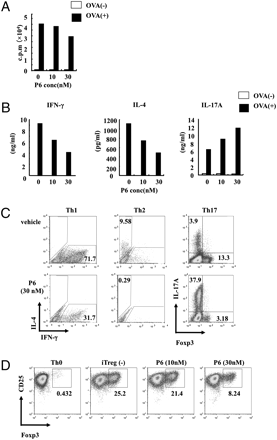
In tests, Pyridone 6 is found to be an inhibitor of 21 additional protein kinases; its IC50 values range from 130 nM to >10 μM. Pyridone 6 suppresses CTLL cell proliferation stimulated by IL2 at an IC50 of 0.1 μM and IL4 at an IC50 of 0.052 μM[1]. It is demonstrated that pyridinone 6 (P6) interacts with each JAK's ATP-binding cleft to inhibit kinase. For each of these cytokines, Pyridone 6 has an IC50 of 3 nM; this is similar to the IC50s of Pyridone 6 that have been reported for JAK2, Tyk2, and JAK3. When present within a specific range of concentrations, pyridonone 6 enhances Th17 development while weakly inhibiting Th2 and modestly inhibiting Th1. Pyridone 6 increases the expression of IL-17 and IL-22 while decreasing IFN-γ and IL-13. Additionally, pyridone 6 suppresses the growth of Th1 and Th2 cells while, at specific concentrations, promoting the differentiation of Th17 from naive T cells[2].
1. Pyridone 6 inhibited 21 other protein kinases with IC₅₀ values ranging from 130 nM to >10 μM, showing selective inhibition for JAK family kinases [1] 2. Pyridone 6 blocked IL2 and IL4 dependent proliferation of CTLL cells [1] 3. Pyridone 6 inhibited the phosphorylation of STAT5 (an in vivo substrate of the JAK family) in CTLL cells, as measured by Western blotting [1] 4. In vitro, Pyridone 6 inhibited both Th1 and Th2 cell development from naive T cells; within a certain concentration range, it promoted Th17 cell differentiation from naive T cells [2] 5. Pyridone 6 strongly inhibited the phosphorylation of STAT1, STAT5, and STAT6 in vitro, while the phosphorylation of STAT3 was less efficiently suppressed at the same concentration [2] 6. IL-22 (related to the mechanism of Pyridone 6) protected keratinocytes from apoptosis induced by IFN-γ in vitro [2] |
| ln Vivo |
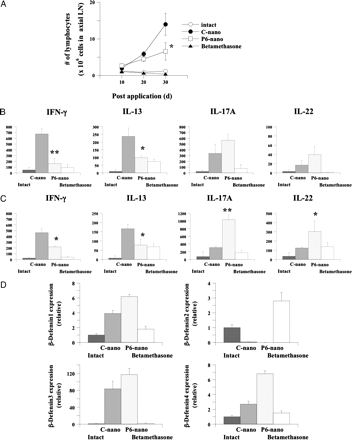
Pyridone 6 (P6) in an AD-like skin disease model of NC/Nga mice postpones the onset and lessens the severity of skin disease. In NC/Nga mice, P6-nano significantly reduces atopic dermatitis (AD), having an impact similar to that of the widely used medication betamethasone ointment, which also functioned as a positive control. On the other hand, it appeared that empty polylactic acid with glycolic acid (PLGA) nanoparticles (C-nano) had no effect[2].
1. Pyridone 6 delayed the onset and reduced the magnitude of skin disease in an AD-like skin-disease model of NC/Nga mice (atopic dermatitis model) [2] 2. Pyridone 6 reduced the expression of IFN-γ and IL-13 in the skin tissue of NC/Nga mice with AD-like skin inflammation, while enhancing the expression of IL-17 and IL-22 [2] 3. Administration of IL-17 and IL-22 partially ameliorated skin diseases in NC/Nga mice, which supported the therapeutic mechanism of Pyridone 6 (enhancing Th17-related cytokines) [2] |
| Enzyme Assay |
Jak3 is a protein tyrosine kinase that is associated with the shared gamma chain of receptors for cytokines IL2, IL4, IL7, IL9, and IL13. We have discovered that a pyridone-containing tetracycle (6) may be prepared from trisubstituted imidazole (5) in high yield by irradiation with >350 nm light. Compound 6 inhibits Jak3 with K(I)=5 nM; it also inhibits Jak family members Tyk2 and Jak2 with IC(50)=1 nM and murine Jak1with IC(50)=15 nM. Compound 6 was tested as an inhibitor of 21 other protein kinases; it inhibited these kinases with IC(50)s ranging from 130 nM to >10 microM.[1]
1. Kinase inhibition assays were performed to evaluate the inhibitory activity of Pyridone 6 on Jak3, Tyk2, Jak2, murine Jak1, and 21 other protein kinases; the Kᵢ value for Jak3 and IC₅₀ values for other JAK family members and non-JAK kinases were determined to assess the selectivity of the compound [1] |
| Cell Assay |
Compound 6 also blocks IL2 and IL4 dependent proliferation of CTLL cells and inhibits the phosphorylation of STAT5 (an in vivo substrate of the Jak family) as measured by Western blotting. [1] Naive CD4+ T cells are treated with various concentrations of Pyridone 6 (10 and 30 nM) in RPMI 1640 medium 1 h before the appropriate cytokines are added to create each Th-differentiating condition. Immunoblotting is performed using antiphospho-STAT protein Abs or anti-total STAT protein Abs. [2]
1. CTLL cells were cultured and treated with Pyridone 6 in the presence of IL2 or IL4; cell proliferation was assessed to determine the inhibitory effect of Pyridone 6 on cytokine-dependent cell growth [1] 2. Western blot analysis was conducted on CTLL cells treated with Pyridone 6; the phosphorylation level of STAT5 was detected to verify the inhibitory effect of Pyridone 6 on the JAK-STAT signaling pathway [1] 3. Naive T cells were isolated and cultured in vitro under conditions inducing Th1, Th2, or Th17 differentiation; different concentrations of Pyridone 6 were added to the culture system, and the differentiation status of T cell subsets was analyzed to evaluate the effect of Pyridone 6 on T cell polarization [2] 4. Keratinocytes were cultured in vitro and treated with IFN-γ to induce apoptosis; IL-22 (a cytokine modulated by Pyridone 6) was added to the culture system, and the apoptosis rate of keratinocytes was detected to explore the protective effect of IL-22 [2] 5. Western blot analysis was used to detect the phosphorylation levels of STAT1, STAT5, STAT6, and STAT3 in cells treated with Pyridone 6, to clarify the molecular mechanism of Pyridone 6 in regulating T cell differentiation [2] |
| Animal Protocol |
2 mg/body; s.c.
NC/Nga mice with AD-like skin-disease model NC/Nga mice are used at the age of 10-15 wk. To assess the effect of Pyridone 6 treatment on AD symptoms, nanoparticles containing Pyridone 6 (2 mg/body) or empty nanoparticles as a negative control (C-nano) are dissolved in 0.1 mL saline and administered s.c. 1 d after Dfb ointment application; this treatment is repeated twice a week. To assess the effects of recombinant murine IL-17 and IL-22, these cytokines (50 μg/kg) or 100 μL PBS is administered for the same duration as the nanoparticles. Twenty milligrams of 0.064% betamethasone ointment are applied to the dorsal lesion of mice once a week[2]. 1. NC/Nga mice were used to establish an AD-like skin-disease model (atopic dermatitis model); Pyridone 6 was administered to the mice ; the onset time and severity of skin lesions were monitored to evaluate the therapeutic effect of Pyridone 6 [2] 2. Cytokine expression levels (IFN-γ, IL-13, IL-17, IL-22) in the skin tissue of NC/Nga mice treated with Pyridone 6 were detected to analyze the immunomodulatory mechanism of the drug [2] 3. IL-17 and IL-22 were administered to NC/Nga mice with AD-like skin inflammation; the improvement of skin lesions was observed to verify the role of these cytokines in the therapeutic effect of Pyridone 6 [2] |
| References |
|
| Additional Infomation |
2-tert-butyl-9-fluoro-1,6-dihydrobenzi[h]imidazo[4,5-f]isoquinoline-7-one is an organoheterocyclic compound, derived from 1,6-dihydrobenzi[h]imidazo[4,5-f]isoquinoline-7-one by introducing additional tert-butyl and fluorine substituents at positions 2 and 9, respectively. It is an EC 2.7.10.2 (non-specific protein tyrosine kinase) inhibitor. It is both an organoheterocyclic compound and an organofluorine compound.
1. Jak3 is a protein tyrosine kinase associated with the common γ chain of receptors for cytokines IL2, IL4, IL7, IL9 and IL13[1] 2. Pyridone 6 can be prepared in high yield by irradiation of trisubstituted imidazole (5) with >350 nm light[1] 3. Atopic dermatitis (AD) is a common pruritic inflammatory disease caused by skin barrier defects and immune dysregulation, and is generally considered to be a Th2-related allergic disease; in the chronic phase, Th1-type immune responses have also been observed to dominate in AD lesions[2] 4. Pyridone 6 is a pan-JAK inhibitor that can improve allergic skin inflammation in NC/Nga mice by inhibiting Th2 and enhancing Th17[2] 5. Prior to this study, the role of IL-17 producing cells (Th17 cells) in AD was not fully understood; the results showed that pyridone 6 can regulate Th2 and Th17 To treat AD by balancing [2] |
| Molecular Formula |
C18H16FN3O
|
|
|---|---|---|
| Molecular Weight |
309.34
|
|
| Exact Mass |
309.127
|
|
| Elemental Analysis |
C, 69.89; H, 5.21; F, 6.14; N, 13.58; O, 5.17
|
|
| CAS # |
457081-03-7
|
|
| Related CAS # |
|
|
| PubChem CID |
5494425
|
|
| Appearance |
Light brown to brown solid powder
|
|
| Density |
1.3±0.1 g/cm3
|
|
| Boiling Point |
646.5±55.0 °C at 760 mmHg
|
|
| Flash Point |
344.8±31.5 °C
|
|
| Vapour Pressure |
0.0±1.9 mmHg at 25°C
|
|
| Index of Refraction |
1.681
|
|
| LogP |
3
|
|
| Hydrogen Bond Donor Count |
2
|
|
| Hydrogen Bond Acceptor Count |
3
|
|
| Rotatable Bond Count |
1
|
|
| Heavy Atom Count |
23
|
|
| Complexity |
529
|
|
| Defined Atom Stereocenter Count |
0
|
|
| SMILES |
FC1=CC2=C(C(NC=C3)=O)C3=C(N=C(C(C)(C)C)N4)C4=C2C=C1
|
|
| InChi Key |
VNDWQCSOSCCWIP-UHFFFAOYSA-N
|
|
| InChi Code |
InChI=1S/C18H16FN3O/c1-18(2,3)17-21-14-10-5-4-9(19)8-12(10)13-11(15(14)22-17)6-7-20-16(13)23/h4-8H,1-3H3,(H,20,23)(H,21,22)
|
|
| Chemical Name |
2-(1,1-dimethylethyl)-9-fluoro-1,6-dihydro-7H-benz[h]imidazo[4,5-f]isoquinolin-7-one
|
|
| Synonyms |
|
|
| HS Tariff Code |
2934.99.9001
|
|
| Storage |
Powder -20°C 3 years 4°C 2 years In solvent -80°C 6 months -20°C 1 month |
|
| Shipping Condition |
Room temperature (This product is stable at ambient temperature for a few days during ordinary shipping and time spent in Customs)
|
| Solubility (In Vitro) |
DMSO: ≥ 31.25 mg/mL
Water: 1 mg/mL (Insoluble) Ethanol: 1 mg/mL |
|---|---|
| Solubility (In Vivo) |
Solubility in Formulation 1: ≥ 2.5 mg/mL (8.08 mM) (saturation unknown) in 10% DMSO + 40% PEG300 + 5% Tween80 + 45% Saline (add these co-solvents sequentially from left to right, and one by one), clear solution.
For example, if 1 mL of working solution is to be prepared, you can add 100 μL of 25.0 mg/mL clear DMSO stock solution to 400 μL PEG300 and mix evenly; then add 50 μL Tween-80 to the above solution and mix evenly; then add 450 μL normal saline to adjust the volume to 1 mL. Preparation of saline: Dissolve 0.9 g of sodium chloride in 100 mL ddH₂ O to obtain a clear solution. Solubility in Formulation 2: 2.5 mg/mL (8.08 mM) in 10% DMSO + 90% (20% SBE-β-CD in Saline) (add these co-solvents sequentially from left to right, and one by one), suspension solution; with ultrasonication. For example, if 1 mL of working solution is to be prepared, you can add 100 μL of 25.0 mg/mL clear DMSO stock solution to 900 μL of 20% SBE-β-CD physiological saline solution and mix evenly. Preparation of 20% SBE-β-CD in Saline (4°C,1 week): Dissolve 2 g SBE-β-CD in 10 mL saline to obtain a clear solution. View More
Solubility in Formulation 3: ≥ 2.5 mg/mL (8.08 mM) (saturation unknown) in 10% DMSO + 90% Corn Oil (add these co-solvents sequentially from left to right, and one by one), clear solution. Solubility in Formulation 4: Solubility in Formulation 1: ≥ 2.5 mg/mL (8.1 mM) (saturation unknown) in 10% DMSO + 40% PEG300 + 5% Tween80 + + 45% Saline (add these co-solvents sequentially from left to right, and one by one), clear solution. For example, if 1 mL of working solution is to be prepared, you can take 100 μL of 25 mg/mL DMSO stock solution and add to 400 μL of PEG300, mix well (clear solution); Then add 50 μL of Tween 80 to the above solution, mix well (clear solution); Finally, add 450 μL of saline to the above solution, mix well (clear solution). Preparation of saline: Dissolve 0.9 g of sodium chloride in 100 mL ddH ₂ O to obtain a clear solution. Solubility in Formulation 2: ≥ 2.5 mg/mL (8.1 mM) (saturation unknown) in 10% DMSO + 90% (20% SBE-β-CD in saline) (add these co-solvents sequentially from left to right, and one by one), suspension solution. For example, if 1 mL of working solution is to be prepared, you can take 100 μL of 25 mg/mL DMSO stock solution and add to 900 μL of 20% SBE-β-CD in saline, mix well. Preparation of 20% SBE-β-CD in Saline (4°C,1 week): Dissolve 2 g SBE-β-CD in 10 mL saline to obtain a clear solution. Solubility in Formulation 3: ≥ 2.5 mg/mL (8.1 mM) (saturation unknown) in 10% DMSO + 90% Corn oil (add these co-solvents sequentially from left to right, and one by one), clear solution. For example, if 1 mL of working solution is to be prepared, you can take 100 μL of 25 mg/mL DMSO stock solution and add to 900 μL of corn oil, mix well (clear solution). |
| Preparing Stock Solutions | 1 mg | 5 mg | 10 mg | |
| 1 mM | 3.2327 mL | 16.1634 mL | 32.3269 mL | |
| 5 mM | 0.6465 mL | 3.2327 mL | 6.4654 mL | |
| 10 mM | 0.3233 mL | 1.6163 mL | 3.2327 mL |
*Note: Please select an appropriate solvent for the preparation of stock solution based on your experiment needs. For most products, DMSO can be used for preparing stock solutions (e.g. 5 mM, 10 mM, or 20 mM concentration); some products with high aqueous solubility may be dissolved in water directly. Solubility information is available at the above Solubility Data section. Once the stock solution is prepared, aliquot it to routine usage volumes and store at -20°C or -80°C. Avoid repeated freeze and thaw cycles.
Calculation results
Working concentration: mg/mL;
Method for preparing DMSO stock solution: mg drug pre-dissolved in μL DMSO (stock solution concentration mg/mL). Please contact us first if the concentration exceeds the DMSO solubility of the batch of drug.
Method for preparing in vivo formulation::Take μL DMSO stock solution, next add μL PEG300, mix and clarify, next addμL Tween 80, mix and clarify, next add μL ddH2O,mix and clarify.
(1) Please be sure that the solution is clear before the addition of next solvent. Dissolution methods like vortex, ultrasound or warming and heat may be used to aid dissolving.
(2) Be sure to add the solvent(s) in order.
|
|---|
P6 modified naive CD4+T cell differentiation.J Immunol.2011 Nov 1;187(9):4611-20. |
|
Products are for research use only; We do not sell to patients
Copyright 2020 InvivoChem LLC | All Rights Reserved


 COA
COA