
| Size | Price | Stock | Qty |
|---|---|---|---|
| 5mg |
|
||
| 10mg |
|


| Targets |
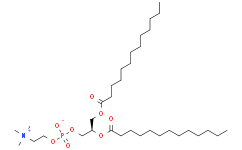
1,2-Ditridecanoyl-sn-glycero-3-phosphocholine does not have a classical pharmacological target, as it is a synthetic phospholipid used in research applications. As a member of the phosphatidylcholine class, it can incorporate into cell membranes and lipid bilayers. It plays a crucial role in various biological processes related to membrane structure and function.
|
|---|---|
| ln Vitro |
In vitro, 1,2-Ditridecanoyl-sn-glycero-3-phosphocholine is used as a model phospholipid for studying membrane properties and lipid interactions. It can be incorporated into liposomes and other lipid-based delivery systems. The compound's amphiphilic characteristics make it suitable for studying membrane biophysics and drug delivery applications. It is a synthetic compound that mimics natural phospholipids.
|
| ln Vivo |
In vivo activity data for 1,2-Ditridecanoyl-sn-glycero-3-phosphocholine are limited, as it is primarily a research reagent rather than a therapeutic agent. Its potential therapeutic applications are being explored in drug development. The compound is not intended for human therapeutic use without further development.
|
| Enzyme Assay |
The non-cellular assay for 1,2-Ditridecanoyl-sn-glycero-3-phosphocholine involves characterizing its chemical properties and lipid bilayer-forming capabilities. Key analytical techniques include HPLC, NMR, and mass spectrometry to confirm structure and purity. Liposome formation and stability can be assessed using dynamic light scattering and electron microscopy.
|
| Cell Assay |
In vitro cell-based assays for 1,2-Ditridecanoyl-sn-glycero-3-phosphocholine involve incorporating the phospholipid into cell culture models to study membrane interactions and drug delivery. It can be used to formulate liposomes for delivering therapeutic agents to cells. The compound's biocompatibility and lack of cytotoxicity make it suitable for these applications.
|
| Animal Protocol |
In vivo animal study protocols for 1,2-Ditridecanoyl-sn-glycero-3-phosphocholine are not well documented, as it is primarily a research reagent. When used in drug delivery formulations, the phospholipid-containing liposomes can be administered to animals to evaluate pharmacokinetics and biodistribution. Standard protocols for liposomal drug delivery studies would apply.
|
| ADME/Pharmacokinetics |
Pharmacokinetic properties of 1,2-Ditridecanoyl-sn-glycero-3-phosphocholine are not extensively characterized. As a phospholipid, it is expected to be biocompatible and biodegradable. When formulated into liposomes, the compound contributes to the overall pharmacokinetic profile of the delivery system. It is not intended for administration as a free compound.
|
| Toxicity/Toxicokinetics |
Toxicological data for 1,2-Ditridecanoyl-sn-glycero-3-phosphocholine indicate that it is generally considered biocompatible and safe for research use. As a phospholipid, it is similar to natural membrane components. Standard safety precautions should be observed during handling. The product is for non-human research only and not for therapeutic or veterinary use.
|
| Additional Infomation |
1,2-Ditridecanoyl-sn-glycero-3-phosphocholine (DTGPC) is a synthetic phospholipid that mimics natural cell membrane components. It belongs to the phosphatidylcholine class and has potential applications in drug development and delivery research. The compound is not a therapeutic drug and has no clinical trial or marketing authorization status.
|
| Molecular Formula |
C34H68NO8P
|
|---|---|
| Molecular Weight |
649.879392623901
|
| Exact Mass |
649.468
|
| CAS # |
71242-28-9
|
| PubChem CID |
24778591
|
| Appearance |
White to off-white solid
|
| LogP |
7.69
|
| Hydrogen Bond Donor Count |
0
|
| Hydrogen Bond Acceptor Count |
8
|
| Rotatable Bond Count |
34
|
| Heavy Atom Count |
44
|
| Complexity |
735
|
| Defined Atom Stereocenter Count |
1
|
| SMILES |
P(=O)([O-])(OC[C@@H](COC(CCCCCCCCCCCC)=O)OC(CCCCCCCCCCCC)=O)OCC[N+](C)(C)C
|
| InChi Key |
RLNYFMQMIIHWFV-JGCGQSQUSA-N
|
| InChi Code |
InChI=1S/C34H68NO8P/c1-6-8-10-12-14-16-18-20-22-24-26-33(36)40-30-32(31-42-44(38,39)41-29-28-35(3,4)5)43-34(37)27-25-23-21-19-17-15-13-11-9-7-2/h32H,6-31H2,1-5H3/t32-/m1/s1
|
| Chemical Name |
[(2R)-2,3-di(tridecanoyloxy)propyl] 2-(trimethylazaniumyl)ethyl phosphate
|
| Solubility (In Vitro) |
Ethanol: ≥ 100 mg/mL (~153.9 mM)
|
|---|
| Preparing Stock Solutions | 1 mg | 5 mg | 10 mg | |
| 1 mM | 1.5387 mL | 7.6937 mL | 15.3875 mL | |
| 5 mM | 0.3077 mL | 1.5387 mL | 3.0775 mL | |
| 10 mM | 0.1539 mL | 0.7694 mL | 1.5387 mL |
*Note: Please select an appropriate solvent for the preparation of stock solution based on your experiment needs. For most products, DMSO can be used for preparing stock solutions (e.g. 5 mM, 10 mM, or 20 mM concentration); some products with high aqueous solubility may be dissolved in water directly. Solubility information is available at the above Solubility Data section. Once the stock solution is prepared, aliquot it to routine usage volumes and store at -20°C or -80°C. Avoid repeated freeze and thaw cycles.
Calculation results
Working concentration: mg/mL;
Method for preparing DMSO stock solution: mg drug pre-dissolved in μL DMSO (stock solution concentration mg/mL). Please contact us first if the concentration exceeds the DMSO solubility of the batch of drug.
Method for preparing in vivo formulation::Take μL DMSO stock solution, next add μL PEG300, mix and clarify, next addμL Tween 80, mix and clarify, next add μL ddH2O,mix and clarify.
(1) Please be sure that the solution is clear before the addition of next solvent. Dissolution methods like vortex, ultrasound or warming and heat may be used to aid dissolving.
(2) Be sure to add the solvent(s) in order.
Products are for research use only; We do not sell to patients
Copyright 2020 InvivoChem LLC | All Rights Reserved


