
| Size | Price | Stock | Qty |
|---|---|---|---|
| 1mg |
|
||
| 5mg |
|
||
| Other Sizes |


| Targets |
Nuclear factor-κB (NF-κB); multidrug resistance (MDR) proteins. 5-O-Caffeoylshikimic acid exerts its anti-inflammatory effects through downregulation of NF-κB signaling. The compound also shows moderate MDR reversal activity, likely through inhibition of drug efflux transporters such as P-glycoprotein. Its antioxidant activity is mediated through free radical scavenging mechanisms. The compound’s ability to modulate NSCLC drug resistance suggests interactions with pathways involved in chemotherapy response.
|
|---|---|
| ln Vitro |
In the near future, 5-O-cafeoylshikimic acid is probably going to play a major role in modulating NSCLC drug resistance[2].
5-O-Caffeoylshikimic acid shows anti-oxidative activity and anti-inflammatory activity. It inhibits macrophage migration and adhesion. The compound shows moderate MDR reversal activity. The growth inhibitory dose (ID₅₀) of related compounds ranged from 12.64 to 20.62 μg/mL. In a checkerboard method, 5-O-Caffeoylshikimic acid enhanced the antiproliferative effects on MDR cells in combination with doxorubicin. It is likely to play a major role in modulating NSCLC drug resistance. |
| ln Vivo |
In vivo studies of 5-O-caffeoylshikimic acid are limited. Based on its MDR reversal activity, the compound has been recommended for further in vivo experiments in combination with anthracyclines in human MDR-cancer xenograft transplanted mice. Its anti-inflammatory and antioxidant activities suggest potential benefits in animal models of inflammation and oxidative stress. Further in vivo studies are needed to characterize its pharmacokinetic and pharmacodynamic properties, as well as its efficacy and safety profile.
|
| Enzyme Assay |
Non-cell-based assays for 5-O-caffeoylshikimic acid include antioxidant assays such as DPPH radical scavenging and ABTS assays. Anti-inflammatory activity is assessed by measuring inhibition of NF-κB activation using reporter gene assays or ELISA. MDR reversal activity is evaluated using cell-free assays measuring inhibition of P-glycoprotein ATPase activity or drug accumulation in membrane vesicles. Standard analytical methods including HPLC, NMR, and mass spectrometry are used for compound characterization.
|
| Cell Assay |
Cell-based assays for 5-O-caffeoylshikimic acid use various cell lines to assess its biological activities. For anti-inflammatory studies, macrophage cell lines (e.g., RAW 264.7) are stimulated with LPS and treated with the compound, and inflammatory mediators are measured. For MDR reversal studies, human mdr1 gene-transfected mouse lymphoma cells are used. Cells are treated with the compound alone or in combination with doxorubicin, and antiproliferative effects and drug accumulation are measured. Cytotoxicity is assessed using standard cell viability assays.
|
| Animal Protocol |
In vivo studies of 5-O-caffeoylshikimic acid are recommended for further evaluation in human MDR-cancer xenograft transplanted mice in combination with anthracyclines. Standard protocols for xenograft studies involve subcutaneous implantation of cancer cells in immunodeficient mice, followed by administration of the compound in combination with doxorubicin. Tumor volume is measured over time, and drug accumulation in tumor tissues is assessed. Pharmacokinetic parameters are determined from blood samples.
|
| ADME/Pharmacokinetics |
5-O-Caffeoylshikimic acid has a molecular formula of C₁₆H₁₆O₈ and a molecular weight of 336.29 g/mol. It is soluble in DMSO (50 mg/mL, 148.68 mM). Storage: powder at -20°C for 3 years; in solvent at -80°C for 2 years. The compound is a natural polyphenolic compound found in Smilax glabra (sarsaparilla) and other plants. It is intended for research use only.
|
| Toxicity/Toxicokinetics |
Specific toxicity data for 5-O-caffeoylshikimic acid are limited. The growth inhibitory dose (ID₅₀) of related compounds ranged from 12.64 to 20.62 μg/mL, indicating moderate cytotoxicity at higher concentrations. The compound shows moderate MDR reversal activity. Standard laboratory safety practices should be followed when handling this compound. It is intended for research use only.
|
| References | |
| Additional Infomation |
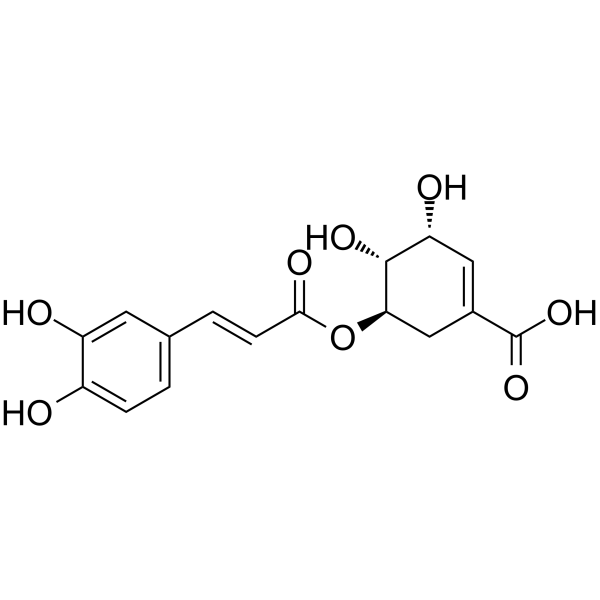
5-[(E)-Caffeoyl]shikimic acid is a carboxylic acid ester formed by the condensation of the carboxyl group of (E)-caffeic acid with the 5-hydroxyl group of shikimic acid. It is a plant metabolite. It is an α,β-unsaturated monocarboxylic acid, cyclohexene carboxylic acid, catechol, and carboxylic acid ester. Functionally, it is associated with shikimic acid and trans-caffeic acid. It is the conjugate acid of 5-[(E)-Caffeoyl]shikimic acid. 5-O-Caffeoylshikimic acid has been reported in Equisetum hyemale, Equisetum arvense, and other organisms with relevant data. See also: Stevia repens leaves (partial).
5-O-Caffeoylshikimic acid is a caffeoyl ester derivative of shikimic acid belonging to the class of natural polyphenolic compounds. It exhibits potent antioxidant and anti-inflammatory activities through downregulation of NF-κB. The compound also shows moderate MDR reversal activity and is being studied for its potential role in modulating NSCLC drug resistance. It has been recommended for further in vivo experiments in combination with anthracyclines in human MDR-cancer xenograft models. It is for research use only. |
| Molecular Formula |
C16H16O8
|
|---|---|
| Molecular Weight |
336.29
|
| Exact Mass |
336.085
|
| CAS # |
73263-62-4
|
| Related CAS # |
5-O-Caffeoylshikimic acid; 73263-62-4
|
| PubChem CID |
5281762
|
| Appearance |
Off-white to light yellow solid
|
| Melting Point |
300 °C
|
| Source |
Originated from plants: other families
Originated from microorganisms |
| LogP |
0.159
|
| Hydrogen Bond Donor Count |
5
|
| Hydrogen Bond Acceptor Count |
8
|
| Rotatable Bond Count |
5
|
| Heavy Atom Count |
24
|
| Complexity |
540
|
| Defined Atom Stereocenter Count |
3
|
| SMILES |
C1=CC(=C(C=C1/C=C/C(=O)O[C@@H]2CC(=C[C@H]([C@H]2O)O)C(=O)O)O)O
|
| InChi Key |
QMPHZIPNNJOWQI-GDDAOPKQSA-N
|
| InChi Code |
InChI=1S/C16H16O8/c17-10-3-1-8(5-11(10)18)2-4-14(20)24-13-7-9(16(22)23)6-12(19)15(13)21/h1-6,12-13,15,17-19,21H,7H2,(H,22,23)/b4-2+/t12-,13-,15-/m1/s1
|
| Chemical Name |
(3R,4R,5R)-5-[(E)-3-(3,4-dihydroxyphenyl)prop-2-enoyl]oxy-3,4-dihydroxycyclohexene-1-carboxylic acid
|
| Synonyms |
5-O-Caffeoylshikimic acid
|
| HS Tariff Code |
2934.99.9001
|
| Storage |
Powder -20°C 3 years 4°C 2 years In solvent -80°C 6 months -20°C 1 month Note: This product requires protection from light (avoid light exposure) during transportation and storage. |
| Shipping Condition |
Room temperature (This product is stable at ambient temperature for a few days during ordinary shipping and time spent in Customs)
|
| Solubility (In Vitro) |
DMSO: 100 mg/mL (297.36 mM)
|
|---|---|
| Solubility (In Vivo) |
Solubility in Formulation 1: ≥ 2.5 mg/mL (7.43 mM) (saturation unknown) in 10% DMSO + 40% PEG300 + 5% Tween80 + 45% Saline (add these co-solvents sequentially from left to right, and one by one), clear solution.
For example, if 1 mL of working solution is to be prepared, you can add 100 μL of 25.0 mg/mL clear DMSO stock solution to 400 μL PEG300 and mix evenly; then add 50 μL Tween-80 to the above solution and mix evenly; then add 450 μL normal saline to adjust the volume to 1 mL. Preparation of saline: Dissolve 0.9 g of sodium chloride in 100 mL ddH₂ O to obtain a clear solution. Solubility in Formulation 2: ≥ 2.5 mg/mL (7.43 mM) (saturation unknown) in 10% DMSO + 90% (20% SBE-β-CD in Saline) (add these co-solvents sequentially from left to right, and one by one), clear solution. For example, if 1 mL of working solution is to be prepared, you can add 100 μL of 25.0 mg/mL clear DMSO stock solution to 900 μL of 20% SBE-β-CD physiological saline solution and mix evenly. Preparation of 20% SBE-β-CD in Saline (4°C,1 week): Dissolve 2 g SBE-β-CD in 10 mL saline to obtain a clear solution. View More
Solubility in Formulation 3: ≥ 2.5 mg/mL (7.43 mM) (saturation unknown) in 10% DMSO + 90% Corn Oil (add these co-solvents sequentially from left to right, and one by one), clear solution. |
| Preparing Stock Solutions | 1 mg | 5 mg | 10 mg | |
| 1 mM | 2.9736 mL | 14.8681 mL | 29.7362 mL | |
| 5 mM | 0.5947 mL | 2.9736 mL | 5.9472 mL | |
| 10 mM | 0.2974 mL | 1.4868 mL | 2.9736 mL |
*Note: Please select an appropriate solvent for the preparation of stock solution based on your experiment needs. For most products, DMSO can be used for preparing stock solutions (e.g. 5 mM, 10 mM, or 20 mM concentration); some products with high aqueous solubility may be dissolved in water directly. Solubility information is available at the above Solubility Data section. Once the stock solution is prepared, aliquot it to routine usage volumes and store at -20°C or -80°C. Avoid repeated freeze and thaw cycles.
Calculation results
Working concentration: mg/mL;
Method for preparing DMSO stock solution: mg drug pre-dissolved in μL DMSO (stock solution concentration mg/mL). Please contact us first if the concentration exceeds the DMSO solubility of the batch of drug.
Method for preparing in vivo formulation::Take μL DMSO stock solution, next add μL PEG300, mix and clarify, next addμL Tween 80, mix and clarify, next add μL ddH2O,mix and clarify.
(1) Please be sure that the solution is clear before the addition of next solvent. Dissolution methods like vortex, ultrasound or warming and heat may be used to aid dissolving.
(2) Be sure to add the solvent(s) in order.
Products are for research use only; We do not sell to patients
Copyright 2020 InvivoChem LLC | All Rights Reserved


