
| Size | Price | |
|---|---|---|
| 10mg | ||
| 25mg | ||
| 50mg | ||
| Other Sizes |


Purity: =98.8%
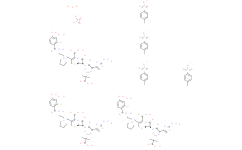
Cefiderocol sulfate tosylate (S-649266; GSK-2696266D; S-649266D; trade name Fetroja) is an injectable siderophore cephalosporin antibiotic that has a catechol moiety on the 3-position of the side chain and was under clinical trials by Shionogi. It exhibits potent in vitro activity against the non-fermenting Gram- bacteria such as Acinetobacter baumannii, Pseudomonas aeruginosa and Stenotrophomonas maltophilia. As of Nov 14, 2019, Cefiderocol sulfate tosylate has gained FDA approval to treat patients with complicated UTI-urinary tract infections who have no other options available. It is indicated for the treatment of multi-drug-resistant Gram- bacteria such as Pseudomonas aeruginosa.
| Targets |
β-lactam
|
|---|---|
| ln Vitro |
Cefiderocol sulfate tosylate (S-649266) is a new parenteral siderophore cephalosporin conjugated with a catechol moiety. It has a strong antibacterial activity against a variety of aerobic Gram-negative bacterial species, including nonfermenting bacteria like Pseudomonas aeruginosa and Acinetobacter baumannii and carbapenem-resistant strains of Enterobacteriaceae. Cefiderocol sulfate tosylate primarily binds to nonfermenting bacteria, such as GR20263, and PBP3 of the Enterobacteriaceae family. Cefiderocol sulfate tosylate MICs can rise 16-fold when the iron transporters PiuA in P. aeruginosa or CirA and Fiu in Escherichia coli are deficient, indicating that these iron transporters aid in Cefiderocol sulfate tosylate's penetration through the outer membrane.Cefiderocol sulfate tosylate activity is not significantly affected by the overproduction of the efflux pump MexA-MexB-OprM in P. aeruginosa or the deficiency of OmpK35/36 in Klebsiella pneumoniae[1].
|
| Cell Assay |
Except in situations where MICs under particular circumstances must be determined, iron-depleted cation-adjusted Mueller-Hinton broth (ID-CAMHB) is prepared for the purpose of determining the Cefiderocol sulfate tosylate MIC. Cefiderocol sulfate tosylate's quality control minimum inhibitory concentration (MIC) ranges for E. Coli ATCC 25922 and P. aeruginosa ATCC 27853 are 0.06 to 0.5 μg/mL. Brusecella agar supplemented with hemin, vitamin K1, and laked sheep blood is used for anaerobic bacteria[1].
|
| ADME/Pharmacokinetics |
Absorption, Distribution and Excretion
Following a single intravenous injection of 2 g cefdinir tosylate sulfate in healthy subjects, the peak plasma concentration (Cmax) was 89.7 mg/L, and the area under the curve (AUC) was 386 mgh/L. For patients with complicated urinary tract infections and a creatinine clearance of at least 60 mL/min, following intravenous injection of 2 g cefdinir tosylate sulfate every 8 hours, the AUC was 394.7 mgh/L, and the Cmax was 138 mg/L. However, this chronic dosing regimen resulted in an infusion rate three times the recommended rate. Cmax and AUC are known to increase proportionally with dose. 98.6% of cefdinir tosylate sulfate is excreted in the urine, of which 90.6% is excreted unchanged. The remaining 8% is excreted as metabolites. 2.8% is excreted in the feces. The metabolic rate of cefdinir tosylate sulfate is less than 10%. The mean volume of distribution of cefdinir tosylate sulfate is 18 liters. The mean clearance of cefdinir toluenesulfonate is 5.18 L/h. Metabolism/Metabolites Cefdinirir toluenesulfonate is metabolized to a small amount to its 7-isomer, cefdinirir toluenesulfonate catechol-3-methoxy and -4-methoxy, and pyrrolidinechlorobenzamide (PCBA). PCBA is further metabolized to sulfated, methylated, and glucuroninated metabolites. The enzymes involved in these reactions have not been identified, and cefdinir ... |
| Toxicity/Toxicokinetics |
Effects During Pregnancy and Lactation
◉ Overview of Use During Lactation While there is currently no information regarding the use of cefdinir tosylate during lactation, it is generally believed that cephalosporins do not have adverse effects on breastfed infants. There are reports that cephalosporins occasionally disrupt the infant's gut microbiota, leading to diarrhea or thrush, but these effects have not been fully assessed. Cefdinir tosylate can be used in breastfeeding women. ◉ Effects on Breastfed Infants No published information found as of the revision date. ◉ Effects on Lactation and Breast Milk No published information found as of the revision date. Protein Binding Cefdinir tosylate binds to 40-60% of plasma proteins, primarily albumin. |
| References | |
| Additional Infomation |
Cefdermal tosylate is a cephalosporin antibiotic with a mechanism of action similar to other β-lactam antibiotics. Unlike other drugs in its class, cefdermal tosylate is a siderophore, enabling it to actively transport into bacterial cells via iron channels. It provides an important supplemental option for antimicrobial therapy because in vitro studies have demonstrated its effectiveness against multidrug-resistant strains, including those producing extended-spectrum β-lactamases and carbapenemases. On November 14, 2019, the U.S. Food and Drug Administration (FDA) granted cefdermal tosylate "Qualified Infectious Disease Product" (QIDP) designation and priority review status. This drug is indicated for the treatment of complicated urinary tract infections in patients with limited or no other treatment options. A clinical trial involving 448 patients with complicated urinary tract infections confirmed this indication, showing that cefdinir tosylate achieved a symptom relief rate and bacterial clearance rate of 72.6% compared to the control drug imipenem/cilastatin, which had a relief rate and bacterial clearance rate of only 54.6%. One issue observed in the trial was a 0.3% higher all-cause mortality rate, the cause of which is not yet determined. Cefdinir tosylate is a cephalosporin antibiotic. See also: cefdinir tosylate, tosylate sulfate (active ingredient). Drug Indications Cefdinir tosylate is indicated for the treatment of complicated urinary tract infections with or without pyelonephritis. FDA Label Fetcroja is indicated for the treatment of aerobic Gram-negative bacterial infections in adults, particularly in cases where treatment options are limited (see Sections 4.2, 4.4, and 5.1). Official guidelines on the rational use of antimicrobial agents should be consulted.
Treatment of Aerobic Gram-Negative Bacterial Infections Mechanism of Action Cefdermal toluene sulfate binds to and inhibits the activity of penicillin-binding protein (PBP), preventing cell wall synthesis and ultimately leading to bacterial cell death. Like other β-lactam antibiotics, cefdermal toluene sulfate passively diffuses into bacterial cells via porins. Unlike other β-lactam antibiotics, cefdermal toluene sulfate contains a chlorocatechin group, enabling it to chelate iron. Once bound to ferric iron, cefdermal toluene sulfate can be actively transported into bacterial cells via iron channels on the outer membrane (such as those encoded by the cirA and fiu genes in E. coli or the PiuA gene in Pseudomonas aeruginosa). After entering the cell, cefdermal toluene sulfate binds to PBP3 with high affinity and inhibits its activity, thereby preventing the peptidoglycan layer from being connected via pentapeptide bridges. PBP1a, 1b, 2 and 4 can also be bound to and inhibited by cefdinir toluenesulfonate, but their inhibitory efficacy is lower than that of PBP3, so they are expected to contribute less to the antibacterial effect. |
| Molecular Formula |
C30H34CLN7O10S2
|
|---|---|
| Molecular Weight |
752.21
|
| Exact Mass |
751.149
|
| Elemental Analysis |
C, 47.90; H, 4.56; Cl, 4.71; N, 13.03; O, 21.27; S, 8.52
|
| CAS # |
2135543-94-9
|
| Related CAS # |
1883830-01-0 (ditosylate hydrate);2135543-94-9;2009350-94-9 (sulfate tosylate 3:1:4);2135543-94-9 (sulfate tosylate hydrate 3:1:4:1);
|
| PubChem CID |
77843966
|
| Appearance |
White to off-white solid powder
|
| LogP |
-1.02
|
| Hydrogen Bond Donor Count |
6
|
| Hydrogen Bond Acceptor Count |
15
|
| Rotatable Bond Count |
12
|
| Heavy Atom Count |
50
|
| Complexity |
1440
|
| Defined Atom Stereocenter Count |
2
|
| SMILES |
ClC1C(=C(C([H])=C([H])C=1C(N([H])C([H])([H])C([H])([H])[N+]1(C([H])([H])C2C([H])([H])S[C@]3([H])[C@@]([H])(C(N3C=2C(=O)[O-])=O)N([H])C(/C(/C2=C([H])SC(N([H])[H])=N2)=N\OC(C(=O)O[H])(C([H])([H])[H])C([H])([H])[H])=O)C([H])([H])C([H])([H])C([H])([H])C1([H])[H])=O)O[H])O[H]
|
| InChi Key |
DBPPRLRVDVJOCL-FQRUVTKNSA-N
|
| InChi Code |
InChI=1S/C30H34ClN7O10S2/c1-30(2,28(46)47)48-36-19(16-13-50-29(32)34-16)24(42)35-20-25(43)37-21(27(44)45)14(12-49-26(20)37)11-38(8-3-4-9-38)10-7-33-23(41)15-5-6-17(39)22(40)18(15)31/h5-6,13,20,26H,3-4,7-12H2,1-2H3,(H7-,32,33,34,35,36,39,40,41,42,44,45,46,47)/t20-,26-/m1/s1
|
| Chemical Name |
(6R,7R)-7-[(2Z)-2-(2-amino-1,3-thiazol-4-yl)-2-{[(2-carboxypropan-2-yl)oxy]imino}acetamido]-3-({1-[2-(2-chloro-3,4-dihydroxybenzamido)ethyl]pyrrolidin-1-ium-1-yl}methyl)-8-oxo-5-thia-1-azabicyclo[4.2.0]oct-2-ene-2-carboxylate
|
| Synonyms |
S-649266; S 649266; S649266; GSK2696266D; GSK-2696266D; GSK 2696266D; S-649266D; S 649266D; S649266D; Cefiderocol sulfate tosylate; Fetroja.
|
| HS Tariff Code |
2934.99.9001
|
| Storage |
Powder -20°C 3 years In solvent -80°C 3 months -20°C 1 week Note: Please store this product in a sealed and protected environment, avoid exposure to moisture. |
| Shipping Condition |
Dry ice required
|
| Solubility (In Vitro) |
DMSO : ≥ 125 mg/mL (~166.18 mM)
H2O : ~1.06 mg/mL (~1.41 mM) Ethanol : < 1 mg/mL |
|---|---|
| Solubility (In Vivo) |
Solubility in Formulation 1: ≥ 2.75 mg/mL (3.66 mM) (saturation unknown) in 10% DMSO + 40% PEG300 + 5% Tween80 + 45% Saline (add these co-solvents sequentially from left to right, and one by one), clear solution.
For example, if 1 mL of working solution is to be prepared, you can add 100 μL of 27.5 mg/mL clear DMSO stock solution to 400 μL PEG300 and mix evenly; then add 50 μL Tween-80 to the above solution and mix evenly; then add 450 μL normal saline to adjust the volume to 1 mL. Preparation of saline: Dissolve 0.9 g of sodium chloride in 100 mL ddH₂ O to obtain a clear solution. Solubility in Formulation 2: ≥ 2.75 mg/mL (3.66 mM) (saturation unknown) in 10% DMSO + 90% (20% SBE-β-CD in Saline) (add these co-solvents sequentially from left to right, and one by one), clear solution. For example, if 1 mL of working solution is to be prepared, you can add 100 μL of 27.5 mg/mL clear DMSO stock solution to 900 μL of 20% SBE-β-CD physiological saline solution and mix evenly. Preparation of 20% SBE-β-CD in Saline (4°C,1 week): Dissolve 2 g SBE-β-CD in 10 mL saline to obtain a clear solution. View More
Solubility in Formulation 3: ≥ 2.75 mg/mL (3.66 mM) (saturation unknown) in 10% DMSO + 90% Corn Oil (add these co-solvents sequentially from left to right, and one by one), clear solution. Solubility in Formulation 4: 10% DMSO+40% PEG300+5% Tween-80+45% Saline: ≥ 2.75 mg/mL (3.66 mM) |
| Preparing Stock Solutions | 1 mg | 5 mg | 10 mg | |
| 1 mM | 1.3294 mL | 6.6471 mL | 13.2942 mL | |
| 5 mM | 0.2659 mL | 1.3294 mL | 2.6588 mL | |
| 10 mM | 0.1329 mL | 0.6647 mL | 1.3294 mL |
*Note: Please select an appropriate solvent for the preparation of stock solution based on your experiment needs. For most products, DMSO can be used for preparing stock solutions (e.g. 5 mM, 10 mM, or 20 mM concentration); some products with high aqueous solubility may be dissolved in water directly. Solubility information is available at the above Solubility Data section. Once the stock solution is prepared, aliquot it to routine usage volumes and store at -20°C or -80°C. Avoid repeated freeze and thaw cycles.
Calculation results
Working concentration: mg/mL;
Method for preparing DMSO stock solution: mg drug pre-dissolved in μL DMSO (stock solution concentration mg/mL). Please contact us first if the concentration exceeds the DMSO solubility of the batch of drug.
Method for preparing in vivo formulation::Take μL DMSO stock solution, next add μL PEG300, mix and clarify, next addμL Tween 80, mix and clarify, next add μL ddH2O,mix and clarify.
(1) Please be sure that the solution is clear before the addition of next solvent. Dissolution methods like vortex, ultrasound or warming and heat may be used to aid dissolving.
(2) Be sure to add the solvent(s) in order.
|
|
Products are for research use only; We do not sell to patients
Copyright 2020 InvivoChem LLC | All Rights Reserved


 COA
COA

