| Size | Price | Stock | Qty |
|---|---|---|---|
| 1mg |
|
||
| 5mg | |||
| Other Sizes |


| Targets |
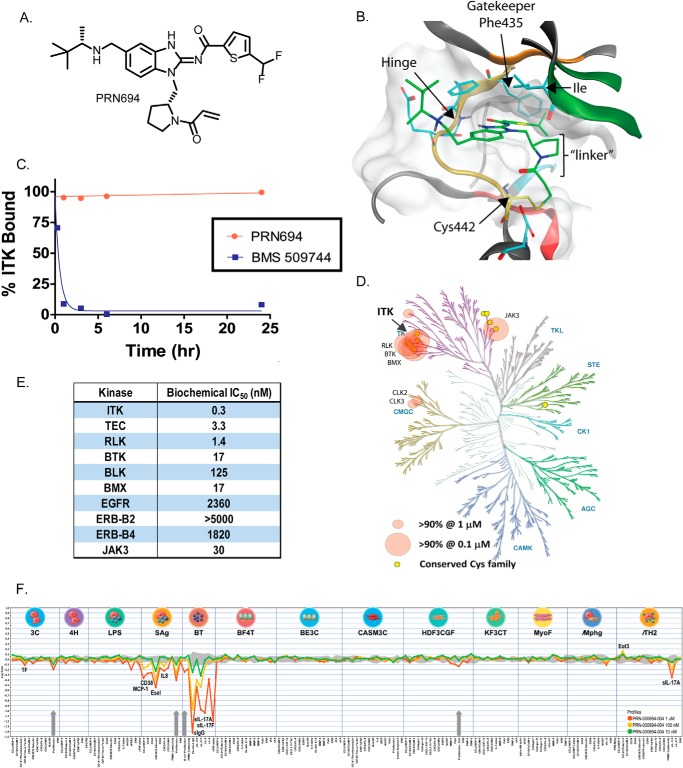
PRN694 specifically targets the Tec kinases ITK and resting lymphocyte kinase (RLK, also known as TXK). It acts as an irreversible, highly selective, and potent covalent dual inhibitor. The IC50 values for ITK and RLK are 0.3 nM and 1.4 nM, respectively. It also inhibits BTK.
|
|---|---|
| ln Vitro |
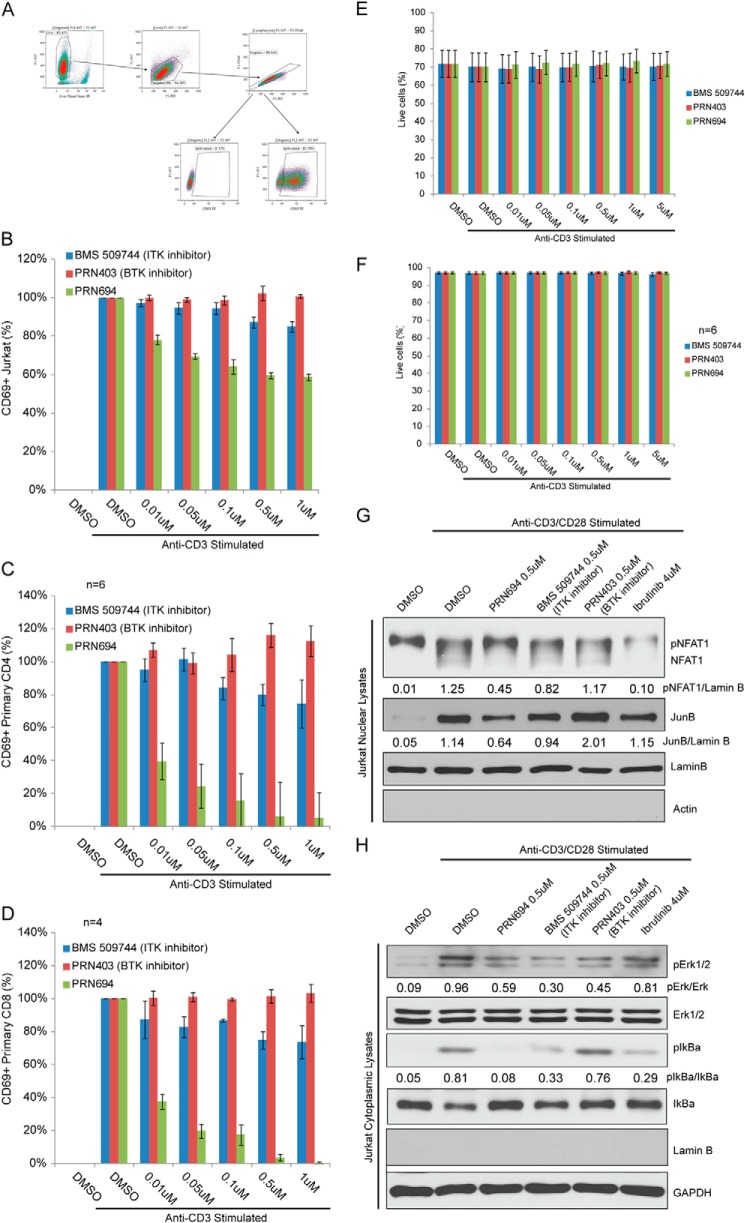
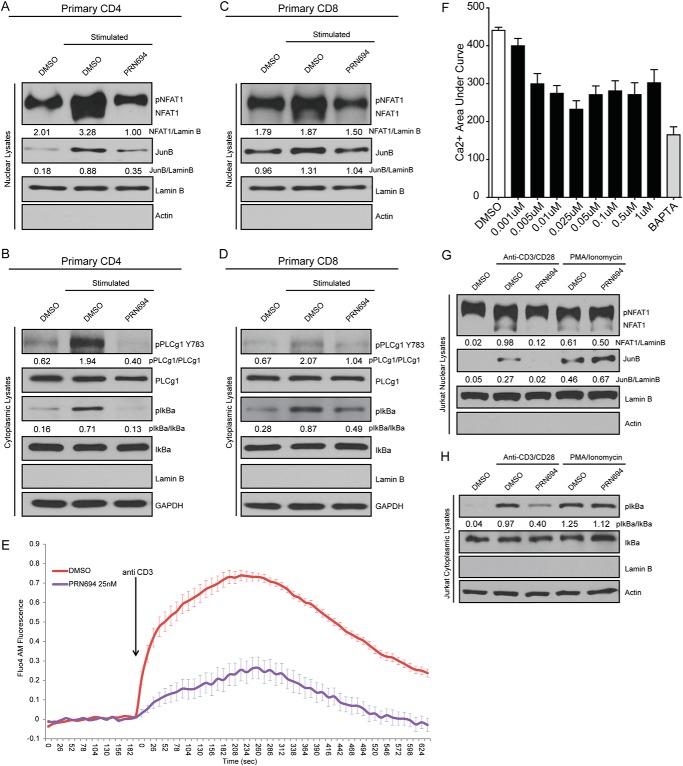
PRN694 has IC50 values of 3.3, 17, 17, 125, and 30 nM, respectively, for TEC, BTK, BMX, BLK, and JAK3 inhibition[1]. According to an immunoblot investigation of TCR activation pathways, PRN694 prevents NFAT1, JunB, pIκBα, and pERK from activating or moving to the nucleus. The findings show that PRN694 inhibits Ca2+ signaling at all doses higher than 1 nM. When PRN694 is added in quantities higher than 0.37 μM, it considerably reduces the death of NK cells caused by FcR[1]. Day 6 flow cytometry analysis shows that PRN694 significantly (p<0.01) suppresses the proliferation of both CD4 and CD8 T-cells produced by anti-CD3/CD28[1].
In vitro, PRN694 demonstrates potent inhibition of ITK and RLK with IC50 values of 0.3 nM and 1.4 nM, respectively. It is a covalent inhibitor, meaning it forms an irreversible bond with its targets, leading to sustained pharmacodynamic effects even after plasma clearance. |
| ln Vivo |
At 1, 6, and 14 hours, the PRN694 occupancy of ITK is 98, 95, and 54%, respectively. The plasma level of PRN694 at 14 hours is more than ten times lower than the whole blood IC50. Additionally, weights treated with RN694 are considerably lower than vehicle weights (p<0.05)[1]. ?Studies on colitis reveal that the colonic epithelium of mice treated with PRN694 has less CD4+ T cells than that of control mice[2].
In vivo, PRN694's covalent inhibition offers sustained pharmacodynamic effects even after plasma clearance. By targeting ITK and BTK in T and B lymphocytes, it modulates immune cell activation and cytokine production. This mechanism makes it a promising candidate for treating autoimmune and inflammatory diseases. |
| Enzyme Assay |
Recombinant ITK at a final concentration of 0.5 μM in 50 mM Hepes, pH 7.5, 10 mM MgCl2, 0.01% Triton X-100, and 1 mM EGTA are combined with 1.5 μM PRN694 for 90 min to facilitate binding. The mixture is then diluted 50 fold to initiate dissociating of the ligand from the enzyme, and 10 μL is transferred to a Greiner 384-well black plate. Europium-coupled anti-His6 antibody is added to each well and incubated for 5 min, followed by the addition of an ITK binding fluorescent tracer. The tracer binds to ITK as a function of ligand dissociation, and binding is detected by time-resolved FRET between the europium-coupled antibody and the tracer on a plate reader. Time points acquired are 0.25, 1, 3, 6, and 24 h[1].
Cell-free assays for PRN694 are performed to measure its inhibition of kinase activity. In these assays, the recombinant kinase (ITK or BTK) is incubated with a substrate peptide and ATP in the presence of varying concentrations of the compound. The amount of phosphorylated substrate is measured to calculate the IC50. |
| Cell Assay |
Cells are cultured in vitro at 37°C and 5% CO2 using RPMI 1640 with 10% fetal calf serum. Cells are pretreated for 30 min with PRN694 or other inhibitors and then washed two times. T-cells are then stimulated for 6 h with 1 μg/mL soluble anti-CD3 for CD69 activation, which is detected by flow cytometry, or 45 min with plate-bound anti-CD3 (10 μg/mL plating concentration) and soluble anti-CD28 (1 μg/mL) for downstream signal analysis by immunoblotting. NK cells are stimulated for 6 h with plate-bound anti-CD52 for CD107a/b activation, detected by flow cytometry, or for 45 min for downstream signal analysis by immunoblotting[1].
In vitro cell-based assays for PRN694 are performed to evaluate its effects on immune cells. T and B lymphocytes are treated with the compound, and the inhibition of downstream signaling pathways is assessed. The compound's effect on cytokine production can also be measured using ELISA. |
| Animal Protocol |
In vivo animal experiments for PRN694 would involve models of autoimmune and inflammatory diseases, such as rheumatoid arthritis, lupus, or psoriasis. The compound would be administered, and its effect on disease progression and immune cell activation would be assessed.
|
| ADME/Pharmacokinetics |
Pharmacokinetic (PK) data for PRN694 is not detailed in the available literature. As a covalent inhibitor, it provides sustained pharmacodynamic effects even after plasma clearance. The compound is typically stored as a powder.
|
| Toxicity/Toxicokinetics |
Toxicological data for PRN694 is not available in the public literature. As a research compound, its safety profile has not been extensively characterized. Its use is strictly for research purposes.
|
| References |
|
| Additional Infomation |
PRN694 is a research-grade compound and a potent, selective, irreversible dual inhibitor of ITK and BTK. It is used to study targeted immunomodulatory therapies for autoimmune diseases. It has not been approved for clinical use. All information is for research reference only.
|
| Molecular Formula |
C28H35F2N5O2S
|
|---|---|
| Molecular Weight |
543.67
|
| Exact Mass |
543.247
|
| CAS # |
1575818-46-0
|
| PubChem CID |
90044055
|
| Appearance |
Off-white to light brown solid powder
|
| Density |
1.3±0.1 g/cm3
|
| Boiling Point |
679.8±65.0 °C at 760 mmHg
|
| Flash Point |
364.9±34.3 °C
|
| Vapour Pressure |
0.0±2.1 mmHg at 25°C
|
| Index of Refraction |
1.619
|
| LogP |
3.92
|
| Hydrogen Bond Donor Count |
2
|
| Hydrogen Bond Acceptor Count |
7
|
| Rotatable Bond Count |
10
|
| Heavy Atom Count |
38
|
| Complexity |
856
|
| Defined Atom Stereocenter Count |
2
|
| SMILES |
C[C@@H](C(C)(C)C)NCC1=CC2=C(C=C1)N(C(=N2)NC(=O)C3=CC=C(S3)C(F)F)C[C@H]4CCCN4C(=O)C=C
|
| InChi Key |
NXTKFBGDLDPFLB-PKOBYXMFSA-N
|
| InChi Code |
InChI=1S/C28H35F2N5O2S/c1-6-24(36)34-13-7-8-19(34)16-35-21-10-9-18(15-31-17(2)28(3,4)5)14-20(21)32-27(35)33-26(37)23-12-11-22(38-23)25(29)30/h6,9-12,14,17,19,25,31H,1,7-8,13,15-16H2,2-5H3,(H,32,33,37)/t17-,19+/m0/s1
|
| Chemical Name |
5-(difluoromethyl)-N-[5-[[[(2S)-3,3-dimethylbutan-2-yl]amino]methyl]-1-[[(2R)-1-prop-2-enoylpyrrolidin-2-yl]methyl]benzimidazol-2-yl]thiophene-2-carboxamide
|
| Synonyms |
PRN 694 PRN-694 PRN694
|
| HS Tariff Code |
2934.99.9001
|
| Storage |
Powder -20°C 3 years 4°C 2 years In solvent -80°C 6 months -20°C 1 month |
| Shipping Condition |
Room temperature (This product is stable at ambient temperature for a few days during ordinary shipping and time spent in Customs)
|
| Solubility (In Vitro) |
DMSO : ~125 mg/mL (~229.92 mM)
|
|---|---|
| Solubility (In Vivo) |
Solubility in Formulation 1: ≥ 2.08 mg/mL (3.83 mM) (saturation unknown) in 10% DMSO + 40% PEG300 + 5% Tween80 + 45% Saline (add these co-solvents sequentially from left to right, and one by one), clear solution.
For example, if 1 mL of working solution is to be prepared, you can add 100 μL of 20.8 mg/mL clear DMSO stock solution to 400 μL PEG300 and mix evenly; then add 50 μL Tween-80 to the above solution and mix evenly; then add 450 μL normal saline to adjust the volume to 1 mL. Preparation of saline: Dissolve 0.9 g of sodium chloride in 100 mL ddH₂ O to obtain a clear solution. Solubility in Formulation 2: ≥ 2.08 mg/mL (3.83 mM) (saturation unknown) in 10% DMSO + 90% (20% SBE-β-CD in Saline) (add these co-solvents sequentially from left to right, and one by one), clear solution. For example, if 1 mL of working solution is to be prepared, you can add 100 μL of 20.8 mg/mL clear DMSO stock solution to 900 μL of 20% SBE-β-CD physiological saline solution and mix evenly. Preparation of 20% SBE-β-CD in Saline (4°C,1 week): Dissolve 2 g SBE-β-CD in 10 mL saline to obtain a clear solution. View More
Solubility in Formulation 3: ≥ 2.08 mg/mL (3.83 mM) (saturation unknown) in 10% DMSO + 90% Corn Oil (add these co-solvents sequentially from left to right, and one by one), clear solution. |
| Preparing Stock Solutions | 1 mg | 5 mg | 10 mg | |
| 1 mM | 1.8394 mL | 9.1968 mL | 18.3935 mL | |
| 5 mM | 0.3679 mL | 1.8394 mL | 3.6787 mL | |
| 10 mM | 0.1839 mL | 0.9197 mL | 1.8394 mL |
*Note: Please select an appropriate solvent for the preparation of stock solution based on your experiment needs. For most products, DMSO can be used for preparing stock solutions (e.g. 5 mM, 10 mM, or 20 mM concentration); some products with high aqueous solubility may be dissolved in water directly. Solubility information is available at the above Solubility Data section. Once the stock solution is prepared, aliquot it to routine usage volumes and store at -20°C or -80°C. Avoid repeated freeze and thaw cycles.
Calculation results
Working concentration: mg/mL;
Method for preparing DMSO stock solution: mg drug pre-dissolved in μL DMSO (stock solution concentration mg/mL). Please contact us first if the concentration exceeds the DMSO solubility of the batch of drug.
Method for preparing in vivo formulation::Take μL DMSO stock solution, next add μL PEG300, mix and clarify, next addμL Tween 80, mix and clarify, next add μL ddH2O,mix and clarify.
(1) Please be sure that the solution is clear before the addition of next solvent. Dissolution methods like vortex, ultrasound or warming and heat may be used to aid dissolving.
(2) Be sure to add the solvent(s) in order.
|
|
|
Products are for research use only; We do not sell to patients
Copyright 2020 InvivoChem LLC | All Rights Reserved