| Size | Price | Stock | Qty |
|---|---|---|---|
| 10mg |
|
||
| 25mg |
|
||
| 50mg |
|
||
| 100mg |
|
||
| 250mg |
|
||
| 500mg |
|
||
| Other Sizes |


Purity: ≥98%
| Targets |
p53
PK11000 (0-120 μM, 24 h) only slightly inhibits cancer cells with mutant p53[1]. PK11000 (0-50 μM, 5 d) shows anti-proliferation effects of breast cell lines[2]. |
|---|---|
| ln Vitro |
PK11000 (0-120 μM, 24 h) only slightly inhibits cancer cells with mutant p53[1].
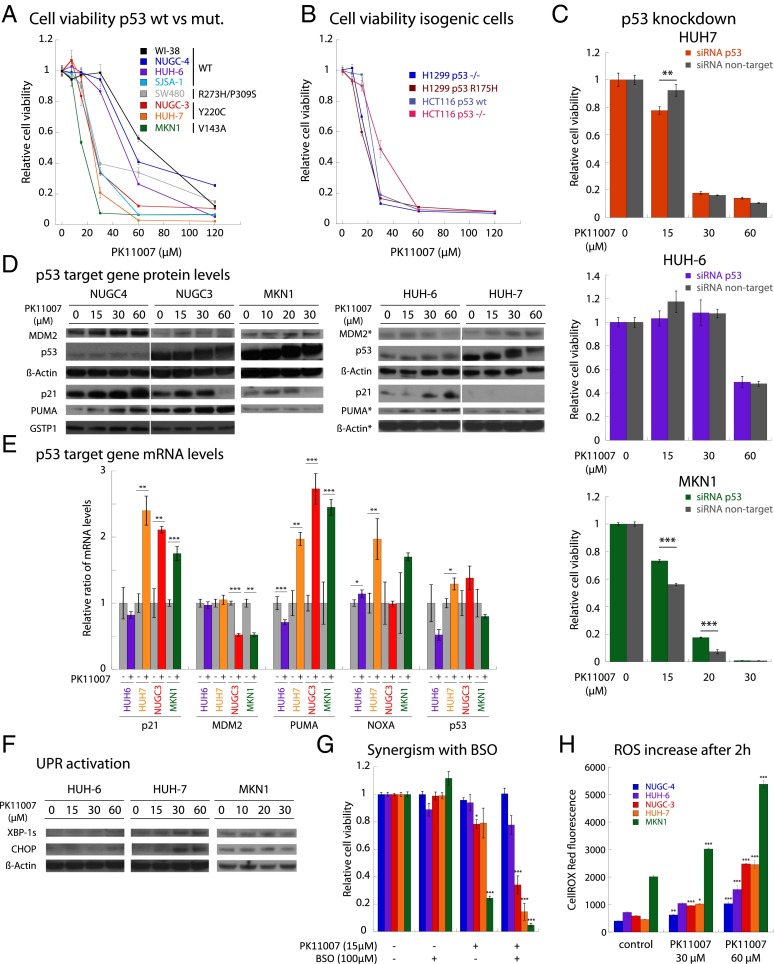
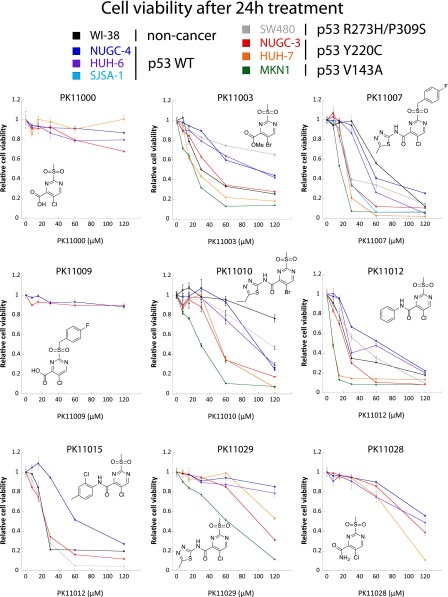
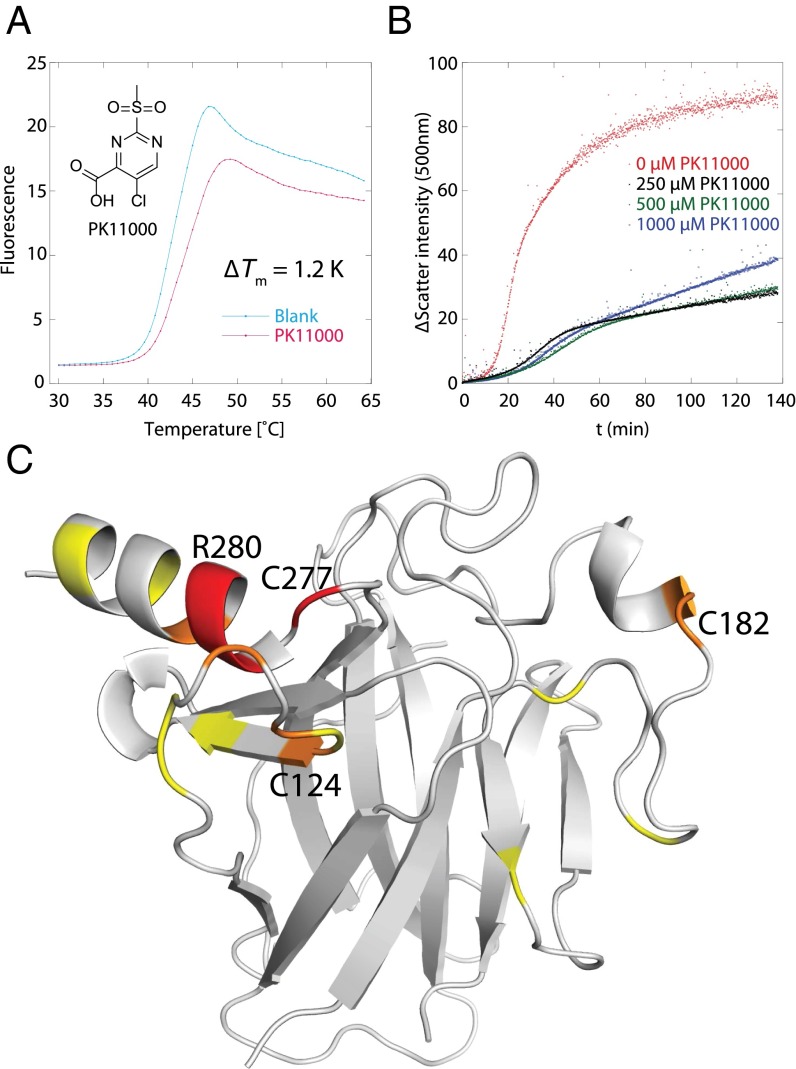
PK11000 (0-50 μM, 5 d) shows anti-proliferation effects of breast cell lines[2]. PK11000 increased the melting temperature (Tm) of the stabilized p53-Y220C DBD (T-p53C-Y220C) by ΔTm > 1.2 K at 1 mM, as measured by differential scanning fluorimetry (DSF). Incubation of T-p53C-Y220C with PK11000 led to specific mass increases of 157 Da or 314 Da, corresponding to mono- and di-alkylation of cysteines, as confirmed by ESI mass spectrometry. A maximum of two cysteines (Cys182 and Cys277) were alkylated even at 5 mM compound concentration. PK11000 inhibited aggregation of T-p53C-Y220C, as monitored by light scattering at 500 nm, with decreased scattering amplitude suggesting covalent adduct formation. HSQC NMR spectra showed PK11000 induced peak shifts near Cys124, Cys182, and Cys277, indicating binding/modification in those regions. PK11000 did not alkylate bacterial N-acetylneuraminate lyase, demonstrating low general thiol reactivity and selectivity for highly nucleophilic, solvent-accessible cysteines. The second-order rate constant for the reaction of PK11000 with glutathione was determined to be 1.37 L·mol⁻¹·s⁻¹ by ¹H-NMR kinetics, which is lower than many Michael acceptors but within the range of therapeutically applied thiol-reactive agents. Structural analogs like PK11007 and PK11010 showed faster kinetics and greater p53 stabilization (ΔTm > 3 K), while other substitutions could reduce or abolish activity. PK11007 (a derivative) reduced cell viability more effectively in p53-mutant cell lines (e.g., HUH-7, NUGC-3, MKN1) compared to p53 wild-type lines, with effects observed at concentrations ranging from 15 to 30 μM after 24 h. PK11007 upregulated protein and mRNA levels of p53 target genes (p21, PUMA, MDM2) in mutant p53 cell lines, suggesting partial reactivation of transcriptional activity. PK11007 induced a strong increase in intracellular ROS levels, especially in mutant p53 cells, and activated the unfolded protein response (UPR), as indicated by increased levels of spliced XBP-1 and CHOP. PK11007-mediated cell death was largely caspase-independent and associated with loss of membrane integrity in some cell lines (e.g., HUH-7). Co-treatment with buthionine sulfoximine (BSO), a glutathione synthesis inhibitor, synergistically enhanced PK11007-induced cell death in mutant p53 cells. N-acetylcysteine (NAC) pretreatment prevented PK11007-mediated ROS increase, likely due to both antioxidant effects and direct adduct formation with the compound. [1] |
| Enzyme Assay |
Differential scanning fluorimetry (DSF) was used to determine the melting temperature (Tm) of p53 protein variants. Protein (8 μM) in phosphate buffer (25 mM potassium phosphate pH 7.2, 150 mM NaCl, 1 mM TCEP, 5% DMSO) was mixed with SYPRO Orange dye. Melting curves were recorded, and ΔTm values were calculated by comparing the Tm of compound-treated samples to DMSO controls. Measurements were performed in triplicate.
¹H-¹⁵N HSQC NMR spectroscopy was performed on uniformly ¹⁵N-labeled T-p53C-Y220C (75 μM) with compound added immediately before measurement. Spectra were acquired at 293 K, and peak shifts were analyzed to map compound binding/modification sites on the protein. Protein aggregation kinetics were monitored by light scattering at 500 nm with 3 μM protein at 37°C in phosphate buffer. The decrease in scattering amplitude upon compound addition indicated inhibition of aggregation, consistent with covalent modification. X-ray crystallography was used to determine the structure of the p53 Y220C DBD in complex with PK11000. Crystals were soaked with 30 mM compound for 4 hours, flash-frozen, and data were collected at 100 K. The structure was solved by molecular replacement and refined, revealing electron density consistent with covalent modification of Cys182. Electrospray ionization mass spectrometry (ESI-MS) was used to detect covalent modification. Protein (50 μM) was incubated with compound for 4 hours at 20°C, desalted, and analyzed in ESI positive mode to measure mass shifts corresponding to alkylation. ¹H-NMR kinetics were used to measure the reaction rate between PK11000 and glutathione. A sample containing 1 mM each of compound and GSH in phosphate buffer with DMSO-d6 was monitored over time. Integration of aromatic proton peaks allowed calculation of adduct formation, and data were fitted to a second-order kinetics equation. [1] |
| Cell Assay |
Cell viability was assessed using a fluorometric cell viability assay. Cells (7,500–15,000 per well) were seeded in 96-well plates, incubated overnight, and treated with PK11007 or DMSO for 23-24 hours. Viability reagent was added, incubated for 45 minutes, and fluorescence was measured. For some experiments, a luminescent viability assay was used instead. Experiments were performed in quadruplicate.
For p53 knockdown, cells were transfected with human-specific p53 siRNA using a transfection reagent. Control cells received non-targeting siRNA. Knockdown efficiency was confirmed by Western blot. Western blot analysis was performed to assess protein levels. Cells were treated with PK11007 for 3-6 hours, lysed, and protein concentrations were determined. Samples (20 μg per lane) were separated by SDS-PAGE, transferred to PVDF membranes, blocked, and probed with primary antibodies (e.g., against p53, p21, PUMA, MDM2, GSTP1, CHOP, XBP-1, β-actin) followed by HRP-conjugated secondary antibodies. Detection was performed using chemiluminescent substrate and X-ray film. Real-time PCR was used to quantify mRNA levels. Cells were treated with PK11007 or DMSO for 4.5-6 hours. Total RNA was extracted, reverse transcribed to cDNA, and quantified by real-time PCR using SYBR Green. Relative mRNA levels were determined using the standard curve method, with samples measured in triplicate. Caspase-3/7 activity and cytotoxicity were measured using a multiplex assay. Cells were treated with compound for 6 hours, followed by addition of Caspase-Glo 3/7 reagent. Luminescence (caspase activity) and fluorescence (cytotoxicity) were recorded. Intracellular reactive oxygen species (ROS) levels were detected using a cell-permeable fluorogenic probe. Cells were treated with PK11007 for 1.5 hours, stained with the probe for 30 minutes, and median fluorescence of live cells was measured by flow cytometry in triplicate. [1] |
| References |
|
| Additional Infomation |
PK11000 and its analogues belong to a new class of thiol-reactive anticancer agents—2-sulfonylpyrimidine compounds. As mild electrophiles, they selectively alkylate highly nucleophilic cysteine residues exposed to solvents under physiological conditions. Their main anticancer mechanisms involve two potential pathways: 1) a p53-dependent pathway, which upregulates pro-apoptotic target genes by stabilizing and partially reactivating mutant p53; and 2) a p53-independent pathway, involving intracellular glutathione depletion, increased reactive oxygen species (ROS) levels, and endoplasmic reticulum (ER) stress induction, ultimately leading to cell death. These compounds exhibit preferential cytotoxicity against cancer cells with p53 mutations or loss of function, as well as cancer cells with impaired ROS detoxification pathways, while exhibiting relatively low cytotoxicity against normal cells. By introducing different substituents, the reactivity and bioactivity of the 2-sulfonylpyrimidine core can be modulated, thereby achieving fine-tuning of selectivity and potency. [1]
|
| Molecular Formula |
C6H5CLN2O4S
|
|
|---|---|---|
| Molecular Weight |
236.63
|
|
| Exact Mass |
235.966
|
|
| Elemental Analysis |
C, 30.46; H, 2.13; Cl, 14.98; N, 11.84; O, 27.05; S, 13.55
|
|
| CAS # |
38275-34-2
|
|
| Related CAS # |
|
|
| PubChem CID |
1241459
|
|
| Appearance |
White to off-white solid powder
|
|
| LogP |
1.312
|
|
| Hydrogen Bond Donor Count |
1
|
|
| Hydrogen Bond Acceptor Count |
6
|
|
| Rotatable Bond Count |
2
|
|
| Heavy Atom Count |
14
|
|
| Complexity |
325
|
|
| Defined Atom Stereocenter Count |
0
|
|
| SMILES |
ClC1=C([H])N=C(N=C1C(=O)O[H])S(C([H])([H])[H])(=O)=O
|
|
| InChi Key |
WZUPWJVRWIVWEF-UHFFFAOYSA-N
|
|
| InChi Code |
InChI=1S/C6H5ClN2O4S/c1-14(12,13)6-8-2-3(7)4(9-6)5(10)11/h2H,1H3,(H,10,11)
|
|
| Chemical Name |
5-chloro-2-methylsulfonylpyrimidine-4-carboxylic acid
|
|
| Synonyms |
PK 11007-analog; PK-11007-analog; PK11007-analog; PK11000; PK-11000; PK 11000
|
|
| HS Tariff Code |
2934.99.9001
|
|
| Storage |
Powder -20°C 3 years 4°C 2 years In solvent -80°C 6 months -20°C 1 month |
|
| Shipping Condition |
Room temperature (This product is stable at ambient temperature for a few days during ordinary shipping and time spent in Customs)
|
| Solubility (In Vitro) |
|
|||
|---|---|---|---|---|
| Solubility (In Vivo) |
Solubility in Formulation 1: ≥ 2.5 mg/mL (10.57 mM) (saturation unknown) in 10% DMSO + 40% PEG300 + 5% Tween80 + 45% Saline (add these co-solvents sequentially from left to right, and one by one), clear solution.
For example, if 1 mL of working solution is to be prepared, you can add 100 μL of 25.0 mg/mL clear DMSO stock solution to 400 μL PEG300 and mix evenly; then add 50 μL Tween-80 to the above solution and mix evenly; then add 450 μL normal saline to adjust the volume to 1 mL. Preparation of saline: Dissolve 0.9 g of sodium chloride in 100 mL ddH₂ O to obtain a clear solution. Solubility in Formulation 2: ≥ 2.5 mg/mL (10.57 mM) (saturation unknown) in 10% DMSO + 90% (20% SBE-β-CD in Saline) (add these co-solvents sequentially from left to right, and one by one), clear solution. For example, if 1 mL of working solution is to be prepared, you can add 100 μL of 25.0 mg/mL clear DMSO stock solution to 900 μL of 20% SBE-β-CD physiological saline solution and mix evenly. Preparation of 20% SBE-β-CD in Saline (4°C,1 week): Dissolve 2 g SBE-β-CD in 10 mL saline to obtain a clear solution. View More
Solubility in Formulation 3: ≥ 2.5 mg/mL (10.57 mM) (saturation unknown) in 10% DMSO + 90% Corn Oil (add these co-solvents sequentially from left to right, and one by one), clear solution. Solubility in Formulation 4: 20 mg/mL (84.52 mM) in PBS (add these co-solvents sequentially from left to right, and one by one), clear solution; with ultrasonication. |
| Preparing Stock Solutions | 1 mg | 5 mg | 10 mg | |
| 1 mM | 4.2260 mL | 21.1300 mL | 42.2601 mL | |
| 5 mM | 0.8452 mL | 4.2260 mL | 8.4520 mL | |
| 10 mM | 0.4226 mL | 2.1130 mL | 4.2260 mL |
*Note: Please select an appropriate solvent for the preparation of stock solution based on your experiment needs. For most products, DMSO can be used for preparing stock solutions (e.g. 5 mM, 10 mM, or 20 mM concentration); some products with high aqueous solubility may be dissolved in water directly. Solubility information is available at the above Solubility Data section. Once the stock solution is prepared, aliquot it to routine usage volumes and store at -20°C or -80°C. Avoid repeated freeze and thaw cycles.
Calculation results
Working concentration: mg/mL;
Method for preparing DMSO stock solution: mg drug pre-dissolved in μL DMSO (stock solution concentration mg/mL). Please contact us first if the concentration exceeds the DMSO solubility of the batch of drug.
Method for preparing in vivo formulation::Take μL DMSO stock solution, next add μL PEG300, mix and clarify, next addμL Tween 80, mix and clarify, next add μL ddH2O,mix and clarify.
(1) Please be sure that the solution is clear before the addition of next solvent. Dissolution methods like vortex, ultrasound or warming and heat may be used to aid dissolving.
(2) Be sure to add the solvent(s) in order.
Biological effects of PK11007 on diverse cancer cell lines and one human fibroblast cell line.Proc Natl Acad Sci U S A.2016 Sep 6;113(36):E5271-80. |
Biological effects of 2-sulfonylpyrimidines on diverse cell lines.Proc Natl Acad Sci U S A.2016 Sep 6;113(36):E5271-80. |
PK11000 bound to and stabilized p53 DBD.Proc Natl Acad Sci U S A.2016 Sep 6;113(36):E5271-80. |
Products are for research use only; We do not sell to patients
Copyright 2020 InvivoChem LLC | All Rights Reserved


 COA
COA