| Size | Price | Stock | Qty |
|---|---|---|---|
| 5mg |
|
||
| 10mg |
|
||
| 25mg |
|
||
| 50mg |
|
||
| 100mg |
|
||
| 500mg | |||
| Other Sizes |
Purity: ≥98%
| Targets |
PF-3758309 targets p21-activated kinases (PAK) family, with IC50 values of 1.9 nM (PAK4), 6.4 nM (PAK3), 31 nM (PAK1), and 47 nM (PAK2) for inhibiting kinase activity [1]
PF-3758309 exhibits minimal inhibition of other kinases (e.g., ERK2, AKT, CDK2) with IC50 values > 1 μM [1] |
|---|---|
| ln Vitro |
In comparison to the kinase domains of the other group B PAKs (PAK5, Ki=18.1 nM; PAK6, Ki=17.1 nM) and group A PAK1 (Ki=13.7 nM), PF-3758309 exhibits comparable enzymatic potency. However, it exhibits lower activity against the two other group A PAKs (PAK2, IC50=190 nM; PAK3, IC50=99 nM)[1]. PF-3758309 inhibits the growth of a panel of tumor cell lines that are anchorage-independent (IC50=4.7 nM) as well as the phosphorylation of the PAK4 substrate GEF-H1 (IC50=1.3 nM) in cells[1]. Moreover, PF-3758309 prevents HCT116 cells from accumulating endogenous pGEF-H1. PF-3758309 significantly suppresses A549 cell growth that is anchorage-independent (IC50=27 nM) and proliferation (IC50=20 nM)[1].
In human colon cancer cell lines (HCT116, SW480, HT29), PF-3758309 inhibited proliferation with IC50 values ranging from 0.8 μM to 3.2 μM [1][4] - In human lung cancer A549 cells, PF-3758309 suppressed cell migration by 78% and invasion by 82% at 2 μM, via downregulating CREB, NF-κB, and β-catenin signaling [3] - PF-3758309 (2 μM) induced apoptosis in HCT116 cells, increasing annexin V-positive cells from 4% to 42% after 72 hours, with activation of caspase-3 and PARP cleavage [1] - In colon cancer cells with epithelial-to-mesenchymal transition (EMT) phenotype (SW620, LoVo), PF-3758309 showed enhanced antiproliferative activity (IC50 = 0.5 μM to 1.1 μM) compared to non-EMT cells [4] - PF-3758309 (1 μM) reduced PAK4 autophosphorylation (Ser474) by 85% in A549 cells and inhibited downstream p-AKT (Ser473) expression by 60% [3] - PF-3758309 (1.5 μM) blocked clonogenic growth of HCT116 and A549 cells, reducing colony formation efficiency by 75% and 70%, respectively [1][3] - PF-3758309 (2 μM) downregulated EMT markers (vimentin, N-cadherin) by 55-65% and upregulated E-cadherin by 2.3-fold in SW620 cells [4] |
| ln Vivo |
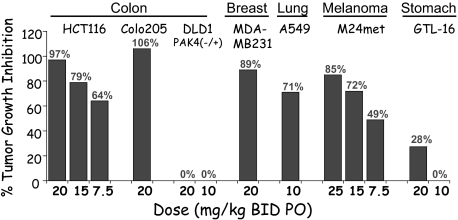
In HCT116 and A549 models, PF-3758309 (7.5-30 mg/kg; po; twice daily for 9–18 days) causes a statistically significant tumor growth inhibition (TGI)[1].
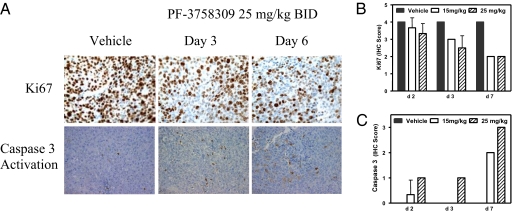
In HCT116 human colon cancer xenograft models (nu/nu mice), oral administration of PF-3758309 (30 mg/kg, b.i.d. for 21 days) resulted in 85% tumor growth inhibition (TGI) and prolonged median survival by 65% vs vehicle [1] - In SW620 colon cancer xenograft models (nu/nu mice, EMT phenotype), PF-3758309 (25 mg/kg, oral, b.i.d. for 21 days) induced 90% TGI, superior to non-EMT xenografts (81% TGI) [4] - Tumor tissues from PF-3758309-treated mice showed reduced p-PAK4 (78% reduction vs vehicle), decreased Ki-67 proliferation index (20% vs 65% in vehicle), and increased TUNEL-positive cells (38% vs 6%) [1][4] |
| Enzyme Assay |
Recombinant PAK kinase activity assay: Recombinant PAK1/3/4 were incubated with ATP (10 μM) and a fluorescently labeled peptide substrate. Serial concentrations of PF-3758309 (0.1 nM to 100 nM) were added, and the mixture was incubated at 37°C for 60 minutes. Phosphorylated substrate was detected by fluorescence resonance energy transfer (FRET), and IC50 values were calculated via nonlinear regression [1]
- PAK4 binding assay: Surface plasmon resonance (SPR) was used to measure binding affinity. PF-3758309 was serially diluted (0.5 nM to 50 nM) and passed over a sensor chip immobilized with PAK4. Binding responses were recorded, and the dissociation constant (Kd) was derived as 0.8 nM [1] |
| Cell Assay |
Antiproliferative assay: Colon or lung cancer cells were seeded in 96-well plates (3×10³ cells/well) and treated with serial concentrations of PF-3758309 (0.1 μM to 10 μM) for 72 hours. Cell viability was assessed by a colorimetric assay based on tetrazolium salt reduction, and IC50 values were calculated [1][3][4]
- Migration and invasion assay: A549 or SW620 cells were seeded in transwell chambers (migration) or Matrigel-coated transwell chambers (invasion) and treated with PF-3758309 (1-2 μM). Migrated or invaded cells were stained and counted after 24 hours [3][4] - Apoptosis assay: Cells were treated with PF-3758309 (1-2 μM) for 72 hours, stained with annexin V-FITC and propidium iodide, and analyzed by flow cytometry. Caspase-3/PARP cleavage was detected by Western blot [1] - Western blot analysis: Cells were lysed in ice-cold RIPA buffer, and proteins were separated by SDS-PAGE, transferred to membranes, and probed with antibodies against p-PAK4 (Ser474), total PAK4, p-AKT, CREB, NF-κB, β-catenin, EMT markers (E-cadherin, vimentin), and β-actin. Signals were detected by chemiluminescence and quantified by densitometry [1][3][4] - Clonogenic assay: Cells were treated with PF-3758309 (0.5-1.5 μM) for 24 hours, seeded in 6-well plates (1×10³ cells/well) in drug-free medium, and incubated for 14 days. Colonies (> 50 cells) were stained and counted, with colony formation efficiency calculated relative to vehicle controls [1][3] |
| Animal Protocol |
Animal/Disease Models: Female nu/nu, CRL breed 6–8 weeks old mice (bearing HCT116 and A549 tumors)[1]
Doses: 7.5-30 mg/kg Route of Administration: Oral administration; twice (two times) daily for 9-18 days Experimental Results: Significant tumor growth inhibition (TGI) in HCT116 and A549 models . HCT116 colon cancer xenograft model: Female nu/nu mice (6-8 weeks old) were subcutaneously implanted with 5×10⁶ HCT116 cells. When tumors reached 100-150 mm3, mice were randomized into groups (n=8/group) and treated with: (1) vehicle (0.5% methylcellulose + 0.2% Tween 80) oral, (2) PF-3758309 (30 mg/kg) oral twice daily for 21 days. Tumor volume and survival were monitored [1] - SW620 colon cancer xenograft model: Female nu/nu mice (6-8 weeks old) were subcutaneously implanted with 5×10⁶ SW620 cells. Tumors reaching 100-150 mm3 were randomized (n=8/group) and treated with PF-3758309 (25 mg/kg) oral twice daily for 21 days. Tumor volume and weight were measured at endpoint [4] |
| ADME/Pharmacokinetics |
In mice, after oral administration of PF-3758309 (30 mg/kg), the peak plasma concentration (Cmax) was 4.2 μM, the area under the curve (AUC0-24h) was 35.7 μM·h, and the oral bioavailability was 68% [1]. In mice, after intravenous injection of PF-3758309 (10 mg/kg), its clearance was 8.3 mL/min/kg, the volume of distribution (Vss) was 1.2 L/kg, and the terminal half-life (t1/2) was 9.5 h [1]. PF-3758309 showed a high plasma protein binding rate (94%) at a concentration of 1 μM [1].
|
| Toxicity/Toxicokinetics |
In repeated oral toxicity studies in mice (28 days, 10-50 mg/kg/day), the maximum tolerated dose (MTD) of PF-3758309 was 40 mg/kg/day, and the dose-limiting toxicity (DLT) was mild myelosuppression (25% reduction in neutrophils at 50 mg/kg/day) [1]
- PF-3758309 (30 mg/kg/day, orally, for 21 days) caused transient weight loss (≤4%), which recovered within 3 days after discontinuation [1][4] - In mice treated with PF-3758309 at a dose of 40 mg/kg/day for 28 consecutive days, no significant histopathological changes were observed in the liver, kidneys, heart, or spleen [1] - PF-3758309 at concentrations up to 20 At μM, human cytochrome P450 enzymes (CYP1A2, CYP2C9, CYP2C19, CYP2D6, CYP3A4) were not inhibited [1] |
| References | |
| Additional Infomation |
N-[(1S)-2-(dimethylamino)-1-phenethyl]-6,6-dimethyl-3-[(2-methyl-4-thieno[3,2-d]pyrimidinyl)amino]-1,4-dihydropyrrolo[3,4-c]pyrazole-5-carboxamide is an organoheterocyclic compound, an organosulfur heterocyclic compound, and an organonitrogen heterocyclic compound. PF-03758309 has been used in clinical trials for the treatment of advanced solid tumors. The PAK4 inhibitor PF-03758309 is a small molecule p21-activated kinase 4 (PAK4) inhibitor with high oral bioavailability and potential antitumor activity. PF-03758309 binds to PAK4, inhibiting PAK4 activity and cancer cell growth. PAK4 is a serine/threonine kinase belonging to the p21-activated kinase (PAK) family. It is often highly expressed in various cancer cell types and plays an important role in cancer cell motility, proliferation, and survival. PF-3758309 is a highly potent and selective small molecule PAK kinase inhibitor with the highest affinity for PAK4 [1][2]. The mechanism of action of PF-3758309 includes inhibiting PAK-mediated downstream signaling pathways (AKT, CREB, NF-κB, β-catenin), thereby inhibiting cell proliferation, migration, invasion, and epithelial-mesenchymal transition (EMT), while inducing apoptosis [1][3][4]. PF-3758309 showed enhanced efficacy in EMT-phenotype colon cancer, suggesting its potential as a targeted therapy for aggressive metastatic tumors. [4]
PF-3758309 has favorable pharmacokinetic characteristics (high oral bioavailability and long half-life), supporting oral administration in a clinical setting. [1] PF-3758309 is a valuable tool for validating PAK as a therapeutic target for solid tumors (especially colorectal and lung cancer). [2][3] |
| Molecular Formula |
C25H30N8OS
|
|
|---|---|---|
| Molecular Weight |
490.62
|
|
| Exact Mass |
490.226
|
|
| CAS # |
898044-15-0
|
|
| Related CAS # |
PF-3758309 hydrochloride;1279034-84-2;PF-3758309 dihydrochloride
|
|
| PubChem CID |
25227462
|
|
| Appearance |
White to light yellow solid powder
|
|
| Density |
1.3±0.1 g/cm3
|
|
| Boiling Point |
647.9±55.0 °C at 760 mmHg
|
|
| Flash Point |
345.6±31.5 °C
|
|
| Vapour Pressure |
0.0±1.9 mmHg at 25°C
|
|
| Index of Refraction |
1.685
|
|
| LogP |
3.28
|
|
| Hydrogen Bond Donor Count |
3
|
|
| Hydrogen Bond Acceptor Count |
7
|
|
| Rotatable Bond Count |
6
|
|
| Heavy Atom Count |
35
|
|
| Complexity |
747
|
|
| Defined Atom Stereocenter Count |
1
|
|
| SMILES |
CC1=NC2=C(C(=N1)NC3=NNC4=C3CN(C4(C)C)C(=O)N[C@H](CN(C)C)C5=CC=CC=C5)SC=C2
|
|
| InChi Key |
AYCPARAPKDAOEN-LJQANCHMSA-N
|
|
| InChi Code |
InChI=1S/C25H30N8OS/c1-15-26-18-11-12-35-20(18)23(27-15)29-22-17-13-33(25(2,3)21(17)30-31-22)24(34)28-19(14-32(4)5)16-9-7-6-8-10-16/h6-12,19H,13-14H2,1-5H3,(H,28,34)(H2,26,27,29,30,31)/t19-/m1/s1
|
|
| Chemical Name |
(S)-N-(2-(dimethylamino)-1-phenylethyl)-6,6-dimethyl-3-((2-methylthieno[3,2-d]pyrimidin-4-yl)amino)-4,6-dihydropyrrolo[3,4-c]pyrazole-5(1H)-carboxamide.
|
|
| Synonyms |
|
|
| HS Tariff Code |
2934.99.9001
|
|
| Storage |
Powder -20°C 3 years 4°C 2 years In solvent -80°C 6 months -20°C 1 month |
|
| Shipping Condition |
Room temperature (This product is stable at ambient temperature for a few days during ordinary shipping and time spent in Customs)
|
| Solubility (In Vitro) |
DMSO: 98 mg/mL (199.7 mM)
Water: 1 mg/mL (Insoluble) Ethanol: 98 mg/mL (199.7 mM) |
|---|---|
| Solubility (In Vivo) |
Solubility in Formulation 1: ≥ 2.5 mg/mL (5.10 mM) (saturation unknown) in 10% DMSO + 40% PEG300 + 5% Tween80 + 45% Saline (add these co-solvents sequentially from left to right, and one by one), clear solution.
For example, if 1 mL of working solution is to be prepared, you can add 100 μL of 25.0 mg/mL clear DMSO stock solution to 400 μL PEG300 and mix evenly; then add 50 μL Tween-80 to the above solution and mix evenly; then add 450 μL normal saline to adjust the volume to 1 mL. Preparation of saline: Dissolve 0.9 g of sodium chloride in 100 mL ddH₂ O to obtain a clear solution. Solubility in Formulation 2: ≥ 2.5 mg/mL (5.10 mM) (saturation unknown) in 10% DMSO + 90% (20% SBE-β-CD in Saline) (add these co-solvents sequentially from left to right, and one by one), clear solution. For example, if 1 mL of working solution is to be prepared, you can add 100 μL of 25.0 mg/mL clear DMSO stock solution to 900 μL of 20% SBE-β-CD physiological saline solution and mix evenly. Preparation of 20% SBE-β-CD in Saline (4°C,1 week): Dissolve 2 g SBE-β-CD in 10 mL saline to obtain a clear solution. View More
Solubility in Formulation 3: ≥ 2.5 mg/mL (5.10 mM) (saturation unknown) in 10% DMSO + 90% Corn Oil (add these co-solvents sequentially from left to right, and one by one), clear solution. |
| Preparing Stock Solutions | 1 mg | 5 mg | 10 mg | |
| 1 mM | 2.0382 mL | 10.1912 mL | 20.3824 mL | |
| 5 mM | 0.4076 mL | 2.0382 mL | 4.0765 mL | |
| 10 mM | 0.2038 mL | 1.0191 mL | 2.0382 mL |
*Note: Please select an appropriate solvent for the preparation of stock solution based on your experiment needs. For most products, DMSO can be used for preparing stock solutions (e.g. 5 mM, 10 mM, or 20 mM concentration); some products with high aqueous solubility may be dissolved in water directly. Solubility information is available at the above Solubility Data section. Once the stock solution is prepared, aliquot it to routine usage volumes and store at -20°C or -80°C. Avoid repeated freeze and thaw cycles.
Calculation results
Working concentration: mg/mL;
Method for preparing DMSO stock solution: mg drug pre-dissolved in μL DMSO (stock solution concentration mg/mL). Please contact us first if the concentration exceeds the DMSO solubility of the batch of drug.
Method for preparing in vivo formulation::Take μL DMSO stock solution, next add μL PEG300, mix and clarify, next addμL Tween 80, mix and clarify, next add μL ddH2O,mix and clarify.
(1) Please be sure that the solution is clear before the addition of next solvent. Dissolution methods like vortex, ultrasound or warming and heat may be used to aid dissolving.
(2) Be sure to add the solvent(s) in order.
 |
|---|
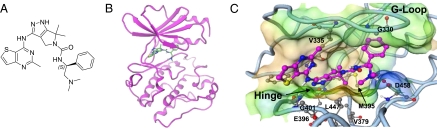
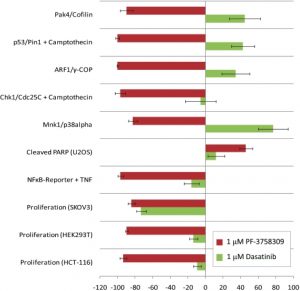
Structural characterization of PF-3758309 binding to the PAK4 catalytic domain.Proc Natl Acad Sci U S A.2010 May 18;107(20):9446-51. |
Tumor growth inhibition of human xenograft tumor models.
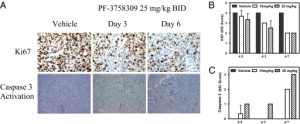
PF-3758309 is antiproliferative and induces apoptosis in a HCT116 tumor model.Proc Natl Acad Sci U S A.2010 May 18;107(20):9446-51. |
Products are for research use only; We do not sell to patients
Copyright 2020 InvivoChem LLC | All Rights Reserved


 COA
COA