| Size | Price | Stock | Qty |
|---|---|---|---|
| 1mg |
|
||
| 5mg |
|
||
| 10mg |
|
||
| 25mg |
|
||
| 50mg |
|
||
| 100mg |
|
||
| 250mg |
|
||
| 500mg | |||
| Other Sizes |


Purity: ≥98%
| Targets |
LMP7 (IC50 ~10 nM)
Immunoproteasome subunit LMP7 (β5i, chymotrypsin-like activity): - Recombinant human LMP7: IC₅₀ ≈ 4 nM; - Selectivity over constitutive proteasome subunits: β5 (constitutive) IC₅₀ ≈ 300 nM, β1/β2 (constitutive/immunoproteasome) IC₅₀ > 1000 nM, showing >75-fold selectivity for LMP7 [1] - Latent HIV-1 activation (via HSF-1/p-TEFb pathway): No explicit EC₅₀ for HIV-1 reactivation; 100 nM ONX-0914 (PR-957) induces ~60% HIV-1 GFP expression in J-Lat 9.2 cells (latent HIV-1 model) [3] - Mycobacterium tuberculosis (Mtb) proteasome: No significant inhibition; ONX-0914 (10 μM) showed <10% inhibition of Mtb proteasome activity (vs. psoralen derivatives as positive controls) [2] |
|---|---|
| ln Vitro |
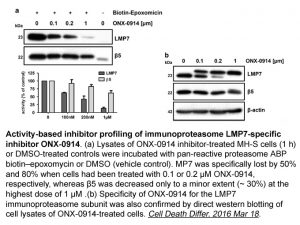
ONX-0914 is 20- to 40-fold more selective for LMP7 than β5 or LMP2, the next most sensitive sites. LMP7-specific, MHC-I-restricted antigen presentation is blocked in vitro and in vivo by ONX-0914 with little to no cross-reactivity with the constitutive proteasome. The production of interleukin-23 (IL-23) by activated monocytes and interferon-gamma and IL-2 by T cells is inhibited by the selective inhibition of LMP7 by ONX-0914. The inhibition of LMP7 reduces the synthesis of IL-23 by approximately 90% and that of TNF-α and IL-6 by approximately 50%.[1]
Anti-inflammatory activity: 1. Cytokine inhibition in immune cells: - Human macrophages (LPS-stimulated): ONX-0914 (1 nM–100 nM) concentration-dependently reduced TNF-α (IC₅₀ ≈ 8 nM) and IL-6 (IC₅₀ ≈ 12 nM) secretion. At 50 nM, TNF-α/IL-6 levels decreased by ~70%/~65% vs. control [1] - Mouse CD4⁺ T cells (anti-CD3/CD28-stimulated): 100 nM ONX-0914 reduced IFN-γ secretion by ~55% and T cell proliferation by ~40% (MTT assay) [1] 2. Signaling suppression: Western blot in LPS-stimulated macrophages showed 50 nM ONX-0914 reduced p-IκBα (Ser32) by ~60% and p-p38 MAPK by ~50%, inhibiting NF-κB and MAPK pathways [1] - Latent HIV-1 reactivation: 1. J-Lat cell lines (J-Lat 9.2/J-Lat 10.6, latent HIV-1 with GFP reporter): - ONX-0914 (10 nM–200 nM) concentration-dependently induced HIV-1 reactivation. At 100 nM, GFP⁺ cells reached ~60% (J-Lat 9.2) and ~55% (J-Lat 10.6) vs. ~5% in control (flow cytometry) [3] - Mechanism: 100 nM ONX-0914 increased HSF-1 nuclear translocation (immunofluorescence, ~3.5-fold) and p-TEFb (CDK9/cyclin T1) association (~2.8-fold, co-IP assay), upregulating HIV-1 LTR transcription [3] 2. Primary CD4⁺ T cells (latent HIV-1 from ART-suppressed patients): 100 nM ONX-0914 increased HIV-1 RNA levels by ~4-fold (qPCR) vs. control [3] - No significant anti-Mtb activity: 1. Mtb H37Rv culture: ONX-0914 (1 μM–100 μM) showed no inhibition of Mtb growth (CFU assay) vs. psoralen derivatives (MIC₅₀ ≈ 10 μM) [2] 2. Mtb proteasome inhibition: 10 μM ONX-0914 inhibited Mtb proteasome activity by <10% (fluorescent substrate assay) [2] |
| ln Vivo |
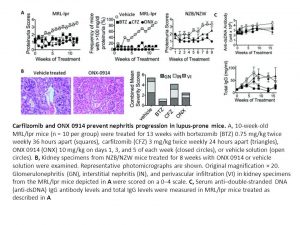
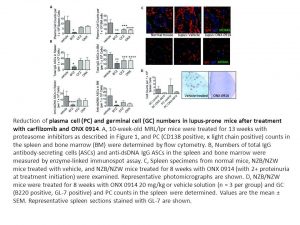
At well-tolerated dosages, ONX-0914 treatment decreases cellular infiltration, cytokine production, and autoantibody levels in mice models of lupus and rheumatoid arthritis while also reversing disease symptoms. In mice, 30 mg/kg body weight is the maximum tolerated dose (MTD) of ONX-0914. Around 60% of ONX-0914's LMP7-selective concentrations and 90% of its higher concentrations inhibit IFN-g release. Moreover, IL-2 production is reduced by about 50%.[1]
Mouse collagen-induced arthritis (CIA) model: 1. Grouping: DBA/1 mice (n=8/group) randomized into 3 groups: (1) Control (intraperitoneal injection of 5% DMSO + 95% normal saline); (2) ONX-0914 1 mg/kg; (3) ONX-0914 5 mg/kg [1] 2. Treatment: CIA induced by bovine type II collagen immunization. Drugs administered intraperitoneally once daily, starting on day 21 post-immunization (onset of arthritis),持续21天 [1] 3. Efficacy: - Arthritis score: Reduced by ~40% (1 mg/kg) and ~65% (5 mg/kg) vs. control (score based on joint swelling/erythema, 0–16 scale) [1] - Serum cytokines: TNF-α/IL-6/IFN-γ levels decreased by ~50%/~45%/~40% (1 mg/kg) and ~70%/~65%/~55% (5 mg/kg) vs. control (ELISA) [1] - Joint histopathology: Reduced synovial hyperplasia (~55%) and inflammatory cell infiltration (~60%) in 5 mg/kg group vs. control (H&E staining) [1] |
| Enzyme Assay |
Human LMP7 (β5i) proteasome activity assay (literature [1], [3]):
1. Protein preparation: Recombinant human LMP7 (β5i) and constitutive proteasome subunits (β5, β1, β2) expressed in E. coli, purified via nickel-chelate affinity chromatography (N-terminal His-tag) [1] 2. Reaction setup: 100 μL reaction mixture contained 50 mM Tris-HCl (pH 7.5), 10 mM MgCl₂, 1 mM DTT, 20 μM fluorescent substrate (Z-LLVY-AMC for chymotrypsin-like activity), and ONX-0914 (0.1 nM–1000 nM, solvent as control) [1] 3. Incubation and detection: Incubated at 37°C for 60 minutes; fluorescence intensity measured (excitation 380 nm, emission 460 nm) at 10-minute intervals. Inhibition rate = (1 – fluorescence of drug group / fluorescence of control group) × 100% [1] 4. Data analysis: IC₅₀ values calculated by fitting inhibition rates to a four-parameter logistic curve using GraphPad Prism [1] - Mtb proteasome activity assay: 1. Protein preparation: Recombinant Mtb proteasome (20S core particle) purified from E. coli [2] 2. Reaction setup: 100 μL mixture contained 25 mM Tris-HCl (pH 7.0), 5 mM MgCl₂, 1 mM ATP, 20 μM Z-LLVY-AMC, and ONX-0914 (1 nM–100 μM) [2] 3. Detection: Fluorescence measured as above; inhibition rate calculated (10 μM ONX-0914 showed <10% inhibition) [2] |
| Cell Assay |
PBMCs were exposed to 1 ng/ml LPS for 24 hours after receiving an hour-long treatment with 200 nM ONX-0914. We examined the expression of the inflammatory cytokines in supernatants. LMP7 was specifically inhibited (> 80%) by ONX-0914. The inhibition of LMP7 resulted in a >90% reduction in the production of IL-23 and a ~50% reduction in the production of TNF-α and IL-6. Greater amounts of ONX-0914, which inhibit LMP2 and MECL-1, further reduced TNF-α and IL-6 secretion, indicating a potential function for these subunits in cytokine regulation.
Macrophage cytokine inhibition assay: 1. Cell seeding: Human peripheral blood monocytes differentiated into macrophages (5×10⁵ cells/well, 24-well plates) in RPMI 1640 + 10% FBS [1] 2. Drug treatment: ONX-0914 (1 nM–100 nM) pre-incubated for 2 hours, then stimulated with LPS (100 ng/mL) for 24 hours [1] 3. Detection: Supernatants collected; TNF-α/IL-6 levels measured via ELISA; cell viability confirmed >90% (MTT assay) [1] - J-Lat HIV-1 reactivation assay: 1. Cell seeding: J-Lat 9.2 cells (2×10⁵ cells/well, 6-well plates) in RPMI 1640 + 10% FBS [3] 2. Drug treatment: ONX-0914 (10 nM–200 nM) added, incubated for 48 hours (37°C, 5% CO₂) [3] 3. Detection: Cells harvested; GFP⁺ cells quantified via flow cytometry; HIV-1 LTR transcription measured via luciferase assay (J-Lat 10.6 cells, ~4.5-fold increase at 100 nM) [3] 4. Western blot/co-IP: Cells lysed with RIPA buffer (含 protease/phosphatase inhibitors); 30 μg protein blotted with anti-HSF-1, anti-CDK9, anti-cyclin T1 antibodies. Co-IP performed with anti-CDK9 antibody to detect p-TEFb complex [3] - Mtb growth inhibition assay: 1. Mtb culture: Mtb H37Rv grown in 7H9 medium; ONX-0914 (1 μM–100 μM) added, incubated for 7 days [2] 2. Detection: 100 μL culture plated on 7H11 agar; CFU counted after 3 weeks (no significant CFU reduction vs. control) [2] |
| Animal Protocol |
collagen antibody–induced arthritis (CAIA) and collagen-induced arthritis (CIA)
2, 6 or 10 mg/kg i.v. Mouse CIA model protocol: 1. Animal housing: Female DBA/1 mice (6–8 weeks old, 18–22 g) housed in SPF facilities (22–25°C, 12-hour light/dark cycle) with free access to food/water [1] 2. CIA induction: Mice immunized subcutaneously with 100 μg bovine type II collagen emulsified in complete Freund’s adjuvant (CFA) on day 0; boosted with incomplete Freund’s adjuvant (IFA) on day 21 [1] 3. Grouping and treatment: On day 21 (arthritis onset), mice randomized into 3 groups. ONX-0914 dissolved in 5% DMSO + 95% normal saline, administered intraperitoneally (10 μL/g body weight) at 1 mg/kg or 5 mg/kg, once daily for 21 days. Control received solvent alone [1] 4. Monitoring and analysis: Arthritis score recorded every 3 days; serum collected for cytokine ELISA on day 42. Mice euthanized via CO₂ inhalation; knee joints excised, fixed in 4% paraformaldehyde, decalcified, and stained with H&E for histopathology [1] |
| Toxicity/Toxicokinetics |
In vitro toxicity (references [1], [3]):
1. Normal human peripheral blood mononuclear cells (PBMCs): 100 nM ONX-0914 (treatment for 72 hours) reduced cell viability by <10% (MTT method) [1] 2. J-Lat cells: 200 nM ONX-0914 (treatment for 48 hours) showed no significant cytotoxicity (viability >85%, trypan blue exclusion method) [3] - In vivo toxicity: 1. Mouse CIA model (5 mg/kg, intraperitoneal injection, once daily for 21 days): - No death or clinical toxicity (e.g., somnolence, diarrhea); weight change <5% (compared to baseline) [1] - Serum ALT, AST, creatinine and BUN levels were within the normal range; no histopathological lesions were observed in the liver, kidneys and spleen [1] |
| References |
|
| Additional Infomation |
See also: Onx-0914 (note moved to).
Mechanism of action: ONX-0914 (PR-957) is a selective immunoproteasome subunit LMP7 (β5i) inhibitor, which is highly expressed in activated immune cells. It inhibits the production of NF-κB/MAPK pathway and pro-inflammatory cytokines by blocking LMP7-mediated protein degradation (anti-inflammatory effect) [1]; in latent HIV-1, it activates HSF-1 and promotes p-TEFb assembly, thereby driving HIV-1 LTR transcription [3] -Therapeutic potential: (1) Based on its anti-inflammatory activity in CIA models, it can be used to treat autoimmune diseases (e.g., rheumatoid arthritis) [1]; (2) Reverses HIV-1 latency by reactivating latent HIV-1 in CD4⁺ T cells (“shock and clear” strategy) [3]; (3) No risk of Mycobacterium tuberculosis infection (weak proteasome inhibition of Mycobacterium tuberculosis) [2] |
| Molecular Formula |
C31H40N4O7
|
|---|---|
| Molecular Weight |
580.67
|
| Exact Mass |
580.289
|
| Elemental Analysis |
C, 64.12; H, 6.94; N, 9.65; O, 19.29
|
| CAS # |
960374-59-8
|
| Related CAS # |
ONX-0914 TFA
|
| PubChem CID |
23642227
|
| Appearance |
white to off-white solid powder
|
| Density |
1.2±0.1 g/cm3
|
| Boiling Point |
878.0±65.0 °C at 760 mmHg
|
| Flash Point |
484.8±34.3 °C
|
| Vapour Pressure |
0.0±0.3 mmHg at 25°C
|
| Index of Refraction |
1.569
|
| LogP |
3.41
|
| Hydrogen Bond Donor Count |
3
|
| Hydrogen Bond Acceptor Count |
8
|
| Rotatable Bond Count |
14
|
| Heavy Atom Count |
42
|
| Complexity |
928
|
| Defined Atom Stereocenter Count |
4
|
| SMILES |
C([C@@]1(OC1)C)(=O)[C@@H](NC(=O)[C@@H](NC(=O)[C@H](C)NC(=O)CN1CCOCC1)CC1C=CC(OC)=CC=1)CC1C=CC=CC=1
|
| InChi Key |
WQAVPPWWLLVGFK-VTNASVEKSA-N
|
| InChi Code |
/C31H40N4O7/c1-21(32-27(36)19-35-13-15-41-16-14-35)29(38)34-26(18-23-9-11-24(40-3)12-10-23)30(39)33-25(28(37)31(2)20-42-31)17-22-7-5-4-6-8-22/h4-12,21,25-26H,13-20H2,1-3H3,(H,32,36)(H,33,39)(H,34,38)/t21-,25-,26-,31+/m0/s1
|
| Chemical Name |
(2S)-3-(4-methoxyphenyl)-N-[(2S)-1-[(2R)-2-methyloxiran-2-yl]-1-oxo-3-phenylpropan-2-yl]-2-[[(2S)-2-[(2-morpholin-4-ylacetyl)amino]propanoyl]amino]propanamide
|
| Synonyms |
ONX0914; PR-957; ONX 0914; PR 957; ONX-0914; PR957
|
| HS Tariff Code |
2934.99.9001
|
| Storage |
Powder -20°C 3 years 4°C 2 years In solvent -80°C 6 months -20°C 1 month |
| Shipping Condition |
Room temperature (This product is stable at ambient temperature for a few days during ordinary shipping and time spent in Customs)
|
| Solubility (In Vitro) |
DMSO: ~100 mg/mL (~172.2 mM)
Water: 1 mg/mL (Insoluble) Ethanol: 100 mg/mL (~172.2 mM) |
|---|---|
| Solubility (In Vivo) |
Solubility in Formulation 1: ≥ 2.17 mg/mL (3.74 mM) (saturation unknown) in 10% DMSO + 40% PEG300 + 5% Tween80 + 45% Saline (add these co-solvents sequentially from left to right, and one by one), clear solution.
For example, if 1 mL of working solution is to be prepared, you can add 100 μL of 21.7 mg/mL clear DMSO stock solution to 400 μL PEG300 and mix evenly; then add 50 μL Tween-80 to the above solution and mix evenly; then add 450 μL normal saline to adjust the volume to 1 mL. Preparation of saline: Dissolve 0.9 g of sodium chloride in 100 mL ddH₂ O to obtain a clear solution. Solubility in Formulation 2: ≥ 2.17 mg/mL (3.74 mM) (saturation unknown) in 10% DMSO + 90% (20% SBE-β-CD in Saline) (add these co-solvents sequentially from left to right, and one by one), clear solution. For example, if 1 mL of working solution is to be prepared, you can add 100 μL of 21.7 mg/mL clear DMSO stock solution to 900 μL of 20% SBE-β-CD physiological saline solution and mix evenly. Preparation of 20% SBE-β-CD in Saline (4°C,1 week): Dissolve 2 g SBE-β-CD in 10 mL saline to obtain a clear solution. View More
Solubility in Formulation 3: ≥ 2.17 mg/mL (3.74 mM) (saturation unknown) in 10% DMSO + 90% Corn Oil (add these co-solvents sequentially from left to right, and one by one), clear solution. Solubility in Formulation 4: 2% DMSO+castor oil: 10 mg/mL |
| Preparing Stock Solutions | 1 mg | 5 mg | 10 mg | |
| 1 mM | 1.7221 mL | 8.6107 mL | 17.2215 mL | |
| 5 mM | 0.3444 mL | 1.7221 mL | 3.4443 mL | |
| 10 mM | 0.1722 mL | 0.8611 mL | 1.7221 mL |
*Note: Please select an appropriate solvent for the preparation of stock solution based on your experiment needs. For most products, DMSO can be used for preparing stock solutions (e.g. 5 mM, 10 mM, or 20 mM concentration); some products with high aqueous solubility may be dissolved in water directly. Solubility information is available at the above Solubility Data section. Once the stock solution is prepared, aliquot it to routine usage volumes and store at -20°C or -80°C. Avoid repeated freeze and thaw cycles.
Calculation results
Working concentration: mg/mL;
Method for preparing DMSO stock solution: mg drug pre-dissolved in μL DMSO (stock solution concentration mg/mL). Please contact us first if the concentration exceeds the DMSO solubility of the batch of drug.
Method for preparing in vivo formulation::Take μL DMSO stock solution, next add μL PEG300, mix and clarify, next addμL Tween 80, mix and clarify, next add μL ddH2O,mix and clarify.
(1) Please be sure that the solution is clear before the addition of next solvent. Dissolution methods like vortex, ultrasound or warming and heat may be used to aid dissolving.
(2) Be sure to add the solvent(s) in order.
|
|---|
|
|
Products are for research use only; We do not sell to patients
Copyright 2020 InvivoChem LLC | All Rights Reserved


 COA
COA