| Size | Price | Stock | Qty |
|---|---|---|---|
| 25mg |
|
||
| 50mg |
|
||
| 100mg |
|
||
| 250mg |
|
||
| 500mg | |||
| Other Sizes |


Purity: ≥98%
| Targets |
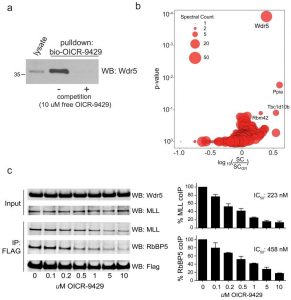
WD repeat domain 5 (WDR5) (IC50 = 1.2 μM for WDR5-MLL interaction inhibition) [1]
|
|---|---|
| ln Vitro |
T24 and UM-UC-3 exhibit strong sensitivity to OICR-9429 (0-10 μM, 48 h), with IC50 values of 67.74 μM and 70.41 μM, respectively[1]. With an IC50 value of 121.42 μM, OICR-9429 (0-10 μM, 48 hours) exhibits poor sensitivity to TCCSUP[1]. By inhibiting WDR5-mediated H3K4me3, OICR-9429 (70 μM, 120 μM, 140 μM, and 240 μM; 48 hours) lowers BCa cell viability[1]. By controlling the G1/S phase transition, OICR-9429 (70 μM, 120 μM, 140 μM, and 240 μM; 48 hours) prevents BCa cell proliferation [1]. OICR-9429 (70 μM, 120 μM, 140 μM, and 240 μM; 24 h) increases BCa cell apoptosis in a dose- and time-dependent manner while enhancing the cells' chemosensitivity to cisplatin [1]. OICR-9429 (70 μM, 120 μM, 140 μM, and 240 μM; 24 hours, 48 hours) prevents bladder cancer cells from spreading [1]. BCa cells' PD-L1 expression is inhibited by OICR-9429 (70 μM, 120 μM, 140 μM, and 240 μM; 48 h) in response to IFN-γ [1].
OICR-9429 dose-dependently inhibited proliferation of bladder cancer cell lines: T24 (IC50 = 1.5 μM), 5637 (IC50 = 1.8 μM) after 72 hours of treatment [1] - Treatment with OICR-9429 (1 μM) for 24 hours reduced WDR5 protein levels by 65% and H3K4me3 (downstream target of WDR5) by 70% in T24 cells (western blot) [1] - OICR-9429 (1 μM) downregulated c-Myc expression by 55% and programmed death-ligand 1 (PD-L1) mRNA and protein levels by 60% and 65% respectively in 5637 cells (qRT-PCR and western blot) [1] - The compound induced apoptosis in bladder cancer cells: 1.5 μM OICR-9429 increased Annexin V-positive cells by 40% in T24 cells, accompanied by upregulated cleaved caspase-3 (2.5-fold) and Bax (1.8-fold), and downregulated Bcl-2 (0.4-fold) [1] - OICR-9429 (1 μM) reduced colony formation rate of T24 cells by 55% and 5637 cells by 50% after 14 days of culture [1] - Combined with cisplatin (10 μM), OICR-9429 (1 μM) enhanced cisplatin-induced cytotoxicity: T24 cell viability decreased from 45% (cisplatin alone) to 20% (combination), with combination index = 0.5 [1] - No significant cytotoxicity was observed in normal human bladder epithelial cells (HBdE) at OICR-9429 concentrations up to 5 μM (cell viability >90% vs. vehicle) [1] |
| ln Vivo |
In addition to enhancing the effectiveness of cisplatin on BCa cells in vivo and inhibiting tumor proliferation, OICR-9429 (30 mg/kg or 60 mg/kg, ip) targets WDR5 and lessens the toxic side effects on normal tissues [1].
In nude mice bearing T24 bladder cancer xenografts, intraperitoneal injection of OICR-9429 (20 mg/kg, once daily) for 21 days reduced tumor volume by 60% and tumor weight by 55% compared to vehicle control [1] - Combination of OICR-9429 (20 mg/kg, intraperitoneal) with cisplatin (5 mg/kg, intraperitoneal, once weekly) for 21 days achieved 85% tumor growth inhibition (TGI) in T24 xenografts, with no increased toxicity [1] - Immunohistochemical staining of tumor tissues showed OICR-9429 (20 mg/kg) reduced WDR5-positive cells by 60%, PD-L1-positive cells by 55%, and increased cleaved caspase-3-positive apoptotic cells by 35% [1] - OICR-9429 treatment (20 mg/kg) did not alter mouse body weight, liver function (ALT/AST), or kidney function (BUN/Cr) during 21-day treatment [1] |
| Cell Assay |
Cell Proliferation Assay[1]
Cell Types: BCa cell lines (T24, UM-UC-3 and TCCSUP) Tested Concentrations: 70 μM, 120 μM, 140 μM and 240 μM Incubation Duration: 5 days Experimental Results: Had a low proliferation rate and remarkably decreased the number of colonies formed by the three BCa cell lines in a dose-dependent manner. Cell Cytotoxicity Assay[1] Cell Types: BCa cell lines (T24, UM-UC-3 and TCCSUP) Tested Concentrations: 0-10 μM Incubation Duration: 48 h Experimental Results: Inhibited cell viability in a dose-dependent manner in BCa cell lines. Apoptosis Analysis[1] Cell Types: BCa cell lines (T24, UM-UC-3 and TCCSUP) Tested Concentrations: 70 μM, 120 μM, 140 μM and 240 μM Incubation Duration: 24 h Experimental Results: demonstrated no obvious apoptotic cells for 24 h but the apoptotic rate was Dramatically increased at 72 h and upregulated caspase 3/7 activity. Cell Migration Assay [1] Cell Types: BCa cell lines ( T24, UM-UC-3 and TCCSUP) Tested Concentrations: 70 μM, 120 μM, 140 μM and 240 μM Incubation Duration: 24 h, 48 h Experimental Results: decreased the migratory speed and diminished the T24/5637/HBdE cells were cultured in complete medium at 37 °C with 5% CO2 until 70-80% confluency [1] - Proliferation assay: Cells were seeded into 96-well plates (5×10³ cells/well), treated with serial dilutions of OICR-9429 (0.1-10 μM) alone or with cisplatin (10 μM) for 72 hours, and cell viability was assessed by CCK-8 assay [1] - Western blot: Cells were treated with OICR-9429 (0.5-2 μM) for 24 hours, lysed in ice-cold RIPA buffer, and protein extracts were probed with anti-WDR5, anti-H3K4me3, anti-c-Myc, anti-PD-L1, anti-cleaved caspase-3, anti-Bax, anti-Bcl-2, and anti-β-actin antibodies [1] - qRT-PCR: Total RNA was extracted from treated cells, reverse-transcribed to cDNA, and PD-L1 and c-Myc mRNA expression was quantified using specific primers [1] - Apoptosis assay: Cells were treated with OICR-9429 (1-2 μM) for 48 hours, stained with Annexin V-FITC/PI, and analyzed by flow cytometry [1] - Colony formation assay: Cells were treated with OICR-9429 (0.5-1.5 μM) for 24 hours, seeded into 6-well plates (1×10³ cells/well), cultured for 14 days, stained with crystal violet, and colonies (>50 cells) were counted [1] |
| Animal Protocol |
Animal/Disease Models: xenograft mouse model[1]
Doses: 30 mg/kg, 60 mg/kg Route of Administration: 30 mg/kg, 60 mg/kg, ip Experimental Results: Suppressed tumour growth, small tumours and enhanced tumour sensitivity. 6-8 week old female nude mice were subcutaneously implanted with 5×10⁶ T24 bladder cancer cells into the right flank [1] - When tumors reached 100-150 mm³, mice were randomized into 4 groups (n=6 per group): vehicle control, OICR-9429 monotherapy, cisplatin monotherapy, combination therapy [1] - OICR-9429 was formulated in DMSO:PEG400:PBS (1:4:5, v/v/v) and administered via intraperitoneal injection at 20 mg/kg once daily for 21 days [1] - Cisplatin was diluted in normal saline and administered via intraperitoneal injection at 5 mg/kg once weekly for 3 weeks (concurrent with OICR-9429 treatment) [1] - Tumor volume was measured with calipers every 2 days, body weight was recorded weekly, and blood samples were collected at endpoint for liver and kidney function tests [1] - Tumors were harvested after 21 days for immunohistochemical staining and protein expression analysis [1] |
| Toxicity/Toxicokinetics |
In vitro cytotoxicity: After treatment of normal HBdE cells with OICR-9429 (0.1–5 μM) for 72 hours, cell viability was not significantly reduced (IC50 > 5 μM) [1]
- In mice, OICR-9429 (20 mg/kg, intraperitoneal injection, once daily for 21 days) did not cause significant changes in body weight (±5% of baseline) or liver and kidney function parameters [1] - No obvious toxic reactions (e.g., abdominal distension, hair loss, somnolence) were observed in treated animals [1] |
| References | |
| Additional Infomation |
OICR-9429 is a small molecule WD repeat domain 5 (WDR5) inhibitor. WDR5 is a key component of the MLL complex and is involved in histone H3K4 methylation [1]. Its mechanism of action includes binding to WDR5, disrupting WDR5-MLL interaction, and inhibiting H3K4me3-mediated transcriptional activation of oncogenes (e.g., c-Myc) and the immune checkpoint molecule PD-L1 [1]. OICR-9429 enhances the chemosensitivity of bladder cancer cells to cisplatin by promoting apoptosis and inhibiting PD-L1-mediated immune escape [1]. This compound shows potential value in treating bladder cancer by targeting tumor proliferation and immune escape, especially when used in combination with chemotherapy [1].
|
| Molecular Formula |
C29H32F3N5O3
|
|
|---|---|---|
| Molecular Weight |
555.59
|
|
| Exact Mass |
555.245
|
|
| CAS # |
1801787-56-3
|
|
| Related CAS # |
|
|
| PubChem CID |
91623360
|
|
| Appearance |
White to off-white solid powder
|
|
| Density |
1.3±0.1 g/cm3
|
|
| Boiling Point |
693.0±55.0 °C at 760 mmHg
|
|
| Flash Point |
372.9±31.5 °C
|
|
| Vapour Pressure |
0.0±2.2 mmHg at 25°C
|
|
| Index of Refraction |
1.602
|
|
| LogP |
1.84
|
|
| Hydrogen Bond Donor Count |
2
|
|
| Hydrogen Bond Acceptor Count |
9
|
|
| Rotatable Bond Count |
6
|
|
| Heavy Atom Count |
40
|
|
| Complexity |
973
|
|
| Defined Atom Stereocenter Count |
0
|
|
| SMILES |
O=C(C1=CNC(C=C1C(F)(F)F)=O)NC2=CC(C3=CC(CN4CCOCC4)=CC=C3)=CC=C2N5CCN(C)CC5
|
|
| InChi Key |
DJOVLOYCGXNVPI-UHFFFAOYSA-N
|
|
| InChi Code |
InChI=1S/C29H32F3N5O3/c1-35-7-9-37(10-8-35)26-6-5-22(21-4-2-3-20(15-21)19-36-11-13-40-14-12-36)16-25(26)34-28(39)23-18-33-27(38)17-24(23)29(30,31)32/h2-6,15-18H,7-14,19H2,1H3,(H,33,38)(H,34,39)
|
|
| Chemical Name |
N-[2-(4-methylpiperazin-1-yl)-5-[3-(morpholin-4-ylmethyl)phenyl]phenyl]-6-oxo-4-(trifluoromethyl)-1H-pyridine-3-carboxamide
|
|
| Synonyms |
|
|
| HS Tariff Code |
2934.99.9001
|
|
| Storage |
Powder -20°C 3 years 4°C 2 years In solvent -80°C 6 months -20°C 1 month |
|
| Shipping Condition |
Room temperature (This product is stable at ambient temperature for a few days during ordinary shipping and time spent in Customs)
|
| Solubility (In Vitro) |
DMSO: 38 mg/mL (68.4 mM)
Water: 1 mg/mL (Insoluble) Ethanol: 15 mg/mL (27 mM) |
|---|---|
| Solubility (In Vivo) |
Solubility in Formulation 1: ≥ 2.5 mg/mL (4.50 mM) (saturation unknown) in 10% DMSO + 40% PEG300 + 5% Tween80 + 45% Saline (add these co-solvents sequentially from left to right, and one by one), clear solution.
For example, if 1 mL of working solution is to be prepared, you can add 100 μL of 25.0 mg/mL clear DMSO stock solution to 400 μL PEG300 and mix evenly; then add 50 μL Tween-80 to the above solution and mix evenly; then add 450 μL normal saline to adjust the volume to 1 mL. Preparation of saline: Dissolve 0.9 g of sodium chloride in 100 mL ddH₂ O to obtain a clear solution. Solubility in Formulation 2: ≥ 2.5 mg/mL (4.50 mM) (saturation unknown) in 10% DMSO + 90% (20% SBE-β-CD in Saline) (add these co-solvents sequentially from left to right, and one by one), clear solution. For example, if 1 mL of working solution is to be prepared, you can add 100 μL of 25.0 mg/mL clear DMSO stock solution to 900 μL of 20% SBE-β-CD physiological saline solution and mix evenly. Preparation of 20% SBE-β-CD in Saline (4°C,1 week): Dissolve 2 g SBE-β-CD in 10 mL saline to obtain a clear solution. View More
Solubility in Formulation 3: ≥ 2.5 mg/mL (4.50 mM) (saturation unknown) in 10% DMSO + 90% Corn Oil (add these co-solvents sequentially from left to right, and one by one), clear solution. |
| Preparing Stock Solutions | 1 mg | 5 mg | 10 mg | |
| 1 mM | 1.7999 mL | 8.9994 mL | 17.9989 mL | |
| 5 mM | 0.3600 mL | 1.7999 mL | 3.5998 mL | |
| 10 mM | 0.1800 mL | 0.8999 mL | 1.7999 mL |
*Note: Please select an appropriate solvent for the preparation of stock solution based on your experiment needs. For most products, DMSO can be used for preparing stock solutions (e.g. 5 mM, 10 mM, or 20 mM concentration); some products with high aqueous solubility may be dissolved in water directly. Solubility information is available at the above Solubility Data section. Once the stock solution is prepared, aliquot it to routine usage volumes and store at -20°C or -80°C. Avoid repeated freeze and thaw cycles.
Calculation results
Working concentration: mg/mL;
Method for preparing DMSO stock solution: mg drug pre-dissolved in μL DMSO (stock solution concentration mg/mL). Please contact us first if the concentration exceeds the DMSO solubility of the batch of drug.
Method for preparing in vivo formulation::Take μL DMSO stock solution, next add μL PEG300, mix and clarify, next addμL Tween 80, mix and clarify, next add μL ddH2O,mix and clarify.
(1) Please be sure that the solution is clear before the addition of next solvent. Dissolution methods like vortex, ultrasound or warming and heat may be used to aid dissolving.
(2) Be sure to add the solvent(s) in order.
|
|---|
|
 16d(OICR-9429) is a potent and selective chemical probe suitable to help dissect the biological role of WDR5.J Med Chem.2016 Mar 24;59(6):2478-96. |
Products are for research use only; We do not sell to patients
Copyright 2020 InvivoChem LLC | All Rights Reserved


 COA
COA