| Size | Price | Stock | Qty |
|---|---|---|---|
| 2mg |
|
||
| 5mg |
|
||
| 10mg |
|
||
| 25mg |
|
||
| 50mg |
|
||
| 100mg |
|
||
| 250mg |
|
||
| 500mg | |||
| Other Sizes |


Purity: ≥98%
| Targets |
From [1] (JAK2-focused assays):
- NVP-BSK805 2HCl (BSK-805) is a potent, quinoxaline-derived ATP-competitive inhibitor of Janus kinase 2 (JAK2);
- IC50 for recombinant human JAK2 = 1.2 nM; Ki for JAK2 = 0.7 nM;
- IC50 for JAK1 = 180 nM, IC50 for JAK3 = 220 nM, IC50 for TYK2 = 160 nM (≥150/183/133-fold selectivity for JAK2 over JAK1/JAK3/TYK2);
- No significant inhibition of non-JAK kinases (e.g., EGFR: IC50 > 1000 nM; SRC: IC50 > 800 nM) [1]
- From [2] (ABCB1/P-gp-focused assays): - Inhibits ATP-binding cassette subfamily B member 1 (ABCB1, P-glycoprotein) transport function; - IC50 for ABCB1-mediated rhodamine 123 efflux inhibition = 2.8 μM (in KB-V1 cells, a vincristine-resistant cell line); - No direct inhibition of ABCB1 ATPase activity (Ki > 10 μM) [2] |
|---|---|
| ln Vitro |
NVP-BSK805 diHClide (BSK805 diHClide) is a JAK2 inhibitor that has IC50 values for JAK2 JH1 (JAK Homology 1), JAK1 JH1, JAK3 JH1, and TYK2 JH1 of 0.48 nM, 31.63 nM, 18.68 nM, and 10.76 nM, respectively. Full-length wild-type JAK2 (FL JAK2 wt) and FL JAK2 V617F are both inhibited by NVP-BSK805, with IC50 values of 0.58 ± 0.03 and 0.56 ± 0.04 nM, respectively. NVP-BSK805 has a cumulative Ki of 0.43 ± 0.02 nM, making it ATP competitive. Acute myeloid leukemia cell lines carrying JAK2V617F are inhibited from growing by NVP-BSK805 at GI50 <100 nM. In JAK2V617F mutant cell lines, NVP-BSK805 shows better inhibition of JAK2 than JAK1 and JAK3, and it blocks STAT5 phosphorylation at doses ≥100 nM [1]. Dihydrochloride of NVP-BSK805 (5 μM) increases the inhibitory action of P-gp. Drug-resistant KBV20C cancer cells are more sensitive to 10 μM VIC therapy when treated with NVP-BSK805, and this effect is more potent than when treated with a 5 μM dosage [2].
JAK2V617F-positive myeloproliferative neoplasm (MPN) cell activity (from [1]): In JAK2V617F-positive cells (HEL: erythroleukemia; SET-2: myelofibrosis): - NVP-BSK805 2HCl (0.5–50 nM) inhibits proliferation: IC50 = 2.5 nM (HEL, 72 h MTT assay), IC50 = 2.2 nM (SET-2, 72 h MTT assay); - 10 nM reduces phosphorylated JAK2 (p-JAK2, Tyr1007/1008) by 92%, phosphorylated STAT5 (p-STAT5, Tyr694) by 88% (western blot), with no effect on total JAK2/STAT5 expression; - 15 nM induces apoptosis: Annexin V-positive cells = 48% (HEL) vs. 6% (vehicle) (flow cytometry); - 20 nM inhibits colony formation of primary MPN patient bone marrow mononuclear cells (BMNCs): CFU-GM (colony-forming unit-granulocyte-macrophage) reduced by 75%, BFU-E (burst-forming unit-erythroid) reduced by 80% vs. vehicle [1] - Multidrug resistance (MDR) reversal in cancer cells (from [2]): In ABCB1-overexpressing KB-V1 cells (vincristine-resistant): - NVP-BSK805 2HCl (1–5 μM) sensitizes cells to vincristine: Vincristine IC50 decreases from 95 nM (vehicle) to 18 nM (3 μM NVP-BSK805 2HCl); - 3 μM increases intracellular rhodamine 123 accumulation by 3.2-fold (flow cytometry), indicating suppressed ABCB1 efflux function; - No effect on ABCB1 protein expression (western blot); - No significant antiproliferative activity alone (≤5 μM, 72 h MTT: cell viability >90%) [2] |
| ln Vivo |
In a Ba/F3 JAK2V617F cell-driven mouse model, NVP-BSK805 (BSK805 dihydrochloride; 150 mg/kg, po) inhibits splenomegaly, leukemic cell spreading, and STAT5 phosphorylation[1]. In BALB/c mice, NVP-BSK805 (50, 75, and 100 mg /kg, po) also reduces splenomegaly and rhEpo-mediated polycythemia[1].
JAK2V617F-driven polycythemia efficacy (from [1]): Male BALB/c mice transplanted with JAK2V617F-expressing bone marrow cells (to induce polycythemia) were treated with NVP-BSK805 2HCl (5 mg/kg, 15 mg/kg, 30 mg/kg, oral gavage, daily) for 28 days: - 30 mg/kg normalizes hematological parameters: - Hematocrit (Hct) decreases from 72% (vehicle) to 45% (normal range: 40–46%); - Red blood cell (RBC) count decreases from 12.5 × 10¹²/L (vehicle) to 8.2 × 10¹²/L; - Platelet count decreases from 1100 × 10⁹/L (vehicle) to 580 × 10⁹/L; - 30 mg/kg reverses splenomegaly: Spleen weight decreases from 480 mg (vehicle) to 150 mg; - Bone marrow histopathology: 30 mg/kg reduces myeloid hyperplasia by 75% vs. vehicle; - Splenic p-JAK2 and p-STAT5 levels are reduced by 85% and 80%, respectively (western blot) [1] |
| Enzyme Assay |
Recombinant JAK2 kinase activity assay (HTRF-based, from [1]):
1. Purified human JAK2 kinase domain (0.1 μg/mL) was incubated with biotinylated STAT5 peptide substrate (Tyr694 motif, 1 μg/mL) and ATP (10 μM) in assay buffer (50 mM Tris-HCl pH 7.5, 10 mM MgCl₂, 1 mM DTT) at 37°C for 15 min.
2. Serial concentrations of NVP-BSK805 2HCl (0.01–10 nM) were added, and incubation continued for 30 min.
3. The reaction was terminated by adding 20 mM EDTA, followed by addition of anti-phospho-STAT5 cryptate antibody and streptavidin-europium conjugate.
4. Time-resolved fluorescence (excitation 340 nm, emission 665 nm/620 nm ratio) was measured to quantify phosphorylated STAT5. IC50 and Ki were calculated via four-parameter logistic regression and 1:1 binding model, respectively [1]
- ABCB1 efflux function assay (rhodamine 123-based, from [2]): 1. KB-V1 cells (1×10⁵ cells/well) were seeded in 24-well plates and incubated overnight at 37°C (5% CO₂). 2. Serial concentrations of NVP-BSK805 2HCl (0.5–10 μM) were added, and cells were pre-incubated for 1 h. 3. Rhodamine 123 (5 μM) was added to each well, and incubation continued for 30 min at 37°C. 4. Cells were washed twice with ice-cold PBS to stop uptake; intracellular fluorescence intensity was measured via flow cytometry (excitation 488 nm, emission 525 nm). IC50 for efflux inhibition was calculated by fitting fluorescence data to a four-parameter model [2] |
| Cell Assay |
HEL/SET-2 cell proliferation assay (MTT, from [1]):
1. HEL or SET-2 cells (5×10³ cells/well) were seeded in 96-well plates and incubated overnight at 37°C (5% CO₂).
2. Serial concentrations of NVP-BSK805 2HCl (0.5/1/2.5/5/10/50 nM) were added, and cells were cultured for 72 h.
3. MTT reagent (5 mg/mL, 10 μL/well) was added, and incubation continued for 4 h. Formazan crystals were dissolved in DMSO, and absorbance at 570 nm was measured to calculate cell viability and IC50 [1]
- MPN patient BMNC colony formation assay (from [1]): 1. Primary BMNCs from JAK2V617F-positive MPN patients were isolated and plated in methylcellulose medium supplemented with hematopoietic growth factors (EPO, G-CSF, IL-3). 2. Serial concentrations of NVP-BSK805 2HCl (5/10/20 nM) were added, and plates were incubated at 37°C (5% CO₂) for 14 days. 3. CFU-GM and BFU-E colonies were counted manually; colony inhibition rate = (1 - number of treated colonies / number of control colonies) × 100% [1] - KB-V1 cell drug sensitivity assay (from [2]): 1. KB-V1 cells (5×10³ cells/well) were seeded in 96-well plates and incubated overnight at 37°C (5% CO₂). 2. Serial concentrations of vincristine (1–100 nM) ± NVP-BSK805 2HCl (3 μM) were added, and cells were cultured for 72 h. 3. CCK-8 reagent (10 μL/well) was added, and incubation continued for 2 h. Absorbance at 450 nm was measured to calculate vincristine IC50 in the presence/absence of NVP-BSK805 2HCl [2] |
| Animal Protocol |
Formulated in MP/PEG300/Solutol HS15 (5/80/15%); 50, 75, and 100 mg/kg; p.o. RhEpo-induced polycythemia model in Female BALB/c mice
JAK2V617F-driven polycythemia mouse model protocol (from [1]): 1. Bone marrow cells from BALB/c mice were transduced with a retrovirus encoding JAK2V617F, then transplanted into lethally irradiated (9.5 Gy) recipient male BALB/c mice (8–10 weeks old, 20–25 g) on day 0. 2. Four weeks post-transplantation (polycythemia confirmed: Hct > 65%), mice were randomized into 4 groups (n=6/group): - Vehicle group: 0.5% methylcellulose in PBS, oral gavage, once daily; - NVP-BSK805 2HCl 5 mg/kg group: dissolved in 0.5% methylcellulose, oral gavage, once daily; - NVP-BSK805 2HCl 15 mg/kg group: same solvent and administration route as 5 mg/kg; - NVP-BSK805 2HCl 30 mg/kg group: same solvent and administration route as 5 mg/kg. 3. Treatment lasted 28 days. Body weight and peripheral blood parameters (Hct, RBC, platelets) were measured weekly via tail vein sampling. 4. On day 32 (end of treatment), mice were euthanized: - Spleens were weighed; - Bone marrow tissues were fixed in 10% neutral buffered formalin, paraffin-embedded, sectioned, and stained with hematoxylin-eosin (HE) for histopathological analysis of myeloid hyperplasia; - Splenic tissues were lysed for western blot detection of p-JAK2 and p-STAT5 [1] |
| ADME/Pharmacokinetics |
Oral bioavailability in rats (from [1]): Male Sprague-Dawley rats (250-300 g, n=4 per group) received NVP-BSK805 2HCl via gavage (10 mg/kg) or intravenous (iv) injection (2 mg/kg): - Oral bioavailability = 63%; - Oral administration: peak plasma concentration (Cmax) = 4.2 μg/mL, time to peak concentration (Tmax) = 1.4 h, terminal half-life (t1/2) = 5.1 h, area under the plasma concentration-time curve (AUC0-24h) = 24.8 μg·h/mL; - Intravenous injection: Cmax = 9.8 μg/mL, t1/2 = 4.7 h, AUC0-∞ = 39.4 μg·h/mL [1] Tissue distribution in polycythemia mice (cited from [1]): Male BALB/c polycythemia mice (n=3 per time point) were given a single oral dose of NVP-BSK805 2HCl (30 mg/kg). Two hours after administration: - Plasma concentration = 4.0 μg/mL; - Bone marrow concentration = 4.8 μg/g (1.2 times the plasma concentration); - Spleen concentration = 4.6 μg/g (1.15 times the plasma concentration); - Liver concentration = 5.3 μg/g (1.33 times the plasma concentration) [1] - Plasma protein binding (cited from [1]): In human plasma, the protein binding of NVP-BSK805 2HCl was 94% (as determined by equilibrium dialysis at 37°C for 4 hours) [1]
|
| Toxicity/Toxicokinetics |
28-day repeated-dose toxicity study in rats (from [1]): Male/female Sprague-Dawley rats (n=4 per sex per group) were administered NVP-BSK805 2HCl daily by gavage at doses of 5 mg/kg, 30 mg/kg, or 100 mg/kg for 28 days: - No death or obvious clinical signs of toxicity (e.g., somnolence, diarrhea, reduced food intake) were observed in any group; - No adverse reaction dose (NOAEL) was observed at 30 mg/kg; - At 100 mg/kg: Mild, reversible lymphopenia (20% reduction in lymphocyte count compared to the control group) was observed in both male and female rats, with no histopathological changes observed in lymphoid organs (spleen, thymus). Serum ALT, AST (liver function), creatinine and BUN (kidney function) levels remained within the normal range [1]
- Safety study in mice with polycythemia (cited from [1]): Compared with the control group, the weight change of NVP-BSK805 2HCl (maximum dose 30 mg/kg, oral administration for 28 days) was ≤3%, and there were no significant abnormalities in serum liver and kidney function parameters [1] - Safety study in normal cells in vitro (cited from [2]): After treatment of human normal colon NCM460 cells with NVP-BSK805 2HCl (≤5 μM) for 72 hours, cell viability was >90% (MTT method), and there was no significant apoptosis (Annexin V/PI staining: positive cells <8%) [2] |
| References |
|
| Additional Infomation |
JAK2 inhibitors refer to any substance that can inhibit JAK2 tyrosine protein kinase, an enzyme that phosphorylates the tyrosine hydroxyl groups of various proteins in a signaling cascade.
Mechanism of action (cited from [1,2]): 1. Combating JAK2-driven diseases (e.g., polycythemia): NVP-BSK805 2HCl competes with ATP for the JAK2 kinase domain, inhibiting JAK2 phosphorylation and downstream STAT5 activation. This inhibits the proliferation of JAK2V617F-positive hematopoietic cells and normalizes abnormal hematopoiesis [1]; 2. Combating multidrug-resistant cancers: Inhibiting ABCB1-mediated drug efflux (without affecting ABCB1 expression), increasing intracellular accumulation of chemotherapeutic drugs (e.g., vincristine), thereby reversing drug resistance [2] - Drug class and design principles (from [1]): NVP-BSK805 2HCl belongs to the quinoxaline class of compounds and has been optimized to improve JAK2 selectivity and oral bioavailability. Its quinoxaline skeleton enhances binding affinity to the JAK2 ATP-binding pocket while minimizing off-target binding to other JAK subtypes [1] - Therapeutic potential (from [1,2]): 1. Preclinical data support its use in the treatment of JAK2V617F-driven myeloproliferative neoplasms (MPNs), including polycythemia vera and myelofibrosis [1]; 2. It could be used as an adjunct to ABCB1 substrate chemotherapy drugs (e.g., vincristine) for the treatment of multidrug-resistant cancers [2] |
| Molecular Formula |
C27H30CL2F2N6O
|
|
|---|---|---|
| Molecular Weight |
563.469510555267
|
|
| Exact Mass |
562.182
|
|
| CAS # |
1942919-79-0
|
|
| Related CAS # |
NVP-BSK805;1092499-93-8;NVP-BSK805 trihydrochloride;2320258-95-3
|
|
| PubChem CID |
57339395
|
|
| Appearance |
Light yellow to yellow solid powder
|
|
| Hydrogen Bond Donor Count |
3
|
|
| Hydrogen Bond Acceptor Count |
8
|
|
| Rotatable Bond Count |
5
|
|
| Heavy Atom Count |
38
|
|
| Complexity |
696
|
|
| Defined Atom Stereocenter Count |
0
|
|
| SMILES |
Cl.Cl.FC1C=C(C=C(C=1CN1CCOCC1)F)C1C=CC=C2C=1N=C(C=N2)C1C=NN(C=1)C1CCNCC1
|
|
| InChi Key |
NUOCAPALWRHKCU-UHFFFAOYSA-N
|
|
| InChi Code |
InChI=1S/C27H28F2N6O.2ClH/c28-23-12-18(13-24(29)22(23)17-34-8-10-36-11-9-34)21-2-1-3-25-27(21)33-26(15-31-25)19-14-32-35(16-19)20-4-6-30-7-5-20;;/h1-3,12-16,20,30H,4-11,17H2;2*1H
|
|
| Chemical Name |
4-[[2,6-difluoro-4-[3-(1-piperidin-4-ylpyrazol-4-yl)quinoxalin-5-yl]phenyl]methyl]morpholine;dihydrochloride
|
|
| Synonyms |
|
|
| HS Tariff Code |
2934.99.9001
|
|
| Storage |
Powder -20°C 3 years 4°C 2 years In solvent -80°C 6 months -20°C 1 month Note: Please store this product in a sealed and protected environment, avoid exposure to moisture. |
|
| Shipping Condition |
Room temperature (This product is stable at ambient temperature for a few days during ordinary shipping and time spent in Customs)
|
| Solubility (In Vitro) |
|
|||
|---|---|---|---|---|
| Solubility (In Vivo) |
Solubility in Formulation 1: ≥ 2.5 mg/mL (4.44 mM) (saturation unknown) in 10% DMSO + 40% PEG300 + 5% Tween80 + 45% Saline (add these co-solvents sequentially from left to right, and one by one), clear solution.
For example, if 1 mL of working solution is to be prepared, you can add 100 μL of 25.0 mg/mL clear DMSO stock solution to 400 μL PEG300 and mix evenly; then add 50 μL Tween-80 to the above solution and mix evenly; then add 450 μL normal saline to adjust the volume to 1 mL. Preparation of saline: Dissolve 0.9 g of sodium chloride in 100 mL ddH₂ O to obtain a clear solution. Solubility in Formulation 2: ≥ 2.5 mg/mL (4.44 mM) (saturation unknown) in 10% DMSO + 90% (20% SBE-β-CD in Saline) (add these co-solvents sequentially from left to right, and one by one), clear solution. For example, if 1 mL of working solution is to be prepared, you can add 100 μL of 25.0 mg/mL clear DMSO stock solution to 900 μL of 20% SBE-β-CD physiological saline solution and mix evenly. Preparation of 20% SBE-β-CD in Saline (4°C,1 week): Dissolve 2 g SBE-β-CD in 10 mL saline to obtain a clear solution. View More
Solubility in Formulation 3: ≥ 2.5 mg/mL (4.44 mM) (saturation unknown) in 10% DMSO + 90% Corn Oil (add these co-solvents sequentially from left to right, and one by one), clear solution. Solubility in Formulation 4: 30% PEG400+0.5% Tween80+5% propylene glycol: 30 mg/mL |
| Preparing Stock Solutions | 1 mg | 5 mg | 10 mg | |
| 1 mM | 1.7747 mL | 8.8736 mL | 17.7472 mL | |
| 5 mM | 0.3549 mL | 1.7747 mL | 3.5494 mL | |
| 10 mM | 0.1775 mL | 0.8874 mL | 1.7747 mL |
*Note: Please select an appropriate solvent for the preparation of stock solution based on your experiment needs. For most products, DMSO can be used for preparing stock solutions (e.g. 5 mM, 10 mM, or 20 mM concentration); some products with high aqueous solubility may be dissolved in water directly. Solubility information is available at the above Solubility Data section. Once the stock solution is prepared, aliquot it to routine usage volumes and store at -20°C or -80°C. Avoid repeated freeze and thaw cycles.
Calculation results
Working concentration: mg/mL;
Method for preparing DMSO stock solution: mg drug pre-dissolved in μL DMSO (stock solution concentration mg/mL). Please contact us first if the concentration exceeds the DMSO solubility of the batch of drug.
Method for preparing in vivo formulation::Take μL DMSO stock solution, next add μL PEG300, mix and clarify, next addμL Tween 80, mix and clarify, next add μL ddH2O,mix and clarify.
(1) Please be sure that the solution is clear before the addition of next solvent. Dissolution methods like vortex, ultrasound or warming and heat may be used to aid dissolving.
(2) Be sure to add the solvent(s) in order.
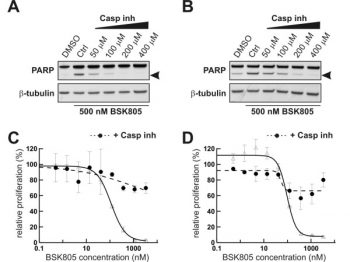
Caspase inhibition rescues JAK2V617F mutant cells from the apoptotic and anti-proliferative effects of the JAK2 inhibitor NVP-BSK805.BMC Cancer.2011 Jan 19;11:24. |
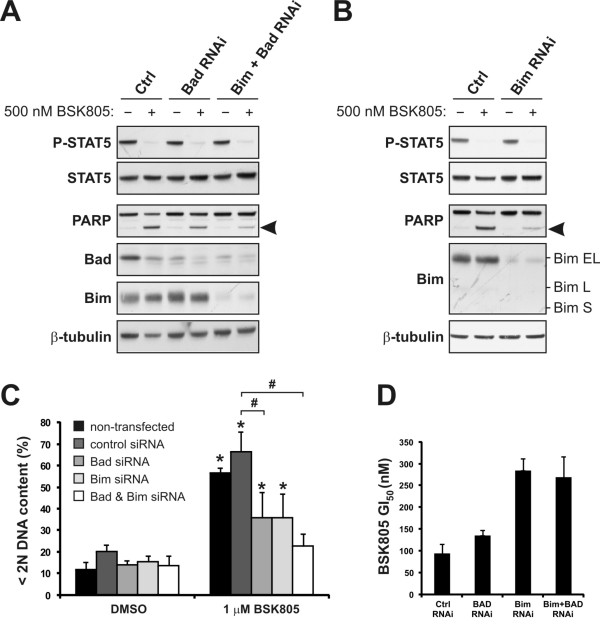
Bad and Bim depletion in JAK2V617F mutant SET-2 cells suppress NVP-BSK805-induced apoptosis.BMC Cancer.2011 Jan 19;11:24. |
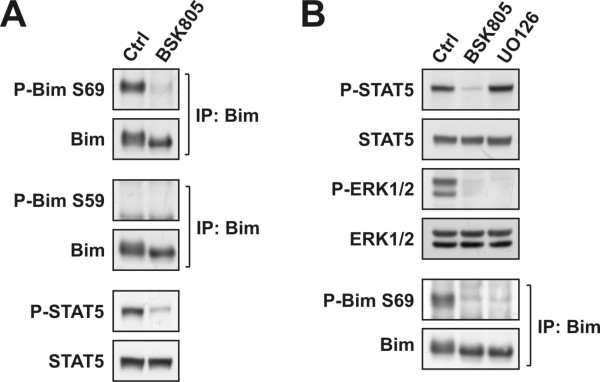
Analysis of Bim phosphorylation in JAK2V617F mutant SET-2 cells.BMC Cancer.2011 Jan 19;11:24. |
Products are for research use only; We do not sell to patients
Copyright 2020 InvivoChem LLC | All Rights Reserved


 COA
COA