| Size | Price | Stock | Qty |
|---|---|---|---|
| 5mg |
|
||
| 10mg |
|
||
| 25mg |
|
||
| 50mg |
|
||
| 100mg |
|
||
| 250mg |
|
||
| 500mg | |||
| Other Sizes |


Purity: ≥98%
| Targets |
Ubc13-Uev1A complex (also known as UBE2N-UBE2V1) [1]
NSC697923 targets UBE2N (Ubc13), an E2 ubiquitin-conjugating enzyme that plays a critical role in the formation of Lys63-linked polyubiquitin chains. It selectively inhibits UBE2N-Ub conjugation and the activity of the UBE2N-Uev1A complex. It has no effect on UbcH5c activity. By inhibiting UBE2N, NSC697923 blocks the activation of NF-κB and other signaling pathways that depend on Lys63-linked ubiquitination. This leads to the induction of apoptosis in cancer cells, particularly in neuroblastoma and DLBCL. |
|---|---|
| ln Vitro |
NSC697923 selectively inhibits PMA-induced NF-κB activation, and also inhibits IκBα phosphorylation by both RANKL and LPS. NSC697923 impedes the formation of the Ubc13 and ubiquitin thioester conjugate and suppresses constitutive NF-κB activity in ABC-DLBCL cells. In addition, NSC697923 inhibits the proliferation and survival of ABC-DLBCL cells and GCB-DLBCL cells, and also induces apoptosis of primary DLBCL cells. In neuroblastoma (NB) cell lines, NSC697923 shows cytotoxic effect, and inhibits both anchorage-dependent and -independent colony formation
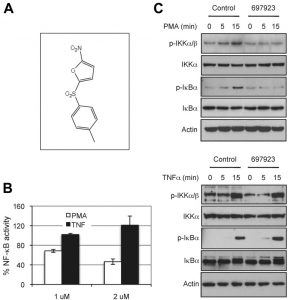
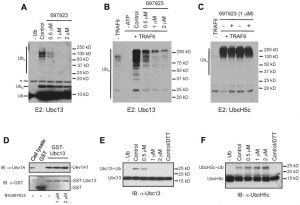
NSC697923 inhibits PMA-induced NF-κB activation in 293T-NF-luc cells at 2 µM but does not inhibit TNFα-induced activation (Figure 1). [1] It inhibits IκBα phosphorylation induced by RANKL (15 ng/mL) and LPS (1.5 µg/mL) in RAW264.7 and MEF cells (Figure 3). [1] It inhibits the formation of Ubc13~Ub thioester conjugate in OCI-Ly10 cells at 0.5-2 µM for 3 hours (Figure 5A). [1] It inhibits constitutive NF-κB signaling in ABC-DLBCL cells: at 0.5-2 µM for 3.5 hours, it decreases phosphorylation of IKK and IκBα, and reduces expression of NF-κB targets p100 and Mcl-1 in OCI-Ly10 cells (Figure 5B). [1] It inhibits proliferation and survival of ABC-DLBCL cells (OCI-Ly3, OCI-Ly10, HBL-1): treatment with 0.5-2 µM for 24 hours causes a dramatic decrease of live cells and increase of dead cells (Figure 5C). [1] It induces apoptosis in OCI-Ly10 cells: at 1-2 µM for 5 hours, it activates caspase-3 and cleaves PARP (Figure 5D); at 0.5-2 µM for 24 hours, it increases Annexin V-positive cells (Figure 5E). [1] It inhibits cell cycle progression: treatment of OCI-Ly10 cells with 1-2 µM for 5 hours results in a marked decrease of cells in S phase (Figure 5F). [1] It also inhibits proliferation and survival of GCB-DLBCL cells (OCI-Ly7, SUDHL-6): at 0.5-2 µM for 24 hours, it reduces live cells and induces apoptosis (Figure 6A-B). [1] It induces apoptosis in primary DLBCL cells from two patients: treatment with 0.5-2 µM for 24 hours increases Annexin V-positive cells (Figure 7). [1] In vitro, NSC697923 inhibits UBE2N-Ub conjugation and the activity of the UBE2N-Uev1A complex. It has no effect on UbcH5c activity. It inhibits NF-κB activation in DLBCL cells and inhibits cell growth and induces apoptosis in DLBCL and neuroblastoma cell lines. It induces neuroblastoma cell death via promoting nuclear importation of p53 in p53 wild-type cells and by activating p53 and JNK pathways. These in vitro activities confirm its mechanism as a UBE2N inhibitor. |
| ln Vivo |
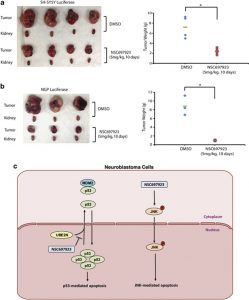
NSC697923 (5 mg/kg/day, i.p.) demonstrates potent antitumor efficacy in both NB SH-SY5Y and NGP xenografts.
In vivo, NSC697923 suppresses neuroblastoma cell xenograft tumor growth in mouse models. This demonstrates its potential as an anticancer agent. The compound's ability to inhibit UBE2N and induce apoptosis in cancer cells translates to antitumor activity in vivo. However, specific detailed in vivo study protocols and results are not extensively documented in standard summaries. Its efficacy in xenograft models supports its further investigation as a therapeutic agent for neuroblastoma and other cancers. |
| Enzyme Assay |
The reactions are carried out at 37°C for 40 minutes in a buffer containing 50mM Tris-HCl, pH 7.5, 5mM MgCl2, 200μM ATP, 120μM Ub (U-100H), and 0.1μM E1 (E-304). For Ubc13-mediated Ub chain synthesis, the reaction mixture includes 0.2 μM Ubc13 (E2-600) and 0.2 mM Uev1A (E2-662) with or without GST-TRAF6. For UbcH5c-catalyzed ubiquitination, UbcH5c (E2-627) instead of Ubc13 and Uev1A is used in the reaction. Compound NSC697923 is added into the reaction mixtures at the indicated concentrations. The reactions are terminated with an equal volume of SDS-PAGE sample buffer and the products are analyzed by Western blotting with a Ub-specific antibody. For detecting the E2-Ub (Ubc13∼Ub or UbcH5c∼Ub) thioester conjugates, the reactions are carried out as described in “In vitro ubiquitination assay” without GST-TRAF6. The reactions are terminated by the addition of the SDS-PAGE sample buffer without a reducing agent unless specified. The products are analyzed by Western blotting with an anti-Ubc13 or anti-UbcH5c antibody.
In vitro ubiquitination assays: Reactions were carried out at 37°C for 40 minutes in a buffer containing 50 mM Tris-HCl (pH 7.5), 5 mM MgCl2, 200 µM ATP, 120 µM ubiquitin, and 0.1 µM E1. For Ubc13-mediated ubiquitin chain synthesis, the reaction mixture included 0.2 µM Ubc13 and 0.2 mM Uev1A with or without GST-TRAF6. NSC697923 was added at indicated concentrations (0.5, 1, 2 µM). Products were analyzed by western blotting with a ubiquitin-specific antibody. The compound inhibited polyubiquitin chain formation in a dose-dependent manner (Figure 4A-B). [1] For detecting E2-ubiquitin thioester conjugates, reactions were carried out as above without GST-TRAF6, terminated with SDS-PAGE sample buffer without reducing agent, and analyzed by western blotting with anti-Ubc13 or anti-UbcH5c antibody. NSC697923 inhibited formation of the Ubc13~Ub conjugate but not UbcH5c~Ub (Figure 4E-F). [1] In vitro interaction assay between Ubc13 and Uev1A: GST-Ubc13 bound on glutathione-agarose beads was incubated with OCI-Ly10 cell lysates with or without NSC697923 (1, 2 µM) at 4°C for 1 hour. Beads were washed and bound Uev1A analyzed by western blotting. The compound showed no inhibitory effect on complex formation (Figure 4D). [1] Non-cellular enzyme assays for NSC697923 typically involve measuring its inhibition of UBE2N activity using purified enzyme and a ubiquitin conjugation assay. The compound's ability to inhibit UBE2N-Ub conjugation and the activity of the UBE2N-Uev1A complex is assessed. Its selectivity is confirmed by testing its effect on other E2 enzymes, such as UbcH5c. These assays are essential for characterizing the compound's potency and selectivity as a UBE2N inhibitor. Dose-response curves are generated to determine IC50 values. |
| Cell Assay |
Cell viability is measured by trypan blue exclusion assay.
Cell culture: HEK293T cells grown in DMEM +10% FBS. DLBCL cells (SUDHL-6, OCI-Ly3, OCI-Ly7, OCI-Ly10, HBL-1) cultured as previously described. Primary DLBCL cells prepared from fresh patient tumors by mechanical disruption and filtration. [1] NF-κB luciferase reporter assay: 293T-NF-luc cells (carrying stably integrated NF-κB-luciferase reporter and constitutively expressing GFP) seeded in 96-well plates at 30,000 cells/well. Compounds added at 2 µM final concentration 1.5 hours before stimulation with PMA (100 ng/mL) or TNFα (10 ng/mL). After 6 hours, cells lysed and luciferase activity measured and normalized to GFP fluorescence. NSC697923 inhibited PMA-induced but not TNFα-induced NF-κB activation (Figure 1B-C). [1] Cell viability assay: Cells seeded at 3×10^5 cells/mL in 6-well plates, treated with DMSO or NSC697923 (0.5, 1, 2 µM) for 24 hours, then live/dead cells counted by trypan blue exclusion. [1] Apoptosis assay: Cells treated as above, stained with 7AAD/Annexin V, and analyzed by flow cytometry. [1] Cell cycle analysis: Cells treated with NSC697923 for 4.5 hours, then BrdU added for 30 minutes before harvest, stained with propidium iodide and BrdU, and analyzed by flow cytometry. [1] Western blotting: Cells treated with NSC697923 for indicated times, lysed, and proteins detected with specific antibodies against phospho-IκBα, phospho-IKK, IκBα, IKK, Mcl-1, p100, cleaved caspase-3, PARP, etc. [1] In vitro cell-based assays for NSC697923 are conducted using cancer cell lines, such as DLBCL and neuroblastoma cells. Cells are treated with the compound, and its effects on cell growth, apoptosis, and NF-κB activation are assessed. The compound's ability to induce p53 nuclear importation and activate JNK pathways can also be studied. These experiments are crucial for confirming its mechanism of action and for identifying sensitive cancer types. The compound is soluble in DMSO up to 100 mM. |
| Animal Protocol |
Dissolved in DMSO; 5 mg/kg; i.p. injection SH-SY5Y and NGP xenografts
In vivo animal studies for NSC697923 have been conducted in mouse xenograft models of neuroblastoma. Tumor-bearing mice are treated with the compound, and tumor growth is monitored. The compound suppresses tumor growth in these models. These studies are crucial for validating its in vivo efficacy as an anticancer agent. However, specific detailed protocols, such as dosing regimens and routes of administration, are not extensively documented in standard summaries. |
| ADME/Pharmacokinetics |
NSC697923 has a molecular weight of 267.26 g/mol and a molecular formula of C11H9NO5S. It is soluble in DMSO up to 100 mM and in ethanol up to 25 mM with gentle warming. The compound should be stored at +4°C. As a research compound, its pharmacokinetic properties, such as absorption, distribution, metabolism, and excretion, are not extensively documented. It is a cell-permeable compound, allowing it to reach its intracellular target.
|
| Toxicity/Toxicokinetics |
NSC697923 shows much less toxic effects on the proliferation and survival of other cell types such as breast cancer and osteosarcoma cells compared to its effect on DLBCL cells (Supplemental Figure S6). [1]
Comprehensive toxicological data for NSC697923 are limited, as it is a research compound. It is intended for laboratory use only and is not for human consumption. As with all research chemicals, appropriate safety precautions should be taken when handling NSC697923. Its safety profile in vivo has not been extensively characterized beyond its antitumor efficacy in xenograft models. Standard toxicological assessments would be required for clinical development. |
| References |
Blood.2012 Aug 23;120(8):1668-77;Cell Death Dis.2014 Feb 20;5:e1079.
|
| Additional Infomation |
NSC697923 was identified from the NCI Mechanistic Set (879 compounds) via a cell-based screen for inhibitors of PKCβ signaling and NF-κB activation. Structure-activity relationship analysis indicates that the nitrofuran moiety is important but not sufficient for its inhibitory activity (Figure 2). [1]
The compound acts by specifically inhibiting the formation of the Ubc13~Ub thioester conjugate, thereby blocking Ubc13-Uev1A-mediated K63-linked polyubiquitination. [1] In ABC-DLBCL cells, inhibition of Ubc13 by NSC697923 leads to NF-κB suppression, p53 activation (increased nuclear p53 and p21 expression, Supplemental Figure S3A), and apoptosis. In GCB-DLBCL cells (which are NF-κB-independent and lack functional p53), the compound still induces toxicity, possibly via MAP kinase pathways. [1] NSC697923 may also sensitize cancer cells to radiation therapy or chemotherapy by inhibiting DNA double-strand break repair (Supplemental Figure S4). It exhibits additive cytotoxic effect on DLBCL cells with CHOP agents (Supplemental Figure S5). [1] Potential therapeutic target for DLBCL, especially ABC-DLBCL which harbors oncogenic mutations in CBM complex and may be resistant to PKCβ inhibition. [1] NSC697923 is a selective, cell-permeable inhibitor of UBE2N (Ubc13) that inhibits UBE2N-Ub conjugation and the activity of the UBE2N-Uev1A complex. It has no effect on UbcH5c activity. It induces apoptosis in neuroblastoma and DLBCL cells by inhibiting NF-κB activation and promoting p53 nuclear importation. It suppresses neuroblastoma xenograft tumor growth in vivo. NSC697923 is not an approved drug and is available as a research compound for studying UBE2N biology and cancer. |
| Molecular Formula |
C11H9NO5S
|
|
|---|---|---|
| Molecular Weight |
267.255
|
|
| Exact Mass |
267.02
|
|
| Elemental Analysis |
C, 49.44; H, 3.39; N, 5.24; O, 29.93; S, 12.00
|
|
| CAS # |
343351-67-7
|
|
| Related CAS # |
|
|
| PubChem CID |
394449
|
|
| Appearance |
White to light yellow solid powder
|
|
| LogP |
3.933
|
|
| Hydrogen Bond Donor Count |
0
|
|
| Hydrogen Bond Acceptor Count |
5
|
|
| Rotatable Bond Count |
2
|
|
| Heavy Atom Count |
18
|
|
| Complexity |
402
|
|
| Defined Atom Stereocenter Count |
0
|
|
| SMILES |
O=S(C1=CC=C([N+]([O-])=O)O1)(C2=CC=C(C)C=C2)=O
|
|
| InChi Key |
GAUHIPWCDXOLCZ-UHFFFAOYSA-N
|
|
| InChi Code |
InChI=1S/C11H9NO5S/c1-8-2-4-9(5-3-8)18(15,16)11-7-6-10(17-11)12(13)14/h2-7H,1H3
|
|
| Chemical Name |
2-[(4-Methylphenyl)sulfonyl]-5-nitrofuran
|
|
| Synonyms |
NSC697923; NSC 697923; NSC-697923
|
|
| HS Tariff Code |
2934.99.9001
|
|
| Storage |
Powder -20°C 3 years 4°C 2 years In solvent -80°C 6 months -20°C 1 month |
|
| Shipping Condition |
Room temperature (This product is stable at ambient temperature for a few days during ordinary shipping and time spent in Customs)
|
| Solubility (In Vitro) |
DMSO : 200~53 mg/mL (748.33 ~198.3 mM)
|
|---|---|
| Solubility (In Vivo) |
Solubility in Formulation 1: ≥ 5 mg/mL (18.71 mM) (saturation unknown) in 10% DMSO + 40% PEG300 + 5% Tween80 + 45% Saline (add these co-solvents sequentially from left to right, and one by one), clear solution.
For example, if 1 mL of working solution is to be prepared, you can add 100 μL of 50.0 mg/mL clear DMSO stock solution to 400 μL PEG300 and mix evenly; then add 50 μL Tween-80 to the above solution and mix evenly; then add 450 μL normal saline to adjust the volume to 1 mL. Preparation of saline: Dissolve 0.9 g of sodium chloride in 100 mL ddH₂ O to obtain a clear solution. Solubility in Formulation 2: ≥ 5 mg/mL (18.71 mM) (saturation unknown) in 10% DMSO + 90% Corn Oil (add these co-solvents sequentially from left to right, and one by one), clear solution. For example, if 1 mL of working solution is to be prepared, you can add 100 μL of 50.0 mg/mL clear DMSO stock solution to 900 μL of corn oil and mix evenly. (Please use freshly prepared in vivo formulations for optimal results.) |
| Preparing Stock Solutions | 1 mg | 5 mg | 10 mg | |
| 1 mM | 3.7417 mL | 18.7084 mL | 37.4167 mL | |
| 5 mM | 0.7483 mL | 3.7417 mL | 7.4833 mL | |
| 10 mM | 0.3742 mL | 1.8708 mL | 3.7417 mL |
*Note: Please select an appropriate solvent for the preparation of stock solution based on your experiment needs. For most products, DMSO can be used for preparing stock solutions (e.g. 5 mM, 10 mM, or 20 mM concentration); some products with high aqueous solubility may be dissolved in water directly. Solubility information is available at the above Solubility Data section. Once the stock solution is prepared, aliquot it to routine usage volumes and store at -20°C or -80°C. Avoid repeated freeze and thaw cycles.
Calculation results
Working concentration: mg/mL;
Method for preparing DMSO stock solution: mg drug pre-dissolved in μL DMSO (stock solution concentration mg/mL). Please contact us first if the concentration exceeds the DMSO solubility of the batch of drug.
Method for preparing in vivo formulation::Take μL DMSO stock solution, next add μL PEG300, mix and clarify, next addμL Tween 80, mix and clarify, next add μL ddH2O,mix and clarify.
(1) Please be sure that the solution is clear before the addition of next solvent. Dissolution methods like vortex, ultrasound or warming and heat may be used to aid dissolving.
(2) Be sure to add the solvent(s) in order.
|
|---|
|
|
Products are for research use only; We do not sell to patients
Copyright 2020 InvivoChem LLC | All Rights Reserved


 COA
COA