| Size | Price | Stock | Qty |
|---|---|---|---|
| 5g |
|
||
| 10g |
|
||
| 25g |
|
||
| Other Sizes |


| Targets |
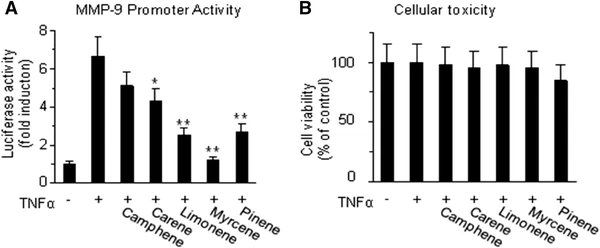
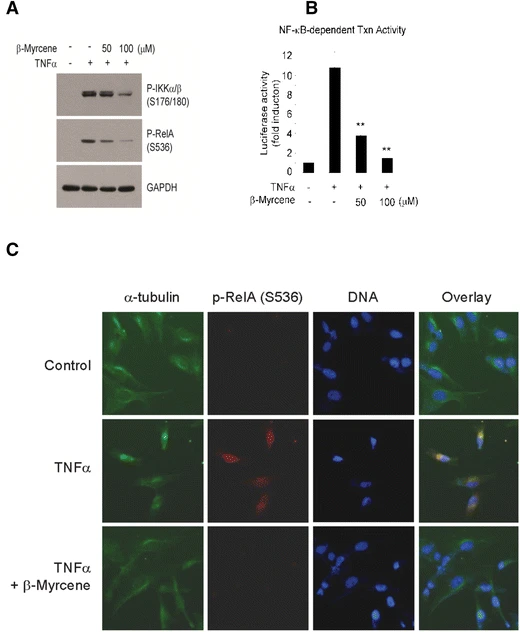
NF-κB (nuclear factor κB) – via inhibition of IKK (inhibitor of κB kinase) phosphorylation and subsequent p65/RelA activation. [2]
MMP-9 (matrix metalloproteinase-9) gene expression – indirectly via NF-κB pathway suppression. [2] |
|---|---|
| ln Vitro |
Myrcene treatment (0.1–10 μM) decreased intracellular reactive oxygen species (ROS) production in UVB-irradiated normal human dermal fibroblasts (NHDFs). At 1 μM and 10 μM, myrcene reduced ROS levels by 26.2% and 45.7%, respectively, compared to UVB-irradiated control cells. [1]
- Myrcene (10 μM) decreased MMP-1, MMP-3, and IL-6 secretion in UVB-irradiated NHDFs by 69.9%, 44.8%, and 80.9%, respectively, compared to irradiated-only cells. [1] - Myrcene (10 μM) increased TGF-β1 and type I procollagen secretion in UVB-irradiated NHDFs by 153.4% and 125.5%, respectively, compared to irradiated-only cells. In non-irradiated conditions, 10 μM myrcene increased type I procollagen expression by 128.7%, and decreased MMP-3 and IL-6 by 26.0% and 78.6%, respectively. [1] - Myrcene (1 and 10 μM) reduced UVB-induced MMP-1 mRNA expression in a dose-dependent manner, with 32.4% and 37.3% reduction, respectively, compared to UVB-only cells. [1] - Myrcene (1 and 10 μM) increased UVB-suppressed type I procollagen mRNA expression by 277.7% and 307.2%, respectively, compared to UVB-only cells. [1] - Myrcene (10 μM) significantly reduced UVB-induced phosphorylation of c-Fos and c-Jun (AP-1 activation) by 48.4% and 60.2%, respectively, compared to irradiated-only cells. [1] - Myrcene (10 μM) significantly reduced UVB-induced phosphorylation of ERK, p38, and JNK (MAPK pathway) by 66.1%, 92.9%, and 72.3%, respectively, compared to irradiated-only cells. UVB radiation alone increased p-ERK, p-p38, and p-JNK by 835.6%, 366.2%, and 1321.4%, respectively, compared to non-irradiated cells. [1] |
| Cell Assay |
Cell culture: Normal human dermal fibroblasts (NHDFs) were obtained from a skin biopsy of a healthy young male donor. Cells were cultured in DMEM supplemented with 10% heat-inactivated fetal bovine serum and 1% penicillin-streptomycin at 37°C in a humidified atmosphere containing 5% CO2. Cells were used between passages 5 and 10. [1]
- UVB irradiation and sample treatment: Cells were seeded in 35-mm tissue culture dishes. When cells reached 80% confluence, they were subjected to UVB irradiation at 144 mJ/cm² using a Bio-Link BLX-312. After irradiation, cells were treated with myrcene at concentrations of 0.1, 1, and 10 μM. Control cells were incubated in untreated DMEM medium. [1] - MTT assay for cell viability: After 72 h of treatment, cells were incubated with MTT, and the resulting product was solubilized in DMSO. After orbital shaking, absorbance was determined at 570 nm using a multi-mode microplate reader. At concentrations from 0.1 μM to 10 μM, myrcene alone had no significant cytotoxic effect. Viability of UVB-irradiated cells (144 mJ/cm²) was approximately 80%, and myrcene treatment slightly lowered viability compared to UVB-only control. [1] - Measurement of ROS generation: After 24 h of UVB irradiation, cells were stained with 30 μM DCFH-DA for 30 min at 37°C in a CO2 incubator and analyzed by flow cytometry. [1] - Measurement of MMP-1, MMP-3, IL-6, TGF-β1, and type I procollagen: After 72 h, supernatants were harvested and assessed using commercial ELISA kits according to the manufacturer’s instructions. Each sample was analyzed in triplicate. [1] - Reverse transcription-PCR (RT-PCR): After 24 h post-UVB irradiation, RNA was isolated from cells. PCR amplification was performed using specific primer pairs for MMP-1, type I procollagen, and GAPDH (internal control). PCR products were separated by gel electrophoresis on 2.0% agarose and visualized with ethidium bromide staining under UV illumination. [1] |
| ADME/Pharmacokinetics |
Absorption, Distribution and Excretion
In a pharmacokinetic study, after oral administration of 1.0 g/kg body weight (7300 μmol/kg body weight) of β-myrcene to female rats 60 minutes later, a blood concentration of β-myrcene was detected as high as 14.1 +/- 3.0 ug/mL (peak). This compound was primarily enriched in adipose tissue and multiple organs, including the brain, liver, kidney, and testes. Metabolisms/Metabolites Metabolites isolated from the urine of rats following oral administration of β-myrcene included: 10-hydroxylinalool, 7-methyl-3-methylene-oct-6-en-1,2-diol, 1-hydroxymethyl-4-isopropenylcyclohexanol, 10-carboxylinalool, and 2-hydroxy-7-methyl-3-methylene-oct-6-enoic acid. Phenobarbital-treated rat liver microsomes can convert β-myrcene to 10-hydroxylinalool in the presence of NADPH and oxygen. NADH neither participates in this reaction nor shows any synergistic effect. The conversion rate in rat microsomes treated with phenobarbital was significantly higher than that in the 3-methylcholanthrene-treated or control groups. The formation of 10-hydroxylinalool could be inhibited by metheprone, carbon monoxide, SKF-525A, p-chloromercuric benzoate (p-CMB), and cytochrome c. … Biological half-life … After oral administration of 1.0 g/kg body weight (7300 μmol/kg body weight) of β-myrcene to female rats, the elimination half-life of β-myrcene at this concentration was 285 minutes. … |
| Toxicity/Toxicokinetics |
Cytotoxicity: In MTT assay, myrcene alone at concentrations ranging from 0.1 μM to 10 μM had no significant cytotoxic effect on human dermal fibroblasts. Cell viability of UVB-irradiated cells treated with myrcene was slightly lower than that of UVB-irradiated control cells. [1]
|
| References |
|
| Additional Infomation |
According to the National Toxicology Program (NTP) in the United States, β-myrcene may be carcinogenic. Myrcene (liquid) is a yellow, oily liquid with a pleasant odor. Its flash point is below 200°F (93°C). It is insoluble in water and has a density less than water. β-Myrcene is a monoterpene, octyl-1,6-diene, with methylene and methyl substituents at positions 3 and 7, respectively. It is a plant metabolite with anti-inflammatory, anabolic, spice, flavoring, and volatile oil components. Myrcene has been reported in tea trees (Camellia sinensis), artemisia (Artemisia thanscula), and several other organisms with relevant data. 7-Methyl-3-methylene-1,6-octadiene is found in allspice. 7-Methyl-3-methylene-1,6-octadiene is also found in many essential oils, such as hop oil. 7-Methyl-3-methylene-1,6-octadiene is a flavoring agent. Myrcene is a metabolite found or produced in Saccharomyces cerevisiae. See also: Citrus oil (one of the ingredients); Juniper berry oil (one of the ingredients); Caraway oil (one of the ingredients)... See more...
Myrcene is a monoterpene first described as a sex pheromone and synergistic host terpene in 1969. The first pharmacological effect reported was antinociception activity in 1990. Other functional activities include antimutagenicity, metabolic activation of some promutagens, analgesic, antioxidant, antibacterial, anti-ulcer effects, and management of oxidative stress-induced type 2 diabetes. Tyrosinase inhibitory and anti-oxidative effects have also been reported for citrus essential oils containing myrcene. [1] - Mechanism in skin photoaging: Myrcene decreases UVB-induced ROS production, inhibits MAPK signaling (p-ERK, p-p38, p-JNK) and AP-1 activation (p-c-Jun, p-c-Fos), thereby downregulating MMP-1 and MMP-3 expression and upregulating TGF-β1 and type I procollagen expression. This protects against UVB-induced collagen degradation and skin photoaging. [1] |
| Molecular Formula |
C10H16
|
|---|---|
| Molecular Weight |
136.23404
|
| Exact Mass |
136.125
|
| CAS # |
123-35-3
|
| Related CAS # |
29463-45-4
|
| PubChem CID |
31253
|
| Appearance |
Colorless to light yellow liquid
|
| Density |
0.8±0.1 g/cm3
|
| Boiling Point |
167.0±0.0 °C at 760 mmHg
|
| Melting Point |
< -10 °C
; < -10 °C
|
| Flash Point |
39.4±0.0 °C
|
| Vapour Pressure |
2.3±0.1 mmHg at 25°C
|
| Index of Refraction |
1.450
|
| LogP |
4.58
|
| Hydrogen Bond Donor Count |
0
|
| Hydrogen Bond Acceptor Count |
0
|
| Rotatable Bond Count |
4
|
| Heavy Atom Count |
10
|
| Complexity |
145
|
| Defined Atom Stereocenter Count |
0
|
| SMILES |
C=CC(=C)CCC=C(C)C
|
| InChi Key |
UAHWPYUMFXYFJY-UHFFFAOYSA-N
|
| InChi Code |
InChI=1S/C10H16/c1-5-10(4)8-6-7-9(2)3/h5,7H,1,4,6,8H2,2-3H3
|
| Chemical Name |
7-methyl-3-methylideneocta-1,6-diene
|
| HS Tariff Code |
2934.99.9001
|
| Storage |
Powder -20°C 3 years 4°C 2 years In solvent -80°C 6 months -20°C 1 month Note: Please store this product in a sealed and protected environment (e.g. under nitrogen), avoid exposure to moisture. |
| Shipping Condition |
Room temperature (This product is stable at ambient temperature for a few days during ordinary shipping and time spent in Customs)
|
| Solubility (In Vitro) |
Ethanol :≥ 100 mg/mL (~734.05 mM)
DMSO : ~100 mg/mL (~734.05 mM) |
|---|---|
| Solubility (In Vivo) |
Solubility in Formulation 1: ≥ 2.5 mg/mL (18.35 mM) (saturation unknown) in 10% DMSO + 40% PEG300 + 5% Tween80 + 45% Saline (add these co-solvents sequentially from left to right, and one by one), clear solution.
For example, if 1 mL of working solution is to be prepared, you can add 100 μL of 25.0 mg/mL clear DMSO stock solution to 400 μL PEG300 and mix evenly; then add 50 μL Tween-80 to the above solution and mix evenly; then add 450 μL normal saline to adjust the volume to 1 mL. Preparation of saline: Dissolve 0.9 g of sodium chloride in 100 mL ddH₂ O to obtain a clear solution. Solubility in Formulation 2: ≥ 2.5 mg/mL (18.35 mM) (saturation unknown) in 10% DMSO + 90% (20% SBE-β-CD in Saline) (add these co-solvents sequentially from left to right, and one by one), clear solution. For example, if 1 mL of working solution is to be prepared, you can add 100 μL of 25.0 mg/mL clear DMSO stock solution to 900 μL of 20% SBE-β-CD physiological saline solution and mix evenly. Preparation of 20% SBE-β-CD in Saline (4°C,1 week): Dissolve 2 g SBE-β-CD in 10 mL saline to obtain a clear solution. View More
Solubility in Formulation 3: ≥ 2.5 mg/mL (18.35 mM) (saturation unknown) in 10% DMSO + 90% Corn Oil (add these co-solvents sequentially from left to right, and one by one), clear solution. |
| Preparing Stock Solutions | 1 mg | 5 mg | 10 mg | |
| 1 mM | 7.3405 mL | 36.7026 mL | 73.4053 mL | |
| 5 mM | 1.4681 mL | 7.3405 mL | 14.6811 mL | |
| 10 mM | 0.7341 mL | 3.6703 mL | 7.3405 mL |
*Note: Please select an appropriate solvent for the preparation of stock solution based on your experiment needs. For most products, DMSO can be used for preparing stock solutions (e.g. 5 mM, 10 mM, or 20 mM concentration); some products with high aqueous solubility may be dissolved in water directly. Solubility information is available at the above Solubility Data section. Once the stock solution is prepared, aliquot it to routine usage volumes and store at -20°C or -80°C. Avoid repeated freeze and thaw cycles.
Calculation results
Working concentration: mg/mL;
Method for preparing DMSO stock solution: mg drug pre-dissolved in μL DMSO (stock solution concentration mg/mL). Please contact us first if the concentration exceeds the DMSO solubility of the batch of drug.
Method for preparing in vivo formulation::Take μL DMSO stock solution, next add μL PEG300, mix and clarify, next addμL Tween 80, mix and clarify, next add μL ddH2O,mix and clarify.
(1) Please be sure that the solution is clear before the addition of next solvent. Dissolution methods like vortex, ultrasound or warming and heat may be used to aid dissolving.
(2) Be sure to add the solvent(s) in order.
Link: https://clinicaltrials.gov/ct2/show/NCT04451863
Conditions:Pain|Abuse, DrugLink: https://clinicaltrials.gov/ct2/show/NCT05432284
Conditions:Cannabis Use
|
|
|
Products are for research use only; We do not sell to patients
Copyright 2020 InvivoChem LLC | All Rights Reserved