| Size | Price | Stock | Qty |
|---|---|---|---|
| 5mg |
|
||
| 10mg |
|
||
| 25mg |
|
||
| 50mg |
|
||
| 100mg |
|
||
| 250mg |
|
||
| 500mg | |||
| Other Sizes |


Purity: ≥98%
| Targets |
MDM2 (Kd = 2.34 μM)
MX69 targets MDM2 (Mouse Double Minute 2) and XIAP (X-linked Inhibitor of Apoptosis Protein). It binds to the MDM2 RING domain, inhibiting its E3 ubiquitin ligase activity and promoting MDM2 autoubiquitination and degradation. This leads to the downregulation of both MDM2 and XIAP. It blocks the MDM2 protein-XIAP RNA interaction. |
|---|---|
| ln Vitro |
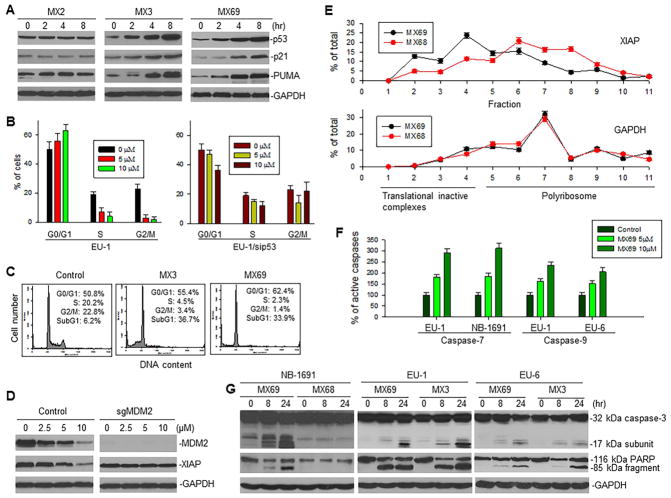
MX69 prevents the interaction between the MDM2 protein and XIAP RNA, which causes MDM2 to degrade. MX69 is extremely well tolerated in animal models and exhibits a negligible inhibitory effect on normal human hematopoiesis in vitro. In addition to inhibiting the expression of XIAP, MX69-induced MDM2 downregulation also activates p53, which aids in the in vitro apoptosis of cancer cells[1].
In vitro, MX69 binds to the MDM2 RING protein with a Kd of 2.34 µM. It inhibits MDM2 and XIAP expression in a time- and dose-dependent manner, and activates caspases 3, 7, and 9, and promotes PARP cleavage. In control-treated EU-1 cells, the half-life of MDM2 is over 90 minutes, while MX69 treatment shortens the MDM2 half-life to less than 30 minutes. |
| ln Vivo |
Cancer cell proliferation in vivo is inhibited by MX69-induced MDM2 downregulation, which also activates p53[1].
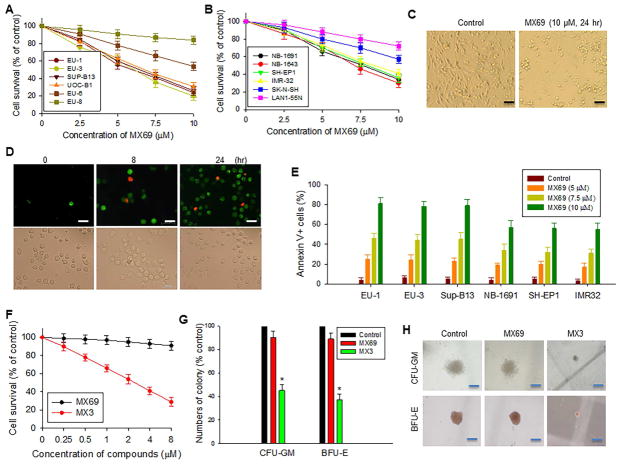
In vivo, MX69 has shown significant cytotoxic effects in acute lymphoblastic leukemia (ALL) and neuroblastoma (NB) cells, particularly in those overexpressing MDM2 and wild-type p53. MX69-induced cell death is primarily apoptotic. It is cytotoxic to a variety of ALL and neuroblastoma cancer cell lines but not to human normal bone marrow mononuclear (NBMM) cells. |
| Enzyme Assay |
MX69 is a novel, potent and selective MDM2/XIAP dual inhibitor that may be used to treat cancer. MX69 prevents the interaction between the MDM2 protein and the XIAP RNA, which causes MDM2 to degrade.
In vitro binding assays, such as surface plasmon resonance or isothermal titration calorimetry, are used to measure the binding affinity of MX69 to the MDM2 RING protein. The Kd of 2.34 µM is determined using these methods. |
| Cell Assay |
The cytotoxic effect of leads on six ALL cell lines (EU-1, EU-3, EU-6, EU-8, SUP-B13, and UOC-B1) and six NB cell lines (NB-1691, NB-1643, SH-EP1, IMR-32, SK-NSH, and LA1-55N) is determined using the WST assay. Briefly, different lead concentrations are applied to cell cultures in 96-well microtiter plates for a 20-hour period. The optical density is then measured using a microplate reader after the addition of WST (25 mg/well) and an additional 4 hours of incubation.
Cancer cells (e.g., ALL and NB cells) are treated with MX69. Cell viability, apoptosis markers (caspase activation, PARP cleavage), and MDM2/XIAP protein levels are measured. The effect on MDM2 ubiquitination and half-life is also assessed. |
| Animal Protocol |
The in vivo efficacy of MX69 is evaluated in xenograft mouse models of cancer. Tumor growth inhibition and survival are measured as key endpoints.
|
| ADME/Pharmacokinetics |
Pharmacokinetic properties of MX69, such as absorption, distribution, metabolism, and excretion, would be studied in preclinical species to support its development as an anticancer agent.
|
| Toxicity/Toxicokinetics |
Toxicology studies would assess the safety profile of MX69. As a dual inhibitor of MDM2 and XIAP, its potential for on-target and off-target effects would be carefully evaluated.
|
| References | |
| Additional Infomation |
MX69 is a research compound used to study the roles of MDM2 and XIAP in cancer. It is a tool for investigating the potential of targeting these proteins for cancer therapy. It is a dual inhibitor of MDM2 and XIAP.
|
| Molecular Formula |
C27H26N2O4S
|
|
|---|---|---|
| Molecular Weight |
474.5713
|
|
| Exact Mass |
474.161
|
|
| Elemental Analysis |
C, 68.33; H, 5.52; N, 5.90; O, 13.48; S, 6.76
|
|
| CAS # |
1005264-47-0
|
|
| Related CAS # |
|
|
| PubChem CID |
4075607
|
|
| Appearance |
White to off-white solid powder
|
|
| LogP |
5.2
|
|
| Hydrogen Bond Donor Count |
3
|
|
| Hydrogen Bond Acceptor Count |
6
|
|
| Rotatable Bond Count |
5
|
|
| Heavy Atom Count |
34
|
|
| Complexity |
876
|
|
| Defined Atom Stereocenter Count |
0
|
|
| SMILES |
O=C(O)C1=CC=C(C2C(CC=C3)C3C(C=C(S(=O)(NC4=CC(C)=C(C)C=C4)=O)C=C5)=C5N2)C=C1
|
|
| InChi Key |
XCBONKHCCRJMNW-UHFFFAOYSA-N
|
|
| InChi Code |
InChI=1S/C27H26N2O4S/c1-16-6-11-20(14-17(16)2)29-34(32,33)21-12-13-25-24(15-21)22-4-3-5-23(22)26(28-25)18-7-9-19(10-8-18)27(30)31/h3-4,6-15,22-23,26,28-29H,5H2,1-2H3,(H,30,31)
|
|
| Chemical Name |
4-[8-[(3,4-dimethylphenyl)sulfamoyl]-3a,4,5,9b-tetrahydro-3H-cyclopenta[c]quinolin-4-yl]benzoic acid
|
|
| Synonyms |
|
|
| HS Tariff Code |
2934.99.9001
|
|
| Storage |
Powder -20°C 3 years 4°C 2 years In solvent -80°C 6 months -20°C 1 month |
|
| Shipping Condition |
Room temperature (This product is stable at ambient temperature for a few days during ordinary shipping and time spent in Customs)
|
| Solubility (In Vitro) |
DMSO: ~95 mg/mL (~200.2 mM)
Water: 1 mg/mL (Insoluble) Ethanol: ~41 mg/mL (~86.4 mM) |
|---|---|
| Solubility (In Vivo) |
Solubility in Formulation 1: 2.5 mg/mL (5.27 mM) in 10% DMSO + 40% PEG300 + 5% Tween80 + 45% Saline (add these co-solvents sequentially from left to right, and one by one), suspension solution; with sonication.
For example, if 1 mL of working solution is to be prepared, you can add 100 μL of 25.0 mg/mL clear DMSO stock solution to 400 μL PEG300 and mix evenly; then add 50 μL Tween-80 to the above solution and mix evenly; then add 450 μL normal saline to adjust the volume to 1 mL. Preparation of saline: Dissolve 0.9 g of sodium chloride in 100 mL ddH₂ O to obtain a clear solution. Solubility in Formulation 2: ≥ 2.5 mg/mL (5.27 mM) (saturation unknown) in 10% DMSO + 90% (20% SBE-β-CD in Saline) (add these co-solvents sequentially from left to right, and one by one), clear solution. For example, if 1 mL of working solution is to be prepared, you can add 100 μL of 25.0 mg/mL clear DMSO stock solution to 900 μL of 20% SBE-β-CD physiological saline solution and mix evenly. Preparation of 20% SBE-β-CD in Saline (4°C,1 week): Dissolve 2 g SBE-β-CD in 10 mL saline to obtain a clear solution. View More
Solubility in Formulation 3: ≥ 2.5 mg/mL (5.27 mM) (saturation unknown) in 10% DMSO + 90% Corn Oil (add these co-solvents sequentially from left to right, and one by one), clear solution. |
| Preparing Stock Solutions | 1 mg | 5 mg | 10 mg | |
| 1 mM | 2.1072 mL | 10.5359 mL | 21.0717 mL | |
| 5 mM | 0.4214 mL | 2.1072 mL | 4.2143 mL | |
| 10 mM | 0.2107 mL | 1.0536 mL | 2.1072 mL |
*Note: Please select an appropriate solvent for the preparation of stock solution based on your experiment needs. For most products, DMSO can be used for preparing stock solutions (e.g. 5 mM, 10 mM, or 20 mM concentration); some products with high aqueous solubility may be dissolved in water directly. Solubility information is available at the above Solubility Data section. Once the stock solution is prepared, aliquot it to routine usage volumes and store at -20°C or -80°C. Avoid repeated freeze and thaw cycles.
Calculation results
Working concentration: mg/mL;
Method for preparing DMSO stock solution: mg drug pre-dissolved in μL DMSO (stock solution concentration mg/mL). Please contact us first if the concentration exceeds the DMSO solubility of the batch of drug.
Method for preparing in vivo formulation::Take μL DMSO stock solution, next add μL PEG300, mix and clarify, next addμL Tween 80, mix and clarify, next add μL ddH2O,mix and clarify.
(1) Please be sure that the solution is clear before the addition of next solvent. Dissolution methods like vortex, ultrasound or warming and heat may be used to aid dissolving.
(2) Be sure to add the solvent(s) in order.
Effect of leads on expression and function of p53 and XIAP following inhibition of MDM2.Cancer Cell.2016 Oct 10;30(4):623-636. |
|---|
Cytotoxic and apoptotic effects of leads on cancer and normal cells (A and B) WST assay for cytotoxic effect ofMX69on ALL (A) and NB (B) cells as indicated.Cancer Cell.2016 Oct 10;30(4):623-636. |
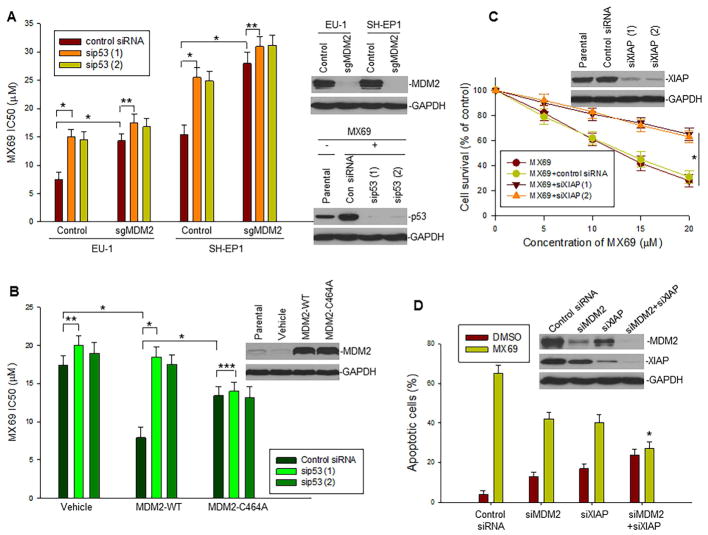 Dependence ofMX69-induced cell death on MDM2 and XIAP expression and p53 status (A) Comparison ofMX69IC50 values in MDM2 KO (sgMDM2) EU-1 and SH-EP1 cells in presence or absence of sip53.Cancer Cell.2016 Oct 10;30(4):623-636. |
Products are for research use only; We do not sell to patients
Copyright 2020 InvivoChem LLC | All Rights Reserved


 COA
COA