| Size | Price | Stock | Qty |
|---|---|---|---|
| 5mg |
|
||
| 10mg |
|
||
| 25mg |
|
||
| 50mg |
|
||
| 100mg |
|
||
| 250mg |
|
||
| 500mg | |||
| Other Sizes |
Purity: ≥98%
| Targets |
UNC-51-like Kinase 1 (ULK1) (Ki = 16 nM; IC50 = 36 nM for kinase activity) [2]
- No significant inhibition of other kinases (e.g., ULK2, Atg13, mTOR) at concentrations up to 10 μM (IC50 > 10 μM for all) [2] |
||
|---|---|---|---|
| ln Vitro |
MRT67307 inhibits TBK1 and IKKε in vitro at 0.1 mM ATP with IC50 values of 160 and 19 nM, respectively, but not IKKα or IKKβ, not even at 10 μM [1]. MRT67307 (2 μM) inhibits bone marrow-derived macrophages (BMDM) from phosphorylating IRF3. Poly (I:C) does not prevent JNK or p38 MAPK from being activated by MRT67307 (2 μM)[1]. MRT67307 (1 nM–10 μM) inhibits macrophages' ability to produce IFNβ [1]. It just takes 10 μM of MRT67307 to bring phosphorylated ATG13 down to control levels [2]. In mouse embryonic fibroblasts (MEFs), autophagy is inhibited by MRT67307 (10 μM) [2]. In 293T cells, TBK1/IKKε-induced CYLD phosphorylation is eliminated by MRT67307 (5 μM; 4 h) [3].
MRT67307 potently inhibited ULK1 kinase activity in a dose-dependent manner, with >90% inhibition at 100 nM [2] - In HeLa cells, MRT67307 (1 μM) blocked rapamycin-induced autophagy: LC3-II (autophagy marker) levels reduced by 75% compared to rapamycin alone (western blot) [2] - MRT67307 (1 μM) inhibited starvation-induced autophagy in HEK293T cells, as evidenced by 65% reduction in GFP-LC3 puncta formation (fluorescence microscopy) [2] - The compound reduced ULK1-mediated phosphorylation of Atg13 (Ser318) by 80% and FIP200 (Ser139) by 70% in rapamycin-treated HeLa cells (western blot) [2] - No significant cytotoxicity was observed in HeLa, HEK293T, or normal human fibroblasts at MRT67307 concentrations up to 5 μM (cell viability >90% vs. vehicle) [2] |
||
| ln Vivo |
|
||
| Enzyme Assay |
Recombinant human ULK1 kinase domain was purified and resuspended in reaction buffer containing Tris-HCl, MgCl2, and DTT [2]
- Kinase activity assay: 96-well plates were loaded with ULK1 (50 nM), ATP (10 μM), biotinylated Atg13 peptide substrate, and serial dilutions of MRT67307 (0.01-10 μM) [2] - Reaction mixtures were incubated at 30 °C for 45 minutes, then mixed with streptavidin-coated beads and phosphospecific antibody to detect phosphorylated substrate [2] - Luminescence signal was measured using a microplate reader, and IC50 values were calculated by nonlinear regression of dose-response curves [2] - Surface Plasmon Resonance (SPR): ULK1 was immobilized on a sensor chip, and MRT67307 was injected at serial concentrations (0.1-50 μM) to measure binding kinetics and derive Ki values [2] |
||
| Cell Assay |
Western Blot Analysis[3]
Cell Types: 293T cells Tested Concentrations: 5 µM Incubation Duration: 4 hrs (hours) Experimental Results: Abrogated TBK1/IKKε-induced CYLD phosphorylation. HeLa/HEK293T/normal human fibroblasts were cultured in complete medium at 37 °C with 5% CO2 until 70-80% confluency [2] - Autophagy inhibition assay (rapamycin-induced): HeLa cells were seeded into 6-well plates (2×10⁵ cells/well), pretreated with MRT67307 (0.1-2 μM) for 1 hour, then treated with rapamycin (100 nM) for 24 hours [2] - Autophagy inhibition assay (starvation-induced): HEK293T cells transfected with GFP-LC3 plasmid were seeded into 24-well plates, pretreated with MRT67307 (1 μM) for 1 hour, then cultured in Earle's balanced salt solution (EBSS) for 4 hours [2] - Western blot: Cells were lysed in ice-cold lysis buffer, and protein extracts were probed with anti-LC3, anti-p-Atg13 (Ser318), anti-p-FIP200 (Ser139), anti-ULK1, and anti-β-actin antibodies [2] - Fluorescence microscopy: GFP-LC3 puncta in HEK293T cells were visualized and counted under a fluorescence microscope to quantify autophagy levels [2] - Cell viability assay: Cells were seeded into 96-well plates (5×10³ cells/well), treated with MRT67307 (0.1-5 μM) for 72 hours, and viability was assessed by MTT assay [2] |
||
| Animal Protocol |
|
||
| References |
|
||
| Additional Infomation |
N-[3-[[5-cyclopropyl-2-[3-(4-morpholinylmethyl)anilino]-4-pyrimidinyl]amino]propyl]cyclobutanecarboxamide is an aromatic amine. MRT67307 is a selective small molecule inhibitor that inhibits UNC-51-like kinase 1 (ULK1), a key regulator of the autophagy initiation complex [2]. Its mechanism of action involves binding to the ATP-binding pocket of ULK1, inhibiting its kinase activity, and blocking the phosphorylation of downstream autophagy-related proteins (Atg13, FIP200) [2]. MRT67307 effectively blocks rapamycin-induced (mTOR-dependent) and starvation-induced autophagy in mammalian cells [2]. This compound has been widely used as a research tool to study the role of ULK1-mediated autophagy in cellular processes and disease pathogenesis [2].
|
| Molecular Formula |
C26H36N6O2
|
|
|---|---|---|
| Molecular Weight |
464.6 (free-base)
|
|
| Exact Mass |
464.289
|
|
| CAS # |
1190378-57-4
|
|
| Related CAS # |
MRT67307 hydrochloride;2095432-39-4;MRT67307 dihydrochloride;1781882-89-0
|
|
| PubChem CID |
44464263
|
|
| Appearance |
Light yellow to yellow solid powder
|
|
| Density |
1.3±0.1 g/cm3
|
|
| Index of Refraction |
1.652
|
|
| LogP |
1.3
|
|
| Hydrogen Bond Donor Count |
3
|
|
| Hydrogen Bond Acceptor Count |
7
|
|
| Rotatable Bond Count |
11
|
|
| Heavy Atom Count |
34
|
|
| Complexity |
637
|
|
| Defined Atom Stereocenter Count |
0
|
|
| InChi Key |
UKBGBACORPRCGG-UHFFFAOYSA-N
|
|
| InChi Code |
InChI=1S/C26H36N6O2/c33-25(21-5-2-6-21)28-11-3-10-27-24-23(20-8-9-20)17-29-26(31-24)30-22-7-1-4-19(16-22)18-32-12-14-34-15-13-32/h1,4,7,16-17,20-21H,2-3,5-6,8-15,18H2,(H,28,33)(H2,27,29,30,31)
|
|
| Chemical Name |
N-[3-[[5-cyclopropyl-2-[3-(morpholin-4-ylmethyl)anilino]pyrimidin-4-yl]amino]propyl]cyclobutanecarboxamide
|
|
| Synonyms |
|
|
| HS Tariff Code |
2934.99.9001
|
|
| Storage |
Powder -20°C 3 years 4°C 2 years In solvent -80°C 6 months -20°C 1 month |
|
| Shipping Condition |
Room temperature (This product is stable at ambient temperature for a few days during ordinary shipping and time spent in Customs)
|
| Solubility (In Vitro) |
|
|||
|---|---|---|---|---|
| Solubility (In Vivo) |
Solubility in Formulation 1: ≥ 2.5 mg/mL (5.38 mM) (saturation unknown) in 10% DMSO + 40% PEG300 + 5% Tween80 + 45% Saline (add these co-solvents sequentially from left to right, and one by one), clear solution.
For example, if 1 mL of working solution is to be prepared, you can add 100 μL of 25.0 mg/mL clear DMSO stock solution to 400 μL PEG300 and mix evenly; then add 50 μL Tween-80 to the above solution and mix evenly; then add 450 μL normal saline to adjust the volume to 1 mL. Preparation of saline: Dissolve 0.9 g of sodium chloride in 100 mL ddH₂ O to obtain a clear solution. Solubility in Formulation 2: ≥ 2.5 mg/mL (5.38 mM) (saturation unknown) in 10% DMSO + 90% Corn Oil (add these co-solvents sequentially from left to right, and one by one), clear solution. For example, if 1 mL of working solution is to be prepared, you can add 100 μL of 25.0 mg/mL clear DMSO stock solution to 900 μL of corn oil and mix evenly. (Please use freshly prepared in vivo formulations for optimal results.) |
Calculation results
Working concentration: mg/mL;
Method for preparing DMSO stock solution: mg drug pre-dissolved in μL DMSO (stock solution concentration mg/mL). Please contact us first if the concentration exceeds the DMSO solubility of the batch of drug.
Method for preparing in vivo formulation::Take μL DMSO stock solution, next add μL PEG300, mix and clarify, next addμL Tween 80, mix and clarify, next add μL ddH2O,mix and clarify.
(1) Please be sure that the solution is clear before the addition of next solvent. Dissolution methods like vortex, ultrasound or warming and heat may be used to aid dissolving.
(2) Be sure to add the solvent(s) in order.
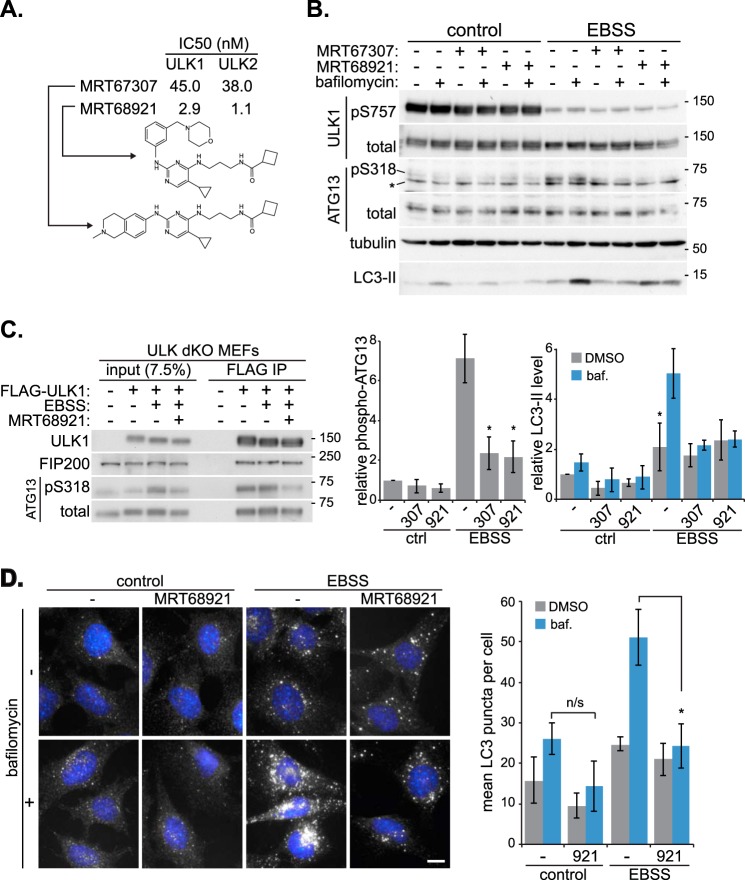 MRT67307 and MRT68921 inhibit ULK and block autophagy in cells.J Biol Chem.2015 May 1;290(18):11376-83. |
|---|
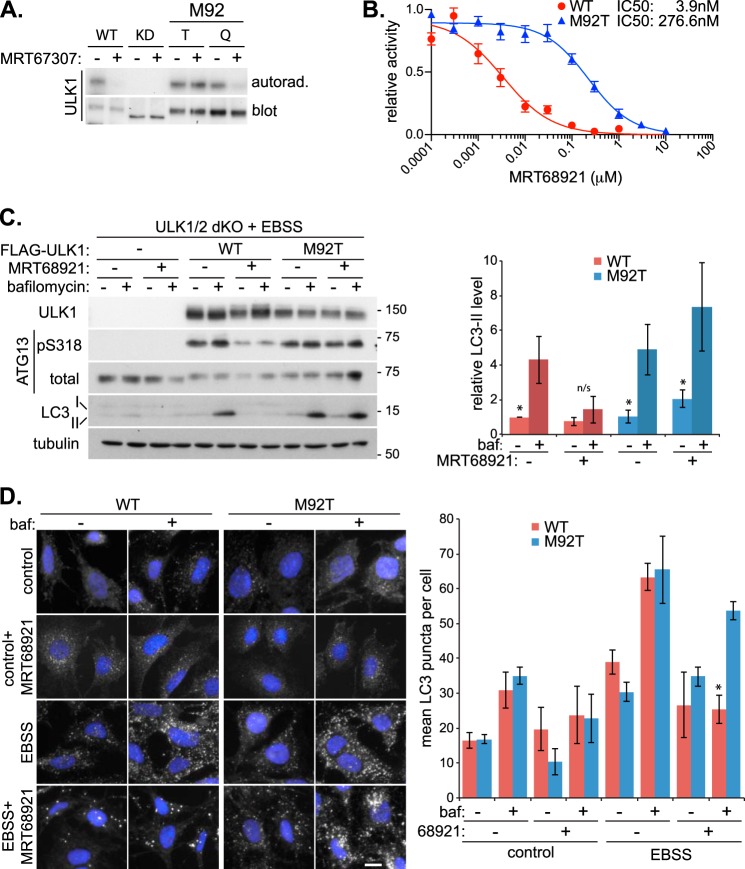
MRT68921 specifically blocks autophagic flux through ULK1 inhibition.J Biol Chem.2015 May 1;290(18):11376-83. |
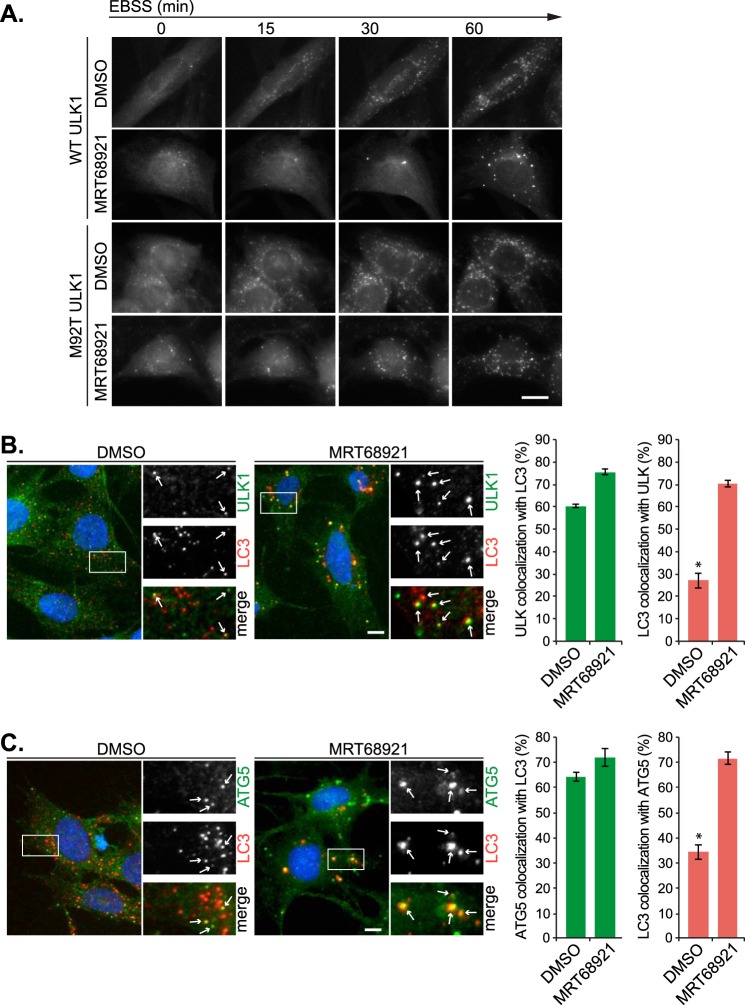 ULK inhibition also disrupts autophagosome maturation.J Biol Chem.2015 May 1;290(18):11376-83. |
Products are for research use only; We do not sell to patients
Copyright 2020 InvivoChem LLC | All Rights Reserved


 COA
COA