| Size | Price | Stock | Qty |
|---|---|---|---|
| 5mg |
|
||
| 10mg |
|
||
| 50mg |
|
||
| 100mg |
|
||
| 250mg | |||
| Other Sizes |


| Targets |
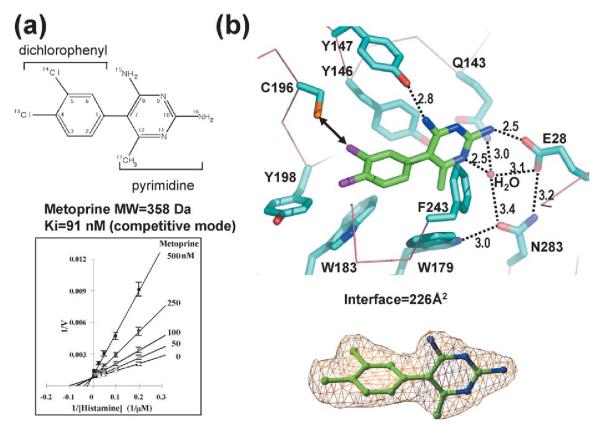
Histamine N-methyltransferase (HMT); dihydrofolate reductase (DHFR). Metoprine inhibits HMT, resulting in decreased histamine catabolism and increased brain histamine levels. It also inhibits dihydrofolate reductase, resulting in decreased cellular folate metabolism and cell growth. The compound is a lipid-soluble diaminopyrimidine capable of crossing the blood-brain barrier.
|
|---|---|
| ln Vitro |
Metoprine attenuates methamphetamine-induced hyperlocomotion via activation of histaminergic neurotransmission in mice. As a dihydrofolate reductase inhibitor, it has potential antineoplastic activity. Its in vitro activity has been characterized in enzyme inhibition assays measuring HMT and DHFR activity.
|
| ln Vivo |
Metropine (BW 197U; 2-10 mg/kg; IP) improves memory deficits produced by magnocellular nucleus basalis (NBM) injury in a dose-dependent manner [2]. Intraperitoneal metropine injection generates a number of behavioral effects, including reduced meal intake and increased water consumption [1].
In vivo, Metoprine increases brain histamine levels by inhibiting HMT, leading to activation of histaminergic neurotransmission. It induces thirst and diuresis in Wistar rats. The compound has anti-insomnia effects in modified mouse passive avoidance tests. Its ability to cross the blood-brain barrier makes it useful for studying central histaminergic function. |
| Enzyme Assay |
In vitro enzyme assays for Metoprine involve measuring histamine N-methyltransferase activity in the presence of varying concentrations of the compound. The enzyme is incubated with histamine and S-adenosylmethionine, and the formation of methylhistamine is measured using chromatographic or radiometric methods. IC50 values are determined from dose-response curves. DHFR inhibition assays measure the reduction of dihydrofolate to tetrahydrofolate.
|
| Cell Assay |
Cellular assays for Metoprine are not extensively documented. When performed, they typically involve culturing cells and assessing the effects of Metoprine on cell proliferation or histamine metabolism. The compound's ability to inhibit DHFR can be assessed by measuring folate-dependent cell growth.
|
| Animal Protocol |
Animal/Disease Models: Male SD (SD (Sprague-Dawley)) rat (200-280g) [2]
Doses: 2, 5, 10 mg/kg Route of Administration: IP Experimental Results: Improvement in a dose-dependent manner by the magnocellular nucleus basalis ( NBM) injury-induced memory deficits, the metastasis latency was Dramatically prolonged at the high dose of 10 mg/kg. In vivo animal studies for Metoprine have been conducted in mice and rats. In mice, the compound attenuates methamphetamine-induced hyperlocomotion. In Wistar rats, Metoprine induces thirst and diuresis. In modified mouse passive avoidance tests, Metoprine has anti-insomnia effects. The compound is typically administered intraperitoneally or orally. Dosing regimens vary depending on the study. |
| ADME/Pharmacokinetics |
Metoprine is a lipid-soluble compound capable of crossing the blood-brain barrier. It has a molecular weight of 269.13 and a molecular formula of C11H10Cl2N4. The compound is typically stored at room temperature. It is soluble in DMSO and other organic solvents. Detailed pharmacokinetic parameters are not extensively documented.
|
| Toxicity/Toxicokinetics |
Metoprine is generally considered safe for research use at appropriate concentrations. Comprehensive toxicological data are limited. The compound is a research chemical and is not approved for human therapeutic use. Standard laboratory safety precautions should be taken when handling the compound.
|
| References |
|
| Additional Infomation |
Metoprine is a diaminopyrimidine folate antagonist with potential antitumor activity. Metoprine inhibits dihydrofolate reductase, thereby reducing cellular folate metabolism and cell growth; it also inhibits histamine-N-methyltransferase, thereby reducing histamine catabolism. The lipid-soluble metoprine can cross the blood-brain barrier. (NCI04)
Metoprine (BW 197U) is a diaminopyrimidine derivative that acts as a potent histamine N-methyltransferase inhibitor and a dihydrofolate reductase inhibitor. It can cross the blood-brain barrier and increase brain histamine levels. The compound has been studied for its effects on histaminergic neurotransmission and its potential antineoplastic activity. It is not approved for clinical use and is available for research purposes only. |
| Molecular Formula |
C11H10N4CL2
|
|---|---|
| Molecular Weight |
269.1299
|
| Exact Mass |
268.028
|
| CAS # |
7761-45-7
|
| Related CAS # |
Metoprine; 7761-45-7
|
| PubChem CID |
24466
|
| Appearance |
White to light yellow solid powder
|
| Density |
1.447g/cm3
|
| Boiling Point |
483.7ºC at 760 mmHg
|
| Melting Point |
275-276ºC
|
| Flash Point |
246.3ºC
|
| Index of Refraction |
1.678
|
| LogP |
4.085
|
| Hydrogen Bond Donor Count |
2
|
| Hydrogen Bond Acceptor Count |
4
|
| Rotatable Bond Count |
1
|
| Heavy Atom Count |
17
|
| Complexity |
266
|
| Defined Atom Stereocenter Count |
0
|
| SMILES |
CC1=C(C(N)=NC(N)=N1)C2=CC=C(C(Cl)=C2)Cl
|
| InChi Key |
VQJHOPSWBGJHQS-UHFFFAOYSA-N
|
| InChi Code |
InChI=1S/C11H10Cl2N4/c1-5-9(10(14)17-11(15)16-5)6-2-3-7(12)8(13)4-6/h2-4H,1H3,(H4,14,15,16,17)
|
| Chemical Name |
5-(3,4-dichlorophenyl)-6-methylpyrimidine-2,4-diamine
|
| HS Tariff Code |
2934.99.9001
|
| Storage |
Powder -20°C 3 years 4°C 2 years In solvent -80°C 6 months -20°C 1 month |
| Shipping Condition |
Room temperature (This product is stable at ambient temperature for a few days during ordinary shipping and time spent in Customs)
|
| Solubility (In Vitro) |
DMSO : ~20.83 mg/mL (~77.40 mM)
|
|---|---|
| Solubility (In Vivo) |
Solubility in Formulation 1: ≥ 2.08 mg/mL (7.73 mM) (saturation unknown) in 10% DMSO + 40% PEG300 + 5% Tween80 + 45% Saline (add these co-solvents sequentially from left to right, and one by one), clear solution.
For example, if 1 mL of working solution is to be prepared, you can add 100 μL of 20.8 mg/mL clear DMSO stock solution to 400 μL PEG300 and mix evenly; then add 50 μL Tween-80 to the above solution and mix evenly; then add 450 μL normal saline to adjust the volume to 1 mL. Preparation of saline: Dissolve 0.9 g of sodium chloride in 100 mL ddH₂ O to obtain a clear solution. Solubility in Formulation 2: ≥ 2.08 mg/mL (7.73 mM) (saturation unknown) in 10% DMSO + 90% Corn Oil (add these co-solvents sequentially from left to right, and one by one), clear solution. For example, if 1 mL of working solution is to be prepared, you can add 100 μL of 20.8 mg/mL clear DMSO stock solution to 900 μL of corn oil and mix evenly. (Please use freshly prepared in vivo formulations for optimal results.) |
| Preparing Stock Solutions | 1 mg | 5 mg | 10 mg | |
| 1 mM | 3.7157 mL | 18.5784 mL | 37.1568 mL | |
| 5 mM | 0.7431 mL | 3.7157 mL | 7.4314 mL | |
| 10 mM | 0.3716 mL | 1.8578 mL | 3.7157 mL |
*Note: Please select an appropriate solvent for the preparation of stock solution based on your experiment needs. For most products, DMSO can be used for preparing stock solutions (e.g. 5 mM, 10 mM, or 20 mM concentration); some products with high aqueous solubility may be dissolved in water directly. Solubility information is available at the above Solubility Data section. Once the stock solution is prepared, aliquot it to routine usage volumes and store at -20°C or -80°C. Avoid repeated freeze and thaw cycles.
Calculation results
Working concentration: mg/mL;
Method for preparing DMSO stock solution: mg drug pre-dissolved in μL DMSO (stock solution concentration mg/mL). Please contact us first if the concentration exceeds the DMSO solubility of the batch of drug.
Method for preparing in vivo formulation::Take μL DMSO stock solution, next add μL PEG300, mix and clarify, next addμL Tween 80, mix and clarify, next add μL ddH2O,mix and clarify.
(1) Please be sure that the solution is clear before the addition of next solvent. Dissolution methods like vortex, ultrasound or warming and heat may be used to aid dissolving.
(2) Be sure to add the solvent(s) in order.
|
|
Products are for research use only; We do not sell to patients
Copyright 2020 InvivoChem LLC | All Rights Reserved