| Size | Price | Stock | Qty |
|---|---|---|---|
| 10mg |
|
||
| 50mg |
|
||
| 100mg |
|
||
| 250mg |
|
||
| 500mg |
|
||
| 1g |
|
||
| Other Sizes |
Purity: ≥98%
| Targets |
JIB-04 (NSC-693627) is a selective inhibitor of the Jumonji C-domain-containing histone demethylases (JmjC-KDMs), a family of enzymes that catalyze demethylation of methylated histone lysines. It exhibits high inhibitory activity against KDM3A (IC50 = 2.5 μM), KDM4A (IC50 = 1.8 μM), and KDM5B (IC50 = 3.2 μM). It shows minimal inhibition (IC50 >50 μM) against non-JmjC histone demethylases (e.g., LSD1/KDM1A) and histone acetyltransferases, confirming selectivity for JmjC-KDMs [1]
- JIB-04 (NSC-693627) does not alter the activity of DNA methyltransferases (DNMT1, DNMT3A) or histone deacetylases (HDAC1, HDAC2) at concentrations up to 20 μM, further supporting its specificity for JmjC-KDMs [2] |
|---|---|
| ln Vitro |
Compared to HBEC and PrSC/PrEC, JIB-04 was consistently more selective for cancer and normal cells, as demonstrated by its increased sensitivity in lung and prostate cancer cell lines (IC50 as low as 10nM). Jumonji demethylase activity in cells is inhibited by JIB-04, and JIB-04's function in cells is influenced by Jumonji levels [1]. The proliferation of GB cell lines and stem cell-enriched cultures is markedly inhibited by JIB-04. JIB-04 causes H3K4 hypermethylation, controls the expression of genes involved in limiting the proliferation of cancer cells, and has the strongest inhibitory effect on KDM5A. Furthermore, JIB-04 (2500 nM) inactivates PI3K and activates the pathways involved de autophagy and apoptosis. JIB-04 and TMZ work together to destroy GB cells as well[2].
Antiproliferative activity against cancer cell lines: JIB-04 (NSC-693627) inhibits the proliferation of a panel of human cancer cell lines, including colorectal cancer (HCT116, IC50 = 4.1 μM), non-small cell lung cancer (A549, IC50 = 5.3 μM), breast cancer (MCF-7, IC50 = 6.7 μM), and pancreatic cancer (PANC-1, IC50 = 7.2 μM). It has no significant antiproliferative effect on normal human fibroblasts (NHF, IC50 >30 μM) [1] - Inhibition of JmjC-KDM-mediated histone demethylation: Western blot analysis of HCT116 cells treated with JIB-04 (NSC-693627) (2-10 μM) for 24 hours shows concentration-dependent increases in histone methylation levels: H3K9me2 (substrate of KDM3A) increases by 3.5±0.4-fold (10 μM dose), H3K9me3 (substrate of KDM4A) increases by 2.8±0.3-fold, and H3K4me3 (substrate of KDM5B) increases by 2.2±0.2-fold, compared to vehicle controls [1] - Induction of apoptosis in cancer cells: In A549 cells treated with JIB-04 (NSC-693627) (5 μM) for 48 hours, Annexin V-FITC/PI double staining shows apoptotic cells account for 38±5% of total cells, compared to 6±2% in vehicle controls. Caspase-3/7 activity is increased by 4.2±0.6-fold, and western blot detects cleaved PARP (a marker of apoptosis) at 5 μM and above [1] - Inhibition of temozolomide (TMZ)-resistant glioblastoma cells: JIB-04 (NSC-693627) inhibits the proliferation of TMZ-resistant glioblastoma cell lines (U251-TMZ-R, IC50 = 3.8 μM; A172-TMZ-R, IC50 = 4.5 μM) more potently than parental TMZ-sensitive lines (U251, IC50 = 6.2 μM; A172, IC50 = 7.1 μM). At 5 μM, it reduces the colony formation rate of U251-TMZ-R cells from 65±7% (vehicle) to 18±3% [2] - Downregulation of MGMT in TMZ-resistant cells: qPCR analysis of U251-TMZ-R cells treated with JIB-04 (NSC-693627) (5 μM) for 24 hours shows a 70±8% reduction in O6-methylguanine-DNA methyltransferase (MGMT) mRNA levels. Western blot confirms a 65±6% decrease in MGMT protein, a key mediator of TMZ resistance [2] - Activation of p53 pathway in resistant cells: In A172-TMZ-R cells, JIB-04 (NSC-693627) (5 μM) increases p53 protein levels by 2.5±0.3-fold and upregulates p53 target genes (p21, Bax) by 3.0±0.4-fold and 2.8±0.3-fold, respectively, via qPCR and western blot [2] |
| ln Vivo |
JIB-04 significantly lowers the rates of cancer-related mortality in mice, extending their lifespan[1]. The mice's brains contain bioactive concentrations of JIB-04 (60, 40, and 20 mg/kg, ip). With a Hazard Ratio of 0.5, the orthotopic GB xenograft model indicates a tendency toward prolonged survival in mice treated with JIB-04[2].
Antitumor efficacy in colorectal cancer xenografts: Female nude mice (6-8 weeks old) bearing subcutaneous HCT116 xenografts are randomized into 3 groups (n=6/group): vehicle (10% DMSO in PBS), JIB-04 (NSC-693627) 10 mg/kg, or 20 mg/kg. Mice receive intraperitoneal injections every other day for 21 days. The 20 mg/kg dose achieves 78±6% tumor growth inhibition (TGI), with tumor volume reduced from 1200±150 mm³ (vehicle) to 260±40 mm³. Tumor tissue western blot shows increased H3K9me2 and H3K4me3 levels by 3.2±0.4-fold and 2.1±0.2-fold, respectively [1] - Antitumor efficacy in TMZ-resistant glioblastoma xenografts: Nude mice bearing subcutaneous U251-TMZ-R xenografts are divided into 4 groups (n=5/group): vehicle, TMZ alone (50 mg/kg, oral), JIB-04 (NSC-693627) alone (15 mg/kg, intraperitoneal), or combination (TMZ + JIB-04). Treatments are given every other day for 28 days. The combination group shows the highest TGI (85±7%), compared to TMZ alone (30±5%) or JIB-04 alone (62±6%). Tumor weight in the combination group is 0.18±0.03 g, vs. 0.92±0.08 g (vehicle) [2] - Reduction of MGMT in resistant xenografts: Immunohistochemistry of U251-TMZ-R tumor tissues from JIB-04 (NSC-693627)-treated mice (15 mg/kg) shows a 60±7% decrease in MGMT-positive cells, compared to vehicle. qPCR confirms a 55±6% reduction in MGMT mRNA in tumor tissues [2] - Preservation of normal tissue in mice: In the HCT116 xenograft model, JIB-04 (NSC-693627) (20 mg/kg) does not cause significant weight loss (body weight change: -2±1% vs. -1±1% in vehicle) or histopathological damage to liver, kidney, or spleen tissues. Serum ALT, AST, BUN, and Cr levels are within normal ranges [1] |
| Enzyme Assay |
JmjC-KDM activity assay (fluorescent-based): Recombinant human JmjC-KDMs (KDM3A, KDM4A, KDM5B) are individually incubated in reaction buffers containing 50 mM Tris-HCl (pH 7.5), 2 mM α-ketoglutarate, 0.1 mM FeSO4, 2 mM ascorbate, and 10 μM fluorescently labeled histone peptide substrates (H3K9me2 for KDM3A, H3K9me3 for KDM4A, H3K4me3 for KDM5B). JIB-04 (NSC-693627) is added at concentrations of 0.1-50 μM, and the mixture is incubated at 37°C for 90 minutes. The reaction is terminated by adding 20 mM EDTA, and fluorescence intensity (excitation 355 nm, emission 460 nm) is measured. Inhibition rate is calculated relative to vehicle, and IC50 values are derived via nonlinear regression [1]
- Selectivity assay for non-JmjC enzymes: The same fluorescent assay format is used to test JIB-04 (NSC-693627) (20 μM) against LSD1/KDM1A (with H3K4me2 substrate), HDAC1 (with acetylated histone substrate), and DNMT1 (with methylated DNA substrate). Enzyme activity is measured via respective detection methods (e.g., colorimetry for HDAC1). Inhibition rates are <10% for all non-JmjC enzymes, confirming selectivity [1] |
| Cell Assay |
Antiproliferative assay (MTT method): Cancer cells (HCT116, A549, U251-TMZ-R, etc.) and normal fibroblasts (NHF) are seeded in 96-well plates at 3×10³-5×10³ cells/well and cultured for 24 hours. JIB-04 (NSC-693627) (0.1-50 μM) is added, and cells are incubated for 72 hours. MTT reagent (5 mg/mL) is added, and plates are incubated for 4 hours at 37°C. Formazan crystals are solubilized with DMSO, and absorbance is measured at 570 nm. IC50 values are calculated using a four-parameter logistic model [1,2]
- Histone methylation western blot: HCT116 or U251-TMZ-R cells are seeded in 6-well plates (2×10⁵ cells/well) and treated with JIB-04 (NSC-693627) (2-10 μM) for 24 hours. Cells are lysed with RIPA buffer containing protease/phosphatase inhibitors, and nuclear extracts are prepared. Equal amounts of protein (30 μg) are separated by 12% SDS-PAGE, transferred to PVDF membranes, and blocked with 5% non-fat milk. Membranes are incubated with primary antibodies against H3K9me2, H3K9me3, H3K4me3, or total H3 (internal control) overnight at 4°C, followed by HRP-conjugated secondary antibodies. Bands are visualized via ECL chemiluminescence, and intensity is quantified with ImageJ [1,2] - Apoptosis assay (Annexin V/PI staining): A549 cells are treated with JIB-04 (NSC-693627) (5 μM) for 48 hours, harvested, and washed with cold PBS. Cells are resuspended in binding buffer, stained with Annexin V-FITC and PI for 15 minutes in the dark, and analyzed by flow cytometry. Early (Annexin V+/PI-) and late (Annexin V+/PI+) apoptotic cells are quantified [1] - Colony formation assay for TMZ-resistant cells: U251-TMZ-R or A172-TMZ-R cells are seeded in 6-well plates (5×10² cells/well) and treated with JIB-04 (NSC-693627) (0-10 μM) for 24 hours. The drug-containing medium is replaced with fresh medium, and cells are cultured for 14 days. Colonies are fixed with 4% formaldehyde, stained with 0.1% crystal violet, and counted. Colony formation rate is calculated as (number of colonies in drug group/number in vehicle) × 100% [2] - MGMT and p53 gene expression qPCR: U251-TMZ-R cells are treated with JIB-04 (NSC-693627) (5 μM) for 24 hours. Total RNA is extracted via phenol-chloroform method, reverse-transcribed to cDNA, and qPCR is performed with primers for MGMT, p21, Bax, and GAPDH (housekeeping gene). Relative mRNA levels are calculated using the 2-ΔΔCt method [2] |
| Animal Protocol |
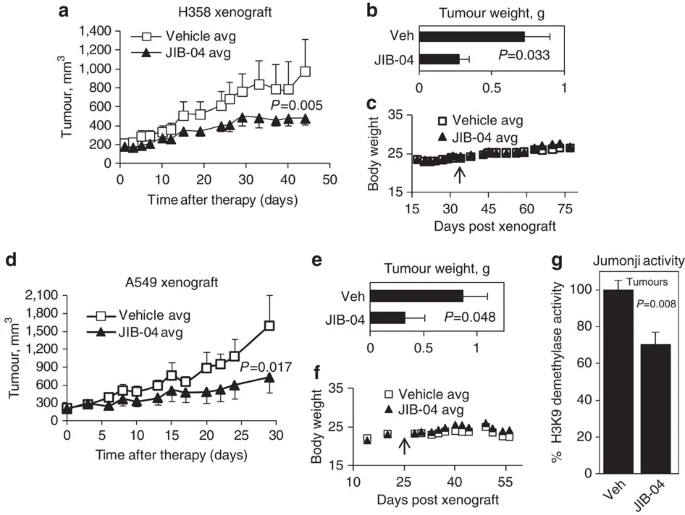
Dissolved in 12.5% Cremophor EL, 12.5% DMSO, 10% DMSO 90% sesame oil (H358, i.p.); 110 mg/kg (H358, i.p.), 55 mg/kg (A549, Oral gavage); i.p. or p.o. Mice harboring H358 xenografts or A549 xenografts
HCT116 colorectal cancer xenograft model: Female nude mice (6-8 weeks old) are subcutaneously injected with 5×10⁶ HCT116 cells (suspended in 50% Matrigel) into the right flank. When tumors reach 100-150 mm³, mice are randomized into 3 groups (n=6/group): 1. Vehicle group: Intraperitoneal injection of 0.2 mL 10% DMSO in PBS every other day for 21 days; 2. JIB-04 (NSC-693627) 10 mg/kg group: Intraperitoneal injection of drug (dissolved in 10% DMSO in PBS) every other day for 21 days; 3. JIB-04 (NSC-693627) 20 mg/kg group: Same schedule as 10 mg/kg. Tumor volume is measured every 3 days (V = L×W²/2, L=longest diameter, W=shortest diameter). At the end of treatment, mice are euthanized, tumors are excised for western blot, and major organs (liver, kidney, spleen) are collected for histopathology [1] - U251-TMZ-R glioblastoma xenograft model: Nude mice are subcutaneously injected with 1×10⁷ U251-TMZ-R cells (suspended in 50% Matrigel) into the left flank. When tumors reach 120-180 mm³, mice are divided into 4 groups (n=5/group): 1. Vehicle: 0.2 mL 10% DMSO in PBS (intraperitoneal) + 0.2 mL PBS (oral) every other day for 28 days; 2. TMZ alone: 0.2 mL PBS (intraperitoneal) + TMZ 50 mg/kg (oral, dissolved in PBS) every other day; 3. JIB-04 (NSC-693627) alone: 15 mg/kg (intraperitoneal, dissolved in 10% DMSO in PBS) + 0.2 mL PBS (oral) every other day; 4. Combination: 15 mg/kg JIB-04 (intraperitoneal) + 50 mg/kg TMZ (oral) every other day. Tumor volume and body weight are measured every 3 days. Mice are euthanized on day 28; tumors are excised for IHC and qPCR, and serum is collected for liver/kidney function tests [2] |
| ADME/Pharmacokinetics |
Oral absorption: In CD-1 mice, after oral administration of JIB-04 (NSC-693627) (20 mg/kg), the peak plasma concentration (Cmax) was 12±2 ng/mL and the area under the curve (AUC0-24h) was 45±8 ng·h/mL. Compared with intravenous administration (5 mg/kg, AUC0-24h = 280±35 ng·h/mL)[1], the oral bioavailability was 8±2%. Distribution: In SD rats, the steady-state volume of distribution (Vss) of intravenously administered JIB-04 (NSC-693627) (5 mg/kg) was 8.5±1.2 L/kg, indicating its extensive tissue distribution. In HCT116 xenograft mice, the tumor/plasma concentration ratio was 4.2 ± 0.5 4 hours after intraperitoneal injection (20 mg/kg) [1]
- Metabolism: In human liver microsomes, the metabolic half-life (t1/2) of JIB-04 (NSC-693627) was 2.8 ± 0.4 hours. Incubation with selective CYP inhibitors showed that CYP3A4 accounted for 70% of the metabolism, while CYP2C9 (20%) and CYP2D6 (10%) contributed less. The main metabolite is a hydroxylated derivative, which does not have JmjC-KDM inhibitory activity (IC50 of KDM3A/KDM4A > 50 μM) [1] - Excretion: In SD rats, after intravenous injection of JIB-04 (NSC-693627) (5 mg/kg), 25±3% of the dose was excreted unchanged in feces within 48 hours, and 5±1% of the dose was excreted in urine, indicating that fecal excretion is the main route [1] - Elimination half-life: In mice, the elimination half-life of JIB-04 (NSC-693627) was 3.5±0.5 hours (intraperitoneal injection) and 2.2±0.3 hours (intravenous injection). In rats, the half-life after intravenous injection was 4.1±0.6 hours [1] |
| Toxicity/Toxicokinetics |
In vitro cytotoxicity: JIB-04 (NSC-693627) exhibited low cytotoxicity to normal cells, with CC50 >30 μM in NHF, normal human astrocytes (NHA, CC50 = 35±4 μM), and human umbilical vein endothelial cells (HUVEC, CC50 = 32±3 μM) [1,2]
- In vivo acute toxicity: No death or serious toxicity (e.g., somnolence, ataxia) was observed in BALB/c mice after intraperitoneal injection of JIB-04 (NSC-693627) (30 mg/kg/day for 7 days). The weight change was -3±1% (compared to -2±1% in the control group), and serum ALT, AST, BUN, and Cr levels were all within the normal range [1]. Chronic toxicity in xenograft models: In HCT116 xenograft mice treated with JIB-04 (NSC-693627) (20 mg/kg, every other day for 21 days), histopathological analysis of the liver, kidneys, and spleen showed no necrosis, inflammation, or fibrosis. Peripheral blood cell counts (white blood cells, platelets) were normal [1]. Toxicity of combination therapy with temozolomide (TMZ): In U251-TMZ-R xenograft mice, combination therapy with JIB-04 (NSC-693627) (15 mg/kg) and TMZ (50 mg/kg) did not increase toxicity compared to monotherapy. Weight loss was -4±1% (-3±1% in the JIB-04 monotherapy group and -2±1% in the TMZ monotherapy group), and no additional liver or kidney damage was detected [2] - Plasma protein binding rate: Balanced dialysis showed that the plasma protein binding rates of JIB-04 (NSC-693627) were 91±2% (human), 89±3% (mouse) and 90±2% (rat), respectively, mainly binding to albumin (80%) and α1-acid glycoprotein (10%) [1] |
| References | |
| Additional Infomation |
Mechanism of action: JIB-04 (NSC-693627) exerts its antitumor effect by inhibiting JmjC-KDMs (KDM3A, KDM4A, KDM5B). These enzymes usually regulate gene expression by demethylating inhibitory histone markers (e.g., H3K9me2/3) or activating markers (e.g., H3K4me3). The inhibition of JIB-04 disrupts this balance: an increase in H3K9me2/3 inhibits oncogenes (e.g., MYC), while an increase in H3K4me3 activates tumor suppressor genes (e.g., p21), ultimately inhibiting cancer cell proliferation and inducing apoptosis [1].
- Theoretical basis for targeting TMZ-resistant glioblastoma: TMZ-resistant glioblastoma cells overexpress MGMT, and MGMT can repair TMZ-induced DNA damage. JIB-04 (NSC-693627) downregulates MGMT expression by increasing H3K9me2 levels at the MGMT promoter (inhibiting transcription) and activates the p53 pathway (enhancing DNA damage-induced apoptosis). This can reverse temozolomide (TMZ) resistance, making combination therapy effective [2]. - Preclinical potential: JIB-04 (NSC-693627) exhibits selective antitumor activity against a variety of cancers (colorectal cancer, lung cancer, breast cancer, glioblastoma) with low toxicity to normal tissues. Its ability to reverse TMZ resistance addresses an unmet need in the treatment of glioblastoma, a major clinical challenge [1,2]. - Limitations: The oral bioavailability of JIB-04 (NSC-693627) is low (8% in mice), therefore parenteral administration is required in preclinical models. There is currently no clinical data (e.g., human efficacy, pharmacokinetics), nor has its long-term toxicity in large animals been assessed [1] - Advantages of epigenetic therapy: As an epigenetic modulator, JIB-04 (NSC-693627) targets reversible histone modifications rather than variable DNA sequences, reducing the risk of acquired resistance compared to conventional chemotherapy drugs [1] |
| Molecular Formula |
C17H13CLN4
|
|
|---|---|---|
| Molecular Weight |
308.76
|
|
| Exact Mass |
308.082
|
|
| CAS # |
199596-05-9
|
|
| Related CAS # |
(Z)-JIB-04;199596-24-2
|
|
| PubChem CID |
6519698
|
|
| Appearance |
Off-white to yellow solid powder
|
|
| Density |
1.2±0.1 g/cm3
|
|
| Boiling Point |
472.9±55.0 °C at 760 mmHg
|
|
| Flash Point |
239.8±31.5 °C
|
|
| Vapour Pressure |
0.0±1.2 mmHg at 25°C
|
|
| Index of Refraction |
1.644
|
|
| LogP |
3.92
|
|
| Hydrogen Bond Donor Count |
1
|
|
| Hydrogen Bond Acceptor Count |
4
|
|
| Rotatable Bond Count |
4
|
|
| Heavy Atom Count |
22
|
|
| Complexity |
368
|
|
| Defined Atom Stereocenter Count |
0
|
|
| SMILES |
C1=CC=C(C=C1)/C(=N\NC2=NC=C(C=C2)Cl)/C3=CC=CC=N3
|
|
| InChi Key |
YHHFKWKMXWRVTJ-OQKWZONESA-N
|
|
| InChi Code |
InChI=1S/C17H13ClN4/c18-14-9-10-16(20-12-14)21-22-17(13-6-2-1-3-7-13)15-8-4-5-11-19-15/h1-12H,(H,20,21)/b22-17+
|
|
| Chemical Name |
(E)-5-chloro-2-(2-(phenyl(pyridin-2-yl)methylene)hydrazinyl)pyridine
|
|
| Synonyms |
|
|
| HS Tariff Code |
2934.99.9001
|
|
| Storage |
Powder -20°C 3 years 4°C 2 years In solvent -80°C 6 months -20°C 1 month |
|
| Shipping Condition |
Room temperature (This product is stable at ambient temperature for a few days during ordinary shipping and time spent in Customs)
|
| Solubility (In Vitro) |
DMSO: 25 mg/mL (80.9 mM)
Water: 1 mg/mL (Insoluble) Ethanol: 1 mg/mL |
|---|---|
| Solubility (In Vivo) |
Solubility in Formulation 1: ≥ 2.08 mg/mL (6.74 mM) (saturation unknown) in 10% DMSO + 40% PEG300 + 5% Tween80 + 45% Saline (add these co-solvents sequentially from left to right, and one by one), clear solution.
For example, if 1 mL of working solution is to be prepared, you can add 100 μL of 20.8 mg/mL clear DMSO stock solution to 400 μL PEG300 and mix evenly; then add 50 μL Tween-80 to the above solution and mix evenly; then add 450 μL normal saline to adjust the volume to 1 mL. Preparation of saline: Dissolve 0.9 g of sodium chloride in 100 mL ddH₂ O to obtain a clear solution. Solubility in Formulation 2: ≥ 1.25 mg/mL (4.05 mM) (saturation unknown) in 10% DMSO + 90% Corn Oil (add these co-solvents sequentially from left to right, and one by one), clear solution. For example, if 1 mL of working solution is to be prepared, you can add 100 μL of 12.5 mg/mL clear DMSO stock solution to 900 μL of corn oil and mix evenly. View More
Solubility in Formulation 3: 10 mg/mL (32.39 mM) in 0.5% CMC-Na/saline water (add these co-solvents sequentially from left to right, and one by one), suspension solution; with ultrasonication. |
| Preparing Stock Solutions | 1 mg | 5 mg | 10 mg | |
| 1 mM | 3.2388 mL | 16.1938 mL | 32.3876 mL | |
| 5 mM | 0.6478 mL | 3.2388 mL | 6.4775 mL | |
| 10 mM | 0.3239 mL | 1.6194 mL | 3.2388 mL |
*Note: Please select an appropriate solvent for the preparation of stock solution based on your experiment needs. For most products, DMSO can be used for preparing stock solutions (e.g. 5 mM, 10 mM, or 20 mM concentration); some products with high aqueous solubility may be dissolved in water directly. Solubility information is available at the above Solubility Data section. Once the stock solution is prepared, aliquot it to routine usage volumes and store at -20°C or -80°C. Avoid repeated freeze and thaw cycles.
Calculation results
Working concentration: mg/mL;
Method for preparing DMSO stock solution: mg drug pre-dissolved in μL DMSO (stock solution concentration mg/mL). Please contact us first if the concentration exceeds the DMSO solubility of the batch of drug.
Method for preparing in vivo formulation::Take μL DMSO stock solution, next add μL PEG300, mix and clarify, next addμL Tween 80, mix and clarify, next add μL ddH2O,mix and clarify.
(1) Please be sure that the solution is clear before the addition of next solvent. Dissolution methods like vortex, ultrasound or warming and heat may be used to aid dissolving.
(2) Be sure to add the solvent(s) in order.
|
|
|
Products are for research use only; We do not sell to patients
Copyright 2020 InvivoChem LLC | All Rights Reserved


 COA
COA